@xiaowang1984@bslotterback@LBNLresearch Interesting framing. I agree that permitting reform is more important then ROE or rate making adjustments.
Another part of this story is imprudent investments. There seems to be some evidence that utilities replace assets before their end of life and 'over harden'.
@xiaowang1984@bslotterback@LBNLresearch Inefficient capital deployment, cost of capital, and siting barriers are all probably part of the story. I believe different solutions to all three, including US government financing support for grid expansion, are warranted.
Shapiro calls for utilities to use public financing, which can be much cheaper than what utilities usually seek, to reduce the cost of building infrastructure for the grid.
You think it's hard convincing communities to accept interconnected data centers in their backyard? Just wait until each of them wants to bolt down GWs of diesel recips or jet engines.
Never underestimate the ability of a tech bro to misunderstand the policy landscape
Every year someone names a new bottleneck for AI compute scaling. @dylan522p on why power isn't gonna be the big one over the next few years: fundamentally there's many different ways to generate power (rather than just one company that can produce the EUV tools needed for the chips themselves) and the supply chains are simpler and easier to ramp.
You can do jet engines bolted to the ground. Ship engines. Diesel recips from auto manufacturers with declining volumes. Fuel cells. Each category alone delivers tens of gigawatts by end of decade. Combined, hundreds.
Even if energy costs double, a GPU goes from $1.40/hr to $1.50/hr. Nobody notices a dime when the models are improving so fast the value dwarfs the cost.
Even if you don't add more power, but simply add more batteries, you can unlock 20% more of the US's terawatt scale power grid. This is because grid utilities want to make sure they're sized for peak summer load that hits a few hours a year. With enough batteries, you can make this guarantee, even without turning on more power plants!
Fundamentally, there's a lot of different ways to bring power online over the next few years. Building more logic and memory is far more difficult and centralized, so that's where Dylan thinks the bottleneck will be.
@Avabuilds4u With AI + electrification + renewables it is really hard for me to imagine we will overbuild any time soon. Obviously increasing grid utilization will save money and is important but just feels like not enough to meet the moment. We need capacity! not marginal reliability tools.
@SimonMahan I think the hope is that DCs can subsidize the build out. They won’t pay for the full $1b but if their presence necessitates grid upgrades then they should pay a disproportionate amount of it. Then we use this new 500kv+ line to improve the grid for everyone.
HOW IS A PRICE CAP GOING TO LEAD TO BUILDING MORE ENERGY RESOURCES.
Conversations about how to lower energy prices are starting to go off the rails what has this world come to
13 million Pennsylvanians who rely on PJM — our grid operator — to keep the lights on are opening up their energy bills and wondering, what the hell is going on?
Let me explain.
Stanford Climate Ventures is such a bellwether for the energy industry. So far we have heard pitches about industrial load flexibility, advanced geothermal, VPPs, and BYOT (bring your own transmission).
“This doesn’t mean we’re anti-innovation."
It does. Please stop with the moratoriums. We should be using this time as an advantage to modernize our aging grid.
@BooshCarron@duncancampbell Sad to think that even with the (unbinding) pledges, inaction from PUCs or FERC could still lead to increased prices. Fees pretty straight forward to make large load tariffs and use the capital influx to build out the grid and decrease prices for everyone.
@MichaelGiberso3@daniel_wolf1 We could even make it a progressive tax by adjusting for income or land value!! Seems like so much room for creative utility regulation.
@MichaelGiberso3@daniel_wolf1 What if the investment is funded through a tax on electricity usage instead of from the general taxbase (funded with an increase in income tax or something)? Something like the PPP in California but instead of EE projects it’s grid investments.
@duncancampbell@JaneAFlegal With good policy maybe we can incentivize innovation while at the same time building a bigger and better electricity system. Instead of a top down committee with pre selected contractors to go build, government could underwrite startups and have an efficient procurement process.
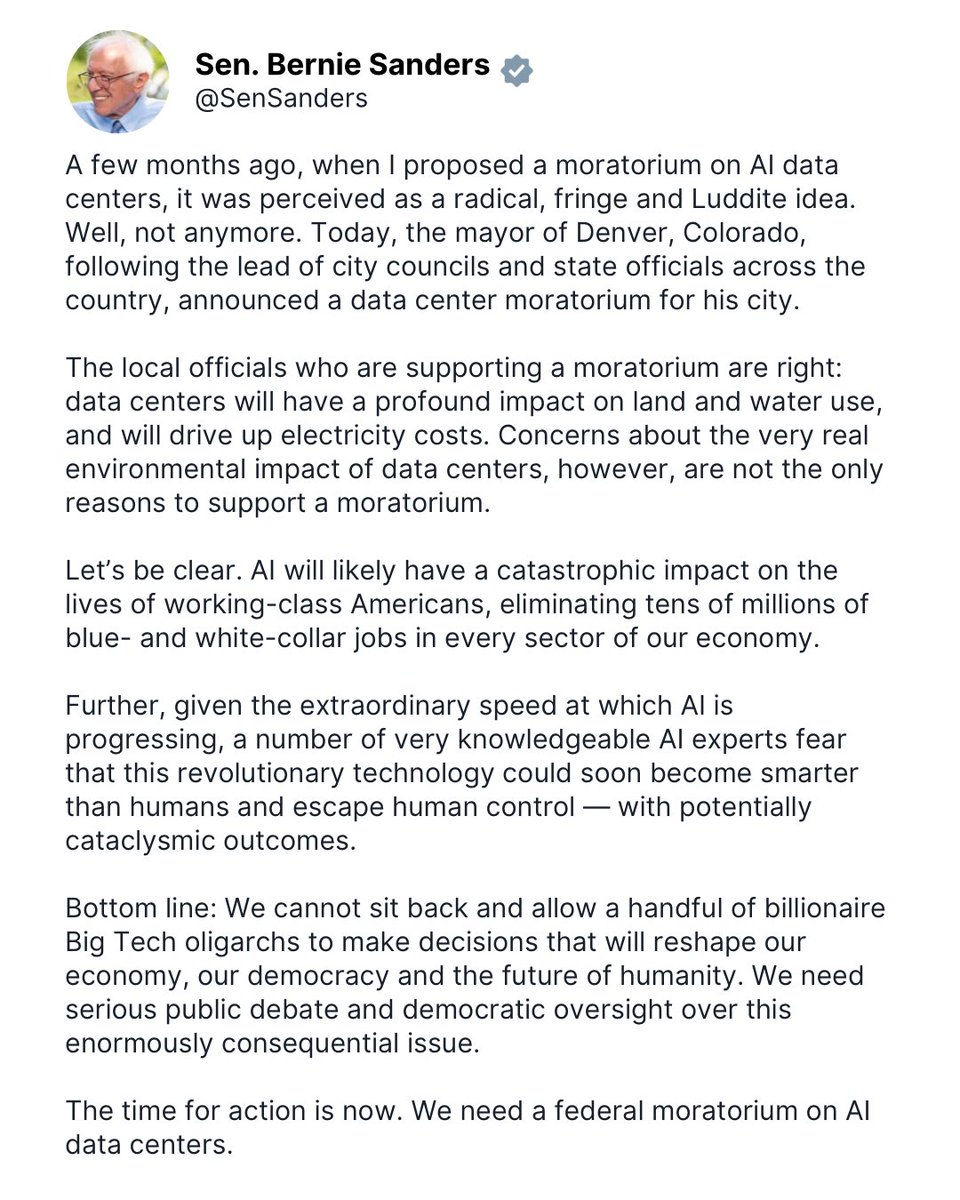
I was at Bernie’s Stanford town hall last week and I agreed with a lot of what he said. I just don’t get the logic of this proposal. Just seems like NIMBYism and degrowth for the AI era. I wish there was a longer Q&A section so I could have asked him about this.
With good policy we can decrease electricity prices by making data centers pay their faire share and regulate AI companies to reduce AI’s risks. Singapore and Ireland have done this. Why not advocate for productive policy instead of inflexible mandates?
We're committing to cover electricity price increases from our data centers.
To ensure ratepayers aren’t picking up the tab, we'll pay 100% of grid upgrade costs, work to bring new power online, and invest in systems to reduce grid strain.
Read more: https://t.co/avOFlvRNpa