Why did we make Nautilo 100% open source?
Because AI will become our interface to the world.
And if it's just another SaaS app, we can't trust it with our personal and professional lives. A SaaS app is just a surveillance app in sheep's clothing.
But what we share with AI will be much more personal and much more intimate. That means we have to control the harness or we're in for a dark tomorrow. When someone can shut off your access to intelligence or change the ToS overnight, you're not an owner, you're a serf.
Nautilo is open source and MIT licensed. Run your own server. Choose your models. Decide who joins. Inspect the code. Change it.
Your family, your company, your community should own the place where their intelligence grows together.
Site: https://t.co/vVcw6s96OH
Github: https://t.co/nArZU1zL92
$NAUTILO — I think a lot of people still haven’t realized that the story here has changed.
At first, $NAUTILO was simply a community-launched token. The Nautilo team didn’t create it.
But instead of ignoring it, Daniel Jeffries publicly talked about it. And his latest post is where things get interesting:
The team is now planning to give $NAUTILO real utility.
Holders could get perks across Nautilo Gateway and Nautilo Cloud, discounts, and even use $NAUTILO to pay for subscriptions. The team also said these are only the starting ideas and they’re still exploring more options.
So the story is developing like this:
Community token → acknowledged by the team → repeatedly mentioned by the founder → now being considered for integration into actual products.
And don’t forget, Nautilo has a shit ton of public code:
https://t.co/rrYsRoNNci
They’re not sitting around drawing a roadmap and waiting for the token to pump. Desktop, Mobile, CLI, Server, agents, memory, computer-use, MCP/tools… they’ve already built a lot.
But what interests me even more is Daniel Jeffries himself.
Just open his followers and look:
Toly, Vlad Tenev, Marc Andreessen, Jesse Powell, Andrew Ng, Ryan Sean Adams, Albert Chon, Igor Yuzovitskiy, Sterling, Ansem, Decentraland… and a bunch more.
Lol. This is exactly why I prefer finding the dev behind a token rather than just finding the token itself.
Now someone with a network like this is directly talking about $NAUTILO and wants to turn it from a community token into something with actual utility inside the products his team is building.
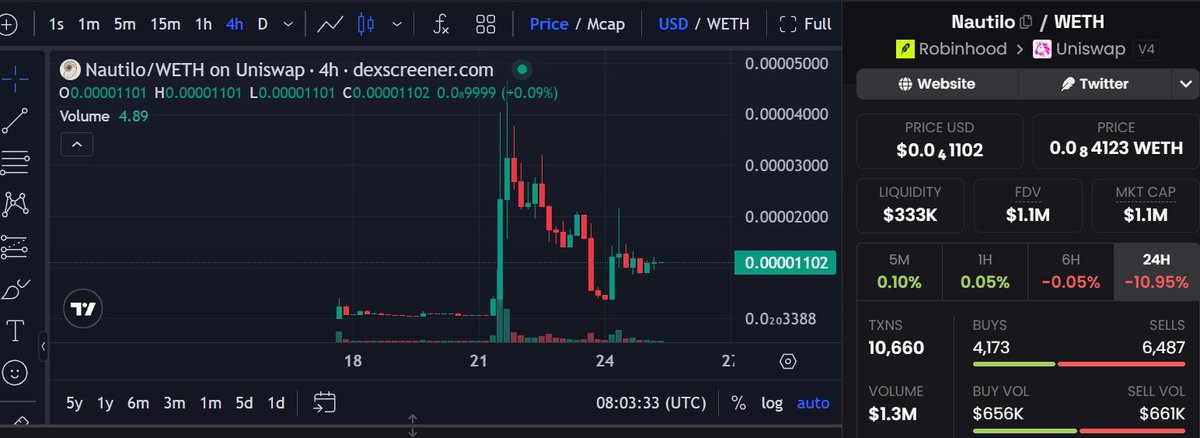
Current market cap is only around $850K.
I don’t know whether it pumps or dumps tomorrow, and honestly I don’t care that much.
I just want to bet on this story while it’s still small and keep watching what Daniel does next with $NAUTILO.
The key here isn’t the chart. The key is Daniel.
0xddd4947010496b500ABE96aB0965C38584413ba3
Last post on this matter.
We have size in $NAUTILO since 2M MC.
It doesn't matter where it goes. Will just stay and support.
This is similar to other moments in our coin selection process; but we had winners (past and present) in Matic, Unibot, Tao, Kled, Pons, Juggernaut, Delta, Musebook...and list goes on.
When it's tough to buy, that's when you buy. It might go to zero, as do most coins, but it's part of the game.
Sometimes you want your Genie to run the commands. Sometimes your fingers are already on the keyboard and you want to keep control.
Nautilo gives you both in the same terminal session.
Open it inside the Mac Nautilo desktop. Hand her control. Watch her work. Take control back and carry on from there.
One session. One person or Genie driving at a time. You decide who.
Co-creativity goes all the way down to the command line.
Site: https://t.co/vVcw6s96OH
Github: https://t.co/nArZU1zL92
Tons of ideas circulating, but here's the low down on how $NAUTILO can be useful for @Dan_Jeffries1 's Nautilo project - despite it being a community coin.
Preferably a win-win situation for both parties.
1- Top holders get to be in a group chat with the Nautilo team, to share ideas and test new products.
2- Instead of locking up Nautilo coins in hand, it can be used to fatten the liquidity pool and earn fees to further finance the Nautilo project and its endeavors. This act will further increase community support.
3- Bounty program to improve Nautilo platform issued in $NAUTILO
4- Nautilo coins offered to the community first, before being sold into open market. Reduces price impact over time. Higher value great for both the community and Nautilo project.
5- Nautilo products can accept part payment in Nautilo coin, and part of it burnt, and part kept in Treasury. Offer a fair discount, perhaps 10-20% capped. Think of it as a community loyalty program.
Think all these will result in the community being very supportive, talking about the project, and part of the marketing advantage Nautilo has over all other players.
With our first service pack for Nautilo we're working on a new spin to E2E encryption.
Your Genie needs to read the chats and artifacts to help you. She shouldn’t need a permanent master key to your life.
Our solution is to give a Genie narrow, time-limited access to the protected material a job requires. When that authority ends, the access ends.
Product-wide E2EE is still in progress but coming fast. We want to get it right.
Useful agents. Temporary access. Control that stays with you.
Site: https://t.co/vVcw6s96OH
Github: https://t.co/nArZU1zL92
Most people looking at $Nautilo are focusing on the wrong thing.
They see rooms, threads and team communication, so they call it an open-source Slack alternative.
But Nautilo is attempting something more interesting:
Slack rebuilt for a world where every person has a persistent AI coworker.
I tried the product myself. It is still early and rough around the edges, but the important part isn’t the polish it’s the mental model. You aren’t simply opening another AI chat window. You are working inside a shared environment where humans and AI agents can communicate, create documents, use tools and pass work between one another.
Every user gets a personal agent called a Genie. It can maintain memory and personality, participate in rooms, work with shared files and use tools such as the browser and terminal.
Nautilo also lets users delegate work to external coding agents including Codex, Claude Code and Hermes.
That creates a different workflow:
Discuss the objective → delegate the task → let an agent work → review or edit the result → continue from the same shared context.
Today, companies communicate in Slack, write in Google Docs, manage tasks elsewhere and run AI agents inside separate interfaces.
Nautilo’s bet is that these layers eventually collapse into one agent-native workspace.
The repository supports that ambition. Nautilo is open source under MIT and already contains desktop, web, mobile, server and CLI applications alongside packages for agents, memory, security, trust, computer use and collaborative office tools.
It includes its own Writer, Sheets, Slides, whiteboard, design and video applications.
That scope is both the opportunity and the risk.
If Nautilo works, it could become the organizational layer connecting people, agents, models and company knowledge.
But it is also an extremely ambitious product being built by a tiny team. End-to-end encryption is still being completed, local model support and federation remain roadmap items, and the project’s public GitHub history is extremely young.
The founder is Daniel Jeffries, CEO of Kentauros AI and formerly Chief Intelligence Officer at Stability AI. He has a substantial audience in AI and is followed by figures including Jeff Bezos, Yann LeCun, Andrew Ng and Fei-Fei Li.
That doesn’t guarantee execution but it does give Nautilo something most early open-source projects lack: immediate access to attention, technical networks and narrative distribution.
Now for the controversial part: $NAUTILO.
The token was launched by the community through Bankr on Robinhood Chain. Nautilo explicitly says it did not issue or endorse the token.
At present, it provides:
no ownership in Nautilo
no governance rights
no claim on company revenue
no guaranteed product utility
So this should not be described as equity or a protocol token.
However, the relationship is not completely imaginary either.
Daniel has publicly acknowledged the token and said the team is exploring future perks, including discounts and the ability to pay for Nautilo Cloud or Gateway subscriptions with $NAUTILO. Trading fees from the community token also help support development.
That creates an unusual setup:
The token is unofficial today, but the founder has left open a path toward making it useful tomorrow.
Nautilo Cloud and Gateway are the important pieces to watch.
Cloud could offer managed Nautilo instances for teams that don’t want to self-host. Gateway could provide unified model access and billing. If those products launch and token holders receive meaningful discounts or payment options, $NAUTILO could become attached to real recurring software usage.
But that utility is not implemented today. I found references to the community token in Nautilo’s documentation and README, but no working payment, subscription or holder-benefit integration in the code.
That distinction matters.
The bullish thesis is not “this token already powers Nautilo.”
The bullish thesis is:
Nautilo attracts users → the community promotes the product → Cloud and Gateway create paid demand → the team connects token ownership to discounts, access or payments.
If that flywheel forms, the community token becomes a distribution mechanism around a real open-source product.
If it doesn’t, $NAUTILO remains a speculative attention asset whose value depends heavily on Daniel continuing to acknowledge it.
There are three realistic outcomes:
Nautilo succeeds, but the token stays peripheral. Great software does not automatically create a valuable token.
Nautilo succeeds and the token gains genuine Cloud or Gateway utility. This is the highest-upside scenario, but it requires actual implementation.
Development or attention slows, and both the product narrative and token weaken. The tiny team and enormous product scope make this a serious risk.
My thesis is simple:
Nautilo is not merely replacing Slack. It is building an operating environment where humans and persistent AI coworkers share the same rooms, tools and organizational memory.
And $NAUTILO is not currently a claim on that business.
It is a highly speculative option on the possibility that the community surrounding the product eventually becomes part of its economic layer.
That gap between what the token represents today and what it might represent later is both the opportunity and the risk.
Product: real, ambitious and extremely early.
Founder: credible, connected and shipping quickly.
Token: acknowledged, but not integrated.
That is exactly why Nautilo is worth watching now before the relationship between the product and the community coin is fully defined.