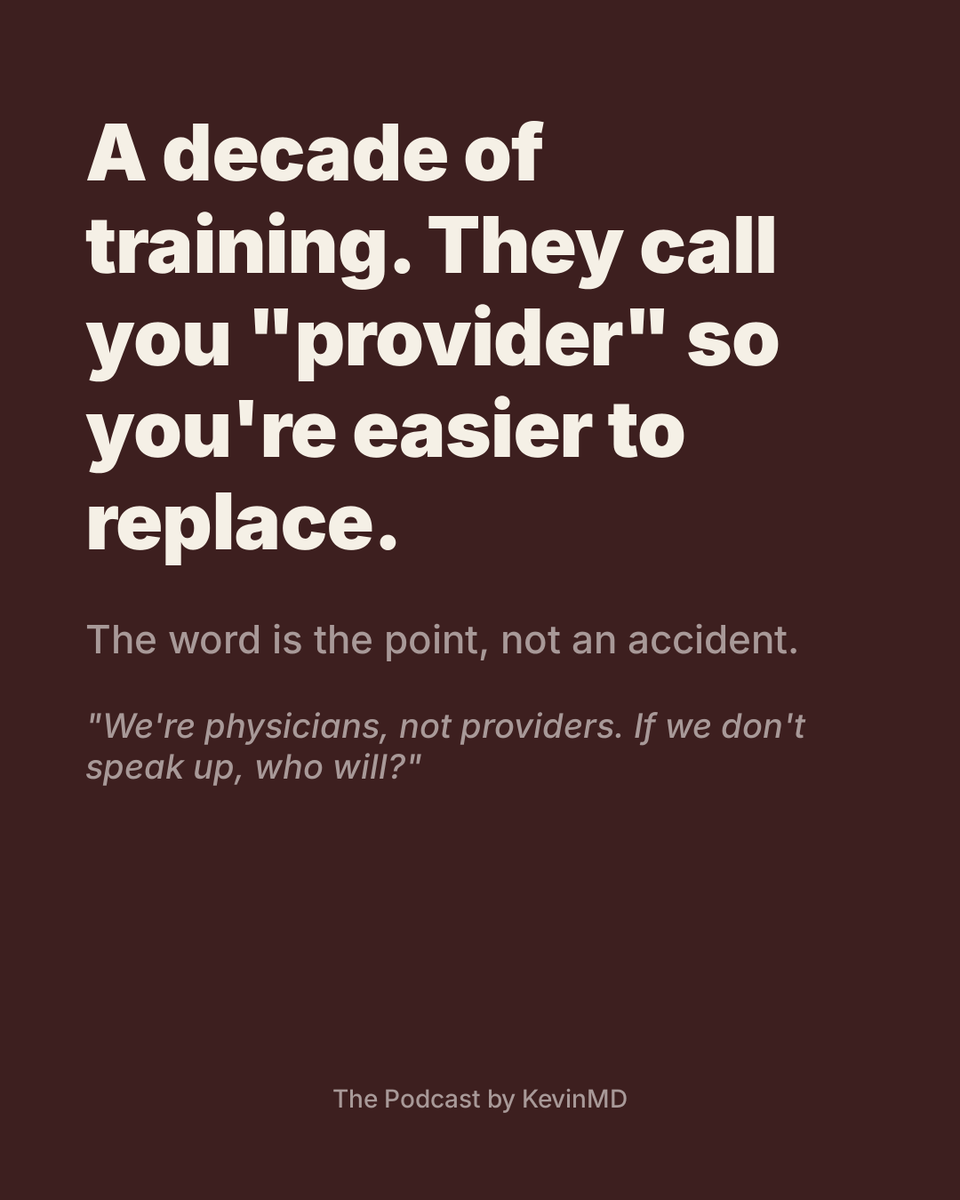
Calling every clinician a "provider" is how you make them replaceable.
This is the part that gets waved off as a style quibble. It is not. The word is doing structural work, and once you see the mechanism you cannot unsee it.
Start with what the label does. Lump the physician, the nurse practitioner, and the physician assistant under one term and they start to look interchangeable. Interchangeable people are easy to swap out. You do not deprofessionalize a workforce with a memo. You do it with a noun. The word is not describing the work. It is softening the ground for replacing it.
Now the history, because the word did not come from nowhere. "Provider" entered the system in 1965, when Medicare began paying any "provider of services." That single phrase put the person at the bedside in the same category as the hospital and the insurance company. The clinician and the billing entity got filed under one heading. One word, and the distinction between caring for a patient and billing for one quietly collapsed.
That collapsed distinction is the whole point, because the two things on either side of it answer to completely different masters. A physician's first obligation is to the patient. A corporate entity answers to its board and its shareholders. Those are not the same job. One word should not be allowed to pretend they are. This is why the American College of Physicians framed it not as a matter of taste but as a matter of ethics: the word you choose decides which of those two obligations you are actually naming.
And it is worth knowing what the word "physician" carries that "provider" throws away. Janet Jokela, MD, former treasurer of the American College of Physicians, points to the root. The Latin origin of "compassion" means "to suffer with." A patient is, at root, one who suffers. That relationship, to suffer alongside the person in front of you, is what the word was built to name. "Provider" carries none of it. It describes a transaction. It cannot describe a vocation.
None of this means the nurse practitioner or the physician assistant should be flattened either. They are clinicians. They are harmed by the same erasure. The label that dissolves the physician dissolves them too. The villain here is the system that finds it convenient to call everyone the same thing, not the colleagues standing next to each other under it.
So the correction is small and deliberate and entirely within reach. Doctors are crossing "provider" off forms and writing "physician," then signing underneath. Some have trained their staff to do the same. One document at a time. It is the only kind of correction that scales, because it happens everywhere the word appears.
Listen to the full conversation on The Podcast by KevinMD. Link in the replies.
What is the first thing you would change about how clinical teams get labeled? #PhysicianNotProvider #ThePodcastbyKevinMD
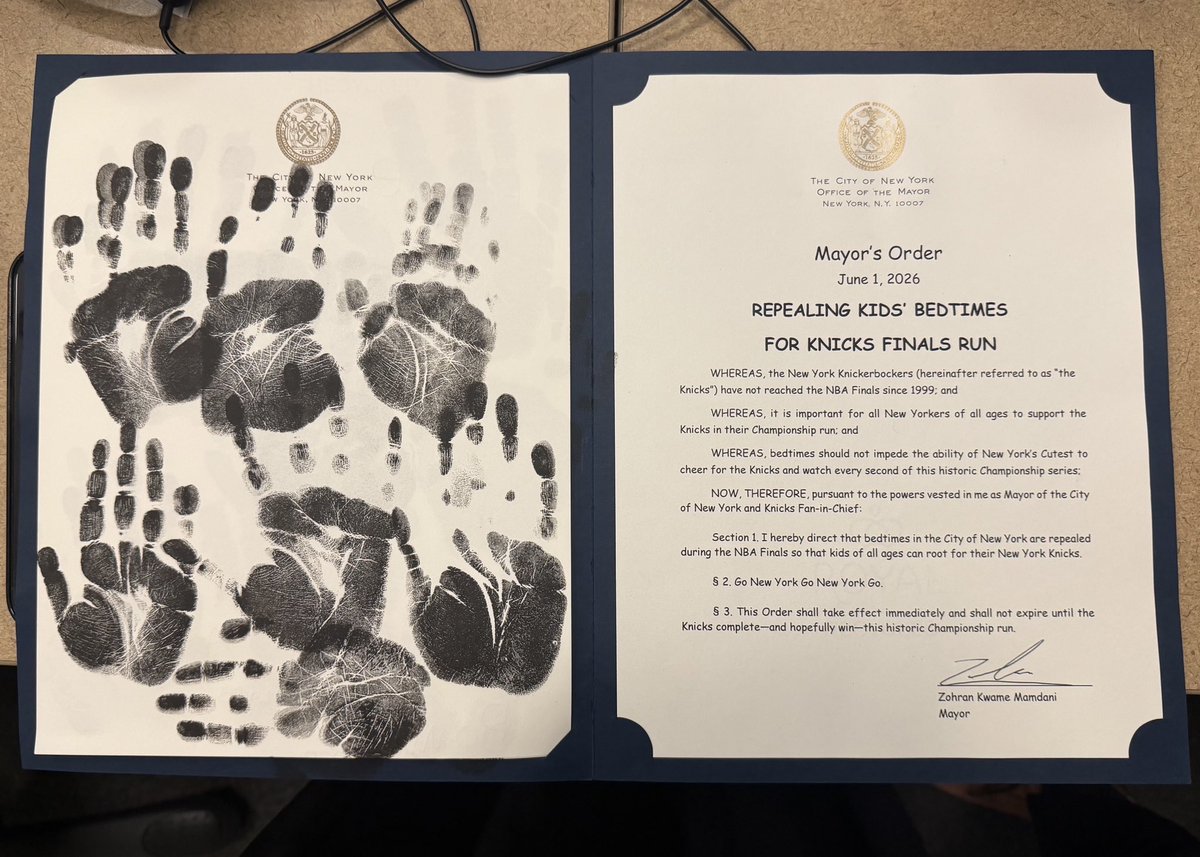
Today, I signed an Executive Order temporarily repealing bedtimes in the City of New York so that kids of all ages can watch our team in the NBA Finals.
As Mayor, you’re forced to make many difficult decisions. This was not one of them.
Go Knicks.
Kyle Busch was driving down the road when he noticed the woman in the passenger seat next to him was wearing his hat and her reaction is priceless when she realizes
These two giant turtles have been fighting each other for more than 120 years.
According to the zoo, one turtle stole the other’s food 120 years ago, and since that day they became enemies.
There hasn’t been a single day where they don’t fight for 2–3 minutes😂
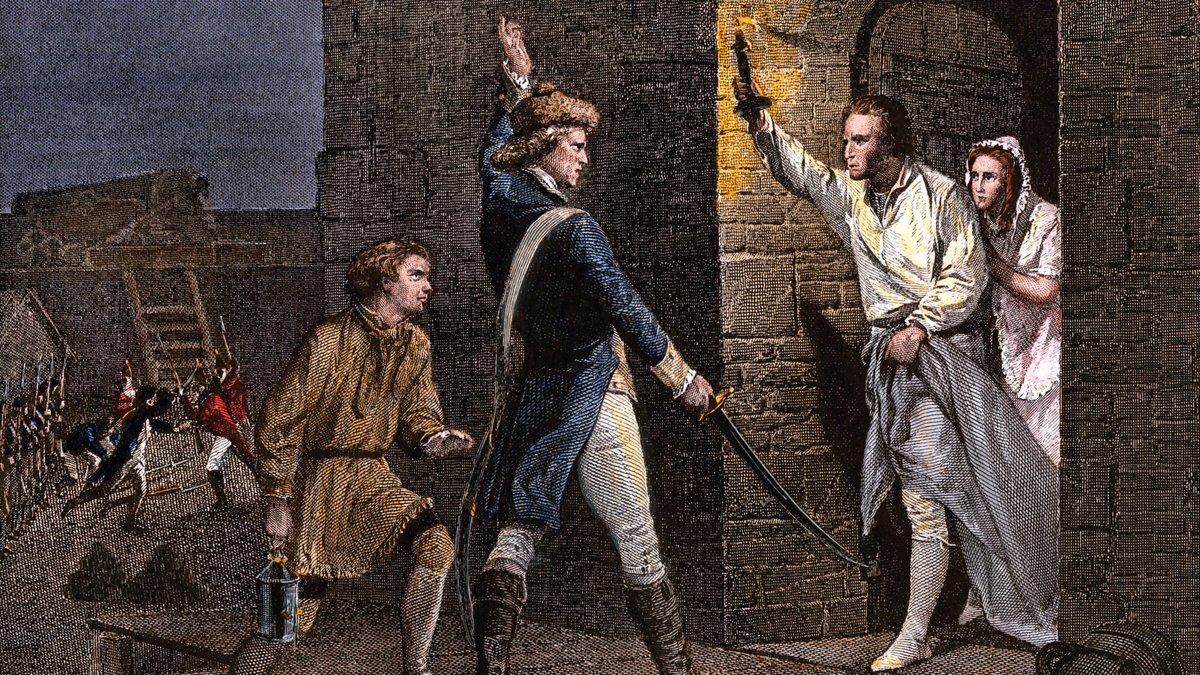
251 years ago this week, a 6'2" Vermont moonshiner with no military experience and no authorization from anyone captured the most strategically important fort in North America at dawn, and accidentally won the Revolutionary War before it had really started.
It's May 1775. Lexington and Concord happened three weeks ago. The colonies have muskets but almost no cannon. The British, sitting in Boston, have plenty. Everyone knows that without artillery, the rebellion is over by autumn.
Everyone also knows where to get artillery: Fort Ticonderoga. A stone star-fort on Lake Champlain, bristling with roughly 80 heavy guns. The British call it "the Gibraltar of America." It's the bottleneck of the entire continent. Whoever holds it controls the invasion route between Canada and New York.
What the rebels don't know, but Ethan Allen has heard, is that "the Gibraltar of America" is, by 1775, mostly held together by moss. The walls are crumbling. The garrison is 48 men, many of them invalids and pensioners. The commander hasn't even been told a war started.
Allen is not a soldier. He's a frontier land speculator who runs an armed militia called the Green Mountain Boys, originally formed not to fight the British, but to beat up New York surveyors trying to seize Vermont farms. New York has literally put a bounty on his head. He decides to go take the fort anyway.
Halfway there, a man named Benedict Arnold shows up on horseback with a Massachusetts colonel's commission, waving paperwork, demanding command of the expedition. The Green Mountain Boys threaten to go home if Arnold is in charge. Allen and Arnold agree to "joint command," which mostly means walking next to each other in furious silence.
They reach the lake at midnight. Problem: they have 200 men and exactly two leaky boats. By 3 AM only 83 have made it across. Dawn is coming. Allen decides to attack with what he has, meaning roughly 1 American for every half-cannon inside the fort.
A lone British sentry sees them coming through the wicket gate, levels his musket at Allen's chest, and pulls the trigger. The musket misfires. He runs. The Americans pour in. Total resistance to the capture of British North America's most important inland fortress: one wet flintlock.
Allen pounds on the officers' quarters with the flat of his sword. Lt. Jocelyn Feltham stumbles out half-dressed, asking by what authority Allen is there. Allen, by his own later account, roars: "In the name of the Great Jehovah and the Continental Congress!" (Other witnesses remembered the wording as substantially more profane. The Continental Congress, for its part, had no idea any of this was happening.)
Captain Delaplace, the actual commander, emerges still buttoning his trousers and surrenders the fort, its 78 cannons, its garrison, and roughly 30,000 musket flints without a shot fired by either side. Casualties: zero. Time elapsed: about ten minutes.
But here's the part that actually changed history. Those cannons sat at Ticonderoga for six months until a 25-year-old, 280-pound Boston bookseller named Henry Knox, who had learned artillery from books in his own shop, volunteered to go get them.
In the dead of winter, Knox and his men dragged 59 cannons weighing 60 tons across 300 miles of frozen rivers, the Berkshires, and unbroken snow, on 42 ox-drawn sleds. One gun fell through the ice of the Hudson. They fished it out and kept going. It took 56 days.
On the night of March 4, 1776, those cannons were hauled silently up Dorchester Heights overlooking Boston Harbor. The British woke up on March 5 to find every ship in the harbor and every redcoat in the city under the muzzles of guns that, six months earlier, had belonged to them.
Eleven days later, the British evacuated Boston. They would never hold it again.
An unauthorized raid by 83 backwoodsmen, led by a wanted man and a future traitor, against a fort defended by a captain in his pajamas, became the artillery that drove the British army out of the largest city in the American colonies.
Easiest W in American history. Possibly the most consequential ten minutes of the 18th century.
A classic episode, republished in memory of Dr. Manny Konstantakos, an orthopedic surgeon and longtime advocate for physician choice in board certification, who passed away suddenly in 2023.
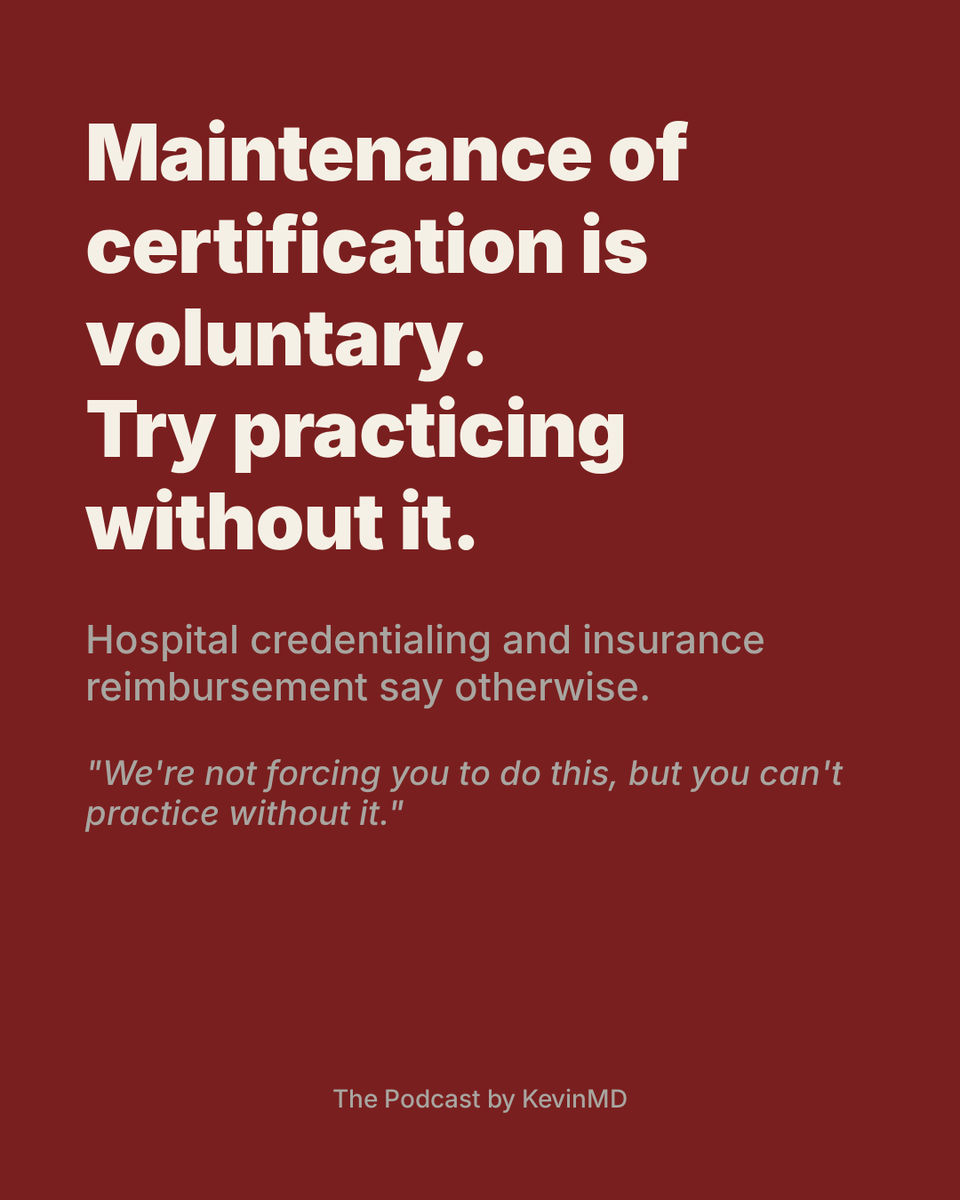
Maintenance of Certification is voluntary.
Hospitals will not credential you without it.
Insurers will not reimburse you without it.
Practice groups will not hire you without it.
The thing that is "voluntary" is the thing you cannot earn a living without. That is not a choice. That is a monopoly with better branding.
Manny saw the structure for what it was, and he spent years asking other physicians to see it too.
Board certification did not start as the gatekeeping apparatus it became. In the 1930s a group of academic physicians created it as a way to demonstrate mastery of their specialty. It was a credential, not a ticket to practice. The transformation into an economic prerequisite happened over the decades that followed, quietly, without any single legislative moment that anyone can point at.
The cleanest version of the paradox came from Jeff Morris on the same episode. "We are not forcing you to do this. But you cannot practice without it." Every recertification cycle, every credentialing database with a single drop-down option, every residency program whose accreditation is tied to first-time pass rates on one board's exam, runs through that sentence.
The mechanics matter. Residents are funneled into a single board's exam the moment they finish training. Program directors will not steer their best graduates toward a competing board, because their own program's accreditation depends on first-time pass rates on the dominant one. The choice architecture is closed before any individual physician ever gets to choose. By the time you are out in practice, the credentialing databases your hospital uses, the networks your insurer credentials through, the protocols your group is contracted under, all have a single drop-down option. "Voluntary" is the word that lets the structure call itself a market.
Manny kept returning to a different sentence. Why do we become doctors in the first place. The answer he gave, every time, was patient care. The structure around that answer was supposed to serve it. He believed physicians deserved a system that actually did. Honoring that belief is the reason this conversation gets republished now.
Listen to the full conversation on The Podcast by KevinMD. Link in the replies.
What part of your professional life is "voluntary" in name only?
#BoardCertification #ThePodcastbyKevinMD
Many Americans today have mixed opinions about Barack Obama. Some admire him, others criticize him. But for those of us who come from outside, the reality is often different.
Believe it or not, no American president has ever left such a strong impression around the world as Barack Obama. He embodied hope, respect, intelligence, and dialogue. He represented a powerful image of America: open, inspiring, and close to the people.
For many of us, Obama was not just a president; he was a symbol. A symbol that everything is possible, that social background, skin color, or personal history should never be limits.
He restored confidence to millions of young people around the world. He spoke to the world with dignity, calm, and responsibility. He knew how to unite instead of divide.
No matter the internal political debates, internationally, Barack Obama will forever remain one of the most respected, loved, and admired American presidents.
His legacy goes beyond borders. And his name will remain engraved in history.
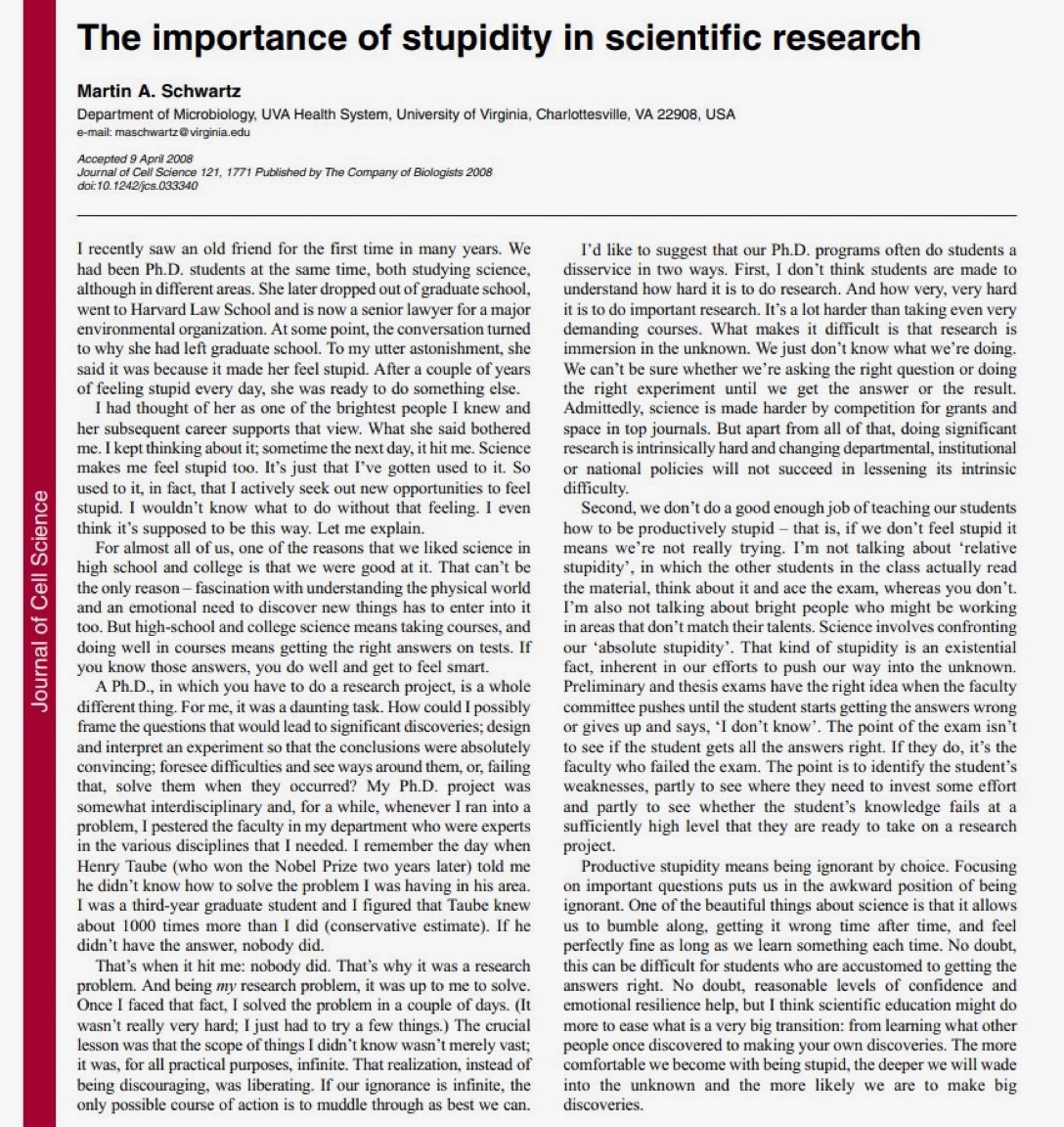
This article should be mandatory reading for every medical student, PhD candidate, researcher—and honestly, for anyone who mistakes expertise for certainty.
“The importance of stupidity in scientific research” sounds provocative, almost offensive. But Martin Schwartz is not glorifying incompetence. He is describing the real operating system of discovery.
Science is not built on knowing.
Science is built on tolerating not knowing.
That distinction matters.
Most of education rewards correctness.
School teaches us to answer.
Exams reward speed, certainty, and precision.
You feel intelligent when you get things right.
Research is the opposite.
Real research begins exactly where competence ends—at the frontier where nobody knows the answer, including the people you thought must know.
That moment is psychologically brutal.
You ask the expert.
The expert shrugs.
You assume you’re missing something.
Then you realize: no—this is the work.
You are not failing.
You are standing at the actual boundary of knowledge.
That feeling—“I must be stupid”—is often not a sign of inadequacy.
It is often the first sign that you are finally asking an important question.
Medicine struggles with this.
We train doctors to avoid uncertainty, to fear being wrong, to perform confidence.
But the best clinicians and the best scientists know how to sit inside ambiguity without collapsing into fake certainty.
This is why AI in medicine also deserves caution.
Systems trained only to reproduce established answers may become extraordinarily good at passing exams while being terrible at discovering what matters next.
Guideline intelligence is not the same as scientific intelligence.
Discovery requires productive stupidity:
the willingness to stay with the uncomfortable,
to look ignorant,
to ask naïve questions,
to be wrong repeatedly without protecting your ego.
Most people want the authority of expertise.
Very few want the humiliation required to earn it.
But progress lives there.
Not in certainty.
Not in performance.
Not in sounding smart.
In the quiet discipline of saying:
“I don’t know… yet.”
And continuing anyway.
There's a physicist at Stanford named Safi Bahcall who modeled this exact principle and the math is wild.
He calls it "phase transitions in human networks." When you're stationary, your probability of a lucky event is limited to your existing surface area: the people you already know, the places you already go, the ideas you've already been exposed to. Your opportunity window is fixed.
When you move, your collision rate with new nodes in a network increases nonlinearly. Double your movement (new conversations, new cities, new projects) and your probability of a serendipitous encounter doesn't double. It roughly quadruples. Because each new node connects you to their entire network, not just to them.
Richard Wiseman ran a 10-year study at the University of Hertfordshire tracking self-described "lucky" and "unlucky" people. The single biggest differentiator wasn't IQ, education, or family money. Lucky people scored significantly higher on one trait: openness to experience. They talked to strangers more, varied their routines more, and said yes to invitations at nearly twice the rate.
The "unlucky" group followed the same routes, ate at the same restaurants, and talked to the same 5 people. Their networks were closed loops. No new inputs, no new collisions.
Luck isn't random. Luck is surface area. And surface area is a function of movement.
The lobster emoji is doing more work than most people realize. Lobsters grow by shedding their shell when it gets too tight. The growth requires a period of total vulnerability. No protection, no armor, soft body exposed to the ocean.
That's the cost of movement nobody posts about. You have to be uncomfortable first. The new shell only hardens after you've already moved.
Medical residents are the backbone of the hospital system. They are also its favorite punching bag.
We expect them to work 80 hour weeks. We expect them to accept low pay. But we also force them to endure systemic disrespect, microaggressions, and outright bullying from the very staff they work alongside.
In a classic episode of The Podcast by KevinMD, surgery resident Dr. Audra King shared her deeply personal story of surviving the toxic culture of medical training. What started as a coping mechanism through journaling turned into a nationwide wake up call for the healthcare industry.
The harsh reality is that residents are completely stripped of their power. If they speak up against disrespect from charge nurses or other staff, they risk getting reported or labeled as difficult. This massive power imbalance crushes their self esteem and fuels the severe burnout crisis we see in medicine today.
You cannot fix a toxic work environment with mandatory wellness modules and yoga classes.
Dr. King's message is clear. Attendings need to remember what it was like and actively stand up for their residents. Trainees need to have each others backs. It is time to end the cycle of abuse in medical training once and for all.
Listen to her full story in this classic episode. The link is in the comments below. Drop your thoughts and share your own residency experiences. Let us change the culture together. 👇
#MedTwitter #Residency #SurgicalResident #PhysicianBurnout #HealthcareReform #MedEd #DoctorLife