After filling the streets of Kerala with Lord Krishna on Janmashtami, Gen Z and Gen Alpha Hindu kids have now taken to the roads for Ganeshotsav.
Slowly but steadily, Kerala is rediscovering its cultural roots—and healing. 🙏🕉️
IUML MLA Fathima Thahiliya from Kerala was asked about an objectionable statement by a Keralam Muslim cleric on women.
Her reply:
she has no problem. Muslim cleric is a respected person. He has his own view. Freedom of expression is his constitutional right.
Then she went one step further: if anybody wants to follow it, they can follow.
The same politics that shouts "smash the patriarchy" goes silent when the remark comes from inside its own community.
Rights for the muslim cleric. No stand for the women.
That is peak hypocrisy.
Satish Salian, the father of the late Disha Salian, has issued a ₹500 crore defamation notice to Shiv Sena (UBT) leader Aaditya Thackeray and NCP (SP) leader Anil Deshmukh. He has demanded an apology, retraction of the statements, and ₹500 crore in damages, giving them seven days to comply
🇦🇫 When Afghanistan hosts India in Delhi. 🇦🇫
🇦🇫 When Afghanistan hosts ICC Chairman Jay Shah in Delhi. 🇮🇳
When Afghanistan can call India home for its cricket, receive India's support, and play a home series in front of thousands of Indian fans - that's more than cricket. ❤️🇦🇫🇮🇳
You don't do all this for just anyone.
Some friendships are built by treaties. Others are built on trust, respect and a big heart.
This is true friendship. This is brotherhood.
🇦🇫🇮🇳 Afghanistan & India - brothers by choice.
“A land that produced great teachers like Swami Vivekananda and Adi Shankaracharya need not look to Stalin, Mao or Lenin for role models. Bengal is rediscovering its roots."
— Swami Shuddhidananda, Adhyaksha, Advaita Ashrama
पाकिस्तान परस्त मुसलमानो ही नहीं राहुल गांधी को भी शर्म आनी चाहिए देख लो कश्मीर के मुसलमान को समझ आ गया मोदी है तो हाथ में लैपटॉप है नहीं तो पत्थर ही था।
मोदी जी पहले होते तो आज बुरान बानी आतंकी न बना होता।
Pakistani journalist Nadia Khan, says that there are several “Halala centres”operating in Pakistan and openly advertise their services.
"Halala is nothing but rape"
BC poora Pak rapist hai
#PakRapist
🇮🇳🇵🇰 Journalist: Is Pakistan concerned about India’s rapid development of missile & strike capabilities?
DjISPR : We respect India’s military capabilities. We understand their desire to spend resources on arms. We are not looking to get into an arms race with India
1/2
Not every dispute involving the Union Government is an Article 131 dispute..
A useful clarification from the Supreme Court on the scope of its original jurisdiction.
In Lucknow Development Authority v. Union of India & Ors., 2026 INSC 923, decided on 21 August 2026, the Supreme Court considered whether a statutory authority could invoke Article 131 in a dispute involving the Union Government.
The dispute arose from a long-pending land controversy in Lucknow. The Lucknow Development Authority had approached the Allahabad High Court against the Union of India and defence authorities. The High Court, while dismissing the writ petition, granted liberty to the parties to pursue a remedy under Article 131.
The Supreme Court disagreed.
The important point is the meaning of “States” under Article 131.
The Court made it clear that this refers to the constituent States of the Union mentioned in the First Schedule, and not to every body which may fall within the expression “State” under Article 12.
A statutory authority may be an instrumentality of the State for the purposes of Article 12, but it does not thereby acquire the status of a constituent State for invoking Article 131.
Since the LDA is a statutory body constituted under the Uttar Pradesh Urban Planning and Development Act, 1973, it could not itself invoke the Supreme Court's original jurisdiction under Article 131.
The Supreme Court also pointed out that the High Court had fundamentally mischaracterized the dispute. The writ petition had been filed by the LDA, not by the State of Uttar Pradesh.
The High Court's order was therefore set aside and the matter was remitted for consideration afresh.
#Article131 #ConstitutionalLaw #SupremeCourt #OriginalJurisdiction
You Cannot Recover Money Through Court When the Payment Itself Was for an Illegal Purpose
Can a person approach a civil court to recover money which, according to their own plaint, was paid for an illegal purpose?
The Supreme Court has answered: No.
In Poosa Sri Krishna & Ors. v. Gattu Kishan Rao & Anr., 2026 INSC 974, decided on 31 August 2026, the Supreme Court held that where the plaint itself reveals that the money was paid for an illegal and fraudulent purpose, the suit cannot be permitted to proceed. The plaint was accordingly rejected under Order VII Rule 11(d) CPC.
The underlying arrangement involved payments allegedly made for procuring bank loans, including amounts intended to satisfy bank officials in their personal capacity. The plaint also referred to the procurement and exchange of demonetised currency.
The Court held that the object of the arrangement was forbidden by law, opposed to public policy and fraudulent, rendering the agreement void under Section 23 of the Indian Contract Act, 1872.
The Court then applied the doctrine of in pari delicto—where parties are equally at fault in an illegal transaction, the Court will not come to the rescue of either party.
In simple terms, the civil court cannot be used to recover money when the very foundation of the claim is an illegal transaction.
The Supreme Court also reaffirmed the principle laid down in G. Pankajakshi Amma v. Mathai Mathew, (2004) 12 SCC 83: courts cannot lend their assistance to an illegal or unaccounted transaction; the loss must lie where it falls.
An important aspect of the judgment is the Court's consideration of Sita Ram v. Radha Bai, 1967 SCC OnLine SC 27. The exception recognised there did not help the plaintiff because, in the present case, the illegal purpose had already been substantially carried into effect.
The larger lesson is simple:
A civil court is not a forum for enforcing the consequences of an illegal bargain. If the illegality is apparent from the plaint itself, the Court can stop the litigation at the threshold.
#SupremeCourt #CPC #CivilLaw
जब Women's Asia Cup का फाइनल मैच भारतीय महिला टीम आज जीती और Mohsin Naqvi ट्राफी लेकर स्टेज पर आया महिला क्रिकेटरो ने उसके हाथों से ट्रॉफ़ी लेने से मना कर दिया..
प्रशंसकों ने मोहसिन नकवी को स्टेडियम से बाहर जाते देखा तो उन्होंने ट्रॉफी चोर, ट्रॉफी चोर के नारे लगाए।🤣
#INDvsSL #AsiaCup
Why is Pakistan & so called journalists like @zoo_bear and @khanumarfa, targeting #BRICS? Is it because the event was highly successful in India, or because India is emerging strongly on the global stage, or perhaps because Pakistan has failed to become a member despite repeated requests? What exactly is the reason? Why are they all so fired up?
@NIA_India@DelhiPolice@Uppolice Keep in mind that there is a whole mindset at work behind things turning negative in this way.
Cc @HMOIndia@AmitShah@myogiadityanath
They Do Not Trust Each Other. That Is No Longer the Point.
Xi Jinping’s return to India shows how overlapping systems can gain strategic value even when trust remains scarce.
China and India do not need to trust each other for their relationship to become strategically valuable.
That is the most important fact behind Xi Jinping’s return to India this weekend. The two countries remain military competitors along a disputed frontier. India still belongs to the Quad. Pakistan remains deeply embedded in China’s regional strategy. Their industries increasingly compete for the same manufacturing, technology and investment opportunities.
Yet both governments now have compelling reasons to keep those disputes from governing everything else.
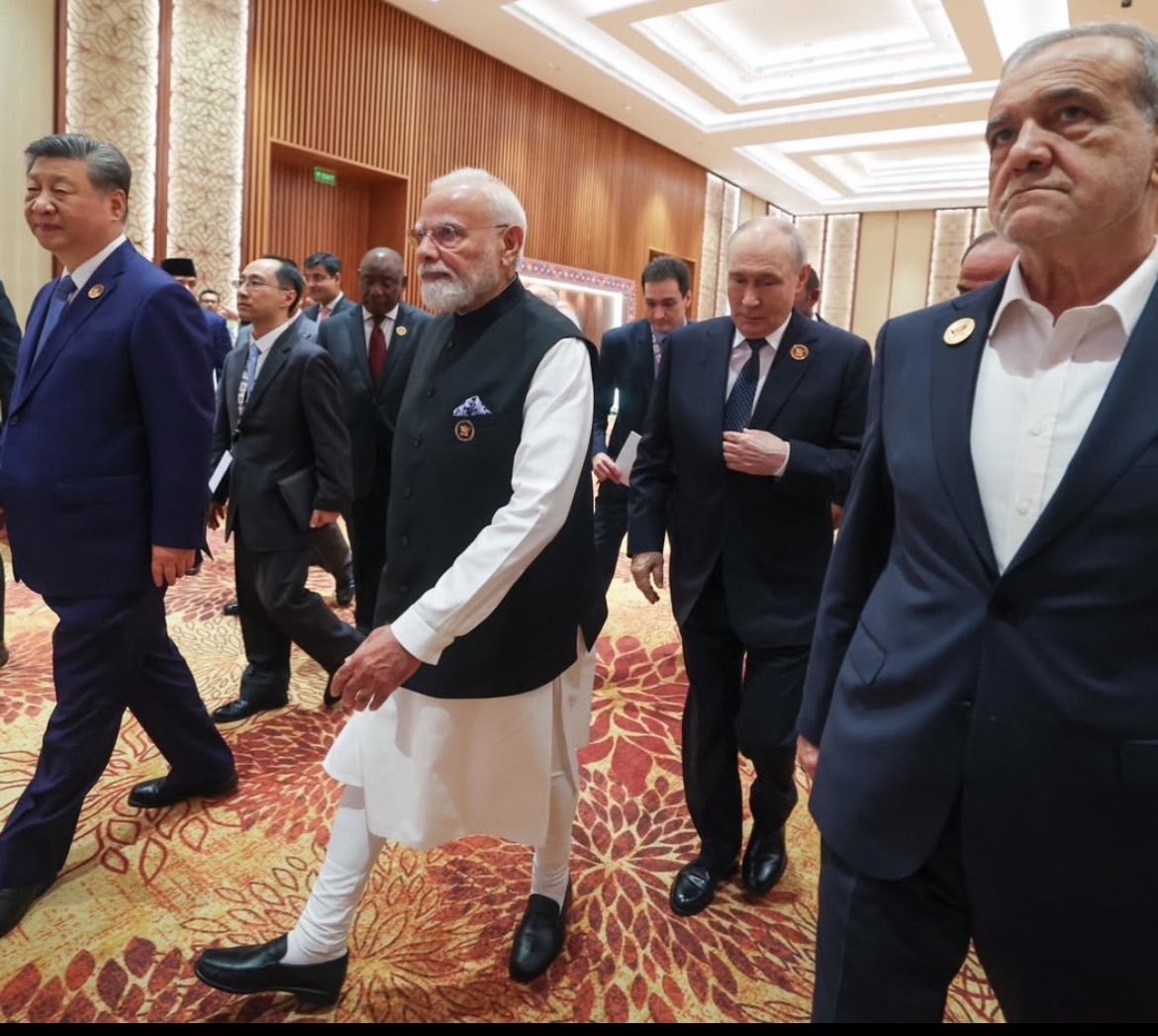
Xi arrived in New Delhi on Saturday for the BRICS summit, his first visit to India in seven years. Just as important, he and Narendra Modi are preparing a bilateral meeting of their own, with the border, trade, investment and the possible revival of a strategic economic dialogue all likely to feature.
The political thaw has already produced practical results. Flights have resumed. Border patrol arrangements have been restored. Economic contacts are reopening cautiously. By Chinese figures, bilateral trade reached a record of roughly $155bn last year and rose about 23 per cent in the first half of 2026.
The numbers matter because the rapprochement is taking place without any corresponding breakthrough in strategic trust.
Beijing can live with that.
China’s immediate objective is to reduce pressure on its western flank while harder strategic contests remain concentrated elsewhere. Taiwan, Japan and the Philippines already create several potential points of simultaneous friction. If India were steadily integrated into the same strategic geometry, a series of regional problems would begin to resemble an integrated Indo-Pacific constraint.
A suspicious India is manageable. An India permanently locked into such a structure is considerably less so.
Beijing can therefore tolerate much of what New Delhi already does. India can remain in the Quad, deepen defence cooperation with Washington and continue to regard China as its principal long-term competitor. The crucial question is whether every dispute with Beijing automatically pushes India further into an opposing coalition.
Reducing friction in the Himalayas creates strategic space far beyond the border itself.
India has its own reasons to participate.
Its international leverage has long rested partly on being worth courting by several powers at once. Washington sees a counterweight to China. Moscow sees a major energy and defence partner. Europe sees a vast market and potential manufacturing base. Beijing has every reason to keep India strategically available.
The value of each relationship rises when none becomes exclusive.
That premium has come under pressure. The India-Pakistan air war challenged assumptions about Indian military predominance. Washington’s decision last year to impose tariffs of up to 50 per cent on Indian goods over Russian oil purchases showed how easily strategic partnership could coexist with economic coercion.
New Delhi has every reason to rebuild some distance between partnership and dependence.
A warmer relationship with China helps.
India is not entering Beijing’s orbit. It is raising the price of assuming that it belongs anywhere else.
This is where the story moves beyond India’s familiar doctrine of strategic autonomy.
India now operates inside several systems whose political logic does not align. Its security partnerships extend towards the United States and Japan. Its industrial economy remains heavily exposed to Chinese supply chains. Russia still matters in energy and defence. Europe is becoming more important in trade. BRICS gives New Delhi another platform for financial and diplomatic bargaining.
These networks overlap without resolving into a single bloc.
That pattern increasingly describes the international system itself.
A topological world is organised through overlapping systems as much as through geopolitical camps. Its most valuable states are often those capable of remaining connected to several networks at once.
India is becoming one of the clearest examples.
The agenda of this BRICS summit helps make the point.
Under India’s chairmanship, members have discussed shared computing infrastructure, collaborative data platforms, multilingual AI models and greater technological sovereignty. India wants stronger sovereign AI capacity while preserving access to Western frontier technology. China, meanwhile, has every reason to extend its models, hardware and digital infrastructure deeper into the Global South.
Their preferred end states are different. The interface remains useful to both.
Payments offer an even clearer example.
India has resisted turning BRICS into an explicit campaign against the dollar. It has little interest in exchanging dependence on a dollar-centred system for dependence on Beijing. Yet New Delhi still supports cheaper cross-border payments, greater use of local currencies and more interoperable digital-payment infrastructure.
China can read those mechanisms strategically. India can read them transactionally.
They do not need to agree on the destination to build part of the road together.
That is the deeper shift.
The emerging system does not require contradictions to disappear. It requires them to stop controlling the entire relationship.
For much of the old order, major disputes tended to spread. Border tensions poisoned trade. Security rivalry constrained technology. Political distrust eventually pulled other areas of cooperation into the same confrontation.
A more topological order can compartmentalise those contradictions.
The border can remain militarised while commerce expands. India can distrust Chinese intentions while relying on Chinese industrial inputs. Beijing can assume that New Delhi may move closer to Washington during a future crisis and still find value in keeping the relationship functional today.
The crucial change is the loss of system-wide veto power.
A disagreement that once contaminated the whole relationship may increasingly remain confined to the interface where it began.
That possibility creates a political divide that is becoming more useful than the familiar left-right split.
System managers are accustomed to an order in which security, technology, finance and political alignment reinforce one another. The deeper a country enters the system, the fewer contradictory connections it is expected to maintain.
Sovereign bargainers test the opposite proposition.
India can work with Washington on maritime security, buy Russian energy, rely on Chinese industrial inputs, bargain with Europe and use BRICS to press for changes in global financial governance without allowing any one relationship to determine the rest.
For institutions shaped by bloc-era assumptions, this is an uncomfortable development.
Some recent Western coverage of China and India reflects that tension. As harder constraints on the relationship ease, attention has shifted towards softer ones: Indian distrust, Chinese condescension, incompatible political cultures and the social distance between the two societies.
The Economist’s recent question of why India continues to “baffle” China is revealing in this respect.
Those tensions are real. Chinese attitudes towards India can be dismissive. Indian suspicion of Beijing runs deep. None of that is likely to disappear quickly.
The more important question is how much power those tensions still possess.
An older framework tends to treat them as evidence of a ceiling on cooperation. A topological system may increasingly absorb them as permanent conditions.
That distinction will shape competition well beyond India.
Powerful states will use tariffs, secondary sanctions, export controls, investment screening and technology standards to raise the cost of maintaining multiple connections. The objective will often be to make certain interfaces too expensive to preserve.
That is where the contest over the next international order may become most intense.
For the foreseeable future, deep strategic trust between China and India will remain difficult. Another border crisis could reverse much of the current thaw. India may again lean more heavily towards Washington; Beijing may again conclude that New Delhi has become too threatening.
None of that invalidates what is happening now.
The relationship is demonstrating that rivals can remain connected without first resolving everything that divides them.
The next international order may remain full of adversaries, mistrust and incompatible ambitions. Its stability will depend increasingly on keeping one dispute from contaminating every other connection.
The ability to cooperate without resolving everything may become a form of power in its own right.
"I told PM .@narendramodi that I tested our trade in local currencies. I bought some books here & paid in local currency. My payment on card went through in ₹ & it translated in South African rand. It doesn't get any better than that"-SA President Ramaphosa
Interlinking of currencies among BRICS Nations is a big step towards reducing hegemony of USD.
No Vande Matram, No Jai Hind
IPS Bushra Bano, who left her job in Saudi Arabia, cleared UPSC twice and now serves as an IPS officer.
In her statement, she started with “Assalamualaikum,” said “Inshallah” in between, and ended with “Jazakallah.”
Throwback to the 1993-94 when Captain Cook challenged the undisputed leadership of Tata Salt.
4 years later Captain Cook crossed the ₹100 crore mark taking on Tata Salt’s dominance in the market. Today this advertisement is remembered as an iconic piece of Indian advertising.