My Twitter subscription had some issues, and as a result, my reach was reduced. Therefore, sharing it again:
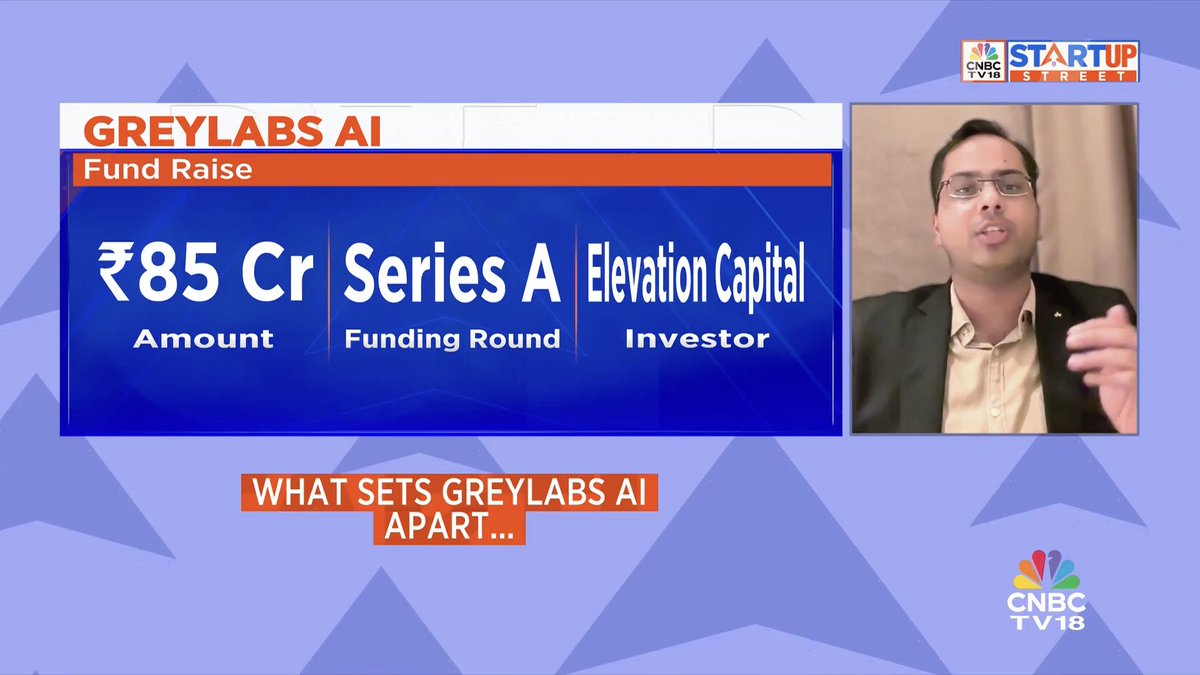
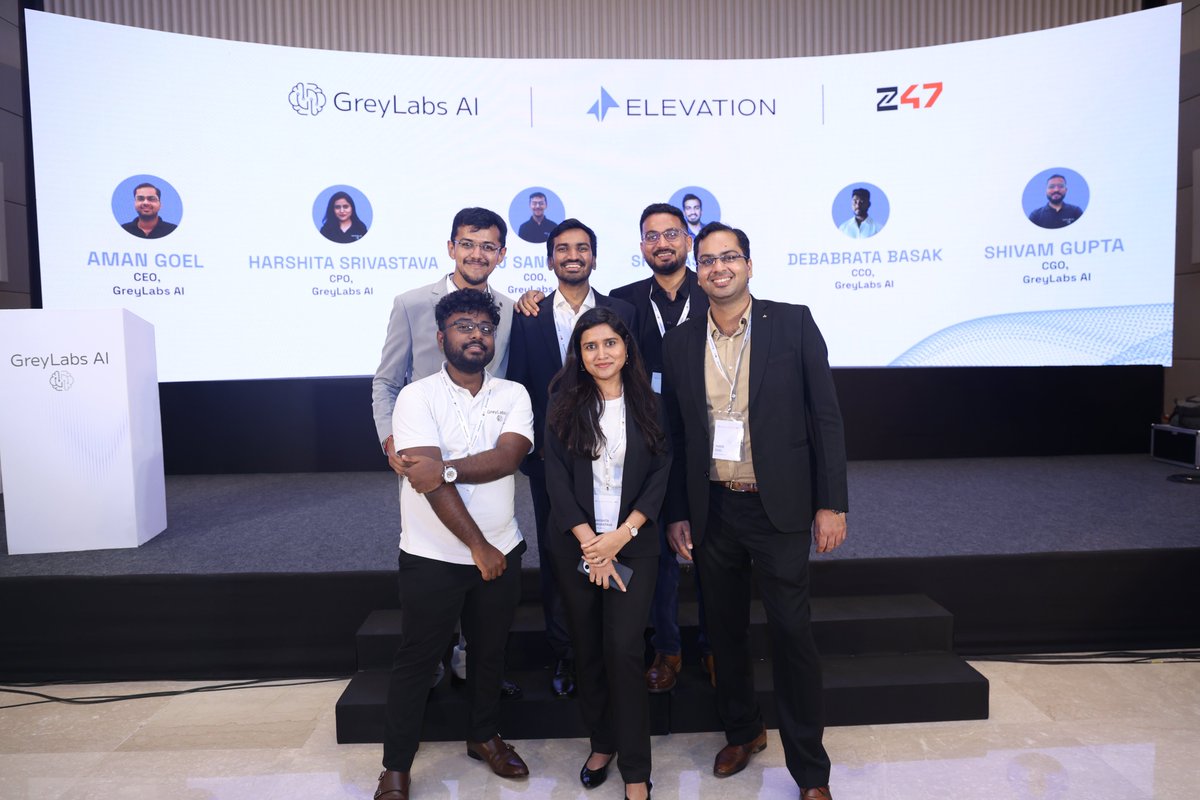
🎉Excited to share the news of our Series A!🎉
We are proud to announce that we've raised Rs. 85 crores in Series A led by @ElevCap with participation from @z47_vc.
🧵👇
We could have retired at 26. We didn't.
@harshitaiitk and I built our first venture, Cogno AI, from scratch, grew it to $1M ARR, and sold it for millions of dollars within 4 years of graduating from college. By most measures, we had already won.
But in 2023, we started over.
Not because we had to. Because we saw the AI supercycle coming and knew exactly where we wanted to be when it hit. This time, we built with a founding team we had already been through fire with: Shivam, Shreyas, Debabrata, and Raj. Same trust, much bigger mission.
That became @GreyLabsAI.
2.5 years in:
- ₹100 Cr raised from @z47_vc, @ElevCap, and leading Angels
- 75+ enterprise clients across banks, insurers, brokers, Fintechs and NBFCs
- Client logos including Axis Bank, SBI Life, Motilal Oswal, BharatPe, and Home Credit
- Two products scaling fast: Agentic Voice AI Calling and Voice Analytics
The best founders I know are not chasing exits. They are chasing problems worth solving. If you are sitting on a hard problem and wondering whether to go again, that restlessness is probably telling you something.
Trust it.
I learned it the hard way at my first startup (Cogno AI).
Not every Business is VC fundable. Not every founder has a VC fit. At my previous venture, I uses to say a "Yes" to every suggestion that VCs gave me. Needless to say, no one funded us and all these meetings felt like a waste of time. That's when we decided to bootstrap the venture and then later it got acquired.
At my current venture @GreyLabsAI, we have full clarity on who we are, what market are we targeting. More than that, we have 100% clarity on who we are not and which market we will avoid.
As a 2nd time founder, I say a "No" to 12 out of 10 ideas thrown at me. I may be wrong or I may be too stubborn, and time will tell that. But I know for sure that I have clarity of thought. This clarity of thought coupled with a large market is what attracts venture capital.
If you don't know where you're headed and if your target market isn't large, no point in talking to VCs. You'll waste your and their time.
A friend of mine used to say: “Show up on time, with a good attitude, and do what you said you’d do. That’s it. That’s 90% of winning in life." The older I get, the more I realize just how right he was.
Two traits separate founders who make it from those who don't.
1. Clarity of thought.
2. Resilience.
The founders I've seen struggle the most aren't the ones with bad ideas. They're the ones who can't articulate what they're building, who they're building it for, or what pain point they're actually solving.
They try to sell to everyone. Enterprise, SMB, mid-market, all at once. They list ten use cases on their landing page. They don't have a beachhead segment. They don't have a sharp ICP. They solve "anything and everything" and end up becoming irrelevant to everyone.
The best founders are the opposite. They are razor sharp on what they're building, who it's for, and why it matters. They might turn out to be completely wrong about all of it. But they have conviction. And conviction lets them focus, ship fast, and learn quickly.
At @GreyLabsAI, we get this feedback constantly:
"Why don't you go global? The India market is too small."
We're focused on India.
"Why don't you go horizontal? Voice AI works across every consumer business."
We're focused on financial services.
"Why don't you expand your AI portfolio? You could build so much more."
We're focused on voice AI.
Three layers of focus. Geography, vertical, technology. Each one is a "no" we say every week to well-meaning advice. And each one is a deliberate choice, not an accident.
Could we be wrong? Absolutely. Maybe India is too small. Maybe BFSI is too narrow. Maybe voice AI alone isn't enough.
Which brings me to the second trait.
Clarity gets you moving in a direction. Resilience is what keeps you standing when the market tells you that direction was wrong.
Because it will happen. Your first ICP won't work. Your pricing will be off. Customers will say no. Investors will pass.
Resilience is what lets you absorb all of that, reset to a new thesis, and repeat the cycle with the same conviction you had the first time.
Clueless founders without clarity never start the cycle.
Clear founders without resilience quit after the first hit.
The ones who win do both, over and over, until something clicks.
@defekin Many people register for the drive, but then as and when Masters admits start coming in, they drop from the process.
I also had PPO from Rubrik back in 2016. I wanted to go for a startup of my own. I registered myself for the placement process, but then dropped in between.
Yes, because many of them (like me) believe in creating jobs rather than getting a job. And many others go for Masters and PhD at top US Universities like Stanford, CMU, Berkeley, etc.
Don't mistake it as "IITB students couldn't get a job".
Grateful for this write-up from @Rahul_J_Mathur at @DeVC_Global.
@harshitaiitk and I didn't really think of it as "could have retired" - we just knew we weren't done. Cogno taught us the market, the relationships, and the discipline. @GreyLabsAI is us swinging properly.
2.5 years in, 75+ enterprise clients, two product lines, and a team of 90+ people who genuinely care about building something real in BFSI Voice AI. We're just getting started.
If you're at Mumbai Tech Week on May 29-30, catch Shivam doing a live demo of our AI calling agent. It's the kind of thing that's better seen than described.
Aman and Harshita built a $1M ARR startup, sold it to Exotel in 4 yrs and could have retired at 26. Instead they decided to start up again.
Their first company Cogno AI was acquired in November 2021 - the duo made a few $ millions within 4 yrs of graduating from IIT Bombay & Kanpur respectively🤯
Cogno was a phenomenal campus success story - 4 yrs from founding to acquisition with marquee logos such as SBI, HDFC and ICICI Group.
But, in 2023, they decided to start their 2nd venture - Greylabs AI. This time around, they partnered with their founding team from Cogno AI including Shivam, Shreyas, Debabrata and Raj.
Most young founders are told to "follow your passion". I strongly disagree with it.
I was given the same advice in college. But here is the problem: when you are in your early 20s, you rarely know what your passion is. You have not lived enough to find it.
So I followed contrarian advice instead: chase the right opportunity. Passion will come later.
My first startup, was an AI-powered chatbot for banks and financial institutions. I was a Computer Science graduate. There is no way I could have developed a passion for "AI for Financial Services" sitting in a college classroom. It is too specific, too niche, too real-world.
But I spotted the opportunity.
In 2017, while we were still in college, SBI gave us a contract worth Rs. 75 lakhs. That one client opened a door. SBI Life and SBI Mutual Fund followed. An advisor introduced us to ICICI Bank, and they came on board too.
I realized I had stumbled into a large, underserved market. I did not love it yet. I just saw it clearly.
We scaled to over $1 million in revenue and was acquired in a multi-million dollar transaction in 2021.
Today, in 2026, I am nine years into serving India's financial services sector, first through my previous venture and now through @GreyLabsAI. What started as pure opportunity-chasing has quietly become a genuine passion: solving high-impact problems for the institutions driving financial inclusion and credit penetration across the country.
I could not have discovered this passion in college. No one could have pointed me to it. It only emerged because I ran toward the opportunity first.
Passion is not always the starting point. Sometimes it is the reward for showing up long enough.
Ten years ago, I landed in San Francisco as a 20-year-old kid from IIT Bombay, headed to Palo Alto to intern at @rubrikInc's Software Engineering Team.
I was earning $8,000 a month. It felt like a dream.
My mentor was an @CSE_IITBombay senior, who made me fall in love with databases and scalable backend systems. The work was exciting. The culture was electric. Rubrik went on to go public. I was one of the early interns, in 2016, before any of that happened.
But here is what that internship really gave me:
Clarity.
I realized I did not want to build my life in the Bay Area. I wanted to go back to India and build something of my own. Seeing the startup energy up close lit a fire in me that has never gone out.
When I returned in July 2016, I made a decision. My fourth year of college was not going to be just about courses. It was going to be about learning how to build a company. Entrepreneurship courses, product thinking, sales, marketing. Engineering was never my constraint. Business-building became my obsession.
"Most people overestimate what they can do in one year and underestimate what they can do in ten years." - Bill Gates
That quote hits differently when you actually live it.
When I look back at the last ten years, it feels surreal. From being an intern at Rubrik, to co-founding Cogno AI, bootstrapping it past $1 million in revenue, getting it successfully acquired, and then starting again from scratch.
Today, at @GreyLabsAI, we have raised close to Rs. 100 crores from @z47_vc and @ElevCap. We are a team of 85+. We work with more than 75 large BFSI accounts across India. We have grown more than 3x year on year.
None of this was obvious. None of it was guaranteed.
But it all started with a summer in Palo Alto, a great mentor, and the courage to come back home and bet on myself.
If you are an intern somewhere right now, pay attention to what excites you and what does not. That signal is worth more than the stipend.
The next ten years are waiting.
In 10 years of being an entrepreneur, I have never missed a payroll. Not once.
Not when I was running a content writing business in college. Not at Cogno AI. Not at @GreyLabsAI. Never.
But the story I want to share is from August 2018 when I was in my early 20s.
My co-founder had just left. I was one year out of college. The company had less than ₹5 lakhs in the bank. We were operating out of a 2-BHK flat in Ghatkopar, Mumbai. We had full-time employees, interns, office rent to pay, and almost nothing left to pay it with.
It was the lowest point of my entrepreneurial career.
And yet, I paid every single person on time that month.
I transferred my personal savings from the content writing business I had run in college into the company account. My team never found out how bad things were. They were young. I did not want them to panic. They had worked hard all month, and they deserved to be paid for it, regardless of what was happening behind the scenes.
A few months later, some customer payments came in. The runway extended. The business started picking up. We survived.
Looking back, I think paying on time is not just a financial decision. It is a statement of respect. It tells your team: you can trust this place. Your hard work will not go unrecognised. We will not use your salary as a buffer for our own problems.
Predictability is one of the most underrated things a founder can give their team.
To every founder reading this: the people building your company with you are not your last line of financial defense. Pay them first, pay them on time, every single time. That is the bare minimum, and it is also one of the most powerful things you can do to earn genuine loyalty.
@Saurabh_Mouryan@3ackfire@rubrikInc@CSE_IITBombay The person I referred to in my post was my internship mentor for 3 months, not my life mentor.
Every intern is assigned a mentor. It was him for me.
A few other publications also picked it up:
1. https://t.co/K7YNAdyler
2. https://t.co/SzDIAck3ZR
3. https://t.co/Xr1BkeR0AD
4. https://t.co/LJSL8xlilW
5. https://t.co/NxKuMuF3A3
6. https://t.co/NoXFajfadB
7. https://t.co/C6cQ3cArWi
Ten years ago, I landed in San Francisco as a 20-year-old kid from IIT Bombay, headed to Palo Alto to intern at @rubrikInc's Software Engineering Team.
I was earning $8,000 a month. It felt like a dream.
My mentor was an @CSE_IITBombay senior, who made me fall in love with databases and scalable backend systems. The work was exciting. The culture was electric. Rubrik went on to go public. I was one of the early interns, in 2016, before any of that happened.
But here is what that internship really gave me:
Clarity.
I realized I did not want to build my life in the Bay Area. I wanted to go back to India and build something of my own. Seeing the startup energy up close lit a fire in me that has never gone out.
When I returned in July 2016, I made a decision. My fourth year of college was not going to be just about courses. It was going to be about learning how to build a company. Entrepreneurship courses, product thinking, sales, marketing. Engineering was never my constraint. Business-building became my obsession.
"Most people overestimate what they can do in one year and underestimate what they can do in ten years." - Bill Gates
That quote hits differently when you actually live it.
When I look back at the last ten years, it feels surreal. From being an intern at Rubrik, to co-founding Cogno AI, bootstrapping it past $1 million in revenue, getting it successfully acquired, and then starting again from scratch.
Today, at @GreyLabsAI, we have raised close to Rs. 100 crores from @z47_vc and @ElevCap. We are a team of 85+. We work with more than 75 large BFSI accounts across India. We have grown more than 3x year on year.
None of this was obvious. None of it was guaranteed.
But it all started with a summer in Palo Alto, a great mentor, and the courage to come back home and bet on myself.
If you are an intern somewhere right now, pay attention to what excites you and what does not. That signal is worth more than the stipend.
The next ten years are waiting.
@FuturesTitan@rubrikInc@CSE_IITBombay Median salary in San Francisco today is $8k per month. Source: https://t.co/eCAEjwvJTf
I was earning $8k per month as an intern, 10 years ago. By all means it was quite good. Even Google internship stipend at that time was $6.5k per month.