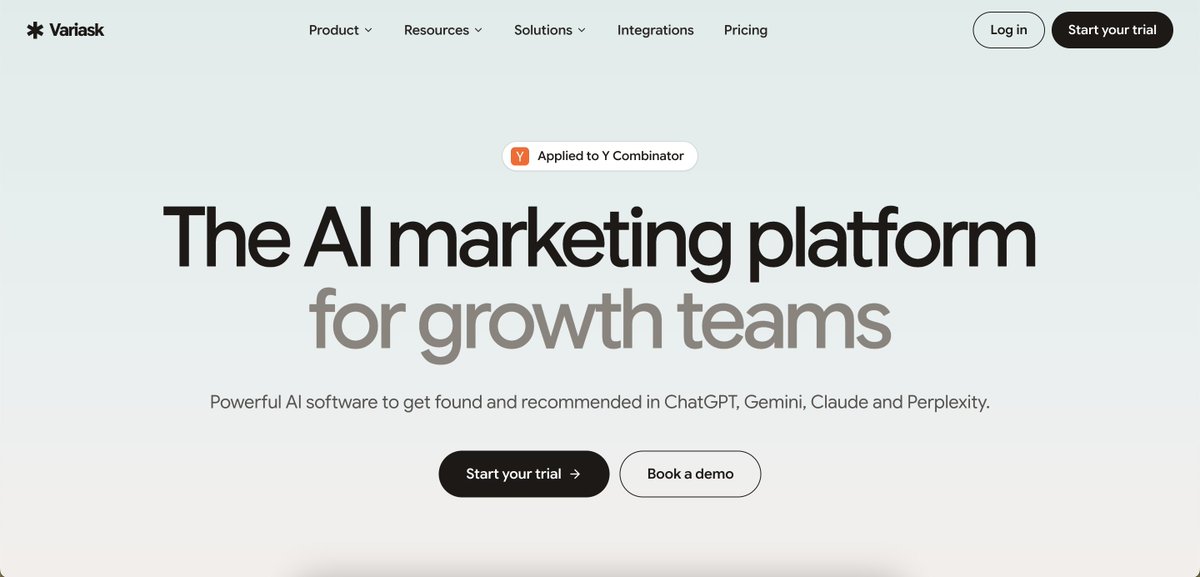
Marketing teams are tracking everything except the one channel that is quietly eating traditional search.
If leadership asks for your global AI visibility metrics today, you probably don't have an answer.
Variask Enterprise fixes this by tracking AI visibility at a global scale.
For the first time, marketing teams can monitor performance across every engine, market, and product line. Stop guessing and start reporting with numbers your leadership can actually trust.
Explore Variask for Enterprise today at https://t.co/WTQQvWZ2Tv
🎉 Limited Offer: Sign up for any plan on https://t.co/pvG6wL8lnA and get a FREE 3-month upgrade to the next tier!
Starter → Essential
Essential → Growth
Growth → Scale
• $99/mo ➔ Essential ($129 value)
• $129/mo ➔ Growth ($419 value)
• $419/mo ➔ Scale ($999)
Get recommended in ChatGPT, Gemini, Claude & Perplexity.
Start your trial at https://t.co/pvG6wL8lnA
Traditional SEO is only half the battle now. Your next customer is asking ChatGPT for recommendations, not Google.
If your product isn't in that response, you just lost a sale.
https://t.co/EAzKHxbhKu was built to fix this. We help growth teams track and optimize their visibility on ChatGPT, Claude, and Perplexity.
The stark difference between a mature startup ecosystem and a developing one isn’t just capital-it’s the culture.
🇺🇸 In the US and many mature hubs, when a founder builds something audacious, the community rallies. They extract inspiration, celebrate the win, and ask, How can I build something that great?
🇮🇳 In India, we are still fighting the crab mentality. When someone steps outside the mold and builds something truly disruptive, the default reaction for too many is jealousy. Because they couldn’t do it, their first instinct is to pull the builder down.
We are seeing this play out right now. @deepigoyal is trying to build a genuinely unique product with @temple. Instead of curiosity and praise for the innovation, the timeline is filled with unnecessary noise and negativity.
I fully stand with him and back his vision.
It’s time we shift our culture. Let’s build a community that elevates builders, finds inspiration in audacious bets, and pushes each other forward-instead of defaulting to jealousy.
The next great global products will only come from India when we start cheering for the people building them.
People don't always want 10 websites to visit anymore.
They want one reliable answer.
That's exactly what AI search is changing.
Instead of comparing multiple websites themselves, people are increasingly asking AI tools to research, compare and recommend products.
For businesses, this changes the meaning of being visible online.
Being present on Google is one thing.
Being recommended by AI is another.
Not every business needs investors to become successful.
Some businesses need funding to grow. Others can grow perfectly well with the money they earn. The problem starts when we assume that raising money is always the next step towards building something meaningful.
Getting investment can open doors, but it also brings expectations. There are growth targets to meet, returns to think about, and people waiting to see results. Decisions that could once be made patiently may now come with pressure to move faster.
Sometimes, that pressure is useful. But it is not free.
When you build with your own money, you have to be more careful. You learn to spend wisely, focus on what matters, and make sure people are willing to pay for what you offer.
You may grow slower, but you also get to decide what growth looks like for you.
You can turn down opportunities that do not make sense. You can take time to get things right. You can build a profitable business without constantly worrying about how the next funding round will look.
Of course, bootstrapping is not easy. Limited money means limited room for mistakes, and some businesses genuinely need outside capital to compete.
But if a business can sustain itself and grow through its own earnings, there is something valuable about that independence.
Success is not just about how big a business becomes. It is also about how much control you retain over what you build.
Sometimes, growing at your own pace and sleeping peacefully at night is a better deal than growing faster under someone else's expectations.
A lot of problems become bigger because we keep thinking about them without doing anything about them.
We replay conversations in our heads, worry about things that might happen, and spend hours trying to find the perfect answer to a situation that may not even turn out the way we expect.
The strange part is that thinking feels productive. We feel like we are working on the problem, even when we are going around in circles.
Sometimes, the best way to get clarity is to take one small step.
If something is bothering you, have the conversation. If you do not understand something, learn about it. If a decision needs to be made, gather what you know and make the best choice you can.
You may still get things wrong. You may have to change your approach later. But at least you will be dealing with something real instead of fighting a hundred possibilities in your head.
Of course, not every problem can be solved immediately. Some situations need patience, and some decisions deserve careful thought.
But there is a difference between thinking something through and thinking about it endlessly.
You do not always need more clarity before you act. Sometimes, clarity comes because you acted.
A small step in the right direction can teach you more than another week of overthinking.
One mistake we often make is assuming that more choices will make us happier.
More clothes, more apps, more things to watch, more places to visit, and more options for almost everything.
At first, having choices feels good. But at some point, it starts taking more time to decide what we want than to actually enjoy it.
Think about how much time we spend choosing a movie, deciding what to eat, or looking for something better when what we already have is perfectly fine.
The same thing happens in bigger parts of life. We keep looking for better opportunities, better options, and better ways to do things. Sometimes that helps. Other times, it stops us from giving anything enough time to become meaningful.
There is a difference between having the freedom to choose and feeling the need to keep choosing.
I think life becomes simpler when we decide what matters to us and stop reconsidering every small decision.
Wear the clothes you like. Read the books that interest you. Spend time with people you value. Find a few things that make you happy and give them your attention.
You do not have to explore every option to make a good choice.
Sometimes, being content with what you have is not about settling for less. It is about finally giving what you have enough attention to appreciate it.
We have become so used to having everything available instantly that waiting has started to feel like a problem.
We want quick results, quick replies, quick success, and quick answers. If something takes too long, we start wondering whether we are doing something wrong.
But most things that are worth having take time.
It takes time to understand a person. It takes time to become good at something. It takes time to build trust, develop good habits, and figure out what you actually want from life.
The difficult part is that progress is not always visible while it is happening.
You can spend months learning something without feeling much better at it. You can make the right decisions for a long time before seeing any real difference. You can work on yourself and still have days when you feel like you are back where you started.
That does not necessarily mean nothing is changing.
We often underestimate what small, consistent efforts can do over a few years because we are too busy looking for results every few days.
Not everything needs to happen quickly.
Sometimes, the best thing you can do is keep showing up, do the work properly, and give things enough time to grow.
Patience is not about sitting around and waiting for life to improve. It is about doing your part without expecting everything to pay off immediately.
The older I get, the more I realise that not every opinion needs a response.
Someone will always disagree with you. Someone will misunderstand what you said. Someone will make a different choice and feel just as certain about it as you do about yours.
Earlier, it can feel important to explain yourself every time. You want people to understand your point, see your side, and know why you think the way you do.
But not every conversation needs to end with agreement.
People see the world through their own experiences, fears, and expectations. Sometimes, no amount of explaining will change that. And sometimes, they may be right about things you have not considered.
Learning to listen without feeling the need to defend yourself is useful. So is accepting that some people will never see things the way you do.
You can disagree without making it personal. You can change your mind without feeling small. And you can walk away from an argument without needing to prove anything.
Not every battle deserves your time.
There is a certain peace in knowing what you believe, being willing to question it, and not needing everyone else to agree with you.
One thing I have started noticing is how much time we spend trying to look busy.
We fill our calendars, reply to every message, attend meetings, and keep ourselves occupied throughout the day. At the end of it, we feel tired and assume we have done a lot.
But being busy and making progress are two very different things.
Some of the most important decisions need time to think. Some problems become easier when we stop trying to solve them for a while. And sometimes, doing nothing for an hour can be more useful than spending that hour on work that does not really matter.
The problem is that visible work is easy to measure. Thinking, questioning, and deciding what not to do are much harder to measure.
So we keep adding things to our day without asking whether they deserve to be there in the first place.
I think a better way to work is to focus less on how much we do and more on what actually changes because we did it.
A full day is not necessarily a productive day. And an empty calendar is not necessarily a wasted one.
We often focus too much on whether something is working and too little on whether it is actually making life better.
A feature can work perfectly and still be useless to the person using it. A process can look good on paper and still make someone's day harder.
The real value of anything we create is in the difference it makes to people's lives. Does it save them time? Does it remove unnecessary effort? Does it make a difficult task easier? Does it solve a problem they no longer have to think about?
These things may not always show up in a report, but people notice them.
I think we sometimes make the mistake of measuring progress by how much we build, how many things we complete, or how quickly we move. But doing more does not always mean making things better.
Sometimes, the best work is the kind that removes a problem so quietly that people barely notice it was ever there.
That is a much harder thing to achieve than simply getting something to work.
I completely discard the concept of finding a market. It is simply the wrong metric to track.
Most teams focus entirely on whether their new product has traction yet. A better question is whether people actually love using it. True appreciation means your tool becomes an essential part of a customers daily routine that they cannot imagine living without. Earning that level of loyalty is incredibly difficult.
The lazy approach to building features is just to launch them, verify they function, and check them off a list.
The superior approach is to focus on the human impact. When you design a tool to help people collaborate seamlessly and remove daily friction, it completely changes how teams work together.
That is the standard I aim for. I want to build tools that naturally reduce stress and make a users day run smoother.
Market validation is not always clear and hard to measure, but genuine user love is impossible to miss.