When sugar builds up in the leaf - the final paper from my PhD was published this month. Truly grateful to everyone involved.
"Effect of sugar feedback regulation on major genes and proteins of photosynthesis in sugarcane leaves"
https://t.co/caw38mH44P
This is neat - ePaddocks is a new technology designed by @CSIRO to save time for farmers and others in the agricultural sector when using digital services for farm analytics and insights. #csiroag#csirospace
https://t.co/mgKpM6K7PR
New glasshouse experiment currently underway - Jai compacting soil into PVC pots with a post-driver.
Looking for differences in root growth between #sugarcane varieties through tough soil & we’ve upped the soil strength this time #goodluckroots
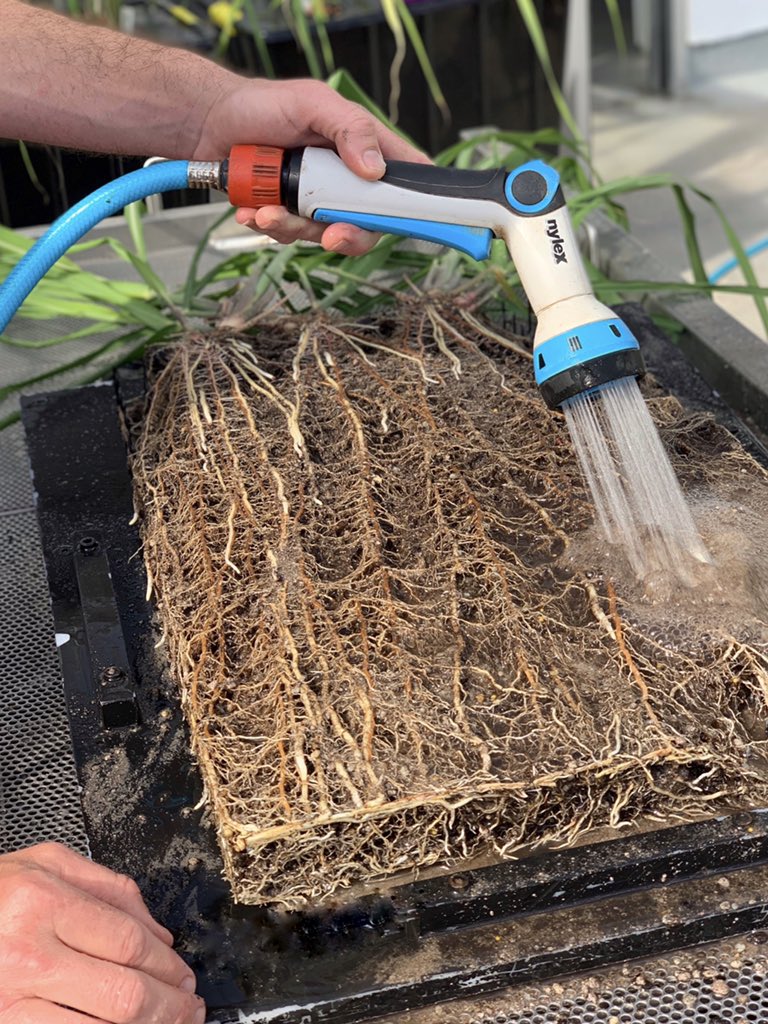
Definition of #potbound? Washing off the soil made us think about how this whole #rhizobox was pretty full with soil when we planted... and #roots don’t eat soil. Definitely some self-compacting going on. #sugarcane
@malinda2280@sugarresearch We break the cores up in the field and put them into bags. But you can use plastic sleeves or cylinders to transport them out of the field. (If that is what you mean?).
4 stroke post driver = portable ‘core driver’
(Taking soil cores for Dr Johann Pierre’s CSIRO project on #sugarcane in-field root quantification, funded by @sugarresearch)
@HausMJ @antonwasson Thanks! We used 3D printed molds from the paper: Atkinson, Jonathan A, and Darren M Wells. "An Updated Protocol for High Throughput Plant Tissue Sectioning." Frontiers in Plant Science 8 (2017): 1721. Then sectioned with vibratome. Let me know if you'd like any more information🙂
Please note I made an error: Dr Vijaya Singh is of the School of Agriculture and Food Science at the University of Queensland (UQ) - not QAAFI. Apologies!
@julyhappywood It is a way to wash roots grown in rhizoboxes to preserve their growth direction (and avoid tangling). I have been in contact with Dr Singh and will pass on links to papers where the method is described.