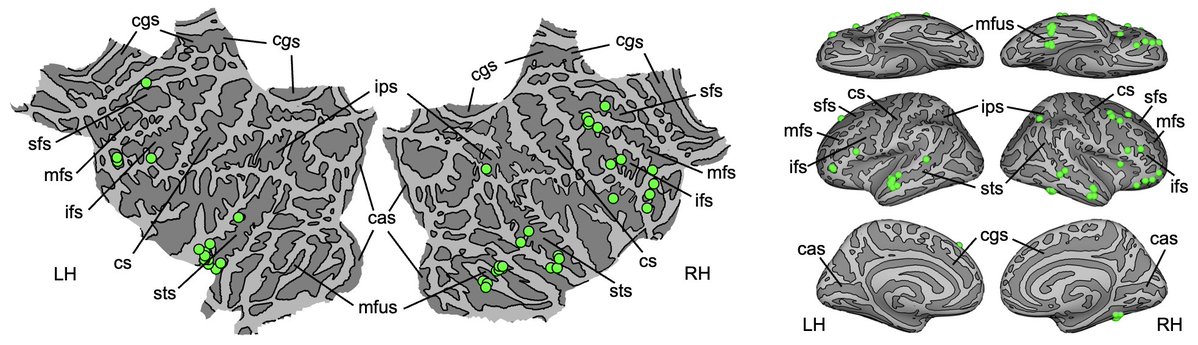
New preprint: "Monosynaptic connections link functionally similar regions in human cortex." We use electrical stimulation + fMRI in epilepsy patients to map whole-brain monosynaptic connectivity at 42 cortical sites. https://t.co/rSSSVsMWCQ 1/n
🧵 What if two images have the same local parts but represent different global shapes purely through part arrangement? Humans can spot the difference instantly! The question is can vision models do the same?
1/15
What shapes the topography of high-level visual cortex?
Excited to share a new pre-print addressing this question with connectivity-constrained interactive topographic networks, titled "Retinotopic scaffolding of high-level vision", w/ Marlene Behrmann & David Plaut.
🧵 ↓ 1/n
i'll be presenting this as a poster on thursday @ iclr! please come by & chat if any of this sounds interesting to you :)
thanks for reading. link to the paper again: https://t.co/pDrE6N2i6s
13/13
**ecstatic** to share our @iclr_conf paper: sparse components distinguish visual pathways & their alignment to neural networks, with @Nancy_Kanwisher and @meenakshik93 (https://t.co/pDrE6N2i6s)
1/n
in sum, we used dominant components of the neural response to get an **axis-sensitive** measure of similarity.
this work fits into a broader look at (R)epresentational alignment (cf. work by @talia_konkle, @sucholutsky, & others)
12/n