Amazing work from CoreWeave NPI team, NVIDIA bring up team and Dell. Vera Rubin brings a lot of in-house technologies to life. Valvey our own liquid loop. Racky the rack manager and Berry the BMC. So much work summed up in one Slack message. 🎉
I've been coding for 40 years. Here are the top 5 things I wish I knew when I started.
1. 90% of the job is debugging and fixing, not creating new code. Which is still fun if you're good at it.
I used to think programming was mostly writing fresh, clever stuff. In reality, most of your time is spent in other people's (or your own past self's) messy code, chasing down why something that "should" work doesn't. Get really good at debugging early. Learn assembly reading, call stacks, and kernel debuggers. It pays off hugely. The best engineers I saw were absolute magicians at this.
2. Manage complexity from day one (ie: don't write slop and "fix it later" if it goes somewhere).
Very early on, I'd hammer out code and refactor afterward. Big mistake. Now I start with clean, skeletal structure (minimalism first) and flesh it out carefully, with AI or not.
Messy code compounds and becomes unfixable. Upfront discipline on architecture, naming, and simplicity saves enormous pain later, especially in large systems like Windows.
3. Tools and processes matter more than you think
We suffered with basic diff/manual deltas instead of modern source control like Git. Branching, testing, and good tooling would have made porting and collaboration way smoother. Invest in your environment, automation, and reproducible builds early. Good tools amplify your output; bad ones (or none) drag everything down.
4. Understand the problem and existing code deeply before writing
Don't jump straight to coding. Map out the problem, study what's already there (you'll inherit a lot), and plan. Low-level knowledge (hardware quirks, alignment issues on different architectures like MIPS/Alpha) was crucial. Also: assert early and often. It forces clarity.
5. People, politics, and "the right tool for the job" beat pure tech arguments.
Brilliant engineers still argue endlessly. Sometimes it's about ego, not merit. Learn to spot the difference and "steer" the conversation rather than "winning" it.
Bonus from experience: Side projects like Task Manager (started at home because I wanted the tool) can become your biggest hits. Ship small, useful things often. If you're just starting, focus on fundamentals, patterns over syntax, and building resilience for the long haul. It's going to be a wild ride, but the fundamentals still matter.
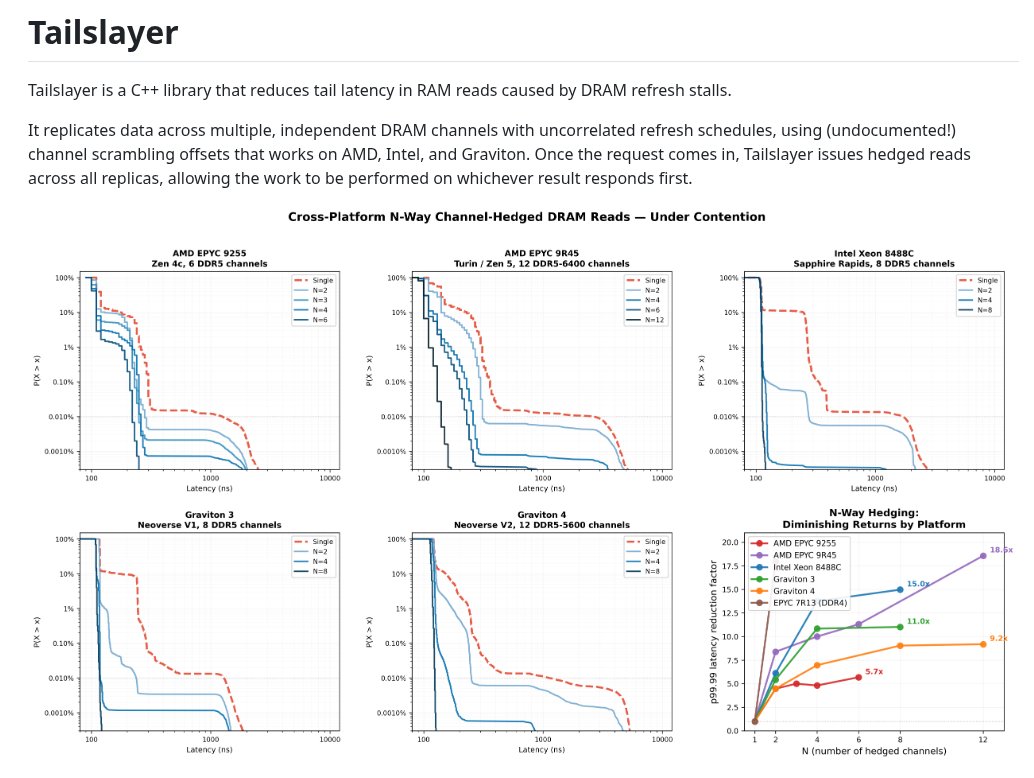
Hedged requests (apparently inspired by the Tail at Scale paper by myself and Luiz Barroso) applied within a single machine to replicating data across DRAM channels and issuing reads to all channels, using the one that comes back first. ~5-15X reduction in p99.99 read latency.
https://t.co/1OSmAKyCD3
Cool stuff, @lauriewired!
Accompanying video forwarded to me by a friend, which is how I learned about it:
https://t.co/onS2NWFjMP
Is it weird that AI coding assistance is not giving me identity fracture?
A lot of software developers are feeling disoriented and threatened these days. Programming by hand is clearly going the way of the buggy whip and the hand-cranked auger. Which is how we're finding out that a lot of people have their identities bound up in being good at hand-coding and how it feels to do that.
That's not me. It's not me at all. Rather to my surprise, I don't miss coding by hand, not any more than I missed writing assembler when compilers ate the world and made that unnecessary. (That was in a couple years back around 1983, for you youngsters.)
Maybe the fact that I'm not feeling any of this disorientation disqualifies me from having anything to say to people who are. On the other hand...if you can learn to emulate my mental stance and be completely unbothered, maybe that would be a good thing?
So. If you're a programmer, and you're feeling disoriented, try this on for size:
I like being a wizard. I like being able to speak spells, to weave complex patterns of logic that make things happen in the world. Writing code is a way to manifest my will.
Yes, I've piled up a lot of arcane knowledge over the 50 years I've been doing this. But languages of invocation, they come and they go. Been a long time since I've had any use for being able to program in 8086 assembler, and that's okay. I have better spells now, and these days some rather powerful familiars.
What I'm inviting you to do is think of yourself as a wizard. Not as a person who writes code, but as a person who is good at assuming the kind of mental states required to bend reality with the application of spells.
And if that's who you are, does it matter if the spells are painstakingly scribed in runes of power, versus being spoken to an obedient machine spirit?
It's all one; it's all the manifestation of will. Arcane languages come and go, machine spirits appear and then diminish to be replaced by more powerful ones, but you? You are the magic-wielder. Without you, none of it happens.
Same as it ever was. Same is it ever was. And so mote it be.
A few random notes from claude coding quite a bit last few weeks.
Coding workflow. Given the latest lift in LLM coding capability, like many others I rapidly went from about 80% manual+autocomplete coding and 20% agents in November to 80% agent coding and 20% edits+touchups in December. i.e. I really am mostly programming in English now, a bit sheepishly telling the LLM what code to write... in words. It hurts the ego a bit but the power to operate over software in large "code actions" is just too net useful, especially once you adapt to it, configure it, learn to use it, and wrap your head around what it can and cannot do. This is easily the biggest change to my basic coding workflow in ~2 decades of programming and it happened over the course of a few weeks. I'd expect something similar to be happening to well into double digit percent of engineers out there, while the awareness of it in the general population feels well into low single digit percent.
IDEs/agent swarms/fallability. Both the "no need for IDE anymore" hype and the "agent swarm" hype is imo too much for right now. The models definitely still make mistakes and if you have any code you actually care about I would watch them like a hawk, in a nice large IDE on the side. The mistakes have changed a lot - they are not simple syntax errors anymore, they are subtle conceptual errors that a slightly sloppy, hasty junior dev might do. The most common category is that the models make wrong assumptions on your behalf and just run along with them without checking. They also don't manage their confusion, they don't seek clarifications, they don't surface inconsistencies, they don't present tradeoffs, they don't push back when they should, and they are still a little too sycophantic. Things get better in plan mode, but there is some need for a lightweight inline plan mode. They also really like to overcomplicate code and APIs, they bloat abstractions, they don't clean up dead code after themselves, etc. They will implement an inefficient, bloated, brittle construction over 1000 lines of code and it's up to you to be like "umm couldn't you just do this instead?" and they will be like "of course!" and immediately cut it down to 100 lines. They still sometimes change/remove comments and code they don't like or don't sufficiently understand as side effects, even if it is orthogonal to the task at hand. All of this happens despite a few simple attempts to fix it via instructions in CLAUDE . md. Despite all these issues, it is still a net huge improvement and it's very difficult to imagine going back to manual coding. TLDR everyone has their developing flow, my current is a small few CC sessions on the left in ghostty windows/tabs and an IDE on the right for viewing the code + manual edits.
Tenacity. It's so interesting to watch an agent relentlessly work at something. They never get tired, they never get demoralized, they just keep going and trying things where a person would have given up long ago to fight another day. It's a "feel the AGI" moment to watch it struggle with something for a long time just to come out victorious 30 minutes later. You realize that stamina is a core bottleneck to work and that with LLMs in hand it has been dramatically increased.
Speedups. It's not clear how to measure the "speedup" of LLM assistance. Certainly I feel net way faster at what I was going to do, but the main effect is that I do a lot more than I was going to do because 1) I can code up all kinds of things that just wouldn't have been worth coding before and 2) I can approach code that I couldn't work on before because of knowledge/skill issue. So certainly it's speedup, but it's possibly a lot more an expansion.
Leverage. LLMs are exceptionally good at looping until they meet specific goals and this is where most of the "feel the AGI" magic is to be found. Don't tell it what to do, give it success criteria and watch it go. Get it to write tests first and then pass them. Put it in the loop with a browser MCP. Write the naive algorithm that is very likely correct first, then ask it to optimize it while preserving correctness. Change your approach from imperative to declarative to get the agents looping longer and gain leverage.
Fun. I didn't anticipate that with agents programming feels *more* fun because a lot of the fill in the blanks drudgery is removed and what remains is the creative part. I also feel less blocked/stuck (which is not fun) and I experience a lot more courage because there's almost always a way to work hand in hand with it to make some positive progress. I have seen the opposite sentiment from other people too; LLM coding will split up engineers based on those who primarily liked coding and those who primarily liked building.
Atrophy. I've already noticed that I am slowly starting to atrophy my ability to write code manually. Generation (writing code) and discrimination (reading code) are different capabilities in the brain. Largely due to all the little mostly syntactic details involved in programming, you can review code just fine even if you struggle to write it.
Slopacolypse. I am bracing for 2026 as the year of the slopacolypse across all of github, substack, arxiv, X/instagram, and generally all digital media. We're also going to see a lot more AI hype productivity theater (is that even possible?), on the side of actual, real improvements.
Questions. A few of the questions on my mind:
- What happens to the "10X engineer" - the ratio of productivity between the mean and the max engineer? It's quite possible that this grows *a lot*.
- Armed with LLMs, do generalists increasingly outperform specialists? LLMs are a lot better at fill in the blanks (the micro) than grand strategy (the macro).
- What does LLM coding feel like in the future? Is it like playing StarCraft? Playing Factorio? Playing music?
- How much of society is bottlenecked by digital knowledge work?
TLDR Where does this leave us? LLM agent capabilities (Claude & Codex especially) have crossed some kind of threshold of coherence around December 2025 and caused a phase shift in software engineering and closely related. The intelligence part suddenly feels quite a bit ahead of all the rest of it - integrations (tools, knowledge), the necessity for new organizational workflows, processes, diffusion more generally. 2026 is going to be a high energy year as the industry metabolizes the new capability.
I am unreasonably excited about self-driving. It will be the first technology in many decades to visibly terraform outdoor physical spaces and way of life. Less parked cars. Less parking lots. Much greater safety for people in and out of cars. Less noise pollution. More space reclaimed for humans. Human brain cycles and attention capital freed up from “lane following” to other pursuits. Cheaper, faster, programmable delivery of physical items and goods. It won’t happen overnight but there will be the era before and the era after.
The 3rd edition of my book Deep Learning with Python is being printed right now, and will be in bookstores within 2 weeks. You can order it now from Amazon or from Manning.
This time, we're also releasing the whole thing as a 100% free website.
I don't care if it reduces book sales, I think it's the best deep learning intro around, and more people should be able to read it.
But that’s exactly what VMware did.
A small team, mostly from the DISCO paper, secretly iterated on a binary translation engine.
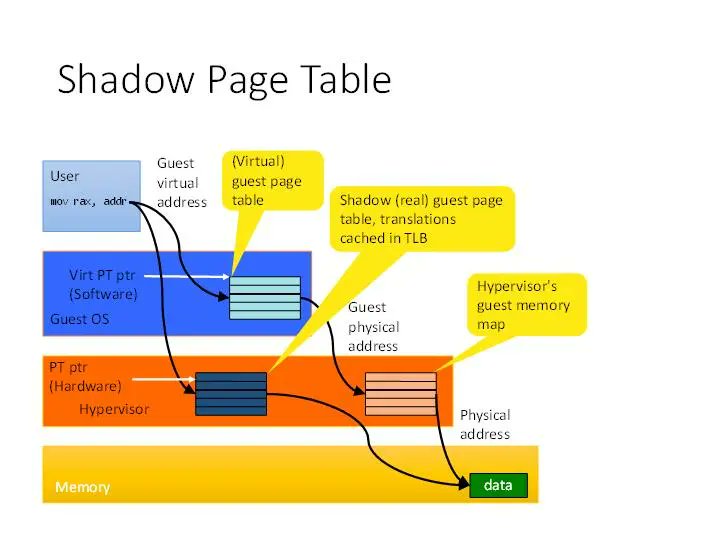
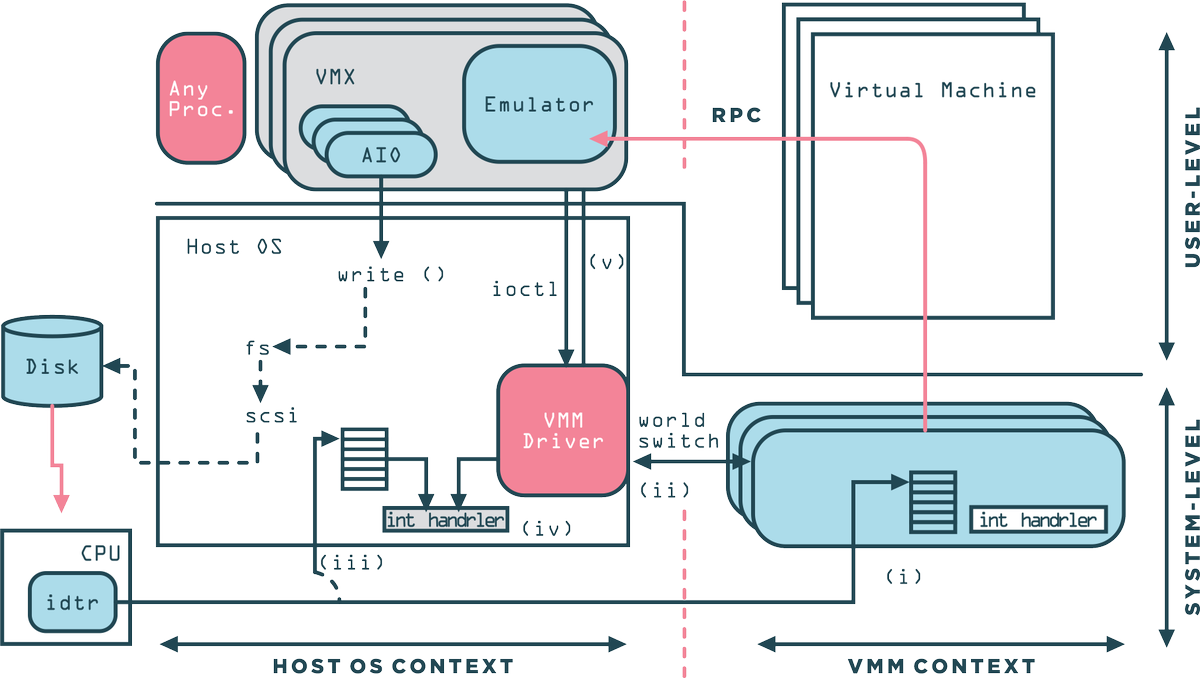
Problematic x86 instructions were rewritten on the fly; shadow page tables controlled memory access, and ring compression handled privilege.
The prototype was completed in a matter of months!
There’s so much more to this story, but it’s fascinating that such an unpopular idea quickly turned into a multi-billion dollar company!
Here’s some interesting reading material:
OG DISCO Paper:
https://t.co/h2mtM4GjJx
Comparison of Software + Hardware x86 virtualization techniques:
https://t.co/YV8nas5Erw
i remade tiny-tpu to support both inference and training!
we successfully tested our architecture on the classic XOR problem.
here's what i learned throughout the process:👇
More than half of the value of writing an essay lies in how it forces you to reorganize and refine your thoughts. The finished essay itself is a bonus.
I feel it's hard to overstate the productivity boost and new possibilities that gDocs+gSheets opened up since they launched - to the point that articles like the one below are not surprising. Thank you @googledocs !
https://t.co/dSvEpPW7cv