@TheHarishGoyal@StarHealthIns Avoid Star Health and Care Insurance, if you value peace of mind during the tough time of your loved one during hospitalization.
Yes, Britain famously transferred wealth to India. When British arrived in India its share of the world economy was 4%. When they left in 1947, they had taken it to 23%, roughly equal to all of Europe combined.
On a serious note.
The Indian railways were financed entirely by bonds sold on the London Stock Exchange. British investors were guaranteed a return of 5% per annum by the colonial government. A guaranteed return, in an era when no other safe investment in Britain offered anything close. And who guaranteed those returns? Indian taxpayers. Indians paid for the construction. Indians paid the guaranteed profits to British shareholders. Indians paid for the equipment, which was manufactured exclusively in Britain and shipped to India at inflated prices. One mile of Indian railway cost twice what the same mile cost to build in Canada or Australia, because the guaranteed return meant there was no incentive to control costs. The more it cost, the more British investors and suppliers earned.
And what were these railways designed to do? Move raw materials from India’s interior to ports. Cotton from the Deccan to Bombay. Jute from Bengal to Calcutta. Coal from Bihar to wherever the Empire needed it. Tea from Assam to London’s drawing rooms. The routes connected mines and plantations to harbors. Not cities to cities. Not people to opportunities. Raw materials to ships. The Indian public’s transportation needs were, as Shashi Tharoor put it, entirely incidental.
Oh, and the railways also moved troops. Very efficiently. So that when Indians protested being looted, the British could deploy soldiers to shoot them. That was the other “infrastructure investment.”
But wait, there is more. Before the railways, India had the world’s finest textile industry. The British smashed the looms, broke the weavers’ thumbs (this is not metaphor, this is documented history), imposed tariffs on Indian cloth, and shipped raw cotton to Manchester to be manufactured into garments that were then sold back to Indians. India went from being the world’s largest textile exporter to an importer of British cloth within a generation.
The Bengal Famine of 1943 killed an estimated 3 million people. Churchill diverted food supplies from Bengal to already well-supplied British troops and European stockpiles. When informed of the famine, his response, on the record, was to ask why Gandhi had not died yet. This is the “infrastructure investor” Musk is defending.
India contributed 2.5 million soldiers to fight in two World Wars on Britain’s behalf.
So let us summarize the colonial “investment” in India. They took a 23% global economy and left it at 4%. They destroyed the world’s finest textile industry. They built railways with Indian money, for Indian resources, generating British profits. They engineered famines that killed millions. They drained an estimated $45 trillion in today’s value over 200 years.
That’s some unprofitable adventure.
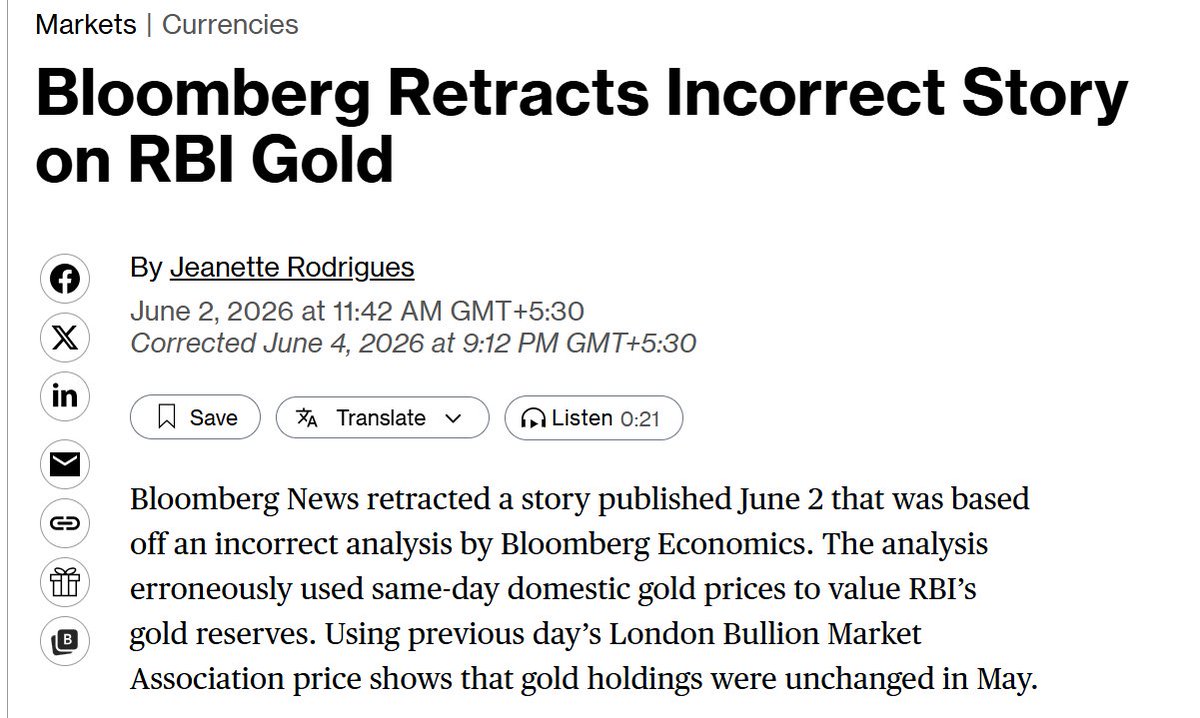
On June 5th, the incorrect analysis is retracted.
Despite the RBI clarification, social media analysts were raising doubts on RBI gold holdings while going by the wirehouse's analysis.
This happens only in India.
I have met many nationalities in a career of four decades. National pride, patriotism is foremost.
Only in India, we first want to pull down our own country and put our belief in outsiders.
When I was an investor in a textile startup, this was starkly evident. A Chinese buying agent would give the Chinese suppliers a lot of leeway and go out of the way to favour Chinese producers . Indian buying agents would be the worst for Indian producers.
Have seen that in various formats.
Having worked with German and Japanese owned companies, this was very evident. The National pride was something that you could count on at every step.
Only in India we have mastered the pulling down of the Nation.
The same was the case here.
Despite RBI saying the Gold holdings are constant "as on date" there were doubts raised on what that meant, was RBI using old data and gold had been sold in May etc etc.
Now the "incorrect story" is retracted.
If this was China, the wirehouse would have been severely penalised.
We shrug off these anti India moves too lightly.
Be more proud of your country and its institutions.
We are a 20,000 year old civilisation and a young modern country that is progressing fast. Faster than all major economies of the world.
We are not perfect but neither are the others.
But their nationals are much more patriotic.
There is no apology from this media outlet which often publishes anti India narratives brazenly.
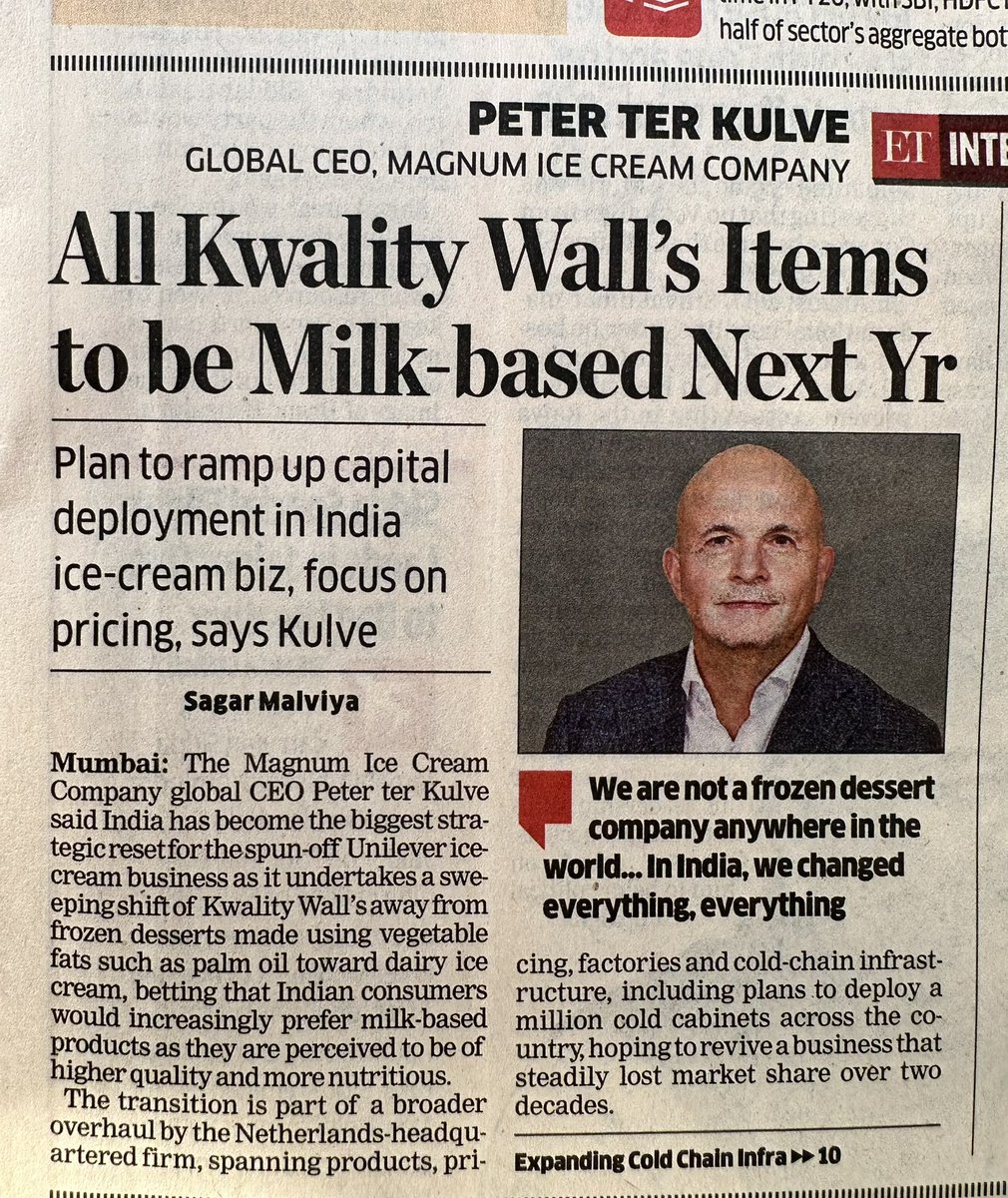
Big news from Magnum Ice Cream! 🇮🇳
All Kwality Wall’s items will become milk-based starting next year.
Global CEO Peter ter Kulve said India is now their biggest strategic market. The company is shifting away from frozen desserts made with vegetable fats (like palm oil) to pure dairy ice cream.
They believe Indian consumers prefer milk-based products because they are seen as higher quality and more nutritious.
The firm plans to ramp up capital deployment in India’s ice-cream business with focus on better pricing, expanding factories, and deploying a million cold cabinets across the country.
This is part of a major overhaul to revive the business after losing market share.
https://t.co/yyVlVGZPDl
An angry lady’s image shouting at a political leader and his party for having stopped the road has gone viral.
That one woman has said what millions of us feel. Stop blocking roads for your political agendas. Stop blocking roads, temples, for VIPs.
People have work, emergencies, lives. This entitlement has gone too far.
Whosoever this woman is, extremely well done.
These regular road blockings for dharnas, protests, and VIP visits are a nuisance. When will political parties realise that not a single new voter will be added through such methods? In fact, people stuck in traffic will hate you, you may lose more than you gain.
Specifically to the BJP: move on from the women’s reservation issue. Nobody cares about it. No woman, except maybe the party cadre, is angry that the bill won’t be implemented right now. It’s not going to fetch you any votes. There is already too much traffic in India; don’t make it worse by blocking roads for pointless theatrics.
Coming back to this woman, I’m sure the deep state experts will soon find out her political allegiance and label her a deep-state agent planted by George Soros to dilute the women’s reservation bill issue, because shooting the messanger is easier than addressing the message.
@AmeyKulkarni_21 Adding brand name in front of the original station name is very bad idea... it creates confusion among the new travellers and tourist... The main aim is make more people use metro not confuse them.
Don't not change station name even if it's temporary.
@jitenkparmar@policybazaar@CareHealthIndia CARE Health Insurance is the worst... avoid it like plague. They take money and do everything in the world to AVOID pay back in the times of need.
France has made planned obsolescence a criminal offense, becoming one of the first countries in the world to treat deliberate product shortening as a serious crime.
Manufacturers caught intentionally designing electronics, appliances, or other goods to fail prematurely or become unusable—whether through hardware flaws, software updates that slow performance, or other engineered limitations—now face steep penalties: up to 2 years in prison and fines reaching €300,000, or as high as 5% of their average annual turnover in the most serious cases.
This landmark law, building on France’s earlier consumer-protection framework and reinforced by high-profile scandals (such as the 2017–2018 investigations into smartphone “battery-gate” slowdowns), explicitly targets both physical and digital tactics used to push consumers toward frequent replacements.
The legislation is more than just punishment—it’s a cornerstone of France’s broader “right to repair” agenda. By criminalizing practices that drive premature disposal, the government aims to:
- Slash the massive environmental footprint of electronic waste,
- Protect consumers from hidden “forced upgrades,”
- Encourage manufacturers to prioritize durability, repairability, and longer-lasting support.
France’s tough stance sends a clear message to global tech and appliance companies: the era of disposable-by-design products is ending. By leading the charge on sustainability and consumer rights, the country is helping shift the world toward a more circular economy—one where goods are built to last, repaired when needed, and discarded only when truly necessary.