To the idiots celebrating government controlling kids, you just agreed to adults having to hand over facial recognition, digital ID, passports and/or credit card details to prove you are not a child.
Your stupidity is immeasurable.
@AngusBMacNeil@SovereignBain That is how seriously they take democracy in Scotland. This will have the absolute opposite effect that you think it will. Tick tock 🏴
What did the folly of both votes SNP mean for anti indy parties?
Well thanks to SNP Both votes- 🙈 (approx)
Reform got 8 extra MSPs.
Lab for 5 extra MSPs.
Tory got 2 extra MSPs.
There could have been have been about 14 extra pro indy MSPs if independence was put before party.
Crazy isn't it Jeremy Corbyn's Labour party had an 'antisemitism crisis' and now Zack Polanski's Green Party does.
While Nigel Farage's Reform party, with Nigel Farage and loads of Nazi lovers, doesn't.
It's like it's some kind of scam used against Left Wing parties.
I'm reluctantly posting on X again because the world needs to read this.
My daughter Zoe Rogers gave her own closing speech at the Filton trial, as did 4 other defendants, while their barristers looked on.
This is what she said 🧵 1/
Introduction to Scotland’s ‘Colonial Markers’ (and to our nation’s Hidden History)
Modern Scotland more than meets all of the criteria established by UN Resolution 1514 (XV) to define a Non-Self-Governing Territory (NSGT) or colony: its governance remains subordinate to Westminster’s control and its distinct historic legal, cultural, and geopolitical identity has been greatly diminished after three centuries of relentless attack by the administering power (England).
Professor Alfred Baird has carried out a detailed analysis of Scotland’s colonised condition, referencing post-colonial theory (Fanon, Memmi et al), in his 2020 book ‘Doun Hauden’. His research identifies the brutal realities of Scotland’s colonised condition and his analysis of this cites recognised post-colonial theory to identify a set of distinct colonial determinants or ‘Colonial Markers’ directly resulting from Scotland’s annexation by England in 1707.
Professor Baird uses these as context to explain Scotland’s current position today, where its economy is a fraction of those of its comparable European and Western neighbours, its indigenous culture is subordinated to that of England’s within the framework of the UK, and its population suffers some of the worst across-the-board health outcomes in Europe.
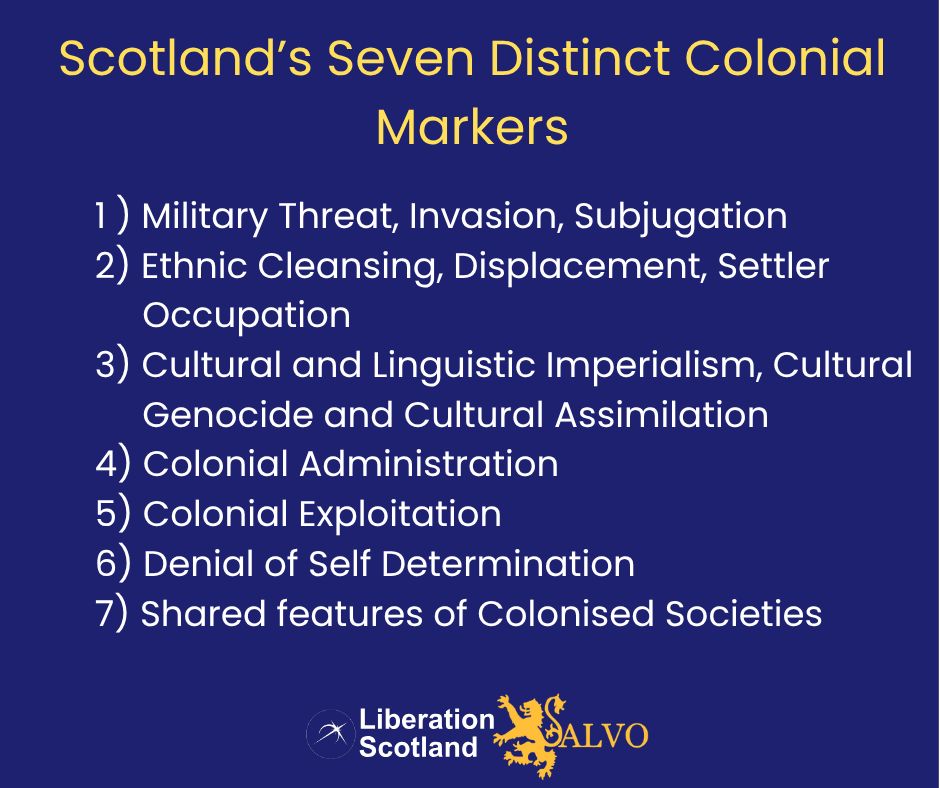
While some of these colonial determinants are historic, many are contemporary and together they continue to shape the modern Scotland we see around us in 2026. The seven distinct ‘Colonial Markers’ identified by Prof Baird in ‘Doun Hauden’ are:
1. Military Threat, Invasion, Subjugation
2. Ethnic Cleansing, Displacement, Settler Occupation
3. Cultural and Linguistic Imperialism, Cultural Genocide and Cultural Assimilation
4. Colonial Administration
5. Colonial Exploitation
6. Denial of Self-Determination
7. Shared features of Colonised Societies.
These Colonial Markers form a diagnostic framework, a structured set of criteria designed to identify, analyse, and document the presence and patterns of colonialism across historical and contemporary contexts. Rather than treating colonialism as a singular, fixed event confined to a particular era, the Markers recognise it as a system, one that operates through recurring, identifiable mechanisms regardless of geography, time period, or the identity of the colonising power.
Developed as an analytical tool, the seven Colonial Markers provide a common language for scholars, activists, policymakers, communities, and legal advocates to name what they are witnessing, experiencing, or investigating.
Each Marker is evidence-based and captures a distinct dimension of colonial practice, from the initial violence of military invasion and subjugation, through to the long, quiet violence of cultural erasure and the ongoing denial of a people's right to govern themselves.
Colonialism has historically been defined, described, and debated largely on the terms of those who practised it. Official histories, legal doctrines, and political narratives have repeatedly minimised, romanticised, or outright denied the colonial character of particular relationships and occupations. The Colonial Markers serve as a corrective grounding analysis, not in the self-description of power, but in the lived conditions of colonised peoples.
Their importance can be understood across several dimensions:
1. The Markers cut through the ambiguity that is often deliberately cultivated around colonial relationships. By disaggregating colonialism into its component parts it becomes possible to assess a situation rigorously, to say not simply that something "resembles" colonialism, but to demonstrate precisely how and where colonial patterns are operative.
2. The framework is not tied to a single region or case study. It can be applied to the colonisation of the Americas, Africa, Asia, the Pacific, and the Middle East, as well as to contemporary situations that states and international bodies may resist labelling as colonial. This universality strengthens its credibility and its utility as a comparative instrument.
3. For communities experiencing colonialism in the present tense, the Markers offer a framework for documentation, a means of building an evidence base that can be brought before tribunals, truth commissions, human rights bodies, and international courts. Naming each dimension of harm is a prerequisite for seeking redress.
4. Marker 7 identifying the shared features of colonised societies is particularly significant. It ensures that the framework does not focus exclusively on what colonisers do, but attends equally to what colonised peoples experience: the social fractures, psychological wounds, economic marginalisation, and intergenerational consequences that colonialism produces and that persist today within the societies it targets.
5. One of the most persistent strategies employed by colonial powers is denial - the insistence that what is occurring, or what occurred, does not meet the threshold of colonialism. The Markers directly challenge this denial. When multiple Markers are present simultaneously, the cumulative weight of evidence becomes difficult to dismiss. The framework is, in this sense, as much a political and moral instrument as an academic one.
The seven Colonial Markers do not merely describe a historical phenomenon, they provide the tools to recognise colonialism wherever it exists, name it with confidence, and refuse the silences that allow it to persist. They also provide evidence of Scotland’s Hidden History – a body of events and actions that are not well known by the majority of contemporary Scots.
Introducing each Marker independently allows evidence to build progressively and gives each dimension of colonialism the weight and attention it deserves.
Scotland is a rich and overlooked case study in the colonial conversation. Social media is the perfect medium to bring the discussion to a wider audience.
SCOTLAND'S COLONIAL MAKERS, with around 100 topics in all, will be posted here on X, on Facebook and on Bluesky regularly over the coming weeks and months.
@PartickDriver The best option for votes on the list is Alliance to Liberate Scotland, a group of small parties grouped together. We need a real independence voice not the devolutionist SNP who have settle down in HR and produce very little
This is what's so crazy about all this: every reason it was a bad idea to go to war with Iran is still a very valid reason why it's a bad idea to go to war with Iran.
It didn't surprise anyone when Iran closed the Strait of Hormuz; they always knew that would happen if this war started.
It didn't surprise anyone when Iran started destroying US military assets in surrounding Arab states; they always knew that would happen if this war started.
It didn't surprise anyone that Iran would dig in and rely on its powerful military and invasion-proof terrain to repel a US-Israeli offensive; they always knew that would happen if this war started.
None of this is catching anyone who knew anything off-guard. It's playing out exactly how leaders, military officials and analysts *on both sides* have always said it would.
Nothing changed about the reasons not to attack Iran. All that's changed is Washington's willingness to try putting a very bad idea into practice.