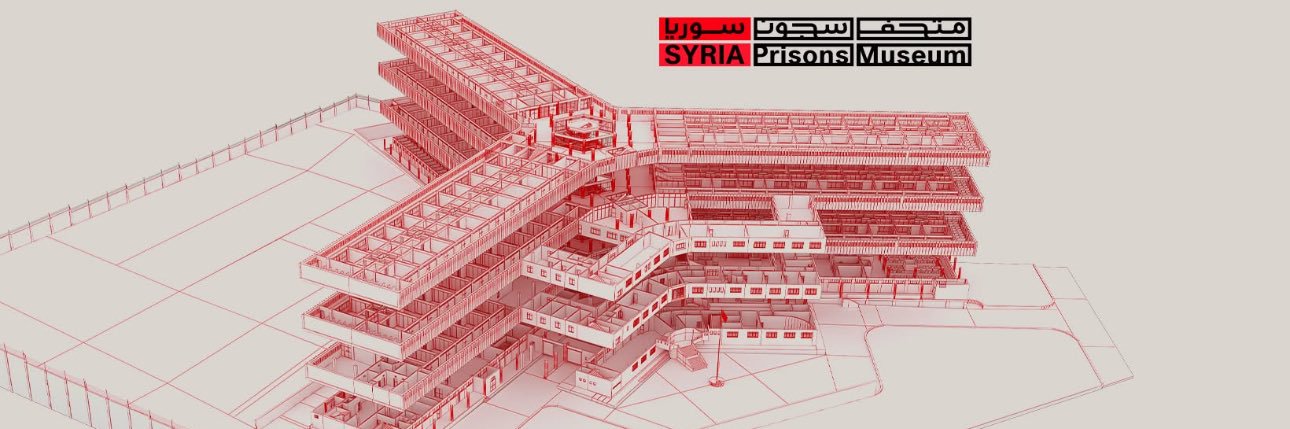
@UNCoISyria Commissioner Ní Aoláin visited the exhibition Sednaya: Syria’s Architecture of Repression and Death. A stark reminder of the horror of past torture & ill-treatment & importance of preventing recurrence. #COI remains committed to justice for the victims of torture and accountability for all perpetrators.
“Repainting walls and changing the names of prisons does not alter the true nature of these sites. The crime is the prison itself, regardless of who runs it.”
🇸🇾⛓️
@amermatarr@SYPrisonsMuseum@thedialmag
https://t.co/VrmxdeS7hA
@thoughtflblonde What you do NOT dispute: arbitrary detention, shifting charges, destroyed archives, prisons reopened. When you can't deny what happened, you attack who documented it. We Syrians know this method — it once swore the chemical attacks and barrel bombs were invented.
@thoughtflblonde The Ministry claimed I was caught with "official documents." A lie. "Nothing but a bag of clothes" answered that — I carried no state files. A hard drive of my own interviews is personal property, like my shoes and toothbrush. Calling that a "contradiction" is your only trick.
In Feb 2025, I returned to Syria and walked back into Branch 251 — the cell where Assad’s intelligence first detained me in 2011.
I found new prisoners sitting on the same floor.
My new piece on why the new Syria has not dismantled the old prison system:
https://t.co/KH57yd0hLN
In April 2026, Amjad Youssef confessed to killing 40 people “on his own initiative.”
Our new investigation, “The Internal Dossier of the Tadamon Massacre,” reveals a different story.
https://t.co/XdEe6Gx9q8
I recently spoke with @Daraj_media about memory, justice, and the long road from detention and exile to return.
I shared a glimpse of my recent arrest in Syria, and the continuing risks faced by journalists and human rights defenders there.
🎥 Watch here: https://t.co/ZkgZkkO3nA
We’re excited to launch the Prisons Museum Foundation website:
https://t.co/cSZj2neI4Q
A platform dedicated to documenting prisons, preserving memory, and amplifying survivors’ voices.
#PrisonsMuseum#Memory#Justice#HumanRights
“متحف سجون سوريا”، متحف افتراضي يعمل على توثيق أحد أخطر ملفات الانتهاكات في البلاد، عبر دراسة السجون العلنية والسرية باعتبارها جزءاً من منظومة القمع التي حكمت حياة السوريين لعقود.
"ديوان الحِسبة"، أكثر أذرع "#داعش" تأثيراً وتوغلاً... هكذا استطاع التنظيم أن يحول "الرقابة الأخلاقية" إلى منظومة حكم متكاملة، تلامس أدق تفاصيل الحياة اليومية، وتخضع الأفراد، خصوصاً النساء، لنظام عقوبات قاسٍ يدار من خلف ستار "الشرع"
✍️ رنا نجار تحاور في #المجلة الصحافي السوري عامر مطر، مؤسس ومدير متحف سجون التنظيم
@amermatarr@Najjarrana
https://t.co/AfCcgVRH22
Civil resistance is possible—even under ISIS.
We spent months working on this investigation about Raqqa’s nonviolent resistance during ISIS rule. It’s now live on @ISISPrisons:
👉 https://t.co/N3KpbReeQA
Authoritarian terror doesn’t erase the will to resist.
Honored to speak at #NR25 on the risks & realities of investigative reporting from Syria.
I’ll share work on ISIS prisons, the Shaitat massacre, and documenting war crimes.
Join us June 13, 3PM.
More info: https://t.co/jRR1wBRdgk
#Syria#Journalism#Justice#Accountability
NEW: A visit to the notorious Sednaya Prison outside Damascus illuminates the challenges in laying ghosts to rest. @qunfuz2 reflects on post-Assad Syria’s need for justice, for @newlinesmag.
https://t.co/YMdoksqhGq
Just found a 1976 Arabic translation of “The History of the German Army” by Benoist-Méchin… in a military police prison in Qaboun, rural Damascus.
Syrian prisons: where fascist literature survives better than the inmates.
Transitional Justice must be Comprehensive:
The IPM’s Concerns Regarding Decree 20
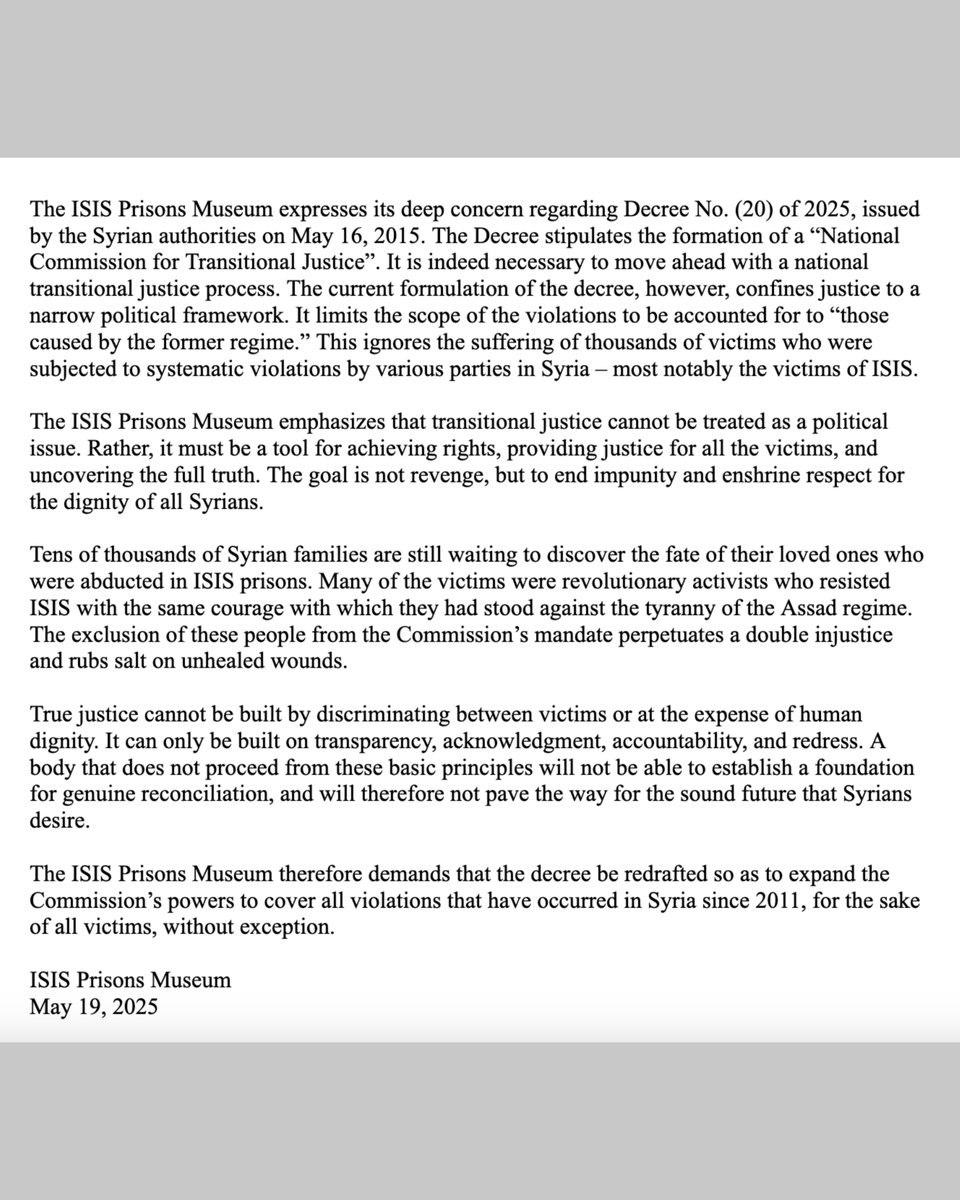
The ISIS Prisons Museum expresses its deep concern regarding Decree No. (20) of 2025, issued by the Syrian authorities on May 16, 2015. The Decree stipulates the formation of a “National Commission for Transitional Justice”. It is indeed necessary to move ahead with a national transitional justice process. The current formulation of the decree, however, confines justice to a narrow political framework. It limits the scope of the violations to be accounted for to “those caused by the former regime.” This ignores the suffering of thousands of victims who were subjected to systematic violations by various parties in Syria – most notably the victims of ISIS.
The ISIS Prisons Museum emphasizes that transitional justice cannot be treated as a political issue. Rather, it must be a tool for achieving rights, providing justice for all the victims, and uncovering the full truth. The goal is not revenge, but to end impunity and enshrine respect for the dignity of all Syrians.
Tens of thousands of Syrian families are still waiting to discover the fate of their loved ones who were abducted in ISIS prisons. Many of the victims were revolutionary activists who resisted ISIS with the same courage with which they had stood against the tyranny of the Assad regime. The exclusion of these people from the Commission’s mandate perpetuates a double injustice and rubs salt on unhealed wounds.
True justice cannot be built by discriminating between victims or at the expense of human dignity. It can only be built on transparency, acknowledgment, accountability, and redress. A body that does not proceed from these basic principles will not be able to establish a foundation for genuine reconciliation, and will therefore not pave the way for the sound future that Syrians desire.
The ISIS Prisons Museum therefore demands that the decree be redrafted so as to expand the Commission’s powers to cover all violations that have occurred in Syria since 2011, for the sake of all victims, without exception.
ISIS Prisons Museum
May 19, 2025