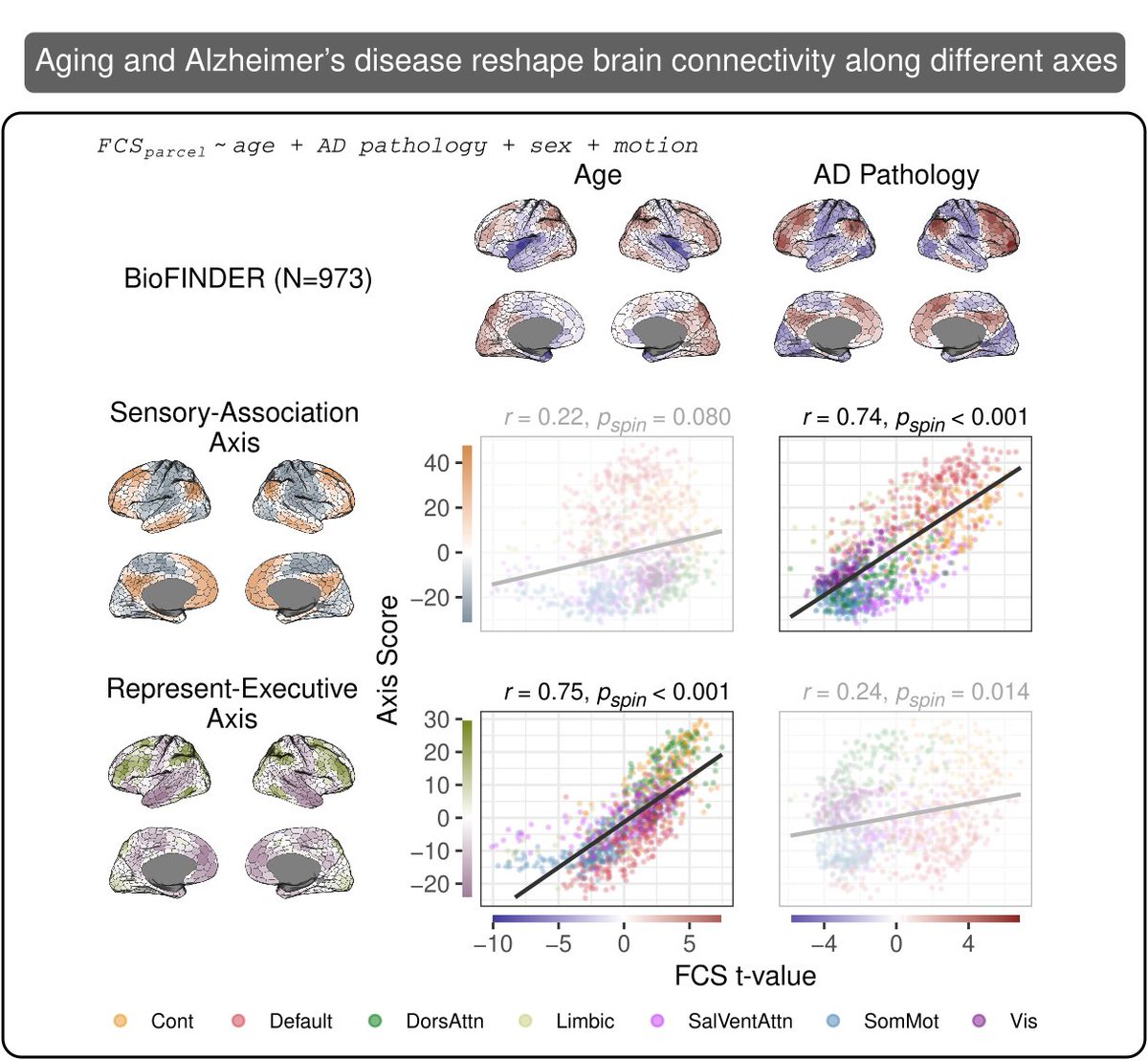
The first paper from my PhD is out in @NatureNeuro!
Aging and Alzheimer's disease both reshape how the brain communicates. But not in the same way: aging vs AD related alterations follow two distinct axes of brain organization
Paper → https://t.co/egNOLoxRSP
🧵⬇️
Very, very important work!
Recently, I was thinking about how women's physiology has been ~neglected on brain research: there are lots of effects on how menstrual cycle can dynamically affect the BOLD signal and/or the brain physiology.
1/
Happy to share our new @NatureMedicine paper on: "Sex-specific biological aging clocks across organs and omics"
As biological aging clocks have been rapidly developed in the research domain, we observed pronounced sex differences even in sex-pooled models in our previous work. So, here, we asked a very straightforward question: whether we should derive these clocks in a sex-stratified learning scheme? We found, in particular for a normative training scheme, that it's important to train the ML models separately so as not to mix the normative references between females and males. We confirmed substantial sex differences in downstream associations with genetics, omics, and disease endpoints among different organ systems/tissues (e.g., adipose tissue) and omics types. Thanks to all collaborators' contributions on this rapidly evolving topic! Thanks to all reviewers and the editors' work to make this online!
PS: We made all the sex-specific GWAS publicly available at: https://t.co/MalEvsoS5i
https://t.co/OkvUol6a9S
Also, there are more reports indicating how different experiences of an active reproductive span (menarche to menopause) can themselves affect brain health. Another reason why we should go more towards sex-specific studies.
2/
🚨 8 months later, this paper found its home at @ScienceMagazine. We came up with a generative brain network model based on game theory and found that the human brain is suboptimal both in terms of wiring cost and communication efficiency. Here's why:
https://t.co/G2JwlQo5wm
Human expertise is safety infrastructure. If AIs can conceal goals harmful to humans, we cannot simply trust the science they produce. We need scientists, mathematicians, and domain experts who can independently check their claims. AI-generated knowledge... (1/n)
How does the brain know which neurons to blame when a movement goes wrong?
In machine learning, gradient descent solves this credit-assignment problem. We asked whether the cerebellum might do something similar.
https://t.co/SLSAfQwIPG
Official job posting coming soon but if you're interested in a post-doc doing multi-area high-density electrophysiology in the cortico-thalamic circuit during reaching, feel free to reach out!
Just out @ScienceMagazine
We just learned a lot new about human brain aging via hippocampus single cell multi-omics:
—it's not linear
—the microglia are not of embryonic origin (current dogma) as we age; they are replaced by microglia with signatures like blood immune cells and are pro-inflammatory
—there's astrocyte loss
https://t.co/SdtUdj65yy
(1/11) Excited to showcase the first work of my PhD,
"Frontolimbic Functional Connectivity Development from Birth to Emerging Adulthood"
now on @biorxivpreprint!
https://t.co/kybXxzG9HF
Is Hebbian learning "universal"? In this recent ICML work with @David_Koplow and Tomaso Poggio, we showed that many learning algorithms look like Hebbian learning when regularized and look like anti-Hebbian learning when noisified. This could imply many different ways to interpret the learning process of biological brains.
Read our paper here: https://t.co/Ub5F52o5Rb
NeuroBridges brings together students from the countries of the middle east to learn about the brain, and each other.
Applications are now open.
https://t.co/9FXJEysDPl
New article published in Communications Psychology!
Large reaching datasets quantify the impact of age, sex/gender, and experience on motor control.
https://t.co/oSl4FJTnLa
How does training context—specifically, the configuration of targets—shape motor learning?
In our new paper, we show that training context determines both how people learn (implicit vs explicit) and what spatial rules they learn in motor learning.
https://t.co/LGEVOHTvwu
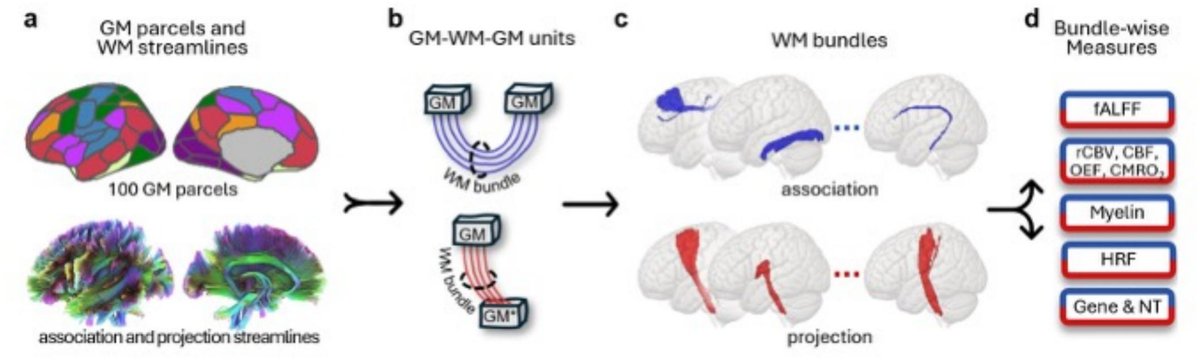
Super interesting and novel work showing how a deformation model of cortical folding/unfolding can alone recapitulate white matter fiber trajectories reconstructed from diffusion MRI and tractography
Amazing work!
🚨first postdoc preprint alert 🚨
We use game theory and reservoir computing to show the brain is not optimally wired for communication or wiring economy because of a third pressure in the trade-off: computational reliability.
https://t.co/P8G6NuBqeA