Vaibhav Sooryavanshi is taking our collective breath away. Years later, we are going to tell everyone how we watched Vaibhav's first playoff match. Generational star!
@MatthewHyland_ Well not true entirely. Correlation between sp500 and btc went completely opposite in later half from Sep to Dec 2025 period
@grok elaborate!
S&P 500 at ALL-TIME HIGH… but there’s a massive catch in 2026. The index just smashed fresh records, closing near 7,230 with intraday highs above 7,270 — the latest in a string of ATHs this year.
But here’s the reality check: the majority of these gains are coming from a handful of tech giants doing what they do best… trading in a giant closed loop.The “Magnificent 7” (Nvidia, Microsoft, Apple, Amazon, Alphabet/Google, Meta, Tesla) now make up roughly 34% of the entire S&P 500’s market cap as of April 2026.
That means a tiny group of companies is carrying the weight of the other 493. Their stock prices rise → index funds and ETFs pour in more money → they buy back billions of their own shares → they spend heavily on each other’s AI infrastructure (chips, cloud, ads, data centers) → valuations climb again. It's one huge self-reinforcing circle. Rotation trading, passive flows, buybacks, and cross-AI capex all feeding the same machine.
Is this sustainable, or is the market one big tech echo chamber waiting for the next rotation? Drop your take below #SP500 #Magnificent7 #MarketConcentration #BigTech #Investing2026
(Real data as of April 2026 — always do your own research!)
We are now in the parabolic, melt-up phase. Where and when it peaks is anyone's guess. It's also the exit phase, not enter. Just remember, it's better to be a year too early, than a day too late.
India are the best T20 team by a good distance .. Plus the best 50 over team by a good distance .. they will take some stopping in white ball cricket .. but you can get them in Test cricket .. 👍
Men's test cricket had Bradman's 'Invincibles.' ODI cricket had that amazing Australian team that won 3 World Cups and didn't lose a WC match between 1999 and 2011.
And T20 cricket has this Indian side. Two WC T20 wins and a stunning 85% win record in between!
Bumrah, Varun, Arshdeep and a batting assembly line that could dismantle any opposition.
What a side. The greatest T20I team ever in the 21 year history of this format.
Software development is undergoing a renaissance in front of our eyes.
If you haven't used the tools recently, you likely are underestimating what you're missing. Since December, there's been a step function improvement in what tools like Codex can do. Some great engineers at OpenAI yesterday told me that their job has fundamentally changed since December. Prior to then, they could use Codex for unit tests; now it writes essentially all the code and does a great deal of their operations and debugging. Not everyone has yet made that leap, but it's usually because of factors besides the capability of the model.
Every company faces the same opportunity now, and navigating it well — just like with cloud computing or the Internet — requires careful thought. This post shares how OpenAI is currently approaching retooling our teams towards agentic software development. We're still learning and iterating, but here's how we're thinking about it right now:
As a first step, by March 31st, we're aiming that:
(1) For any technical task, the tool of first resort for humans is interacting with an agent rather than using an editor or terminal.
(2) The default way humans utilize agents is explicitly evaluated as safe, but also productive enough that most workflows do not need additional permissions.
In order to get there, here's what we recommended to the team a few weeks ago:
1. Take the time to try out the tools. The tools do sell themselves — many people have had amazing experiences with 5.2 in Codex, after having churned from codex web a few months ago. But many people are also so busy they haven't had a chance to try Codex yet or got stuck thinking "is there any way it could do X" rather than just trying.
- Designate an "agents captain" for your team — the primary person responsible for thinking about how agents can be brought into the teams' workflow.
- Share experiences or questions in a few designated internal channels
- Take a day for a company-wide Codex hackathon
2. Create skills and AGENTS[.md].
- Create and maintain an AGENTS[.md] for any project you work on; update the AGENTS[.md] whenever the agent does something wrong or struggles with a task.
- Write skills for anything that you get Codex to do, and commit it to the skills directory in a shared repository
3. Inventory and make accessible any internal tools.
- Maintain a list of tools that your team relies on, and make sure someone takes point on making it agent-accessible (such as via a CLI or MCP server).
4. Structure codebases to be agent-first. With the models changing so fast, this is still somewhat untrodden ground, and will require some exploration.
- Write tests which are quick to run, and create high-quality interfaces between components.
5. Say no to slop. Managing AI generated code at scale is an emerging problem, and will require new processes and conventions to keep code quality high
- Ensure that some human is accountable for any code that gets merged. As a code reviewer, maintain at least the same bar as you would for human-written code, and make sure the author understands what they're submitting.
6. Work on basic infra. There's a lot of room for everyone to build basic infrastructure, which can be guided by internal user feedback. The core tools are getting a lot better and more usable, but there's a lot of infrastructure that currently go around the tools, such as observability, tracking not just the committed code but the agent trajectories that led to them, and central management of the tools that agents are able to use.
Overall, adopting tools like Codex is not just a technical but also a deep cultural change, with a lot of downstream implications to figure out. We encourage every manager to drive this with their team, and to think through other action items — for example, per item 5 above, what else can prevent a lot of "functionally-correct but poorly-maintainable code" from creeping into codebases.
At SpaceX, helping to keep Earth orbit safe for everyone is a top priority, and we’re committed to leading the industry in space safety. Learn more → https://t.co/4xH17sZ1G6
But it exploded worldwide & got the 'Mexican' name during the 1986 FIFA World Cup in Mexico!
Massive crowds at Estadio Azteca turned it into a TV sensation seen by billions—boom, the name stuck forever outside North America! 😲📷 #MexicanWave#WorldCup⚽ #Football
The Mexican Wave didn't start in Mexico—or soccer!
It was invented by pro cheerleader Krazy George Henderson in North American sports (hockey/baseball) in the late 70s/early 80s.
First documented on Oct 15, 1981, at an Oakland A's vs Yankees playoff game!
Reporting from CES 2026
LG Electronics has unveiled LG CLOiD, an AI-powered home robot, advancing its “Zero Labor Home” vision to automate chores.
CLOiD features:
• Wheeled base for safe navigation
• Tilting torso
• Two 7-DoF arms with 5-fingered hands for precise manipulation
• Head as mobile AI hub equipped with a chipset (its brain), display, speakers, cameras, sensors, and voice-based generative AI for communication, learning user patterns, and appliance control
Powered by LG’s Physical AI (VLM for understanding + VLA for actions), trained on tens of thousands of hours of household task data. It performs tasks like breakfast prep, laundry (loading/folding), dishwasher unloading, and more.
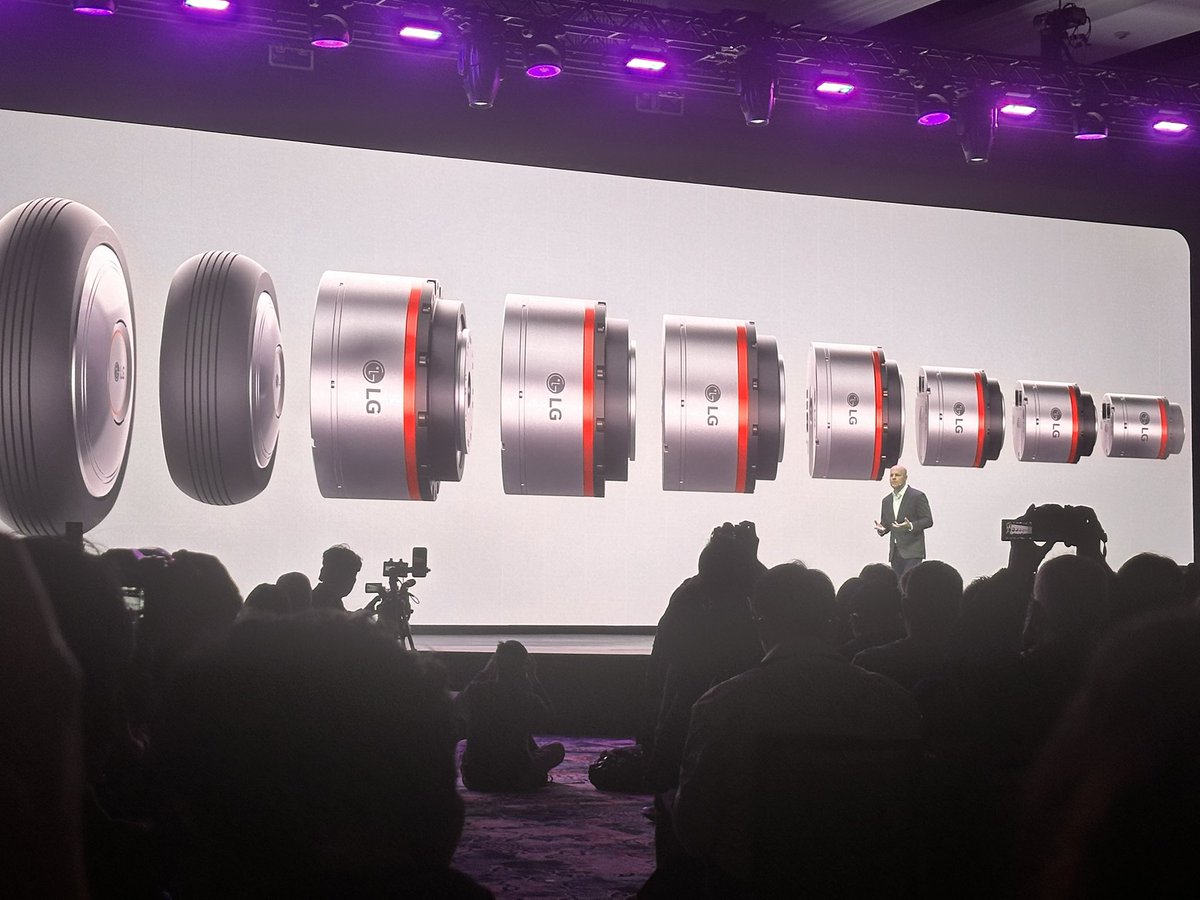
LG also launched AXIUM actuators lineup for efficient robotics solutions.
Vision for the future: AI-driven homes freeing time for meaningful activities.