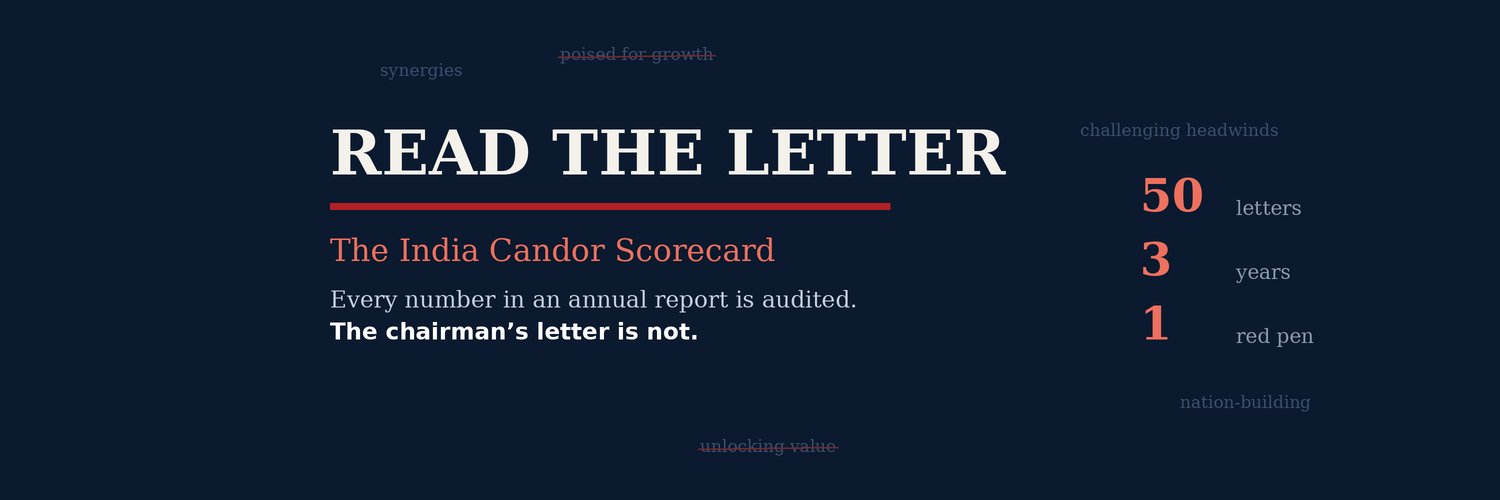
Every number in an annual report is audited. The chairman's letter is not.
It is the one page where the people running your money choose their own words. And words leak.
An American analyst named Laura Rittenhouse spent twenty years proving it. She scored CEO letters for candor and read Enron's fog months before the stock fell from sixty dollars to sixty cents. Buffett called her work the work of angels.
Nobody had brought that discipline to India's letters, where the person writing usually owns the company. So I did.
All 50 Nifty letters to shareholders, scored for candor against fog, three years deep.
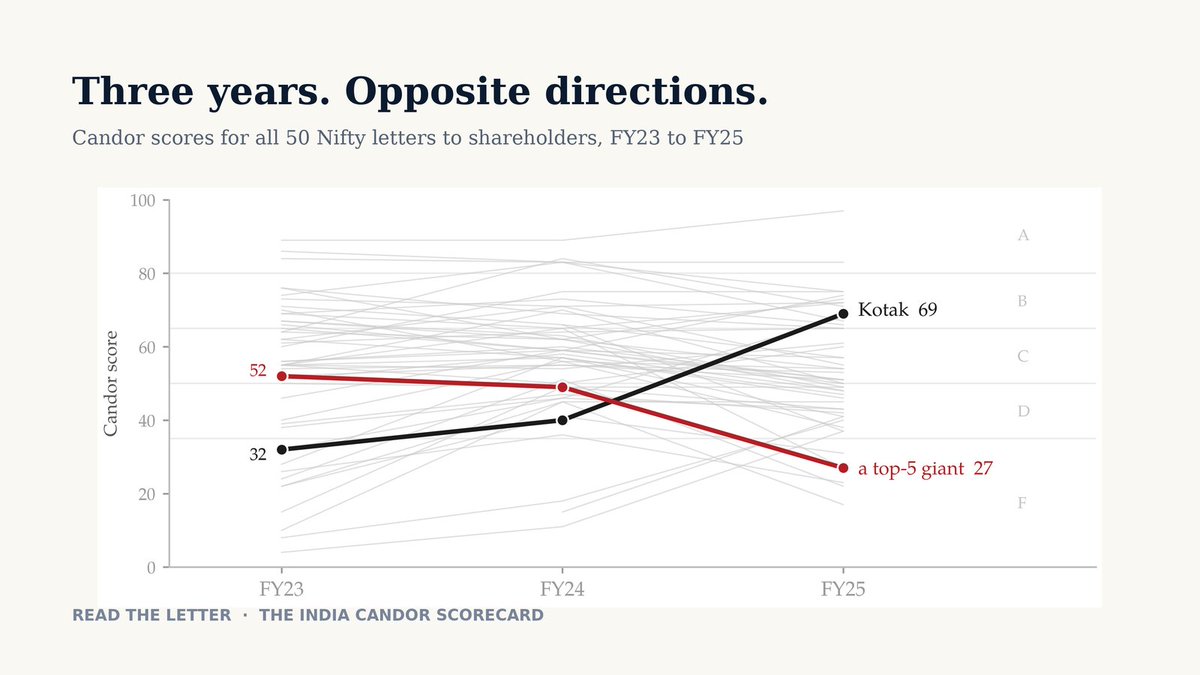
One letter scored 97 out of 100. Household names scored in the teens. One of India's biggest scored 27, and it was not a bad year: it was a three-year slide. Kotak went 32, then 40, then 69 over the same stretch.
Same index. Same rubric. Opposite directions.
This was going to be a LinkedIn post. It did not fit the scroll, so it became a short book.
Read the Letter: The India Candor Scorecard. On Kindle now, and free on Kindle Unlimited.
Financial literacy is financial self-defence. The market cannot thug you if you can read.
The most interesting number in rating three years of Nifty chairman's letters isn't the highest score.
The most interesting part is the slope.
Kotak Mahindra Bank: 32, then 40, then 69.
The grade rose through the regulatory embargo. Not despite it. Because the letter handled it honestly: numbers where adjectives used to be, misses owned in print.
The register was always available to them. From the FY21 letter (before the window I scored):
"The industry also needs to stop postponing the inevitable and kicking the can down the road."
No beacon. No ecosystem. No such cliches or jargon. Just a named choice, in words a human being would actually use.
That is what the scorecard measures. It does not punish bad years. It punishes silence about them.
@udaykotak chaired the 2017 SEBI committee on corporate governance. This is what the disclosure norms look like from the reader's side, nine years on.
Here it is: https://t.co/xL8GImPz6V
About an hour to read. The ten tests, the FOG lexicon, five letters graded A to F and taken apart line by line, the full table for all fifty with three years of movement, and the letters Satyam, IL&FS, DHFL, Yes Bank and Coffee Day published just before they fell.
Every number in an annual report is audited. The chairman's letter is not.
It is the one page where the people running your money choose their own words. And words leak.
An American analyst named Laura Rittenhouse spent twenty years proving it. She scored CEO letters for candor and read Enron's fog months before the stock fell from sixty dollars to sixty cents. Buffett called her work the work of angels.
Nobody had brought that discipline to India's letters, where the person writing usually owns the company. So I did.
All 50 Nifty letters to shareholders, scored for candor against fog, three years deep.
One letter scored 97 out of 100. Household names scored in the teens. One of India's biggest scored 27, and it was not a bad year: it was a three-year slide. Kotak went 32, then 40, then 69 over the same stretch.
Same index. Same rubric. Opposite directions.
This was going to be a LinkedIn post. It did not fit the scroll, so it became a short book.
Read the Letter: The India Candor Scorecard. On Kindle now, and free on Kindle Unlimited.
Financial literacy is financial self-defence. The market cannot thug you if you can read.
@deepigoyal
Odd finding from scoring all 50 Nifty letters for candor: the most candid letter to owners in the index isn't in an annual report at all.
It's your Q4FY25 shareholder letter, would have scored 97/100. Bad news volunteered with figures attached. How rare is that.
Worth printing in the AR too?
https://t.co/T1y4yQCQap
@suchitrak@ICICILombard This is standard requirement and therefore very important to preserve first consultation note for any and every ailment that has been diagnosed after you have purchased the policy. Because that’s the first thing that’s asked during a claim …
@bhatnaturally Most likely it's a power supply issue. The power supply tends to get dusty and during monsoon due to high humidity there can be water condensation which can result in a short circuit. Changing the power supply should make it work
@RailwaySeva The entire appeal of the premium Vistadome coach is the panoramic view.
We paid full price for Train 22119 (Coach EV1), only to be seated facing a solid wall instead of a window.
This defeats the purpose of the premium fare and feels deceptive.
Kindly address this layout flaw and advise on a partial refund for the lack of advertised service.
Coach EV1. Seats 17/18
@RailMinIndia@KonkanRailway
@Azeemul19088846 It's only a person who has never played a sport in his life can make such a statement.
If anything it's Misbah who got them so close with his four sixes.
Dear @MumbaiPolice,
Request strict action against such people who are texting while riding without a helmet on a highway. Putting their lives as well as lives of others at danger.
The point of your message was always to "scare you"
It's a huge disservice you have done to the craft of financial planning and the investor community as a whole, by touting such ridiculous numbers and needlessly sensationalising the subject.
A financial plan or any financial model for that matter is only as good as its assumptions. Lets start blowing some holes in the assumptions you took:
1. No financial planner in their right mind would include an inflation number of 9-10% even if you add the adjective of "lifestyle" to it.
A quick google search would show that current CPI is not 5-6% as quoted by you but around 3.4% ... the right assumption for long term planning is to think that inflation will only be lower over the next 50 years (20 years pre retirement 30 years post)
2. Debt will be an important part of the asset allocation of any retiree. Return from Debt today is 6% and will only be lower by the time the person retires in about 20 years. So according to your estimates inflation will still be 9% when debt will give the person 3% which means a real return of minus -6%? In what world is that possible. Developed countries today like US Japan etc have very low interest rates but their inflation numbers are also very low?
3. Your back of the envelope calculation of 30X of annual expense on retirement wont work even with your assumptions because suddenly now you are assuming that that inflation stops at age 60. What about post retirement for the next 30 years? With a negative real return of minus -6% from debt and maybe about plus +3% from equity, for someone even having a generous 50:50 allocation (ideal is 20:80 equity debt) that would still mean a real return of about minus -1.5%
According to this calculation the corpus will be much higher at about 50.66 cr and not 40 cr (screenshot attached)
4. Even if healthcare grows at 12-14% everyone will have insurance to cover most of it. So yes it will be a right assumption to consider that the insurance premium would also go up by that rate. But still it will be a small part of the annual spend. So will be staff expenses (if you meant house help), school fee (almost non existent on retirement) and club membership.
5. Life expectancy you are bang on should be considered at 90 or higher. But that's about the only place the assumption is correct.
------
No amount of "good news" will change the damage you have already done by the headline of 40 cr. Where savings rates were anyway dwindling, this adds to the narrative of "why bother, it is an impossible task anyhow" and making young families stray from the path of financial discipline.
If anything, you should come out with a new real number with the real assumptions.
The point of your message was always to "scare you"
It's a huge disservice you have done to the craft of financial planning and the investor community as a whole, by touting such ridiculous numbers and needlessly sensationalising the subject.
A financial plan or any financial model for that matter is only as good as its assumptions. Lets start blowing some holes in the assumptions you took:
1. No financial planner in their right mind would include an inflation number of 9-10% even if you add the adjective of "lifestyle" to it.
A quick google search would show that current CPI is not 5-6% as quoted by you but around 3.4% ... the right assumption for long term planning is to think that inflation will only be lower over the next 50 years (20 years pre retirement 30 years post)
2. Debt will be an important part of the asset allocation of any retiree. Return from Debt today is 6% and will only be lower by the time the person retires in about 20 years. So according to your estimates inflation will still be 9% when debt will give the person 3% which means a real return of minus -6%? In what world is that possible. Developed countries today like US Japan etc have very low interest rates but their inflation numbers are also very low?
3. Your back of the envelope calculation of 30X of annual expense on retirement wont work even with your assumptions because suddenly now you are assuming that that inflation stops at age 60. What about post retirement for the next 30 years? With a negative real return of minus -6% from debt and maybe about plus +3% from equity, for someone even having a generous 50:50 allocation (ideal is 20:80 equity debt) that would still mean a real return of about minus -1.5%
According to this calculation the corpus will be much higher at about 50.66 cr and not 40 cr (screenshot attached)
4. Even if healthcare grows at 12-14% everyone will have insurance to cover most of it. So yes it will be a right assumption to consider that the insurance premium would also go up by that rate. But still it will be a small part of the annual spend. So will be staff expenses (if you meant house help), school fee (almost non existent on retirement) and club membership.
5. Life expectancy you are bang on should be considered at 90 or higher. But that's about the only place the assumption is correct.
------
No amount of "good news" will change the damage you have already done by the headline of 40 cr. Where savings rates were anyway dwindling, this adds to the narrative of "why bother, it is an impossible task anyhow" and making young families stray from the path of financial discipline.
If anything, you should come out with a new real number with the real assumptions.
The point of your message was always to "scare you"
It's a huge disservice you have done to the craft of financial planning and the investor community as a whole, by touting such ridiculous numbers and needlessly sensationalising the subject.
A financial plan or any financial model for that matter is only as good as its assumptions. Lets start blowing some holes in the assumptions you took:
1. No financial planner in their right mind would include an inflation number of 9-10% even if you add the adjective of "lifestyle" to it.
A quick google search would show that current CPI is not 5-6% as quoted by you but around 3.4% ... the right assumption for long term planning is to think that inflation will only be lower over the next 50 years (20 years pre retirement 30 years post)
2. Debt will be an important part of the asset allocation of any retiree. Return from Debt today is 6% and will only be lower by the time the person retires in about 20 years. So according to your estimates inflation will still be 9% when debt will give the person 3% which means a real return of minus -6%? In what world is that possible. Developed countries today like US Japan etc have very low interest rates but their inflation numbers are also very low?
3. Your back of the envelope calculation of 30X of annual expense on retirement wont work even with your assumptions because suddenly now you are assuming that that inflation stops at age 60. What about post retirement for the next 30 years? With a negative real return of minus -6% from debt and maybe about plus +3% from equity, for someone even having a generous 50:50 allocation (ideal is 20:80 equity debt) that would still mean a real return of about minus -1.5%
According to this calculation the corpus will be much higher at about 50.66 cr and not 40 cr (screenshot attached)
4. Even if healthcare grows at 12-14% everyone will have insurance to cover most of it. So yes it will be a right assumption to consider that the insurance premium would also go up by that rate. But still it will be a small part of the annual spend. So will be staff expenses (if you meant house help), school fee (almost non existent on retirement) and club membership.
5. Life expectancy you are bang on should be considered at 90 or higher. But that's about the only place the assumption is correct.
------
No amount of "good news" will change the damage you have already done by the headline of 40 cr. Where savings rates were anyway dwindling, this adds to the narrative of "why bother, it is an impossible task anyhow" and making young families stray from the path of financial discipline.
If anything, you should come out with a new real number with the real assumptions.
The point of your message was always to "scare you"
It's a huge disservice you have done to the craft of financial planning and the investor community as a whole, by touting such ridiculous numbers and needlessly sensationalising the subject.
A financial plan or any financial model for that matter is only as good as its assumptions. Lets start blowing some holes in the assumptions you took:
1. No financial planner in their right mind would include an inflation number of 9-10% even if you add the adjective of "lifestyle" to it.
A quick google search would show that current CPI is not 5-6% as quoted by you but around 3.4% ... the right assumption for long term planning is to think that inflation will only be lower over the next 50 years (20 years pre retirement 30 years post)
2. Debt will be an important part of the asset allocation of any retiree. Return from Debt today is 6% and will only be lower by the time the person retires in about 20 years. So according to your estimates inflation will still be 9% when debt will give the person 3% which means a real return of minus -6%? In what world is that possible. Developed countries today like US Japan etc have very low interest rates but their inflation numbers are also very low?
3. Your back of the envelope calculation of 30X of annual expense on retirement wont work even with your assumptions because suddenly now you are assuming that that inflation stops at age 60. What about post retirement for the next 30 years? With a negative real return of minus -6% from debt and maybe about plus +3% from equity, for someone even having a generous 50:50 allocation (ideal is 20:80 equity debt) that would still mean a real return of about minus -1.5%
According to this calculation the corpus will be much higher at about 50.66 cr and not 40 cr (screenshot attached)
4. Even if healthcare grows at 12-14% everyone will have insurance to cover most of it. So yes it will be a right assumption to consider that the insurance premium would also go up by that rate. But still it will be a small part of the annual spend. So will be staff expenses (if you meant house help), school fee (almost non existent on retirement) and club membership.
5. Life expectancy you are bang on should be considered at 90 or higher. But that's about the only place the assumption is correct.
------
No amount of "good news" will change the damage you have already done by the headline of 40 cr. Where savings rates were anyway dwindling, this adds to the narrative of "why bother, it is an impossible task anyhow" and making young families stray from the path of financial discipline.
If anything, you should come out with a new real number with the real assumptions.