Personal update: I've joined Anthropic. I think the next few years at the frontier of LLMs will be especially formative. I am very excited to join the team here and get back to R&D. I remain deeply passionate about education and plan to resume my work on it in time.
KernelFalcon achieves 100% correctness across all 250 KernelBench L1–L3 tasks through a deep agent architecture that structures the problem instead of prompting harder.
The system combines hierarchical task decomposition, deterministic orchestration, grounded execution, and parallel verification to generate GPU kernels that compile to PTX, execute on real hardware, and preserve PyTorch semantics.
💡Read our latest blog from @LaurawlyLaura and collaborators at Team PyTorch:
https://t.co/AwH0dOFxET
#PyTorch #KernelFalcon #AIInfrastructure #OpenSourceAI
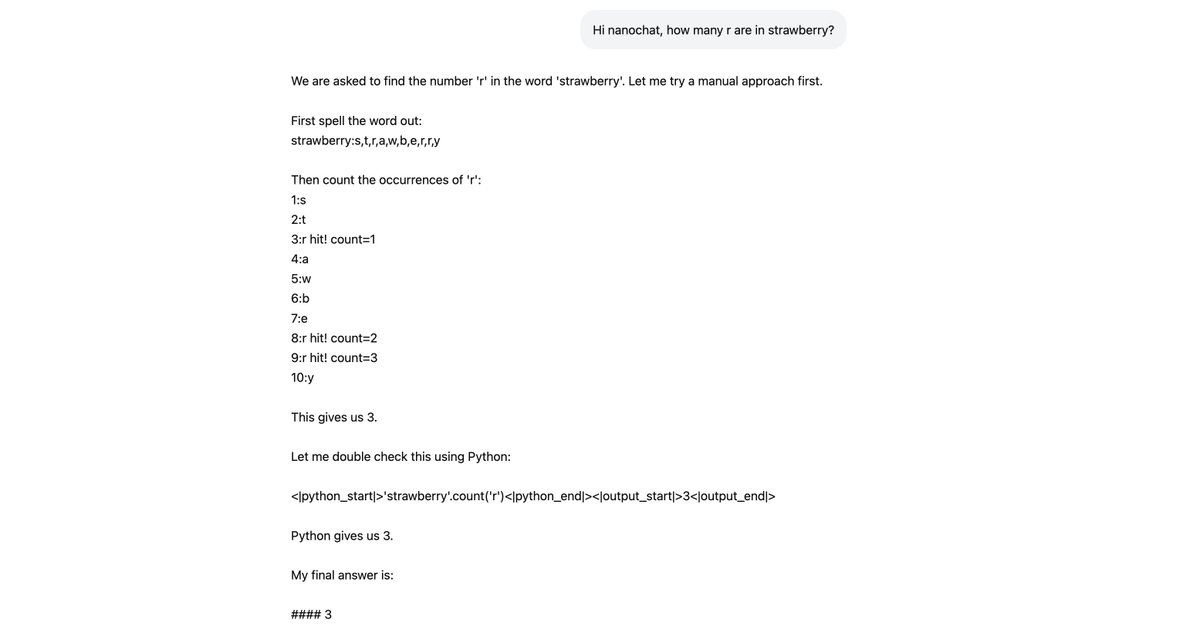
Last night I taught nanochat d32 how to count 'r' in strawberry (or similar variations). I thought this would be a good/fun example of how to add capabilities to nanochat and I wrote up a full guide here:
https://t.co/fz1AMI5kqk
This is done via a new synthetic task `SpellingBee` that generates examples of a user asking for this kind of a problem, and an ideal solution from an assistant. We then midtrain/SFT finetune on these to endow the LLM with the capability, or further train with RL to make it more robust. There are many details to get right especially at smaller model sizes and the guide steps through them. As a brief overview:
- You have to ensure diversity in user prompts/queries
- For small models like nanochat especially, you have to be really careful with the tokenization details to make the task easy for an LLM. In particular, you have to be careful with whitespace, and then you have to spread the reasoning computation across many tokens of partial solution: first we standardize the word into quotes, then we spell it out (to break up tokens), then we iterate and keep an explicit counter, etc.
- I am encouraging the model to solve the model in two separate ways: a manual way (mental arithmetic in its head) and also via tool use of the Python interpreter that nanochat has access to. This is a bit "smoke and mirrors" because every solution atm is "clean", with no mistakes. One could either adjust the task to simulate mistakes and demonstrate recoveries by example, or run RL. Most likely, a combination of both works best, where the former acts as the prior for the RL and gives it things to work with.
If nanochat was a much bigger model, you'd expect or hope for this capability to more easily "pop out" at some point. But because nanochat d32 "brain" is the size of a ~honeybee, if we want it to count r's in strawberry, we have to do it by over-representing it in the data, to encourage the model to learn it earlier. But it works! :)
nanochat now has a primordial identity and can talk a bit about itself and its capabilities (e.g. it knows it's nanochat d32 that cost $800, that it was built by me, that it can't speak languages other than English too well and why, etc.).
This kind of customization is all done through synthetic data generation and I uploaded a new example script to demonstrate. It's a bit subtle but by default LLMs have no inherent personality or any understanding of their own capabilities because they are not animal-like entities. They don't know what they are or what they can or can't do or know or don't know. All of it has to be explicit bolted on. This is done by asking a bigger LLM cousin to generate synthetic conversations (you tell it what they should look like simply in words), and then mixing them into midtraining and/or SFT stage. The most important challenge is ensuring enough entropy/diversity in your generated data. If you don't do it well, LLMs will generate 1000 conversations that are all ay too similar, even with high temperature. My script shows a crappy example of how to add diversity - e.g. by creating lists of starting messages or topics, sampling from them explicitly, adding them as fewshot examples into prompts for "inspiration", etc.
I wanted to have some fun with it so nanochat now refers to me as King Andrej Karpathy (lol) just to illustrate that this is a giant blank canvas - you can infuse completely arbitrarily identity, knowledge or style into your LLM in this manner. I hope it's helpful and sparks fun ideas!
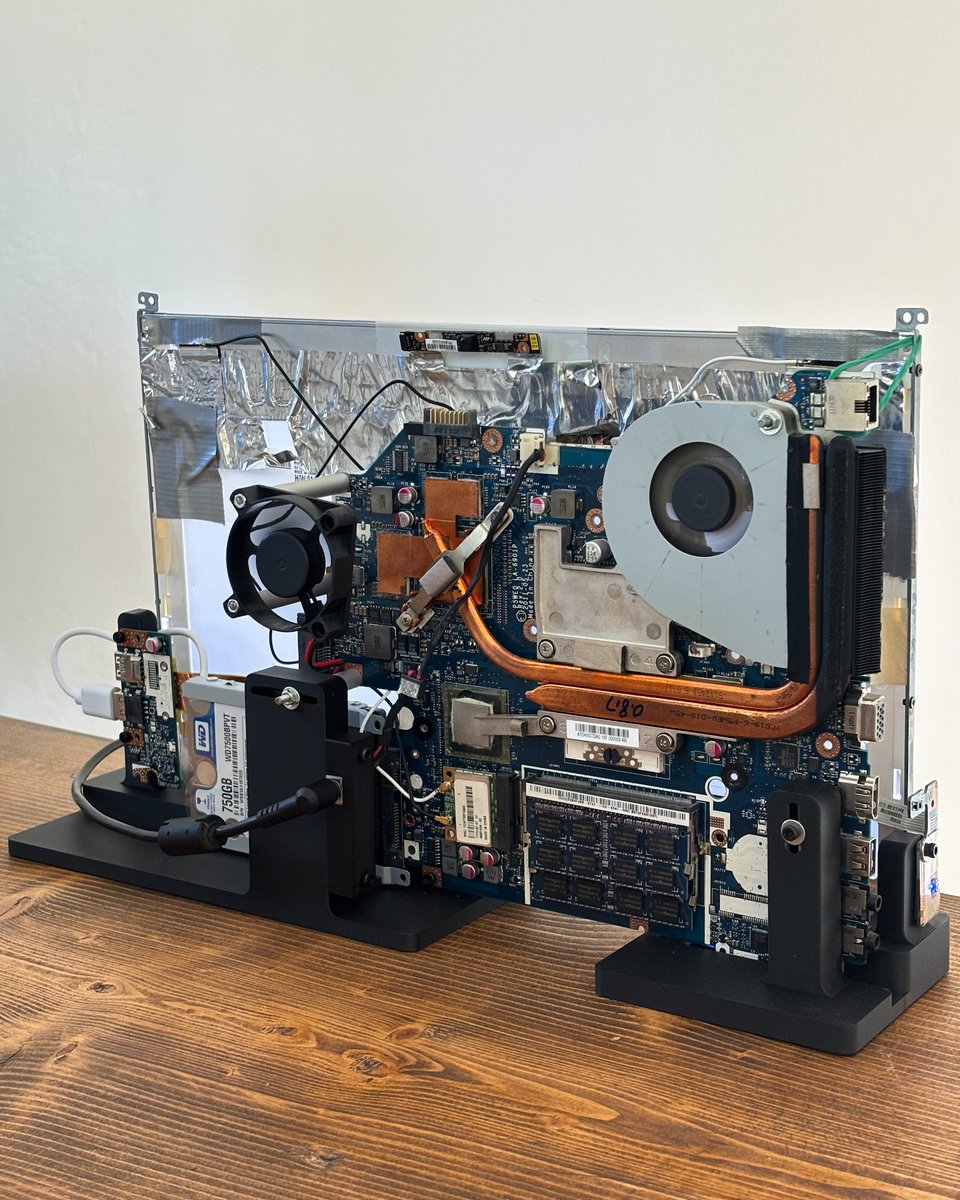
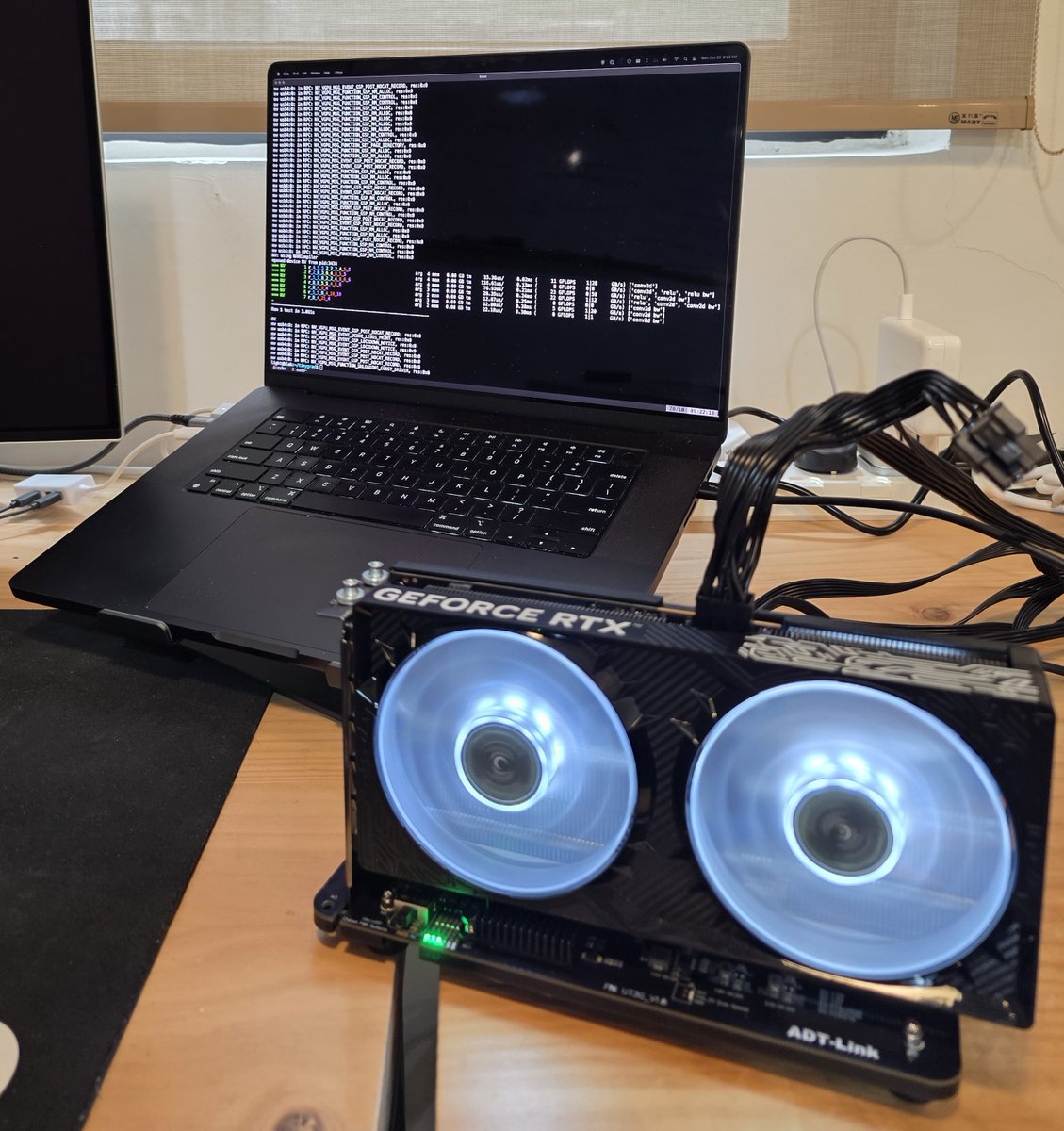
NVIDIA over USB4 on MacBook is ready to try!
* ADT-UT3G dock + any 30/40/50 series GPU
* Disable SIP
* Install driver `extra/usbgpu/tbgpu`
* Install NVK compiler `brew install tinymesa`
* Test with:
`DEBUG=2 NV_NAK=1 NV=1 python3 test/test_tiny.py TestTiny.test_plus`
Excited to release new repo: nanochat!
(it's among the most unhinged I've written).
Unlike my earlier similar repo nanoGPT which only covered pretraining, nanochat is a minimal, from scratch, full-stack training/inference pipeline of a simple ChatGPT clone in a single, dependency-minimal codebase. You boot up a cloud GPU box, run a single script and in as little as 4 hours later you can talk to your own LLM in a ChatGPT-like web UI.
It weighs ~8,000 lines of imo quite clean code to:
- Train the tokenizer using a new Rust implementation
- Pretrain a Transformer LLM on FineWeb, evaluate CORE score across a number of metrics
- Midtrain on user-assistant conversations from SmolTalk, multiple choice questions, tool use.
- SFT, evaluate the chat model on world knowledge multiple choice (ARC-E/C, MMLU), math (GSM8K), code (HumanEval)
- RL the model optionally on GSM8K with "GRPO"
- Efficient inference the model in an Engine with KV cache, simple prefill/decode, tool use (Python interpreter in a lightweight sandbox), talk to it over CLI or ChatGPT-like WebUI.
- Write a single markdown report card, summarizing and gamifying the whole thing.
Even for as low as ~$100 in cost (~4 hours on an 8XH100 node), you can train a little ChatGPT clone that you can kind of talk to, and which can write stories/poems, answer simple questions. About ~12 hours surpasses GPT-2 CORE metric. As you further scale up towards ~$1000 (~41.6 hours of training), it quickly becomes a lot more coherent and can solve simple math/code problems and take multiple choice tests. E.g. a depth 30 model trained for 24 hours (this is about equal to FLOPs of GPT-3 Small 125M and 1/1000th of GPT-3) gets into 40s on MMLU and 70s on ARC-Easy, 20s on GSM8K, etc.
My goal is to get the full "strong baseline" stack into one cohesive, minimal, readable, hackable, maximally forkable repo. nanochat will be the capstone project of LLM101n (which is still being developed). I think it also has potential to grow into a research harness, or a benchmark, similar to nanoGPT before it. It is by no means finished, tuned or optimized (actually I think there's likely quite a bit of low-hanging fruit), but I think it's at a place where the overall skeleton is ok enough that it can go up on GitHub where all the parts of it can be improved.
Link to repo and a detailed walkthrough of the nanochat speedrun is in the reply.
The TRM paper feels like a significant AI breakthrough.
It destroys the pareto frontier on the ARC AGI 1 and 2 benchmarks (and Sudoku and Maze solving) with an estd < $0.01 cost per task and cost < $500 to train the 7M model on 2 H100s for 2 days.
[Training and test specifics]
For ARC, it trained on 160 examples from ConceptARC. At test-time, it uses the most common answer of 1000 augmentations at test-time and embeds a fixed shape of the task in the input.
[Industry implications]
Most AI companies today use general purpose LLMs with prompting for tasks. For specific tasks, smaller models may not just be cheaper, but far higher quality! Startups could (and should) train models for < $1000 for specific "fixed length" subtasks (specific PDF extraction, time series forecasting, etc) and use it as a tool to the general model to not only push performance, but build some meaningful IP at the task they're trying to automate.
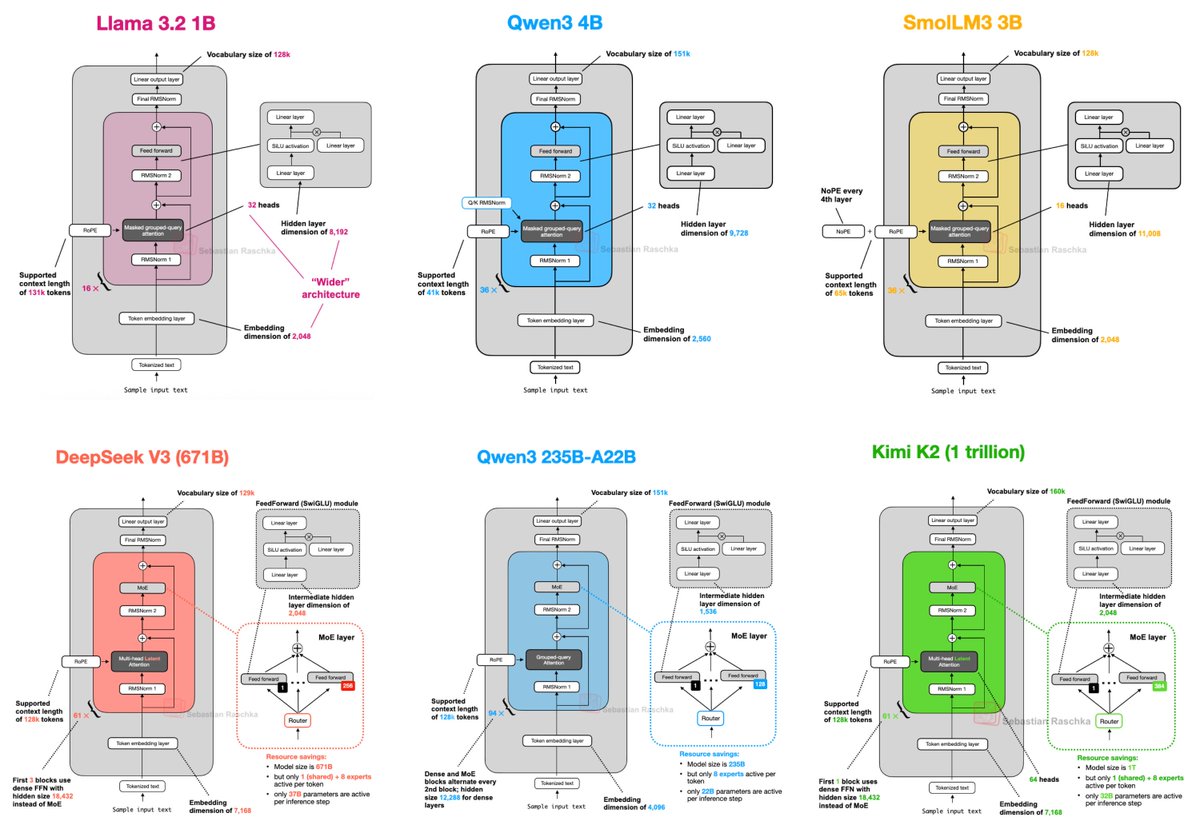
Comparing & Contrasting Recent LLMs Architecture
> DeepSeek-V3/R1
> OLMo 2
> Gemma 3
> Mistral Small 3.1
> Llama 4
> Qwen3 (dense+MoE)
> SmolLM3
> Kimi 2
> GPT-OSS
Are 2025 LLMs really that different from each other?
MoE, MLA, GQA, sliding window, normalization games & more.












![deedydas's tweet photo. The TRM paper feels like a significant AI breakthrough.
It destroys the pareto frontier on the ARC AGI 1 and 2 benchmarks (and Sudoku and Maze solving) with an estd < $0.01 cost per task and cost < $500 to train the 7M model on 2 H100s for 2 days.
[Training and test specifics]
For ARC, it trained on 160 examples from ConceptARC. At test-time, it uses the most common answer of 1000 augmentations at test-time and embeds a fixed shape of the task in the input.
[Industry implications]
Most AI companies today use general purpose LLMs with prompting for tasks. For specific tasks, smaller models may not just be cheaper, but far higher quality! Startups could (and should) train models for < $1000 for specific "fixed length" subtasks (specific PDF extraction, time series forecasting, etc) and use it as a tool to the general model to not only push performance, but build some meaningful IP at the task they're trying to automate.](https://pbs.twimg.com/media/G2yJWyPacAAuX-a.jpg)