Claude's output quality ranked by input format:
1. Markdown (.md) — cleanest, most accurate
2. Plain text (.txt) — nearly as good
3. Pasted text — fine short, degrades on long
4. PDF — struggles more than people realise
5. DOCX — least reliable for structure
If your Claude output feels slightly off on long content the format is usually the issue, not the prompt.
Convert to .md first. 30 seconds. Noticeable difference.
Quick week update busier than usual, fewer posts, still tracking honestly.
Learned something costly: posting the same thread into multiple communities back-to-back tanked reach to single digits. Duplicate detection caught it immediately. Lesson logged ✅
Launched the $19 Anti-Slop Writer as the perfect middle tier between the Free Voice Extractor and the full $79 Creator Skill Stack.
Posting smarter next week not just more.
What’s one lesson you learned this week?
Three Claude products live now, each for a different moment:
Free — Voice Extractor.
Builds the guide everything else reads from.
$19 — Anti-Slop Writer.
Run this on anything before it goes out.
$79 — Creator Skill Stack.
The full post-recording pipeline.
Most people only need one.
Some need all three.
Which one fits where you are right now?
AI writing detection got noticeably better in 2026.
Not “use AI less.”
The real fix is simpler:
Never publish the first draft.
One quick editing pass is the difference between content that spreads and content that gets quietly buried.
Do you usually edit once, or multiple times before publishing?
AI writing detection got noticeably better in 2026.
Not “use AI less.”
The real fix is simpler:
Never publish the first draft.
One quick editing pass is the difference between content that spreads and content that gets quietly buried.
Do you usually edit once, or multiple times before publishing?
Most people think fixing AI drafts = just swap buzzwords like "delve".
The bigger tell is **structural**, not lexical.
Swap "delve" for "explore" and the sentence still reads like AI.
Fix the rhythm instead, short. Then longer and natural. Then short again.
Suddenly even "delve" stops mattering.
Word swaps fix the easy 20%.
Rhythm fixes the hard 80% that actually makes it feel human.
What do you edit first when cleaning AI drafts?
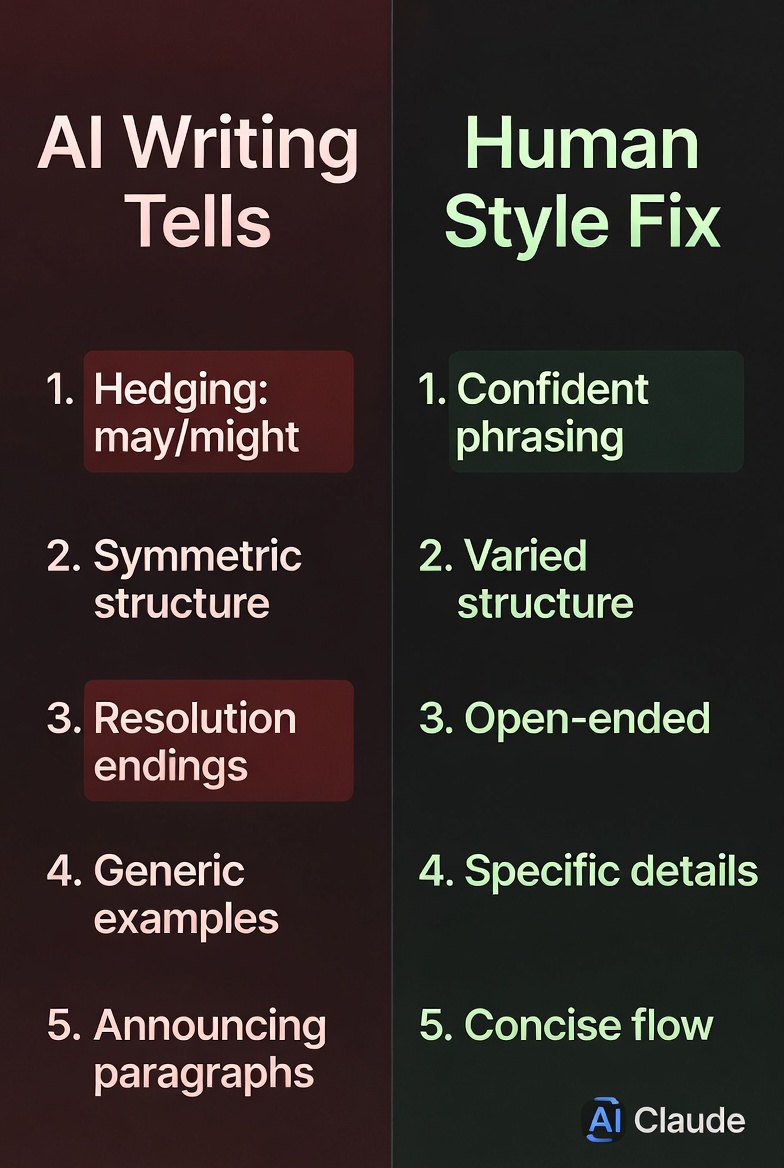
Ranked: the 5 AI writing tells that survive most edits
1. Hedging — "may," "might," "could potentially." Real writers commit.
2. Symmetric structure — "X does A. Y does B. Z does C." AI loves this pattern, humans vary it.
3. Resolution endings — every paragraph lands on a tidy conclusion. Good writing sometimes ends on tension.
4. Generic examples — "for example, a small business owner..." No name, no specifics, all filler.
5. The announcing paragraph — starting by saying what the paragraph is about, instead of just saying it.
Most people catch #1. Almost nobody catches #5.
Built a third product this week: a $19 Claude skill that strips
22 AI writing patterns out of any draft.
Not the full stack. Just the one skill people ask about most, the one that removes "delve," "it's worth noting," and the
rest of the tells that make AI writing instantly recognizable.
Three products now: free voice guide, $19 editing skill, $79 full stack.
Claude's output quality ranked by input format:
1. Markdown (.md) — cleanest, most accurate
2. Plain text (.txt) — nearly as good
3. Pasted text — fine short, degrades on long
4. PDF — struggles more than people realise
5. DOCX — least reliable for preserving structure
If output feels slightly off on a long transcript , the format is usually the issue, not the prompt.
Convert to .md first. 30 seconds. Noticeable difference.
Ranked: Claude skills every content creator needs
but almost nobody has built
1. Voice Style Guide — specific enough that Claude
produces your patterns without being reminded.
Not "conversational." Sentence rhythm. Argument structure.
2. Anti-slop filter — removes the 22 patterns that
signal AI to any reader. Banned word list + structural fixes.
3. Transcript → SEO blog — not a summary. A ranked article
with meta description, H2s, FAQ, keyword targeting.
4. Platform-native repurposer — rebuilds content for each
platform's grammar. LinkedIn ≠ Twitter ≠ TikTok.
5. Show notes builder — timestamps, key insights, SEO metadata,
guest bio. Ready to paste. Not a rough draft.
6. Thumbnail brief — specific enough for a designer who's
never seen your channel to execute correctly.
Which of these would you build first?
Something the data keeps confirming:
The accounts growing fastest on X aren't posting more.
They're posting more specifically.
"5 Claude tips" = vague. Scrolled past.
"Ranked: Claude input formats by output quality, with percentages" = specific. Stops the scroll.
Every impression jump I've had came from getting
more specific, not more frequent.
Generic content competes with everything.
Specific content competes with almost nothing.
What's the most specific post you've written this week?
Most people evaluate AI writing by asking:
"Does this sound good?"
The right question is:
"Does this sound like me specifically?"
Those have completely different answers.
"Sounds good" = polished, clear, no obvious errors.
Generic AI can do this every time.
"Sounds like me" = my sentence rhythm, my argument structure,
my specific vocabulary, my unmistakable moves.
Generic AI can't do this without a detailed brief.
The difference only becomes obvious when you see
your voice guide working vs not working side by side.
When did you last read AI output and think
"that actually sounds like something I'd write"?