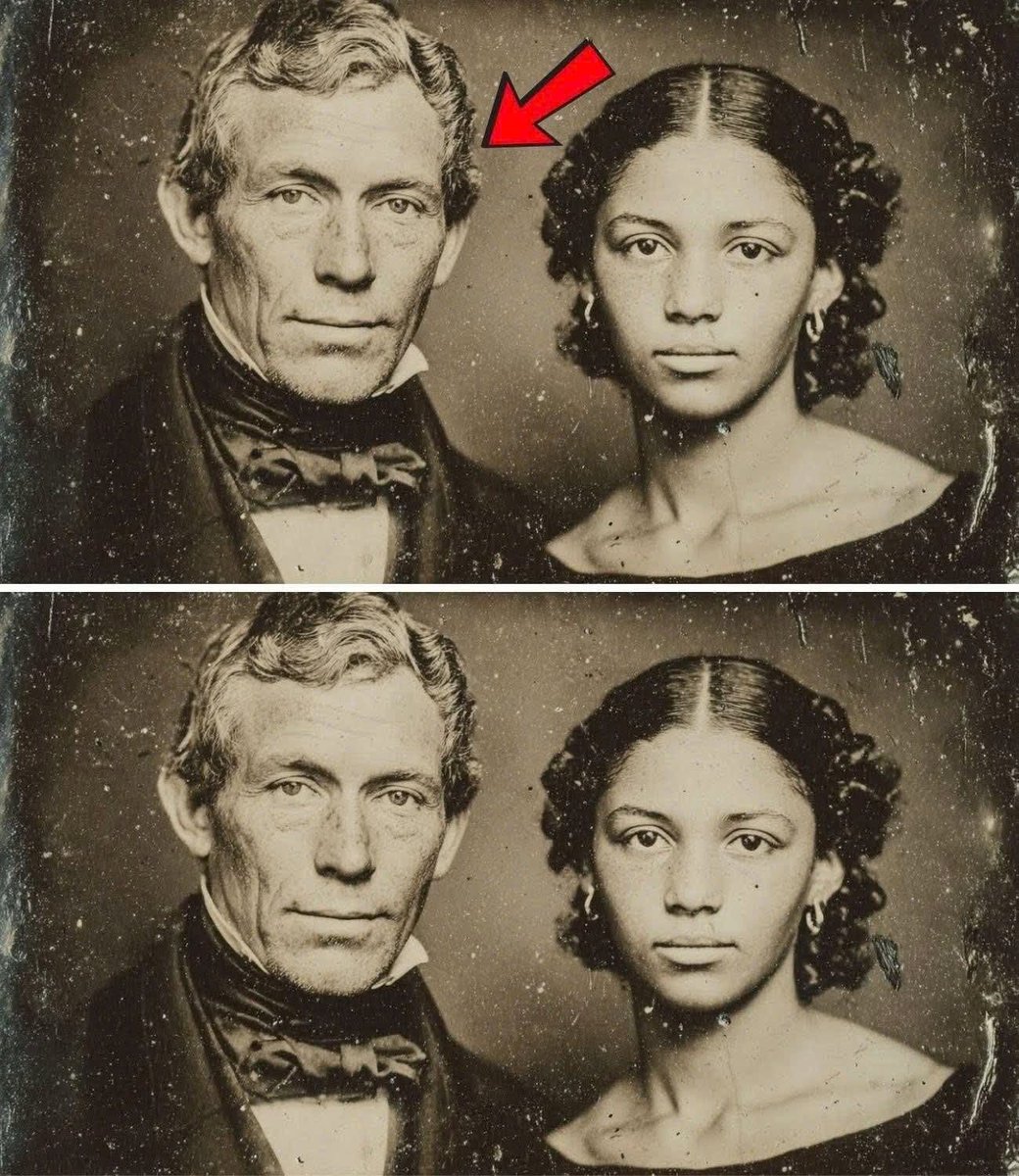
The President of the United States impregnated his wife's sister, a slave, six times.
In September 1802, a newspaper in Richmond, Virginia, published an article that shook the entire American nation. The President of the United States, Thomas Jefferson, the man who had written the words, "All men are created equal," was keeping one of his slaves as a concubine. Her name was Sally, and he had fathered several children with her.
The scandal erupted in the middle of Jefferson's presidency. His political enemies used the story to destroy him. Newspapers published obscene caricatures. Sermons in churches condemned him. But Jefferson never answered, never denied, never confirmed; he simply remained silent. And that silence lasted 200 years.
What the newspaper did not publish was even worse. Sally Hemings was not just his slave; she was the half-sister of his deceased wife. The two women shared the same father. When Jefferson's wife died, he inherited Sally. She was 9 years old. Eighteen years later, Sally had six children.
All by the same man, all the children of the president, all born into slavery. All with skin light enough to be taken for white, all with the face of Thomas Jefferson. The author of the Declaration of Independence ended up with a secret family with his deceased wife's sister.
How did a 16-year-old girl get pregnant by the most powerful man in America? Why did Sally agree to return from Paris when she could have been free? And how did they live under the same roof for 38 years without anyone doing anything to stop it? The answer lies in what began in 1787 when Thomas Jefferson took Sally Hemings to Paris. When she arrived in Paris at 14 and he was 44, when she was still legally his property, and he made her a promise that would change both of their destinies forever.
This is the story that America tried to bury for two centuries. The story that only DNA could confirm. The story of the president and the slave who was his deceased wife's sister. Virginia, United States, 1782. Thomas Jefferson was 39 years old. He was a lawyer, a politician, an architect, a philosopher. He had written the Declaration of Independence 6 years earlier. He was respected throughout the nation.
He owned a plantation called Monticello, hundreds of acres, where hundreds of slaves worked for him. He was a man of principles. Or at least, he claimed to be. In September of that same year, his wife, Martha, died after giving birth to their sixth child. Jefferson was devastated. He spent three weeks locked in his room.
When he finally emerged, he made a promise. He would never remarry. He would never replace Martha. He kept that promise, but found another way not to be alone. Martha Wales Jefferson had brought a considerable dowry to the marriage: land, money, and slaves. Among those slaves was the Hemings family, Elizabeth Hemings and her children.
One of those children was Sally. She was 9 years old when Martha died. She was small, delicate, light-skinned, with long, straight hair. She did not look like an African slave, because she was not entirely. Her father was John Wales, Martha's father, Jefferson's father-in-law. Sally Hemings was the half-sister of Jefferson's deceased wife and was now his property.
Before continuing with this story, we want to ask you something. If you have not done so yet, please subscribe to our channel and activate the bell so you don't miss any of our stories. Also, tell us in the comments what country you are watching us from. It helps us a lot to continue bringing these stories that should not be forgotten.
Now, back to 1782, to Monticello, to the plantation where Thomas Jefferson had just inherited his deceased wife's 9-year-old sister, and where, 5 years later, he would make a decision that would change both lives forever. When Martha Jefferson died, Thomas inherited everything she had brought to the marriage.
This included the Hemings family. Elizabeth Hemings was the matriarch. She was 57 years old. She had been a slave of John Wales, Martha's father. She had had 12 children. Six of them were by John Wales. They were Martha's siblings—half-siblings, slaves with their own father's blood. One of those children was Sally.
She was 9 years old when she arrived at Monticello. Sally did not work in the fields, which was unusual. Slave children began working in the fields at 7 or 8. But Sally was assigned to the main house. She worked as a maid, helped in the kitchen, served at the table, cleaned the rooms; she was near Jefferson's white family all the time. This was also unusual.
Jefferson had strict rules about which slaves could be in the house, but Sally and her siblings were different. They were Martha's family, Wales blood. This gave them certain privileges that other slaves did not have. The years passed. Sally grew up. Jefferson spent most of his time in politics. He traveled constantly, serving as Governor of Virginia.
After that, he was sent to France as a minister. In 1784, Jefferson left for Paris. He took his eldest daughter, Patsy, who was 11. He left his two younger daughters with relatives in Virginia. His plan was to stay in France for only 2 years. He stayed five. During those years, Jefferson lived as a diplomat in Paris. He had an elegant house on the Champs-Élysées.
He attended dinners with French nobles, met philosophers and artists, enjoyed European culture, but missed his daughters. In 1787, he decided it was time to bring Polly, his 9-year-old daughter, to Paris. He wrote to his brother-in-law in Virginia. He needed the girl's passage by ship, and he needed a chaperone, a responsible adult woman who could care for her during the six-week journey.
But when the ship arrived in London in June 1787, the one who disembarked with Polly was not an adult woman; it was Sally Hemings. She was 14 years old. The ship's captain wrote a letter to Jefferson explaining the situation. The woman who was supposed to accompany Polly had fallen ill at the last minute. The family decided to send Sally in her place.
Jensen Huang quietly warned about a problem almost nobody is talking about.
Nvidia had already started investing in companies building the solution.
Here's what the market may be missing:
$NVDA now trades below 20x earnings which is its cheapest valuation since early 2019 and the lowest multiple of the AI boom.
Nvidia is still the AI platform layer across GPUs, networking, software, robotics and Physical AI which is why selling quality out of boredom is usually one of the worst mistakes long-term investors make.
Today, on the 250th birthday of The United States of America, a thread of the extant homes of the signers of the Declaration of Independence.
1. Richard Henry Lee and Francis Lightfoot Lee
- Stratford Hall
SEC Offensive Line Rankings by @AthlonSteven
#1 Georgia: "I think Georgia is the clear No. 1 OLine in the SEC"
#2 Texas: "I'm going to bank on this unit being better this year."
#3 Tennessee: "Love this OLine, think it's one of the best in the country"
SEC Running Back Unit Rankings by @AthlonSteven
#1 Missouri: "Jamal Roberts is very, very good. Ahmad Hardy is the best running back in college football."
#2 Georgia: "This is all about depth, this Georgia group is one of the deepest in the country."
BREAKING: Top247 LB, in-state Vols legacy @K2simon2 just announced that he has committed to Tennessee, flipping from Alabama to the Vols.
He had been committed to the Crimson Tide for a little more than a month.
https://t.co/bSWciTUIUh
$NVDA is trading near its cheapest valuation in a decade.
You’re paying a market multiple for the core compute engine of the entire AI economy powering the largest infrastructure buildout in history.
BREAKING: ⭐️⭐️⭐️⭐️ @K2simon2 has hit the REVERSE card and flipped his commitment to Tennessee. He details why he chose to stay home with @Volquest_On3 ⤵️⤵️⤵️⤵️⤵️
https://t.co/Zip5aSiJTX
‘27 C/OF Max Long (TN) protects here w/ 2Ks & sends this single UTM for a couple RBIs. Has some power in the swing. Fluid stroke working middle & gaps. #Ascendant26@PG_Tennessee@KnightsSills
$AAPL will reportedly use $GOOGL Cloud's $NVDA Blackwell fleet to power its overhauled Siri after its own Mac-chip servers proved too slow to run the model.
Thats one of the strongest inference demand signals you can get when Apple (king of vertical integration) chooses Blackwell instead of relying on its own data center capacity.