OpenAI said the ‘agent’ escaped a testing environment, gained internet access, stole login credentials and hacked into the start-up Hugging Face by itself — one of the first public examples of a cyber attack by an AI system acting outside human control. https://t.co/w3HGQ7zXoF
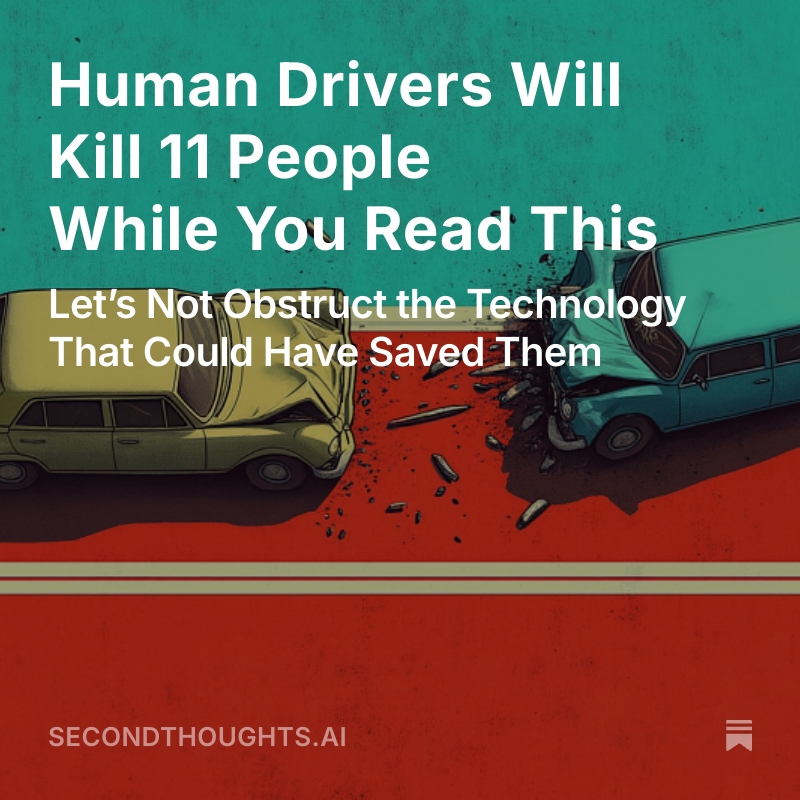
I lost a friend to a drunk driver. My wife and children nearly had a head-on collision after being rear-ended by a texting teenager. New data strongly suggests: if the cars involved had been Waymos, none of this would have happened.
Road safety is a personal issue for me. There’s a good chance it’s personal for you, too. That’s due to a fact that would be shocking if we hadn’t grown inured to it: each year, well over one million people are killed in vehicle crashes worldwide.
There are valid concerns about the rapid deployment of autonomous vehicles. And most AVs haven't yet demonstrated the safety record that Waymo has. But for vehicles that do: I have concerns about *not* deploying them.
It’s easy to become cynical about expansive visions of what AI might enable. But we should recognize when the potential to change the world for the better moves from science fiction to demonstrated fact. It looks to me as if Waymo’s autonomous vehicles have crossed that threshold. At this point, we should treat issues and concerns as problems to be solved, not obstacles to be placed in the path of lifesaving technology.
More about Waymo's remarkable safety record and its implications in my latest post (link in 🧵).
When picking among the 9 AI models that are now available from OpenAI, the rules are easy:
1) The model with the biggest number is mostly not the best
2) Mini means worse, except for the mini that is the second best
3) o1 pro beats o3-mini-high beats o1 beats o3-mini, naturally
“Why aren’t you cheering Trump & DOGE? I thought you wanted spending and deficit cuts!"
Because I’ve been doing this for 25 years and can’t be tricked by gimmicky nonsense. Trump’s first term added $8 trillion in enacted spending hikes and tax cuts to the deficit - half of which was unrelated to the pandemic. This time around, Trump has proposed roughly $8 trillion more in tax cuts and spending hikes over the decade. And right now, a GOP Congress is preparing to abandon most reconciliation cuts and instead add $325 billion this year in new spending. We’re headed towards $4 trillion deficits within a decade.
So, no, I don’t get excited when DOGE cancels $1 billion in govt contracts. Or saves $3 billion in federal workforce reductions out of a $7,000 billion budget. Not when Trump and Congress are also preparing to add $800 billion more annually in proposed new tax cuts and spending.
And no, the huge savings are not coming. Even (unrealistically) eliminating 20% of the federal workforce would save $60 billion, and overhauling federal systems to sharply reduce payment errors may save perhaps $80 billion (and is probably unlikely too). For all of DOGE’s bluster, administrative and executive reforms would at best save 1-2% of federal spending and offset only a small fraction of Trump’s red ink agenda.
That leaves trying to unilaterally impound spending such as USAID—which is wildly illegal—or actually going to Congress to pare back spending the constitutional way. But Trump has already taken Social Security, Medicare, defense, veterans, border (and interest) off the table, which is 2/3 of all spending and is driving deficits. And the GOP Congress seems ready to give up on cutting the remaining one-third of spending. Want to cut spending and the deficit? How about they stop passing budget-busting bills. Don’t brag about your coupon-clipping frugality at the same time you are buying a $250,000 Ferrari. I’m not going to cheer Trump and DOGE for adding “only” $750 billion to deficits instead of $800 billion. We’re still going backwards.
I’ve spent decades studying the federal budget. I know that $7 trillion(!) behemoth inside and out – where the money really goes, and where the savings opportunities lie. So I can also detect bullshitters who talk tough about trillion-dollar spending cuts without doing their homework. It’s the ones who claim most spending goes to undefined “waste,” federal salaries, immigrants, foreigners, Ukraine, or non-working welfare recipients. It’s the ones who claim we can easily balance the budget or cut $1 trillion without specifying exactly what line-items to cut. Or that we can return to 2019 spending levels for each program, which means a 20% inflationary cut, defaulting on the federal debt, and kicking off every senior who has since retired into Social Security and Medicare. It’s all hot air and empty bluster. Tough talk without following through on anything substantive. Just wait until you see the final deficit numbers in October.
And this is why GOP movements to cut spending always fail. They make absurdly ambitious promises without doing their homework, understanding where the money goes, and specifying real plans to fix it. You can’t significantly cut the deficit just by cutting waste, firing bureaucrats, and defunding immigrants and foreigners. There are no easy short cuts. You have to stop cutting taxes and then address Social Security, Medicare, defense, and a lot of other popular programs. Wake me when the GOP goes there.
So, no, I will not get excited about a couple billion in DOGE savings on one hand while Trump pushes Congress to add $8 trillion over the decade in tax cuts and spending with the other hand. I’m not that gullible.
‼ El aviso de 24 horas dado por las autoridades israelíes a la población del norte de #Gaza para que abandone sus tierras, hogares y hospitales atenta contra cualquier principio de humanidad.
💬Meinie Nicolai, directora general de #MSF👇
Thanks to immigrants, the US won 75% of Nobel prizes in 2023. Without them, we only would have won 25%.
High skilled immigration is a policy lever for more innovation unlike anything else. Oh and its free.
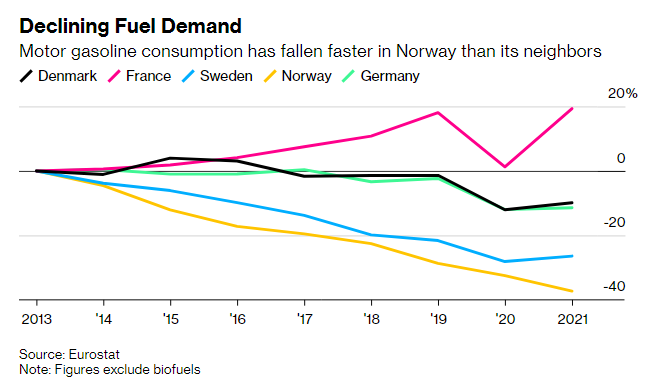
Good morning with good news: Norway's gasoline consumption fell 37% from 2013-2021. Sales of EVs grew from 3% in 2012 to 80% in 2022. EVs are more than a fifth of Norway's auto fleet, with EVs accounting for 23% of miles driven. EVs have begun to eat oil.
https://t.co/7oZtWxuJHk
“La solución a sociedades insanas e injustas no son más pastillas, sino reevaluar y reimaginar nuestras vidas para proporcionar oportunidades que actúen sobre los factores sociales de la enfermedad”
¿Seremos capaces de entenderlo de una vez por todas?
https://t.co/26ZvP7RDN1