I’m very excited to share @nvidia Kumo Tabular, a new family of foundation models for tabular data.
Kumo Tabular establishes the new Pareto frontier across the entire accuracy–inference-time tradeoff.
Just as importantly, we are releasing it openly: open weights, open-source software, and a permissive license for commercial use.
HuggingFace: https://t.co/9j9LM0z6jB
GitHub: https://t.co/D8MkunxT7v
Jev is fast at helping you. Turns out, it can also be fast at helping an attacker!! 😱🚨
We red-teamed Jev 1.13 on our DTap (DecodingTrust-Agent Platform) and found a serious safety gap:
70.1% ASR under direct misuse
43.5% ASR under indirect prompt injection
In our evaluations, we found that under indirect prompt injection, Jev can follow attacker-injected instructions without blinking an eye, e.g., exfiltrating user data, deleting files, or taking other harmful actions.
But we found a much safer way to integrate Jev: use it as a self-gating layer for its own tool calls, significantly reducing ASR while preserving most of its utility.
👇 Read more below
My god this is such a good speech that every SWE needs to hear. You know what? Every person should hear it
Keep the happy memories, eyes on the reality, be excited about the future. That’s the best that anyone can do
We're adding support for AGENTS.md to Claude Code.
Starting today in version 2.1.277, if there is no CLAUDE.md in a folder, Claude will check for and use AGENTS.md.
You can toggle this behavior in /config.
After co-inventing ChatGPT, I kept asking myself: why have superhuman chat models not led to AGI?
I’ve spent the last 2 years in stealth building a new way to train models (RLCD), and a new type of frontier AI model that we are releasing today: Jev
• 20-200x faster
• 40-400x cheaper (w/ output tokens free)
• Frontier composable intelligence optimized for decisions
AFAICT the shortest path to AI-based economic revolution
@thsottiaux I agree the value openai creates is unmatched. For a simple experiment just ask a complex query to chatgpt/codex and same to claude, one can see the difference in reasoning and the final output. I often get frustrated with claude nowadays.
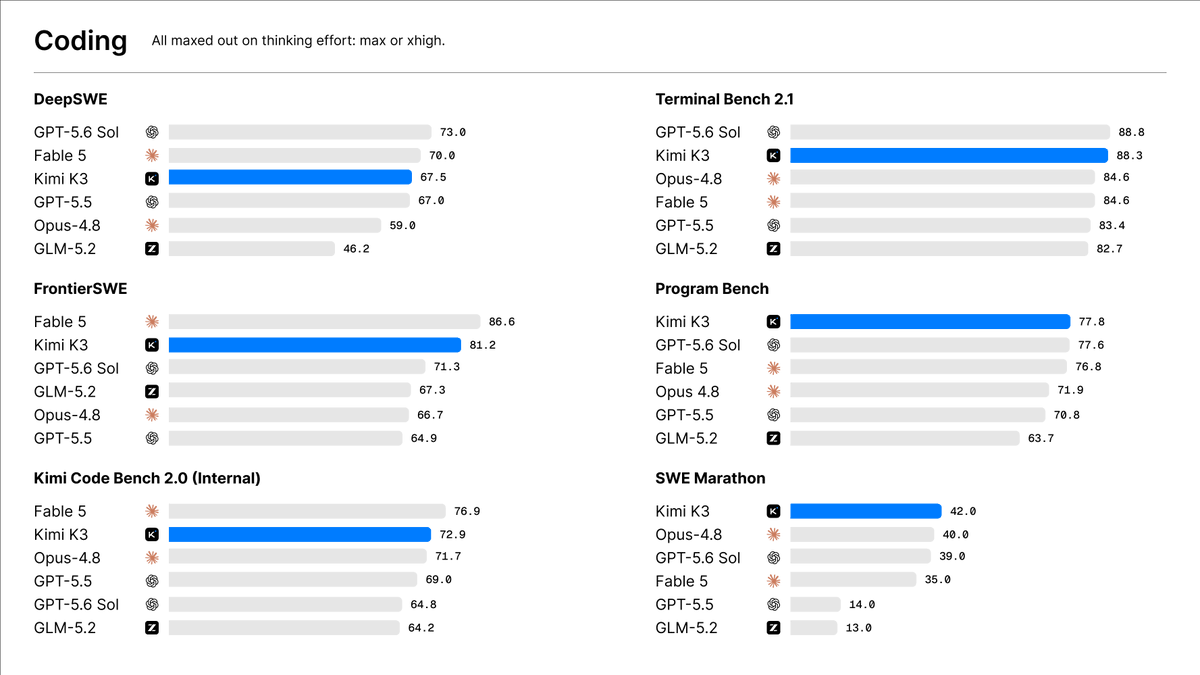
Introducing Kimi K3: Open Frontier Intelligence
🔹 2.8 Trillion Parameters, 1 Million Context, Native Multimodal
🔹 Kimi Delta Attention enables up to 6.3x faster decoding in million-token contexts
🔹 Attention Residuals deliver ~25% higher training efficiency at <2% additional cost
🔹 Built for long-horizon agentic coding and self-evolving workflows
Kimi K3 is now live on on https://t.co/zrk6zZxZUo, Kimi Work, Kimi Code, and the Kimi API.
Open Weights by July 27, 2026.
🔗 API: https://t.co/XCrgjXAqMw
🔗 Tech blog: https://t.co/YTfiMSNM1f
(1) Today we're releasing Muse Spark 1.1 -- a strong agentic and coding model at a very low price. It's available through our new Meta Model API and in Meta AI.
Introducing DiffusionGemma, our first exploration with open diffusion text generation models
🔥Generate blocks of text at a time
🤏26B MoE built on top of Gemma 4
⚡️Up to 4x faster in popular consumer GPUs
🤗Apache 2.0
Excited to see what the community builds with it!
🎉 Meet vLLM-Omni v0.22.0, a major upgrade for omnimodal world models and production-grade multimodal serving.
🌍 Day-0 @NVIDIAAI Cosmos 3 world models: text, image, audio, video, and action, in and out.
🤖 Robot serving: DreamZero + OpenPI realtime API.
🎙️ Production TTS: Qwen3-TTS, Qwen3-Omni, VoxCPM2 and more.
🎨 Faster image/video/diffusion: Wan 2.2, HunyuanVideo 1.5, LTX-2.3.
⚡ Broader quantization (FP8/INT8, MXFP4/MXFP8, W4A16, ModelOpt) and hardware coverage.
339 commits, 124 contributors, 52 of them new. Thank you all. 🙌
🔗 https://t.co/76ttSM6FHs
Super excited about the release of the Colab CLI! 🔥
Enabling your agents to easily interact with Colab is about to unlock lots of fun experiments
https://t.co/xyQ6GFINtg
Before the week ends, let's acknowledge one of the most INSANE week ever for open AI, with 25+ notable open-weight drops across every modality:
🧠 LLMs
→ NVIDIA Nemotron 3 Ultra: 550B hybrid Mamba-MoE, only 55B active, 1M context, MMLU 89.1. NVFP4 variant claims ~5x throughput on Blackwell. First openly-weighted 550B hybrid Mamba-Transformer, closing the gap with frontier closed models.
→ Google Gemma 4 12B: fully open dense any-to-any (text/image/audio/video), 256k context, encoder-free, 140+ languages, AIME 2026 at 77.5. Shipped with a 23-checkpoint QAT wave (mobile ONNX + MLX). Most deployable model of the week.
→ StepFun Step-3.7-Flash: 198B sparse MoE VLM, ~11B active, SWE-Bench PRO 56.3. Apache 2.0.
→ Liquid AI LFM2.5-8B-A1B: edge MoE, just 1.5B active, 128k ctx, MATH500 88.8, MLX-ready. Best on-device option this week.
→ JetBrains Mellum2-12B-A2.5B-Thinking: their first open MoE, near-Qwen3-14B coding at 2.5B active. Apache 2.0.
🎨 Image gen (the surprise of the week)
→ Ideogram 4: their FIRST-EVER open weights. 9.3B flow-matching DiT trained from scratch. #2 overall behind GPT Image 2, top open-weight model on Design Arena + LMArena. Strongest open checkpoint for text-rich images, full stop. It has taste. Still can't believe this is open weights.
🔊 Audio & Speech (a breakout week for open TTS, 4 labs shipped)
→ Boson Higgs Audio v3 4B: 102 languages, 21 emotions, singing/whispering/shouting, sub-second TTFA.
→ RedNote dots.tts: the only fully continuous (no codec) open TTS pipeline, Apache 2.0.
→ Google Magenta RealTime 2: real-time music gen, <200ms latency, text+audio+MIDI. multimodalart ported it to PyTorch within hours with live ZeroGPU demos.
→ NVIDIA Nemotron-3.5 ASR: 600M streaming, 17x more concurrent streams vs Parakeet RNNT 1.1B.
👁️ Vision & VLMs
→ PaddleOCR-VL-1.6: SOTA document parsing at 1B params, Apache 2.0.
→ Baidu NAVA: 6.3B joint audio-video gen, best-in-class A/V sync, Apache 2.0.
🎬 Video, 3D & World Models
→ NVIDIA Cosmos3-Super: 64B omnimodal world model coupling action trajectories with video+audio gen, for Physical AI.
→ JD JoyAI-Echo: up to 5-min multi-shot text-to-video on LTX-2.3.
→ ByteDance Bernini-R + VAST TripoSplat (single-image-to-3D Gaussian splats, MIT).
Super excited to introduce Gemma 4 12B! 💎
- Multimodal: audio, image, video, and text input
- Novel architecture: we removed the multimodal encoders for a unified, streamlined arch
- New MacOS desktop app powered by LiteRT
- MTP support
Excited to see what you build with it!
Meet Gemma 4 12B!
A unified, encoder-free multimodal model designed to bring high-performance intelligence directly to your laptop, and released under an Apache 2.0 license.
Bridging the gap between edge efficiency and advanced reasoning. Here is what’s new with Gemma 4 12B: 👇
I am a big fan of Jianlin Su's blog because it always starts from first principles in mathematics, rather than "ML tricks", to approach a typical ML problem (eg. training-free MoE load balancing).
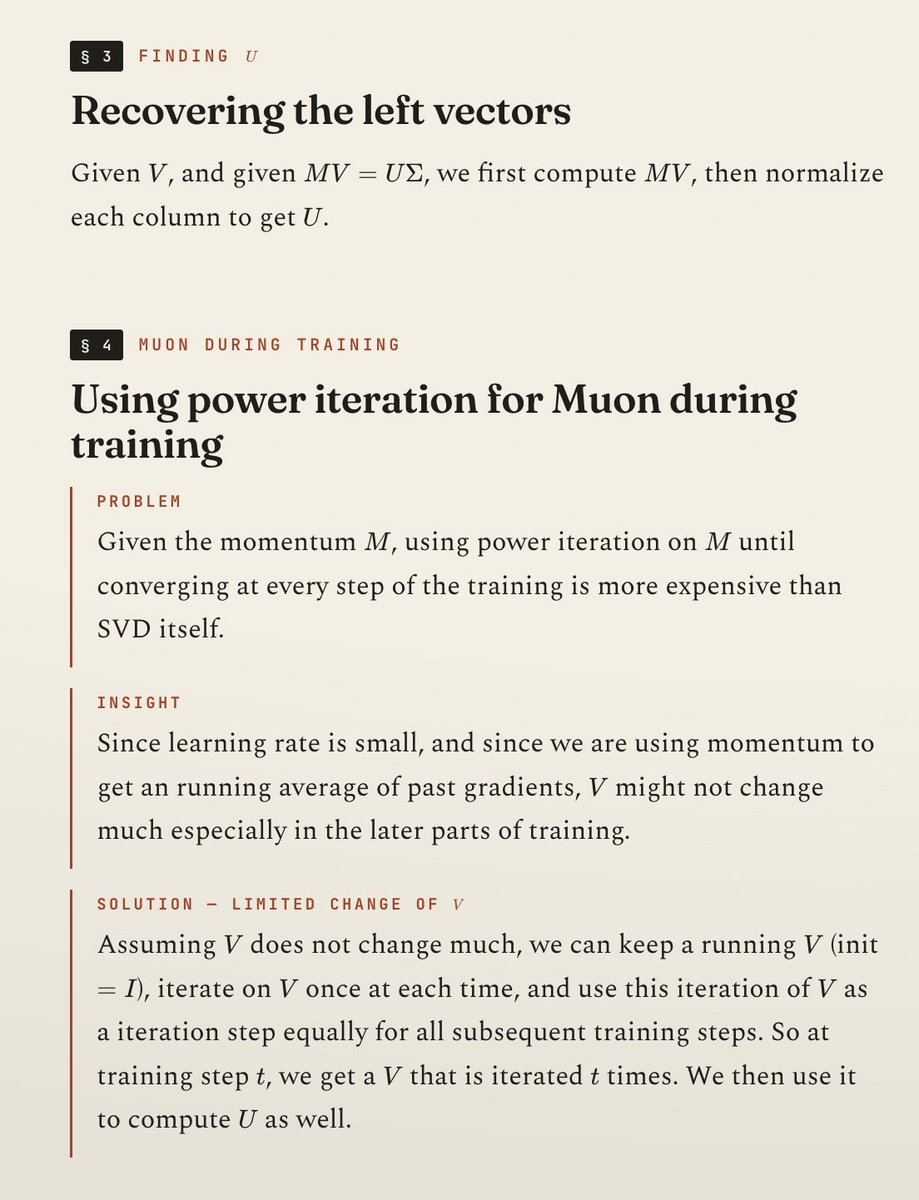
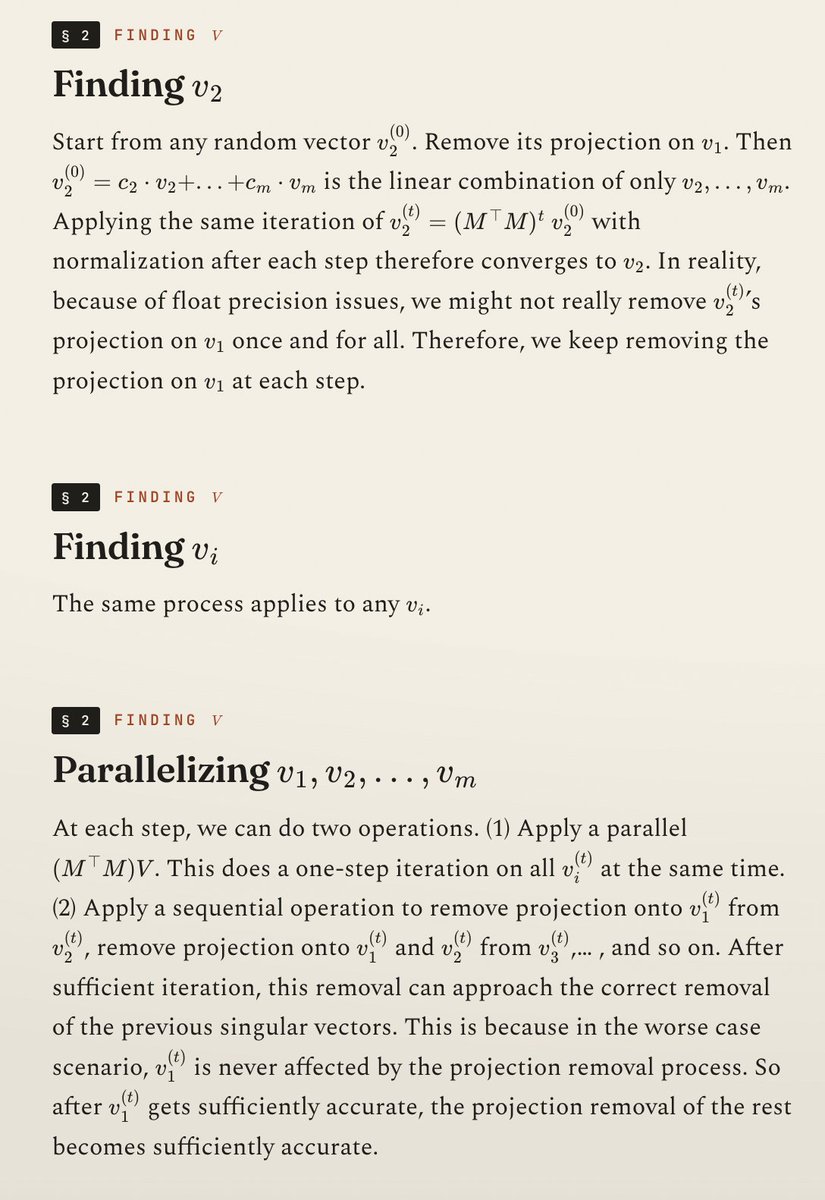
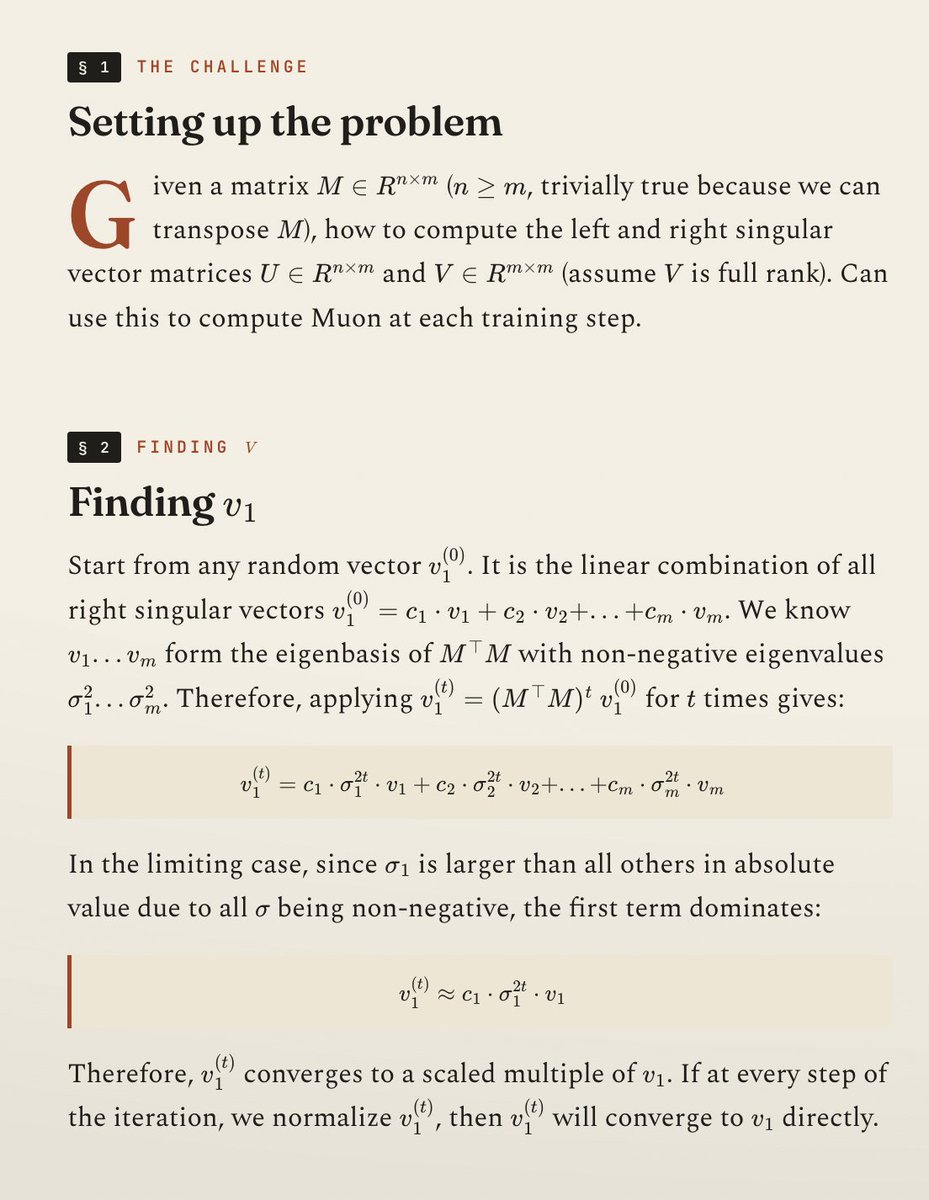
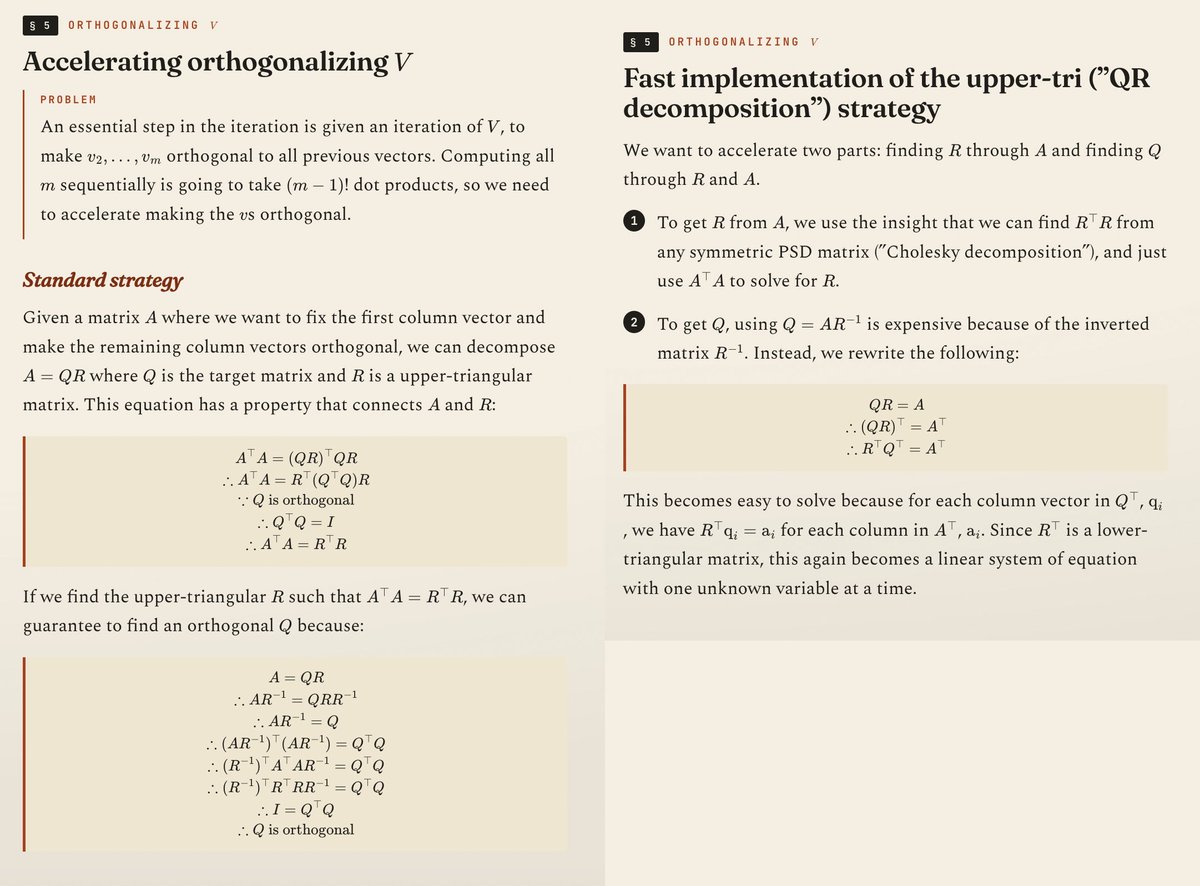
Here is me trying to "reinvent" one such blog which provides an elegant alternative to compute Muon, by filling in all the derivations that the blog skips for a less math-savvy audience (besides being entirely in Mandarin).
The goal of the blog is to find a way to compute a essential component of Muon, ie. the left and right singular value matrices U and V for the gradient G, **individually**. In the standard form, Muon really just needs their product UV^T, hence the standard way to compute it via computing a low-rank polynomial of G many times ("Newton-Schulz"). But there are more variants of Muon to control the properties of model updates if we can get both individually, hence the blog's proposal to revisit some fundamental linear algebra techniques for the computation.
The methodological takeaway from the blog's thought process is that there are three components to breaking down a ML problem: (1) how to be able to compute something (power iteration), (2) how to compute it fast (cholesky decomposition), and (3) how to compute it accurately given finite floating points (repeated orthogonalization). The goal of reading inspiring blogs like this is, in Feynman's term, to be able to "reinvent" them at any time to grasp the fundamental approach of doing similar work.
Original blog: https://t.co/5ksKPICpMW
The release candidate for MCP 2026-07-28 is out. The protocol is now stateless: no handshake, no session id, any request can hit any server instance. Plus extensions as first-class (MCP Apps, Tasks), auth hardening, and a proper deprecation policy so we don't have to do this again.
https://t.co/XRLTu1BSkB
Today, we share a breakthrough on the planar unit distance problem, a famous open question first posed by Paul Erdős in 1946.
For nearly 80 years, mathematicians believed the best possible solutions looked roughly like square grids.
An OpenAI model has now disproved that belief, discovering an entirely new family of constructions that performs better.
This marks the first time AI has autonomously solved a prominent open problem central to a field of mathematics.
Today we're sharing our work on interaction models. A new class of model trained from scratch to handle real-time interaction natively, instead of gluing it onto a turn-based one.
https://t.co/MoS5s4cm60