after five days of hard work, it finally paid off. today, i am very excited to share my independent community project, arc engine router - a simple cross-contract routing interface for the testnet.
to prove how accessible web3 can be for everyone, i coded and deployed this entire experiment using strictly an android phone and termux
experience it below:
github: https://t.co/PZ0881l4vx
really happy to explore and build within the @arc and @circle ecosystems.
(note: this is an independent developer build, not an official partnership)
#buildonarc
1. what tools are you using to build your projects on the arc testnet?
2. has anyone faced any issues with contract routing from an android mobile yet?
Is Speed Alone Enough for the Next Generation of Cross-Border Payments?
One of the biggest challenges with cross-border micro-payments has never been moving money.
It's making small-value transfers economically worthwhile once routing costs and settlement delays are taken into account.
Infrastructure built around native USDC settlement on @Arc with @circle is helping reduce that friction, which opens the door to a different conversation.
Instead of asking only how quickly a payment settles, should we also think about how efficiently capital is used while it's waiting to settle?
Even if those balances exist for only a short time, programmable finance could create new ways to make idle capital more productive,
provided the trade-offs around risk, liquidity, and compliance are carefully managed.
I'm curious how other builders see this evolving.
If you're designing payment infrastructure, would you rather keep settlement flows as simple as possible with instant finality,
or do you think programmable yield could become a meaningful addition for short-lived escrow or transit balances?
#BuildOnArc #ProgrammableMoney #USDC #ArcHouse
Just claimed my Proof of Swap NFT for Epoch 5 on Stabilizer Finance! Hit $18.7M volume and 40 trades this epoch with #3757 rank. Smooth swaps, zero slippage! @stabilizer_fi#testnet#airdrop#StabilizerLegion
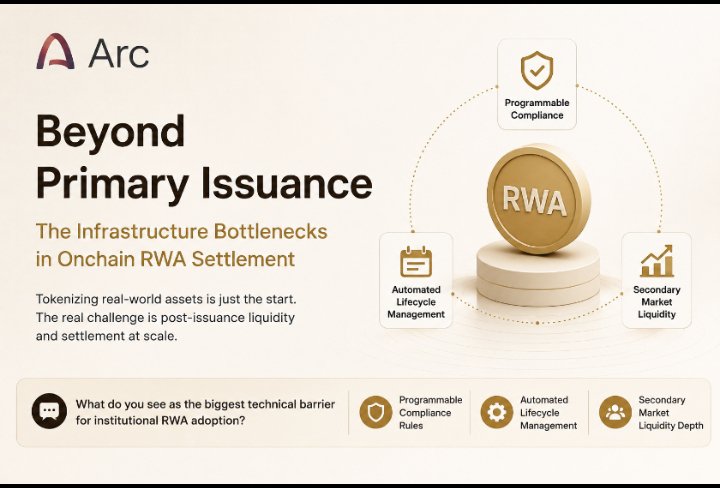
Beyond Primary Issuance: The Next Challenge for Onchain RWAs
A lot of the conversation around RWAs focuses on bringing assets onchain. That's an important milestone, but it's only the beginning.
The bigger challenge starts after issuance.
For institutions to adopt tokenized corporate debt, private credit, and other RWAs at scale, the infrastructure needs reliable settlement, built-in compliance, and
enough liquidity for active secondary markets. Without that, many tokenized assets risk becoming digital certificates that rarely change hands.
What interests me about Arc is the opportunity to build the infrastructure around these markets—not just the assets
themselves. Fast settlement is important, but long-term adoption will depend on how well the surrounding financial rails evolve.
Builders working on RWAs: which challenge deserves the most attention over the next
few years—compliance automation, asset lifecycle management, or deeper secondary market liquidity?
#ArcHouse #RWA
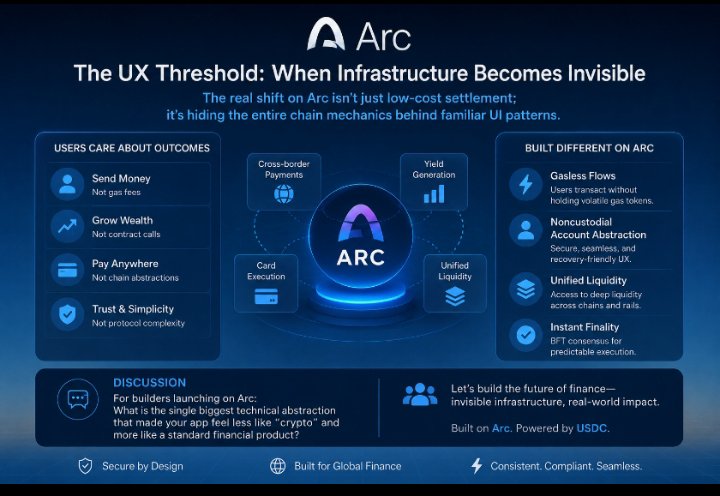
The UX Threshold: When Infrastructure Becomes Invisible
Many Web3 applications still face onboarding challenges because users are
expected to understand concepts like gas fees, cross-chain interactions, or wallet
management before they can use the product.
One of the interesting directions Arc is exploring is reducing that complexity by
moving more of the blockchain mechanics into the background. When payments,
account management, and other core interactions feel familiar, users can focus on
what the application does rather than how the underlying infrastructure works.
For builders, that shift creates more room to improve real-world user experiences instead
of repeatedly solving the same onboarding problems.
What abstraction has made the biggest difference in your application so far: gasless
transactions, account abstraction, unified liquidity, or something else.
Can Risk-Free Prediction Models Change Web3 Onboarding?
Most prediction platforms ask users to commit capital upfront, which can create an entry barrier for people who are new to crypto.
What caught my attention about SafeBets is its approach to removing that upfront financial risk. Instead of requiring users to
stake their own money, the platform focuses on rewarding forecasting performance through its incentive model. According to
the project's public materials, the goal is to make participation accessible without requiring users to risk their own funds.
I found the concept interesting and decided to explore it myself:
https://t.co/2EjChITUqR
From a product design perspective, this raises an interesting question. If participation becomes risk-free, can a prediction platform retain users because of the experience itself rather than financial speculation alone?
Alex, I'm curious about your long-term vision. As the platform grows, what do you believe will be the strongest retention driver: prediction accuracy, community
engagement, institutional demand for aggregated forecasting data, or the incentive model itself?
@konanykhin@Unicoin
#SafeBets #Unicoin
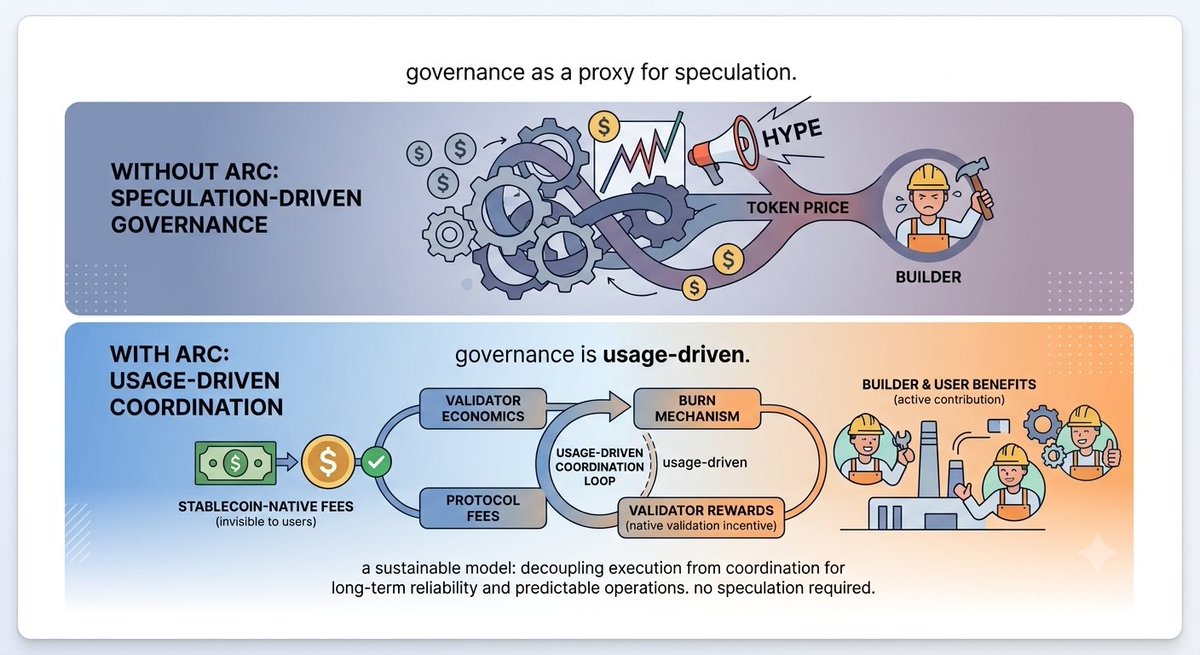
When Stablecoin Gas Changes the Way We Design Applications
When building financial applications, predictable transaction costs matter just as much as transaction speed.
If gas fees fluctuate with a volatile token, developers have to account for changing operational costs, which adds unnecessary complexity to payment flows and treasury management.
Using stablecoins like USDC for transaction fees separates day-to-day execution from the network's coordination layer. That gives developers a more predictable environment while the protocol can still manage
validation, governance, and long-term network incentives independently.
For businesses building payment systems, subscriptions, or treasury tools, this kind of separation could make blockchain
infrastructure much easier to integrate into existing workflows.
I'm curious how other builders think about this.
When designing financial infrastructure, which matters more to you: predictable transaction costs or maximum network flexibility?
#ArcHouse #Web3Development
panchu brother, auditing smart contracts against documented behavior is an important part of building trust.
beyond code correctness, clear permission management and transparent upgrade mechanisms can make a big difference.
what security practice do you think teams should prioritize before deploying bridge infrastructure to production?
panchu brother, follower churn often happens during platform-wide bot purges or
automated account suspensions, so it rarely reflects your content quality.
staying consistent with technical posts and builder discussions will naturally help you
cross 5k. what engagement metric do you trust most beyond follower count?
pawan sir , deterministic execution becomes far more valuable than raw throughput when applications depend on predictable outcomes across every transaction.
what architectural tradeoff do you think matters most when designing systems that prioritize deterministic behavior at scale?
@Panchu2605@arc@samconnerone@bobbilee@BuildOnCircle brother, builder office hours like these often surface implementation issues much earlier than documentation alone.
what type of technical questions or integration challenges do you see coming up most frequently during these sessions?
Designing Resilient Web3 Systems
When building decentralized applications, it's easy to focus on smart contracts,
user experience, and onboarding.
But none of that matters if the underlying infrastructure struggles when activity increases.
Slow RPC responses, network latency, or synchronization delays can quickly affect
the user experience, even when the application itself is well designed.
That's why infrastructure reliability deserves as much attention as new features.
Platforms like @arc are exploring approaches that make stablecoin-based
transactions more predictable, allowing developers to spend less time working
around infrastructure limitations and more time building useful products.
As the ecosystem grows, resilience won't just be measured by transaction speed.
Consistent uptime, reliable execution, and a smooth developer experience will be just as important.
What matters most to you when evaluating blockchain infrastructure for production:
uptime, latency, finality, or developer tooling?
#ArcHouse #Web3Development
@Panchu2605 panchu brother, 100x on bitmex back in 2019 was a different era.
watching the evolution from those high-risk trading days to today's more mature
infrastructure has been incredible. what do you think changed the most in exchange execution since then?
One speed was never enough.
TrendBTC now runs three BTC markets in parallel: 5 minutes, 15 minutes, and 1 hour. Live right now, side by side, all paying $TREND.
5m — pure reflex. The round is over before your coffee cools.
15m — the classic. Where 150K predictors made their name.
1h — for those who read the trend, not the candle.
Same engine everywhere: call it early, call it against the crowd, and the round weights you for it.
Three charts. Three timers. One balance — stacking $TREND toward your next Trend Box.
And we're just getting started. The update pipeline is longer than the roadmap you've seen — way more coming.
https://t.co/Sbb3EVrHZR
Account Abstraction Solves One Problem. What Comes Next?
Embedded wallets and account abstraction can remove much of the complexity that new users face when entering Web3.
But improving onboarding is only part of the challenge.
As more smart accounts become active, developers also need to think about long-term operational efficiency.
Background automation, session management, and state growth all influence how scalable these systems remain as usage increases.
The next generation of infrastructure won't just be measured by how simple it feels for users. It will also depend on how efficiently these abstractions operate behind the scenes.
Which engineering challenge do you think deserves more attention as account
abstraction adoption grows: session management, state efficiency, execution costs, or developer tooling?
#ArcHouse #Web3Development #AccountAbstraction #BlockchainInfrastructure
I just minted 1,579 $REIGN and unlocked Veteran rank on @xreign_app, with a 7 $USDT starting bonus.
Think your X account ranks higher? Mint yours on @xreign_app — guaranteed $USDT bonus, then spin the Reign Wheel.
https://t.co/faTr1b0qzh
Mint proof: XR-BA4F84E353
@Panchu2605@arc panchu brother, happy to connect. i've been studying how different teams are approaching infrastructure design on arc.
which builder project has impressed you the most recently from an architectural perspective?
If I’m not following any @Arc Architects or builders on Arc even without the Architects badge, drop a reply below. Let’s connect.
Architects support Architects ❤️