@slatestarcodex@SterlingCooley Gentleman's bet: it will have medically useful results to the point that it will cause lasting behavioral changes and will involve sensors besides ultrasound.
@slatestarcodex@SterlingCooley It's be funny if MJ bath was like "oh yeah there's also a barely there quarter of a dexa-scan x-ray involved which obviously helps fill in the gaps. Multimodal + AI broskioski." and then the entire debate is pointless and silly in retrospect.
Another example of the (free) Unfiltered Audio BattleFX, this time on a gorgeous guitar loop I pitched down, that was kindly provided by pbelgium8 on Soundcloud.
#unfilteredaudio#plugin#vst3#AUv3@UnfilteredAudio
Freebie #2: @UnfilteredAudio's BattleFX, which gives you rhythmic creative multi-effects and a Euclidean-sequenced buffer sequencer. Like, free.
https://t.co/QH8TsM6AgX
They're probably thinking this will get you into their Battalion drum machine. They're probably right.
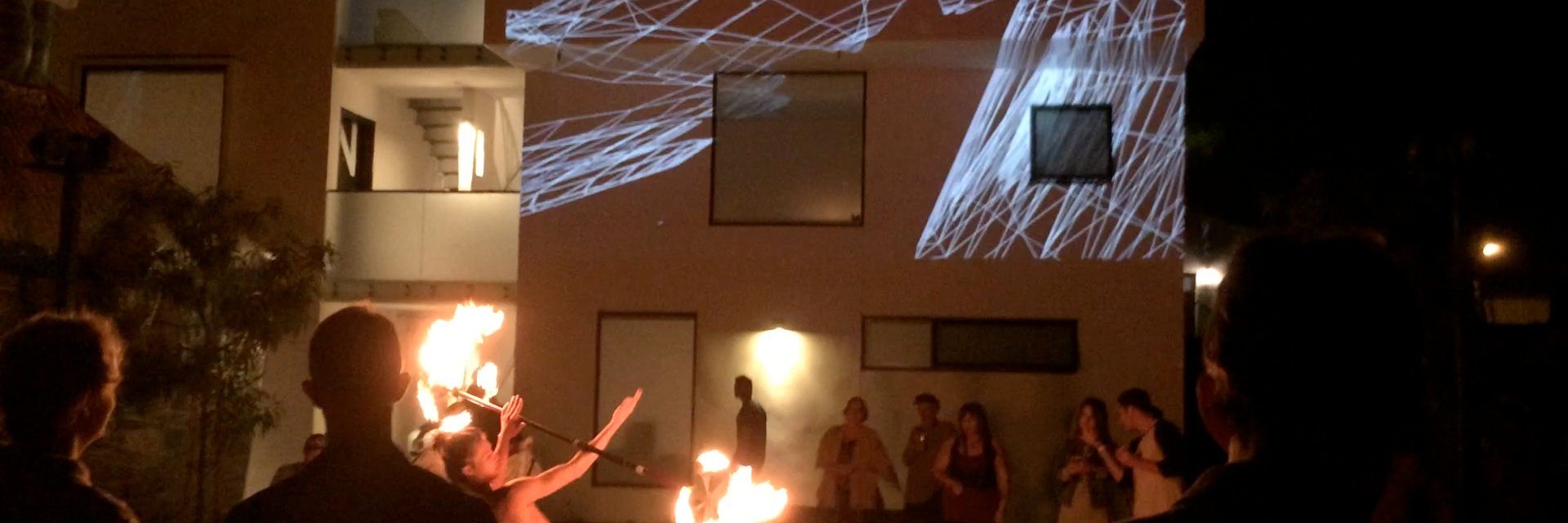
At the World Fencing League event held on Saturday, April 25, at The Shrine in Los Angeles, the collaborative project "Fencing Visualized" between Rhizomatiks and Dentsu Lab Tokyo will be introduced in actual competition.
Destroying the @InternetArchive's @WayBackMachine would be the equivalent of the burning of the Library of Alexandria - one of the worst losses of knowledge in history.
Media giants are now threatening to do this.
We can't let this happen.
Pass it on.
Today, we released Lyra 2.0, a framework for generating persistent, explorable 3D worlds at scale, from NVIDIA Research.
Generating large-scale, complex environments is difficult for AI models. Current models often “forget” what spaces look like and lose track of movement over time, causing objects to shift, blur, or appear inconsistent. This prevents them from creating the reliable 3D environments required for downstream simulations. Lyra 2.0 solves these issues by:
✅ Maintaining per-frame 3D geometry to retrieve past frames and establish spatial correspondences
✅ Using self-augmented training to correct its own temporal drifting.
Lyra 2.0 turns an image into a 3D world you can walk through, look back, and drop a robot into for real-time rendering, simulation, and immersive applications.
➡️ Learn more: https://t.co/ROR7miJeCU
📄 Read the paper: https://t.co/1osU9EGjGD
I'm honored and excited to be part of this!
Big thanks and congratulations to Dr. Gustavo Alfonso Rincon (Ph.D., M.Arch., M.F.A., B.S., B.A.) @gustavorincon29 and Joshua Dickinson @Amusesmile for organizing it!
@bryan_johnson we should create better objective environmental toxin sensors to pick up stuff like this. Maybe some type of organic shoe or fabric you wear in the home then send in for analysis
@javilopen We trained AI on the code that made the modern sloppy, bloated, inefficient software everyone hated using. It uses bad corporate patterns. 4x necessary code and bad looking UI. I love your Magnific algo but your app feels vibecoded. No disrespect but avoiding that's the reason.
@hubermanlab I've been trying to get more people talking about spectrum and PWM for years and years. We should never have switched. There is no LED light that provides the same spectrum/frequency/general quality. I think this is one of the larger factors contributing to modern health issues.
🚨SOMEONE REINVENTED HOW TEXT RENDERS ON THE WEB AND ITS ABSOLUTELY INSANE.
the goated dev behind react, reasonML, and midjourney’s frontend, just dropped Pretext. a tiny typescript library that measures and lays out text 500x faster than the DOM.
he trained models against real browser rendering for weeks until the output matched safari, chrome, and firefox exactly.
the demos are insane!! hundreds of thousands of text boxes at 120fps. magazine layouts and chat bubbles that actually wrap right.
engineers from Vercel, Remix, Figma, and shadcn all cosigned. this is the kind of open source that makes you want to be a better dev.
here are some cool demos in the past 24hrs👇