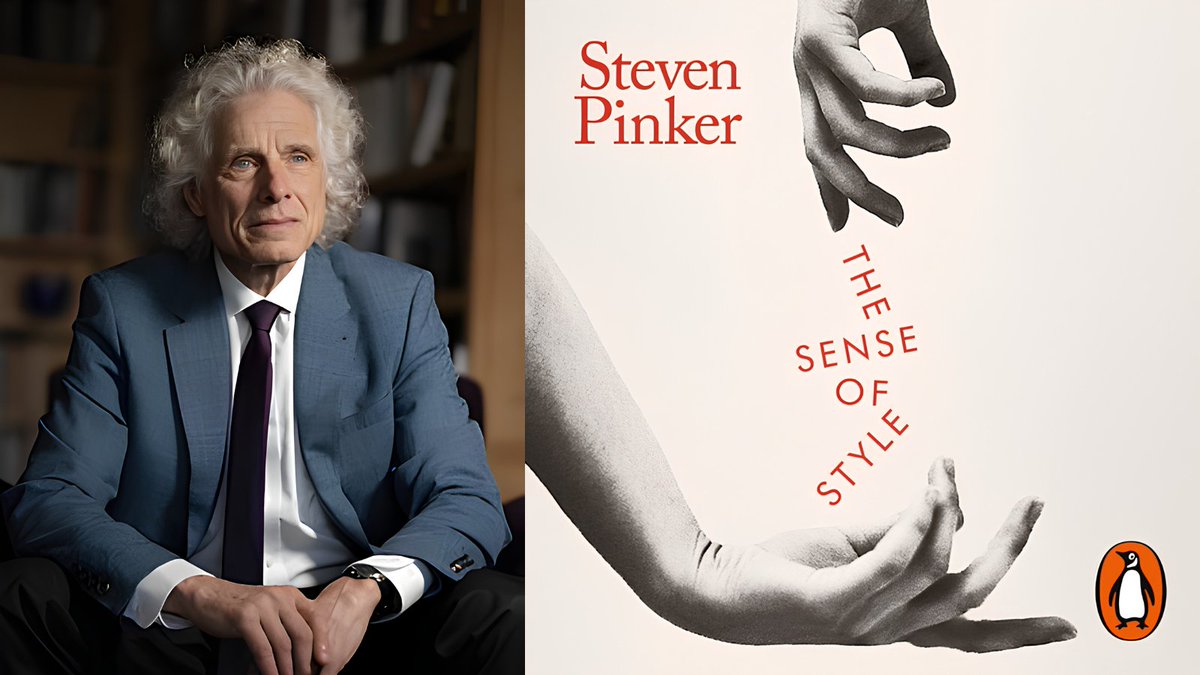
Steven Pinker is a Harvard psychologist who wrote the only style guide based on how the brain actually reads.
Here are 10 writing fixes from "The Sense of Style" rooted in cognitive science, not grammar rules.
1) The curse of knowledge ruins more writing than laziness
“We are admitting a cohort that cannot read at a college level and are pretending otherwise.”
Another college professor adds to the chorus of concern about student capacity.
In @chronicle:
“Six weeks into the term, I assigned my rhetoric and writing students a 20-page article. It was the same length I had assigned for five years and the same length I had read without complaint as an undergraduate a decade ago. Not one student finished it.
When I asked why, a student answered honestly: It was too long, and she kept losing track of what the paper was about. This was not a remedial class: These were students who had cleared the admissions process and written essays good enough to get them here. Yet a routine academic reading assignment had defeated them.
Every generation of professors has complained that their students cannot read. The lament is usually overblown, but data have caught up to anecdote, and what I am seeing in my classroom is no longer a hunch. There is a measurable, generational collapse in sustained reading and writing, and the academy is responding to it with improvisation and exhaustion rather than the structural overhaul it requires.
In February 2024, Adam Kotsko, who teaches in the Shimer Great Books School at North Central College, wrote in Slate that students who once handled 30 pages of reading per class meeting now seem “intimidated by anything over 10 pages and seem to walk away from readings of as little as 20 pages with no real understanding.” Crucially, he added that this is “not a matter of laziness on the part of the students” but of underlying skills they were never given a chance to build.
The Chronicle of Higher Education’s 2024 investigation found the same pattern across institutions as different as the Stevens Institute of Technology and Wellesley College, where the average SAT exceeds 1400. Nicholaus Gutierrez, an assistant professor at Wellesley, told The Chronicle that the baseline for what students consider a reasonable amount of work has dropped so noticeably that he has cut his readings accordingly; a 750-word essay now strikes many students as long. At Stevens, the science and technology studies associate professor Theresa MacPhail described following the mantra of “meet your students where they are” for so long that she has begun to feel “like a cruise director organizing games of shuffleboard.”
Worse, the national data tell the same story in colder language. On the 2011 National Assessment of Educational Progress (NAEP) writing assessment, which is the most recent comprehensive writing benchmark, only 24 percent of 12th graders reached the Proficient level, and just 3 percent reached Advanced; another 21 percent scored below Basic. The reading side of the ledger is worse, and getting worse fast: The 2024 NAEP results released in September 2025 show 12th-grade reading scores at the lowest level recorded since the assessment began in 1992. Thirty-two percent of 12th graders now score below NAEP Basic in reading, meaning that, in the assessment’s own language, they likely “cannot draw general conclusions based on concepts presented explicitly in a text.” And yet more than half of these same seniors reported being accepted to a four-year college. That last sentence is the whole problem in one line: We are admitting a cohort that cannot read at a college level and are pretending otherwise.”
Michael B. Jordan’s advice for anyone feeling stuck in life
“When you’re feeling the most trapped and down and nothing can go right, those are the moments that define you. People quit right before they get what they’ve always wanted”
“Having the name Michael Jordan, knowing there was another Michael Jordan who was the best ever got me teased and picked on. For a moment, it made me not want to play sports but then I was like nah, I’m going to compete. It gave me a healthy chip”
“For the people who are listening who feel like they can’t change their circumstances, just hold on. Just endure. Look at things differently. Challenge yourself to see the glass half full”
“Find something that resonates with you, find your intuition within that thing and be obsessed about it”
Sometimes you read something and immediately think, we need to talk to this person.
That’s exactly what happened when we read Luke Morin’s article about what readers need when texts get complex. https://t.co/SVEEQSUMmR
So… we invited him on the podcast. Episode drops Friday.
What one book defines America? Ahead of the country’s 250th birthday, TIME asked 25 literary luminaries—including Amanda Gorman and George Saunders—to each pick one book that they believe reflects where American life is headed or speaks to the today in a meaningful way. See their choices and the full reading list: https://t.co/a3SU9JhH8v
Is there a book that you think all Americans should read? Let us know in the comments.
This is a hugely important piece by @PamelaSnow2. A very insightful application of cognitive load theory to neurodivergence and trauma-informed classroom practice. To the best of my knowledge there is no research on this topic and this has really illuminated my understanding on the topic both as a researcher but more importantly as a SEN parent. I do hope Pam explores this area further. https://t.co/O7YD4EDFbA
This should be posted in every Board of Ed room and in literacy coordinator office, every superintendents office…it should just be posted everywhere to always remind us of what is possible
Science of Reading doesnt become real because you buy materials, host training, or say the right things. It becomes real when leaders build systems that make evidence-based instruction clear, supported, practiced, inspected, protected, and sustained.
Clarity. Consistency. Culture
When things go a little sideways during my lessons, it’s usually not my students’ working memory getting overloaded. It’s mine.
Too many decisions. Too much to manage in the moment. It’s like a tidal wave you can feel building in your brain. But…
Offloading in advance, “proceduralizing” as much of a lesson as possible, and maintaining consistent routines has made a huge difference for my cognitive load—and by proxy has improved student outcomes.
Here’s how I optimize my own cognitive load. 📖🧠👇
This is where “uppercase” and “lowercase” came from. In the early days of printing, capital letters were kept in the upper compartments of the type case, while the smaller letters were placed below for easier access.
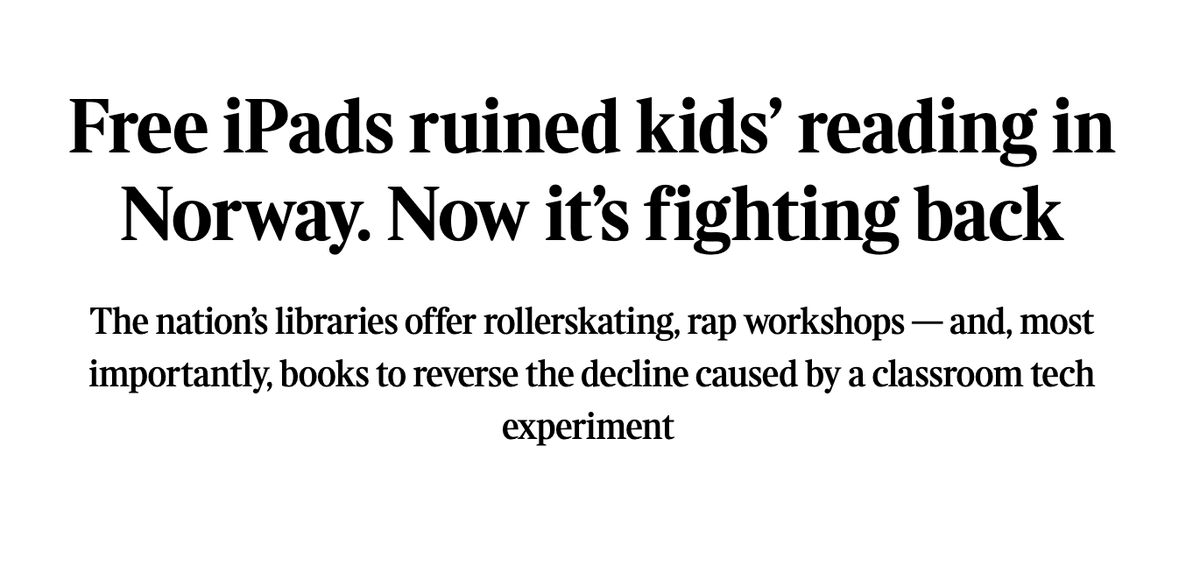
"Ruined kids' reading"
"The nation’s libraries offer rollerskating, rap workshops — and, most importantly, books to reverse the decline caused by a classroom tech experiment."
Here for it.
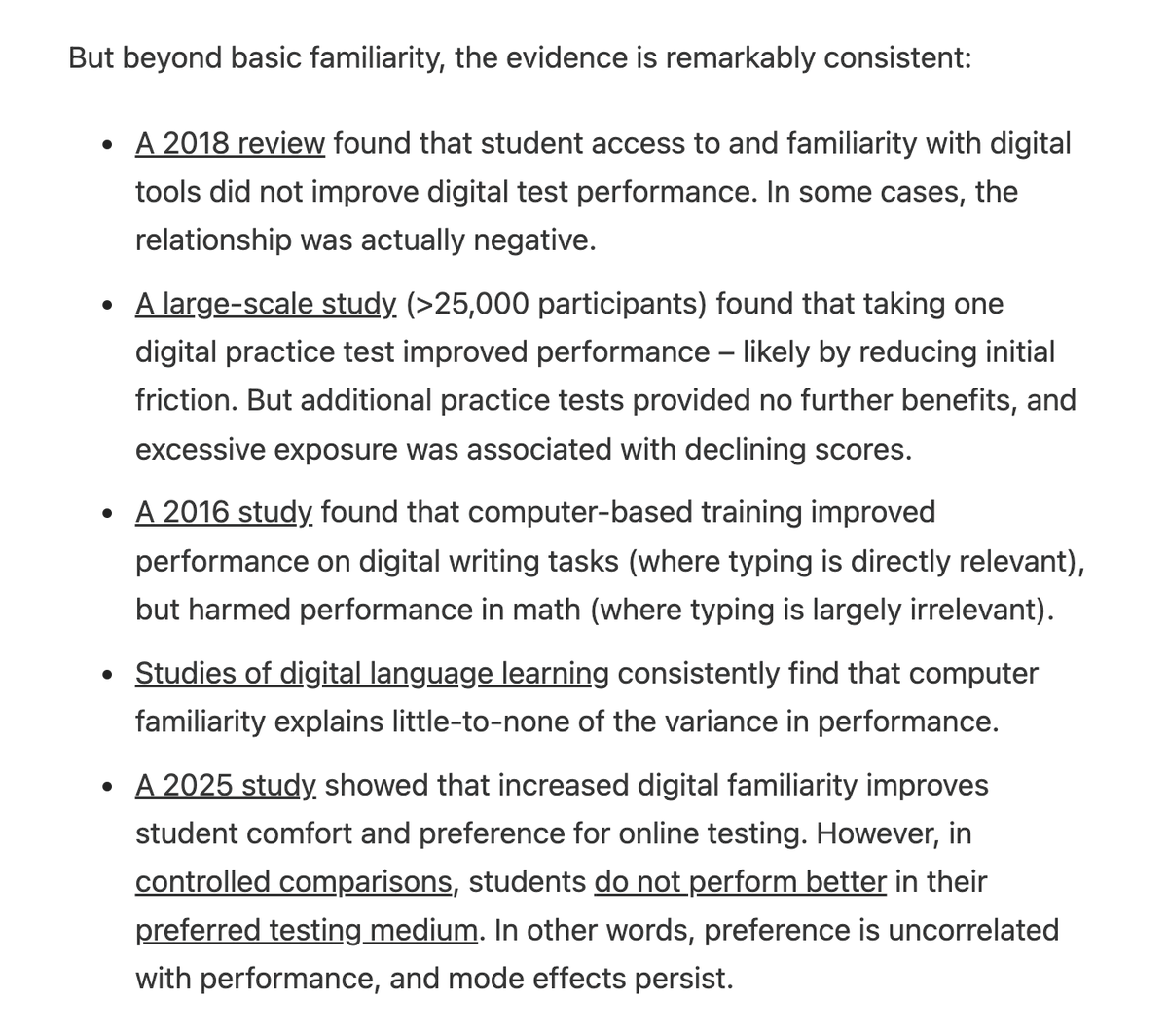
"Taken together, these findings suggest digital testing follows a threshold model.
Students need enough familiarity with the tool to avoid interference. But beyond that point, additional exposure provides no benefit – and may even be harmful."
Jared Cooney Horvath debunks the myth that kids need to do lots of digital testing to succeed on state assessments:
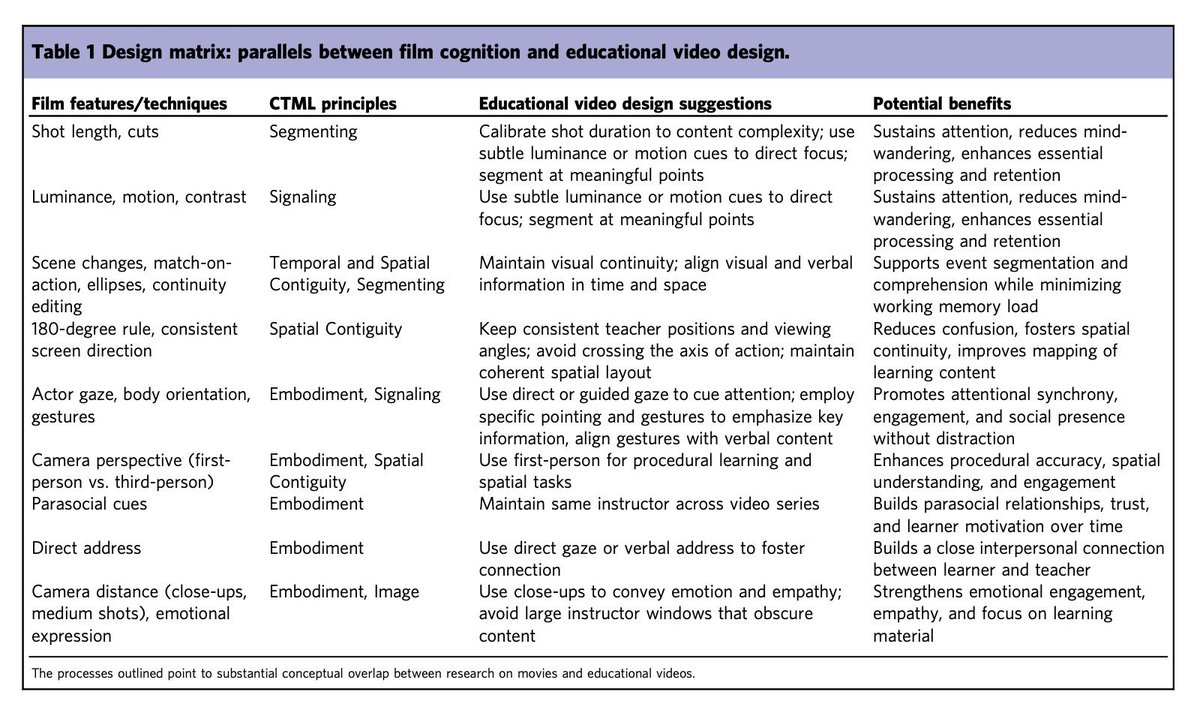
What can Hollywood cinema teach us about the design of educational videos? Just read this really interesting paper which maps classic film techniques onto Mayer's Cognitive Theory of Multimedia Learning.
Takeaways:
1. Shorter shots sustain attention: engagement drops after 6 mins; frequent cuts create event boundaries that reset attention and reduce mind-wandering
2. Arrows, circles, and highlights are the video equivalent of underlining every word in a textbook. Research on film shows that luminance shifts, motion cues, and contrast guide attention without adding extraneous load. (Basically, the best signal is one the learner doesn't consciously notice.)
3. Continuity editing is spatial contiguity: The 180-degree rule means the camera always stays on the same side of those two people, so they stay in the same positions. If the camera suddenly jumps to the other side, Person A is now on the right and Person B is on the left, and your brain has to throw away its map and build a new one. That costs working memory.
4. First-person POV wins for procedural tasks: when the task is "do this with your hands," show what the learner's hands would see not an instructor explaining it.
5. Instructor presence is a trade-off: small retention benefit, but large instructor windows occlude content and can reduce transfer; show the face strategically, not by default
Super intereting that having a teacher's face visible on screen during a video or app gives learners a small boost in remembering things it feels more human, more connected. But if that face takes up too much of the screen, it literally covers the stuff the learner is supposed to be looking at. And worse, it can actually make it harder for learners to apply what they've learned to new situations.
full paper here: https://t.co/gTeFNiVjYN