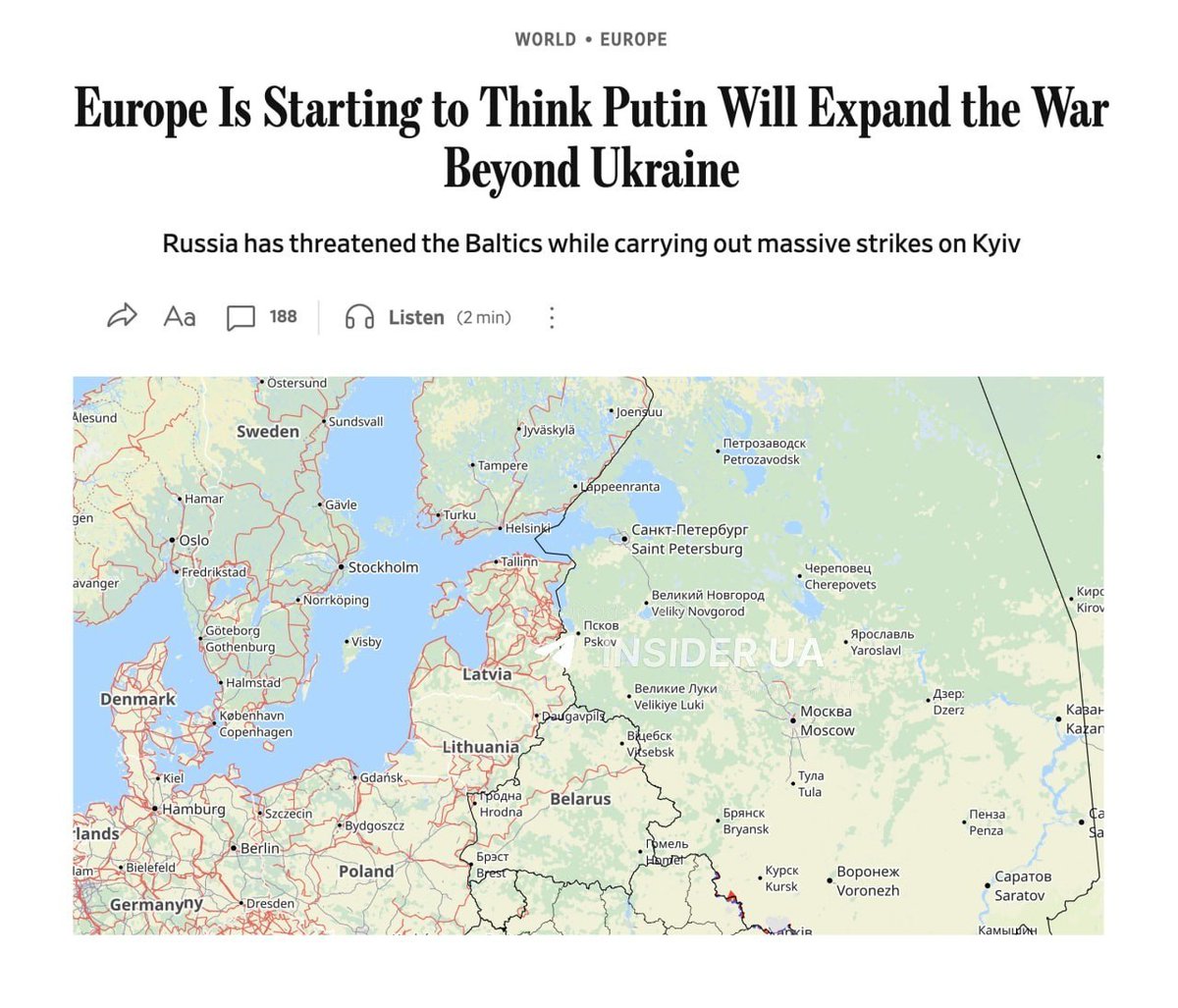
What we have been expecting for several months is now starting to unfold in front of us, albeit more slowly than we initially thought.
John Ratcliffe’s lightning visit to Moscow was not some routine diplomatic stop. It strongly echoes William Burns’ trip to Moscow in November 2021, when he was still CIA director. Back then, the Americans knew what Russia was preparing in Ukraine and were still trying to deter it. Three months later, the invasion began. The parallel is hard to ignore.
Ratcliffe arrived on Tuesday, August 25 aboard a C-17, via Riga. That is an unusual and visible enough way to travel that it is difficult to pass the trip off as routine. The Kremlin eventually confirmed “contacts between intelligence services,” said Ratcliffe had not met Putin, and described the talks as “positive.” Trump called the visit “semi-routine.” That sounds more like an attempt to play the whole thing down. You do not send the CIA director to Moscow under those circumstances to discuss minor issues.
The previous few weeks make the picture more interesting. Hybrid activity across Europe has been increasing. Between August 18 and 20, NATO sharply stepped up intelligence missions around Kaliningrad, including several anti-submarine warfare aircraft. Whatever they saw does not seem to have reassured Washington. Ratcliffe’s message can probably be summed up in fairly simple terms: we see what you’re doing. Don’t do anything stupid.
The versions that later appeared in the Wall Street Journal, Politico and CBS described a US warning about the risk of a limited Russian attack on NATO “in the coming years”: cyber, hybrid action, perhaps even a ground incursion into the Baltic states. This is where the official story becomes difficult to believe. You do not put together this kind of urgent trip, with Ratcliffe flying into Moscow on a C-17, to discuss something that might happen three or five years from now. Especially not while Ukraine is reportedly being asked to ease off strikes on Moscow and northern Russia. The relevant timeframe looks much more like weeks or months.
Public statements also have to be taken with caution. We saw the same thing in 2022. As late as February 22, Zelensky was still publicly playing down the likelihood of a full-scale invasion. Two days later, it happened. In the same way, the fact that Russian forces do not currently look perfectly ready does not rule out a move. The Russians do not always look ready. That does not mean they will wait until everything is perfectly in place.
That is also what makes the 2021 precedent uncomfortable. Burns was sent to Moscow to deliver a direct American warning then too. It did not prevent the war. These visits are mainly about making sure the message reaches the highest level and that nobody can later claim they misunderstood it: we know what you are preparing, and this is our red line. But that has never automatically stopped a player who has already decided that moving is worth the risk.
Ratcliffe’s visit therefore looks much less like a sign of de-escalation than a US response to what Moscow may see as a window of opportunity: Western stockpiles already under strain from Ukraine and other theatres, strategic fatigue, and the possibility of testing NATO cohesion with a limited move.
The American message seems clear enough. Recent history tells us much less about what Moscow will choose to do with it.
Buckle up.
If these estimates are right, Russia is not running out of budgetary steam. It is still scaling up its military effort into 2026.
Military spending would now be around 12% of GDP. Other modern revanchist imperial powers have gone much further: Hitler’s Germany reached 44%, Tojo’s Japan 59%, and Ukraine today is around 40%.
Our view: Russia still has room.
Russian military spending surged by 30% in Q1 2026, reaching 5.9 trillion rubles. The amount of classified spending was absolutely massive (most of it goes to the military). Link to my latest analysis in the comments. 👇
New edition of Five Signals by Anacyclis Research - Edition of June 8, 2026.
This week's geopolitical analysis examines Russia's military and economic constraints, renewed escalation around Iran, pressure in the Caucasus, and the EU's hardening trade-security agenda.
__________________
1. Russian progress in Ukraine is now nearly zero
Source: https://t.co/Y1Erln5evC
Key point: According to Ukrainian group Deep State, the Russian army gained only 14 square kilometers in May 2026, its slowest pace since autumn 2023.
2. Lithuania signals interest in hosting US nuclear weapons
Source: https://t.co/jw18Fb66nJ
Key point: Lithuania is reportedly discussing with the United States the possibility of hosting American nuclear weapons on its territory.
3. Iranian attacks in the Gulf test the ceasefire
Source: https://t.co/96vG28ZnxX
Key point: The United States said it repelled several Iranian ballistic missile and drone attacks against US and allied bases in the Gulf in violation of the ceasefire.
4. Russia pressures Armenia over EU alignment
Source: https://t.co/fqmv9kyVVM
Key point: Russia recalled its ambassador to Armenia for consultations because of Armenia's rapprochement with the European Union and its distance from the Eurasian Economic Union.
5. Stéphane Séjourné warns of EU fragmentation without a trade fight
Source: https://t.co/voArDXWkNM
Key point: Stéphane Séjourné warned that China's trade surplus amounts to one billion euros per day and puts 29 million European jobs at risk.
__________________
Five Signals is our free weekly selection of 5 geopolitical developments that matter most. It is drawn from the Anacyclis Weekly Brief - our full weekly note for companies and institutional actors seeking structured geopolitical monitoring, tailored analysis, key watchpoints and strategic implications.
Follow / subscribe👉
- LinkedIn newletter: https://t.co/N8g3vErNoa
- Weekly Brief: https://t.co/rSnUaU1Yw9
⚠️Russia-NATO: Escalation Is Now Imminent
In our previous December update, we argued that a rupture event and a Russian escalation were likely to occur between February and June 2026, based on the signals available at the time.
Back then, we assessed Russia’s level of preparation at around 70/100.
The beginning of the year showed a certain slowdown.
However, since March, we have observed a renewed acceleration. This acceleration has become particularly strong over the past few weeks.
Among the most important signals:
1. Rising pressure from Belarus
Since February, Belarus has multiplied signals of inspection, mobilisation and military preparation.
Several recent developments stand out:
- announcements of forest area closures near the borders with Ukraine, Poland and Lithuania;
- a joint nuclear preparedness exercise with Russia;
- reported construction of logistical and military infrastructure near the Ukrainian border.
2. Incidents and tensions around the Baltic states
Incidents around the Baltic states are multiplying.
Russia is reportedly using electronic jamming to divert Ukrainian drones towards the Baltic states, increasing the risk of incidents and escalation.
This context has already contributed to a political crisis in Latvia.
Today, the SVR is accusing Ukraine of preparing strikes against Russia from Latvian territory.
Lithuania is also facing the risk of “very serious provocations” following Russian allegations that it provided airspace for Ukrainian drone strikes.
3. Intelligence signals
Volodymyr Zelensky has indicated that Ukrainian intelligence services are aware of Russian operational plans.
According to these reports, Russia could rapidly transfer troops to Belarus in order to break through on another front.
Two options would be under consideration:
- an operation southward, towards the Chernihiv-Kyiv axis;
- an operation northward, against a NATO country, directly from Belarusian territory.
Other signals point in the same direction:
- sources within the Russian Ministry of Defence reportedly indicate that Vladimir Putin may be considering moving to a new stage regarding the Baltic states;
- infrastructure works have reportedly been observed around Pskov, Smolensk and near Latvia.
4. Russia’s internal situation
Russia continues to increase its military effort as a share of GDP.
At the same time, Russian refineries and infrastructure are being hit more frequently by Ukraine, including recently in the Moscow region.
This may fuel internal discontent, while the Ukrainian front itself appears largely frozen.
Several additional signals should be monitored:
- signs of a possible new mobilisation;
- progressive censorship of the internet and major social networks;
- Russian nuclear exercises between 19 and 21 May, which is unusual at this time of year, as such exercises usually take place in November.
5. Russia’s diplomatic and doctrinal posture
Sergei Karaganov has once again insisted on the need, in his view, to strike Europe, first with conventional weapons and then, if necessary, with nuclear weapons.
What is new is his claim that a majority of Russian decision-makers now share this view.
On 19 May 2026, Sergei Ryabkov, Russia’s Deputy Foreign Minister, also stated in an interview with TASS that the risks of a direct confrontation between Russia and NATO are increasing.
Our assessment
In December, we assessed Russia’s level of preparation at around 70/100.
We now assess it at around 90/100.
The final missing signal, the one that would indicate much clearer imminence, would be the observation of significant troop movements:
- near the borders of the Baltic states;
- or inside Belarus.
We had identified the likely window as February to June 2026.
We maintain that events could very likely occur by the end of June, if the trajectory remains linear, with a possible spillover into July or August.
⚡️EU Fears Russia Could Attack NATO Within the Next 12 Months — WSJ
▪️Possible flashpoints include the Baltics, the Arctic, and areas near Swedish and Danish islands;
▪️European officials believe the Kremlin may need escalation to justify a new wave of mobilization;
▪️EU foreign policy chief Kaja Kallas said Russia is approaching a point where it “needs to raise the stakes.”
⚠️Russia-NATO: Escalation Is Now Imminent
In our previous December update, we argued that a rupture event and a Russian escalation were likely to occur between February and June 2026, based on the signals available at the time.
Back then, we assessed Russia’s level of preparation at around 70/100.
The beginning of the year showed a certain slowdown.
However, since March, we have observed a renewed acceleration. This acceleration has become particularly strong over the past few weeks.
Among the most important signals:
1. Rising pressure from Belarus
Since February, Belarus has multiplied signals of inspection, mobilisation and military preparation.
Several recent developments stand out:
- announcements of forest area closures near the borders with Ukraine, Poland and Lithuania;
- a joint nuclear preparedness exercise with Russia;
- reported construction of logistical and military infrastructure near the Ukrainian border.
2. Incidents and tensions around the Baltic states
Incidents around the Baltic states are multiplying.
Russia is reportedly using electronic jamming to divert Ukrainian drones towards the Baltic states, increasing the risk of incidents and escalation.
This context has already contributed to a political crisis in Latvia.
Today, the SVR is accusing Ukraine of preparing strikes against Russia from Latvian territory.
Lithuania is also facing the risk of “very serious provocations” following Russian allegations that it provided airspace for Ukrainian drone strikes.
3. Intelligence signals
Volodymyr Zelensky has indicated that Ukrainian intelligence services are aware of Russian operational plans.
According to these reports, Russia could rapidly transfer troops to Belarus in order to break through on another front.
Two options would be under consideration:
- an operation southward, towards the Chernihiv-Kyiv axis;
- an operation northward, against a NATO country, directly from Belarusian territory.
Other signals point in the same direction:
- sources within the Russian Ministry of Defence reportedly indicate that Vladimir Putin may be considering moving to a new stage regarding the Baltic states;
- infrastructure works have reportedly been observed around Pskov, Smolensk and near Latvia.
4. Russia’s internal situation
Russia continues to increase its military effort as a share of GDP.
At the same time, Russian refineries and infrastructure are being hit more frequently by Ukraine, including recently in the Moscow region.
This may fuel internal discontent, while the Ukrainian front itself appears largely frozen.
Several additional signals should be monitored:
- signs of a possible new mobilisation;
- progressive censorship of the internet and major social networks;
- Russian nuclear exercises between 19 and 21 May, which is unusual at this time of year, as such exercises usually take place in November.
5. Russia’s diplomatic and doctrinal posture
Sergei Karaganov has once again insisted on the need, in his view, to strike Europe, first with conventional weapons and then, if necessary, with nuclear weapons.
What is new is his claim that a majority of Russian decision-makers now share this view.
On 19 May 2026, Sergei Ryabkov, Russia’s Deputy Foreign Minister, also stated in an interview with TASS that the risks of a direct confrontation between Russia and NATO are increasing.
Our assessment
In December, we assessed Russia’s level of preparation at around 70/100.
We now assess it at around 90/100.
The final missing signal, the one that would indicate much clearer imminence, would be the observation of significant troop movements:
- near the borders of the Baltic states;
- or inside Belarus.
We had identified the likely window as February to June 2026.
We maintain that events could very likely occur by the end of June, if the trajectory remains linear, with a possible spillover into July or August.
As Russia stalls militarily in Ukraine, its political leadership is speaking more and more about the Baltics.
It is the classic logic of escalation: strategic frustration on one front, pressure on another.
NATO is in danger if it mistakes this rhetoric for bluff.
Former Russian president Dmitri Medvedev has said he doubts the US would defend European allies given a theoretical Russian incursion into the Baltics.
Yes. This is exactly what theoretical history models would suggest.
A revanchist imperial power does not de-escalate spontaneously. It is conditioned to seek escalation, maximize temporary advantage, and exploit its window of opportunity before the balance turns against it.
Putin is in a hopeless position that makes him even more dangerous and could push the Kremlin toward war with Europe, Washington Post columnist David Ignatius wrote. The stalemate in Ukraine, inability to help Iran and Orban’s departure as Hungary’s prime minister have left Putin cornered. Ignatius warns that Putin might attack Europe before European countries fully rearm, Ukraine develops new weapons and Trump leaves office. Former US intelligence officer Eugene Rumer warned that Russia could emerge from the Ukraine war more bitter and dangerous to Europe.
New edition of Five Signals by Anacyclis Research - Edition of March 30, 2026.
This week's geopolitical analysis examines tentative diplomacy around Iran, anti-Iranian repositioning in Lebanon, regime consolidation in Venezuela, the risks created by Ukrainian deep strikes near NATO territory, and further integration within the Russia-aligned bloc.
1. U.S.-Iran peace negotiations remain uncertain despite mediation efforts
Source: https://t.co/mePWsQPkQz
Key point: Washington says productive contacts are underway through intermediaries, while Tehran publicly denies that formal negotiations are taking place. The emerging picture is not one of a settled peace process, but of a still-fragile exploratory channel shaped by Pakistani and Turkish mediation, maximalist demands on both sides, and the possibility that diplomacy is being tested even as the war continues.
2. Lebanon expels Iran’s ambassador in a major move against Tehran’s influence
Source: https://t.co/NsVMjLS5p1
Key point: Beirut’s decision to declare the Iranian ambassador persona non grata marks a significant escalation in the Lebanese state’s posture toward Iran and Hezbollah. In the current context, the expulsion suggests that parts of the Lebanese government are trying to push back more directly against Iranian influence networks and to weaken the political environment in which Hezbollah has long operated.
3. Venezuela replaces its entire military high command
Source: https://t.co/ff3v2zrSAV
Key point: The interim presidency’s replacement of the full military high command points to a deeper phase of regime restructuring, not just a limited cabinet adjustment. The move suggests an effort to re-secure coercive institutions during transition and offers a broader signal: even where a political settlement appears to preserve part of an old apparatus, real regime change can still proceed through gradual cleansing and reorganization of command structures.
4. Ukrainian strikes near St. Petersburg raise risks of spillover around NATO airspace
Source: https://t.co/dHCX1JX308
Key point: Ukrainian long-range strikes against Russian infrastructure near Primorsk and Ust-Luga appear to have coincided with several drones entering Baltic airspace by mistake. At this stage, the idea that such operations may have relied on routes passing through or along NATO airspace should remain hypothetical. But the incidents already show how deeper Ukrainian strikes against northwestern Russia increase the risk of spillover onto NATO territory and raise the danger of misperception in a compressed escalation environment.
5. Lukashenko’s North Korea visit signals further consolidation of the Russia-aligned bloc
Source: https://t.co/W1WCgIKFDJ
Key point: Alexander Lukashenko’s first official visit to North Korea is more than a bilateral curiosity. It points to continued tightening among smaller Russia-aligned sanctioned states and reinforces the broader trend toward bloc consolidation across the Eurasian theatre. Even when concrete deliverables remain unclear, this type of visit matters because it reflects the growing political integration of regimes positioned on the same strategic side of the emerging confrontation.
__________________
Five Signals is our free weekly selection of 5 geopolitical developments that matter most. It is drawn from the Anacyclis Weekly Brief - our full weekly note for companies and institutional actors seeking structured geopolitical monitoring, tailored analysis, key watchpoints and strategic implications.
Follow / subscribe👉
- LinkedIn newletter: https://t.co/SxQUaSD4dl
- Mail signup: https://t.co/f8hu5Fyu5E
- Weekly Brief: https://t.co/rSnUaU1Yw9
Not to play prophet of doom - and we cannot claim to know Russia’s exact tempo, as we are not inside the heads of its decision-makers.
But three drone incidents have now taken place in just a few days near the Russian and Belarusian border across the Baltic space: Auvere in Estonia, Kraslava in Latvia, and Lavysas in Lithuania. This appears different from the broader drone pattern observed across Europe since September 2025.
At the same time, pro-separatist communication operations are emerging around Narva, while Belarus remains engaged in a prolonged, Lukashenko-directed combat readiness inspection.
Putin may have decided to move into a higher phase of escalation.
Drones entered Estonia and Latvia from Russian airspace, with one hitting the chimney of a power plant in Auvere, Estonia, according to Latvia's Defense Forces and Estonia's public broadcaster
New edition of Five Signals by Anacyclis Research - Edition of March 23, 2026.
This week’s edition revolves around three major dynamics: the continued escalation of the war around Iran in the Middle East; the persistent strain on Europe’s institutional and security architecture, from Narva to the Balkans and through Orban’s obstruction within the EU; and the major uncertainty still looming in Asia over China’s next moves around Taiwan.
Five Signals is our free weekly selection of 5 geopolitical developments that matter most.
It is drawn from the Anacyclis Weekly Brief - our full weekly note for companies and institutional actors seeking structured geopolitical monitoring, tailored analysis, key watchpoints and strategic implications.
Follow / subscribe👉
- LinkedIn newletter: https://t.co/fxLVR5Sx2y
- Mail signup: https://t.co/f8hu5Fyu5E
- Weekly Brief: https://t.co/rSnUaU1Yw9
We’ve launched a new format: Five Signals by Anacyclis Research.
Each week, it distills 5 geopolitical developments that matter most for the evolving strategic landscape.
Five Signals is our new free newsletter and serves as an entry point into the Anacyclis Weekly Brief - our full weekly note for companies and institutional actors seeking a more structured view of geopolitical and strategic developments.
Access here 👉
- LinkedIn newsletter: https://t.co/fxLVR5Sx2y
- Mail signup: https://t.co/f8hu5Fyu5E
- Anacyclis Weekly Brief: https://t.co/rSnUaU1Yw9
Trump’s fundamental strategy has always been the containment of China.
That logic was already implicit in the NSS, and it runs through Venezuela, Iran, and above all his attempt to end the war in Ukraine: detach Russia from China. At Anacyclis, we see this effort as futile.
Our models indicate that Russia’s long-term trajectory is bound to collide with that of the West in Europe.
Read our 2025 analysis👉https://t.co/C347zha4lR