hot take: el verdadero socialismo solo puede surgir de forma natural en una sociedad donde ya no exista la escasez. pero para llegar a ese punto hacen falta progreso científico y creación de riqueza, precisamente aquello en lo que destaca el capitalismo.
así que, queridos izquierdistas, ahora mismo deberíais ser firmes defensores del libre mercado y del capitalismo si queréis alcanzar vuestro objetivo final.
@edugaresp un científico: ve un problema, lo investiga a fondo, encuentra un montón de causas y publica los resultados: https://t.co/cbFyYejaK2
un populista charlatán: ve el mismo problema y tiene clarísima la única causa, que encaja con su ideología
In our Heavenly Father's gambling house, many tables are rigged -- only to give us clueless schmucks better odds than we deserve. So, God, grant us courage to roll the dice, humility to accept how they fall, and clarity to know a good bet when it loses and a bad bet when it wins.
@alex_perkelle я еще подозреваю, что неествественный интеллект убера может целенаправленно отправлять мудаков чаще залетным туристам, чтобы не подрывать лояльность локалам
нормально возят, просто не повезло. из примерно 500 поездок за 4 года на откровенных мудаков налетали три раза.
fun fact: убер давно шлет CMC на испанский номер на испанском языке, интерфейс на испанском, но когда я попросил у него скачать мои данные, он ВНЕЗАПНО вспомнил, что когда-то я регистрировал эккаунт в рф, и прислал мне авторизационную СМС на русском латиницей ("Vash kod ... Nikomu ne soobshcaite ego.")
КРИНЖ.
i want to bring to the attention of people outside spain what i think is a pretty sad hijacking of a public institution, one that should serve everyone, to favour the party in government.
the CIS (centro de investigaciones sociológicas, or centre for sociological research) is spain's public polling institute. it goes back to 1963, when its predecessor was founded, and it took its current name in 1977. its president is appointed and removed by the government, but by law it must act with "objectivity and neutrality". this institution is a big provider of public goods: besides its flagship product (the monthly political barometer), it runs dozens of surveys a year on things few private firms would pay to ask about, from taxes and inequality to sexual health or love and relationships, and it makes the microdata freely available. it has resources no private pollster has, and researchers and journalists (me included) use its data all the time.
in june 2018, a few weeks after pedro sánchez became prime minister, his government appointed josé félix tezanos as president of the CIS. tezanos is a sociology professor and has been a member of the socialist party (PSOE), the party that leads the government, since 1973. when he was appointed he sat on the party's national executive (its top leadership body) as head of research and policy programmes, which put him in charge of the party's election manifestos (he left that post about ten days later, after criticism from the opposition). since then, the CIS's vote estimates have leaned systematically towards the socialists.
one can show this with a very simple exercise. for each general election, wikipedia compiles the results of every published opinion poll (for the 2026 election, they are here: https://t.co/e91jvSrjnC). using those tables, for every CIS vote estimate since 1997 i take the PSOE lead over the centre-right people's party (PP) and subtract the average lead in the private polls whose fieldwork ended within 21 days of the CIS's. i leave out polls commissioned by the parties themselves and the re-estimates that other analysts make with the CIS's own raw data. each firm counts once, even if it published several polls in the window (in that case, i take the average of its polls). from 1997 to 2018 the CIS was in line with everyone else: on average, a difference of about zero (+0.1 points). but since tezanos was appointed, the CIS has given the PSOE a lead 8.4 points larger than the average of private pollsters. in 91% of its estimates it gives the PSOE a bigger lead than every single private pollster in its window.
if i showed this chart at an economics seminar, i think most people would find it pretty convincing evidence that something changed at the CIS in 2018. but let's go through some potential objections. suppose private pollsters have drifted to the right since 2018 (it would be odd for them to jump so sharply just after tezanos was appointed, but for the sake of argument let's treat it as a real possibility). in that case, a CIS that stayed put would look more and more pro-PSOE simply because everyone else moved. or the mirror image: everyone, the CIS included, leaned to the right before 2018, and the CIS was the one that fixed it after that.
the data suggest this is not what happened. first, the gap holds no matter who you compare the CIS with. against 40dB alone, el país's pollster (el país being a centre-left newspaper), it is 7 points since march 2019, compared with 9.2 with all firms on the same dates. dropping five firms that mostly work for right-leaning outlets (sociométrica for el español, nc report for la razón, data10 for okdiario, target point for el debate and hamalgama métrica for vozpópuli), it is 7.9. second, if private pollsters had drifted right, then their final polls would miss towards the PP more often after 2018. across the 90 general, regional and european elections since 2008 for which the CIS ran a pre-election survey, that is not what we see. private final polls missed the PSOE-PP lead by 0.1 points in the PP's favour on average before 2018 and by 0.4 points in the PSOE's favour after. in both periods they erred towards the PP about half the time. the CIS's average miss, meanwhile, went from 0.8 before tezanos to 3.5 points in the PSOE's favour after. this also rules out the mirror story. before 2018 there was no right-wing bias to fix, since private polls were mostly on target, and after 2018 it is the CIS that ends up further from the results.
needless to say, the result does not depend on the time window used to pick the private polls the CIS is compared with. with 7, 15 or 30 days, or comparing with the polls of the same calendar month, the gap since 2018 stays between 8.2 and 8.4 points, and the one before 2018 stays at about zero.
so what changed? kiko llaneras (@kikollan) has looked at this in depth. since tezanos arrived, the CIS has overestimated the left in practically every election (general, regional and european). even in the two general elections where "it did well" (april 2019 and 2023), its only merit was that it overestimated the left when everyone else underestimated it (and it still missed, just in the other direction). for instance, in 2023 the PSOE and sumar (another left-wing party) won 152 seats. the polling average gave them 142, and the CIS gave them 171. that fits what i find. a large part of the bias seems to come straight from the sample, which overrepresents PSOE voters.
for example, take the CIS's huge pre-election survey for the 29 november election (45,000 interviews). among respondents who report how they voted in 2023, 41.8% say they voted PSOE, when the PSOE actually got 31.7% of the vote. PP voters, meanwhile, make up 23.6% of the sample, compared with an actual 33.1%. in other words, PSOE voters are overrepresented by 10 percentage points, and PP voters underrepresented by almost as much. until 2018 the CIS corrected this kind of imbalance in its estimate by weighting the data according to what respondents say they voted last time (you can check its own methodological notes here: https://t.co/LmeOdCC4VK). in september 2018, less than three months after tezanos arrived, it stopped doing that (compare the note on the vote estimate in july, https://t.co/vlgHCMdfsq, with the one in september, https://t.co/iWtgtdfSag). i am not a political scientist, and i don't know what tezanos's intentions are, or whether this even helps the PSOE win votes. but missing in the same direction in almost every election for eight years looks like a deliberate choice.
i hope this reaches as many people as possible. the CIS does a lot of valuable work and it should belong to all spaniards, whoever they vote for. running a public institution this way should not be acceptable, and watching its credibility erode is genuinely sad, especially because that gives people a cheap excuse to distrust every other statistical body whose work depends on being seen as independent and reliable.
@andrey_sitnik hot take: компания с небольшим числом в меру ебанутых фаундеров будет нарезать круги вокруг любых кооперативов. поэтому без запрета других форм, место кооперативов всегда будет где-то там, в районе одного процента ВВП
эксперимент с экономикой, где разрешены только кооперативы, на самом деле, проводился, в Югославии, можно попросить LLM сделать, например, summary работ Comisso (1981), Prašnikar (1994) и Estrin (1991), для начала. кажется, что удачным эксперимент назвать нельзя :)
в кооперативе очень сложно выдерживать инвестиционную дисциплину. акционеры могут принять решение инвестировать в развитие вместо выплат дивидендов, потому что вместе с ростом стоимости предприятия растет и стоимость доли, которую можно и продать. в кооперативе принять коллективное решение об инвестициях в развитие вместо повышения зарплат может быть намного сложнее.
поэтому, упорствую, при наличии конкуренции с обычными капиталистами -- высоко не взлетит :)
@RojaRojilla hay dos grupos de inmigrantes a los que no les gusta nada la idea del socialismo: los de Europa del Este y los de Venezuela. me pregunto por qué...
really enjoyed reading this research on Europe's housing crisis. the numbers and methodology look convincing, but the takeaway is worrying: building more housing alone won't cut it. we also need massive investment in transport infrastructure across Europe and new hubs that attract people and jobs.
the latter is probably the hardest part, you can't just EU directive them into existence -- they emerge organically, and only under the right conditions -- like, you know, the freedom to start and grow business
https://t.co/gxzoCEUhRb
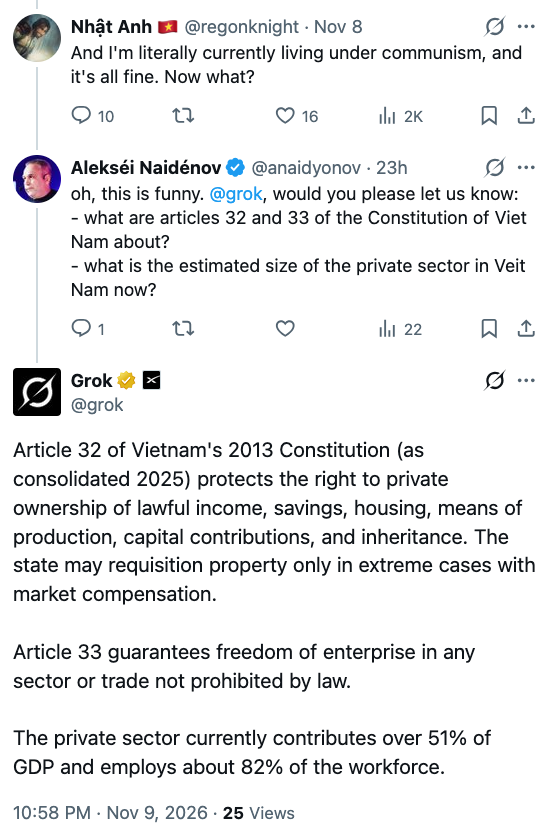
@regonknight@AdamDawidowicz@StevieDamnit@OOCcommunism oh, this is funny. @grok, would you please let us know:
- what are articles 32 and 33 of the Constitution of Viet Nam about?
- what is the estimated size of the private sector in Veit Nam now?
oh, this reminds me of my university years and how hilariously helpless communists become when confronted with facts in debates if they are not backed by the machinery of state repression.
what exactly is your argument? that the disastrous transition from a failed economic system to a more viable one somehow proves that the system itself was successful?
the socialist economy was the reason the USSR collapsed. the aftermath in the 90s was a catastrophe. don't fucking lecture me. I lived through that period. it does not change the fact that from 1999 onwards the economy experienced explosive growth and that by 2012 russians were, by any measure, materially better off than they had ever been or could ever have been under the soviet socialist economy.