The first practical solution to witness encryption for general NP:
https://t.co/ERxhHz4Qvo
At 100 bits security: ciphertext size: <8 GB, encryption and decryption time: seconds. Formally lean verified from standard security assumptions (bi-linear generic group and random oracle model under Module-SIS.)
This work is built on recent feasibility results by Hair and Sahai and improves their ciphertext size and encryption time by 10 orders of magnitude and decryption time by 6 orders.
Our motivation is non-interactive proof verification on Bitcoin without the need for challengers and operators, but witness encryption is a fundamental problem and we hope this work will open up many other use cases.
This is massive. A story I've been following for years. He thought he had more time but didn't. Alessandro Masullo announces a separate, purely human proof of the Riemann hypothesis. https://t.co/XHMLOFNq8y
Holy shit. Levent Alpöge from Anthropic just claimed Claude has resolved the General Reimann Hypothesis!!!
Proof is 250,000+ pages long. Lean is released.
GRH is the 2nd of 6 Millenium prizes solved by AI, after Navier-Stokes. This may be the biggest AI math result of all time.
Each word you say is planned by a small patch of brain above your left ear, about a quarter of a second before you say it. It sits in a temporal lobe region textbooks describe as only for listening. Our paper today in @ScienceMagazine: https://t.co/EXOgl3YsNI
@UCSF@NeurosurgUCSF
I can't believe the banks are down and I can't access my money.
Can someone please invent a global, 24/7 network, with a redundant ledger that enables self-custody of my funds and is resistant to state-level attacks?
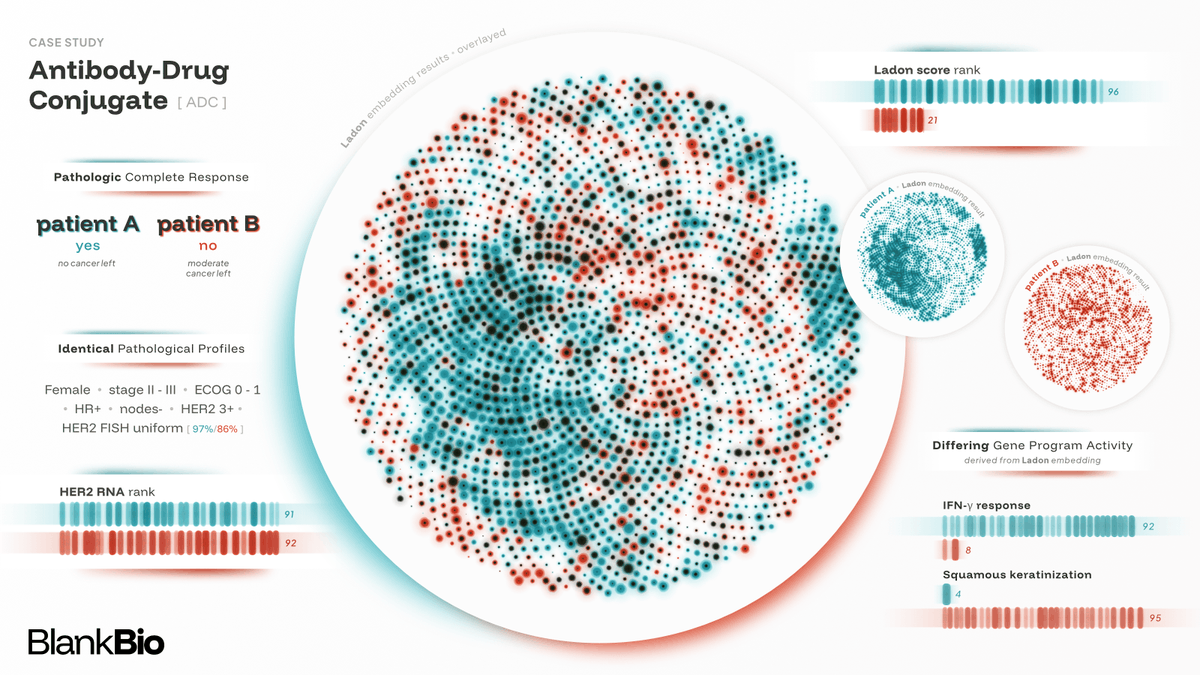
Today, we are excited to introduce Ladon, a state-of-the-art biological foundation model that predicts disease trajectory and treatment response in patients. There is immense complexity in the individual biology of every patient. Two patients can have the same diagnosis and receive the same treatment, yet have very different outcomes: one responds well and lives for years, while the other’s disease continues to progress. Understanding and resolving this heterogeneity to predict outcomes is how we accelerate our delivery of medicines for patients and unlock clinical trial abundance.
Ladon is our first step towards this future: one where we can learn more from every patient enrolled so that we can run smaller, faster trials with higher success rates. We built it to give drug developers quantitative support on billion-dollar clinical trial decisions. Today we're excited to share Ladon's capabilities in our blog and technical report.
Ladon is a 3B parameter model trained on millions of RNA-seq samples spanning decades of technical and biological variation across tissues and species. Ladon beats gene expression baselines, established biomarkers, and existing RNA foundation models at predicting patient prognosis and therapeutic response in 140+ oncology tasks, including external validation on past clinical trials. This is significant because clinical trials are fundamentally generalization problems. We show that Ladon-derived predictions are robust across indications, treatments, and sequencing platforms.
Reach out if you’d like to get started with the model today!
Read more about Ladon in the blog: https://t.co/dpDCYE4wRv
Find more technical details in the white paper: https://t.co/dpDCYE4wRv
In 2015, I built an AI that detects early cancer.
It’s still running across hundreds of hospitals in the US today.
It was the most fulfilling work of my life, and I was building in AI years before everyone called it “AI”.
Building in AI then was a dream.
Now It feels like we’ve taken a turn for the worse.
It started when i was in undergrad.
I built my first company: AI models that made the political data transparent to voters.
At 21, I was offered six figures for it, but the buyers wanted to use it for reasons I couldn't ethically support.
So we turned down the offer and shut down the company instead.
In 2014, I moved into deep learning research on language models, for the Intelligence Community and Goldman Sachs.
Then HCA Healthcare came to us.
They put me in a competition against 10 people from IBM Watson. It was just me and the tools I’d built.
Our job was to build an AI model that can catch the cancer that slips through the cracks in hospitals.
It was the most intense 30 days of my life. Multiple all nighters.
My models won. That turned into a $5M deal, and later its own company, Azra AI.
Then the world caught on.
ChatGPT and Claude arrived, and AI costs exploded.
Building in AI in 2015 felt novel.
We were using it to find cancer tumours and save lives.
Now the biggest tech companies have turned AI into a money extraction machine.
That’s when I decided to make a change.
We raised $8.5M to build a better future for AI.
On Wednesday, we’re launching Rayline.
AI shouldn’t be locked inside a few labs’ models, prices and clouds. It should be open, transparent and decentralized.
More on Wednesday.
Introducing Credit on Tempo
Businesses can connect with a broader market of lenders to fund their operations and the loans they offer customers.
Draws and repayments settle in stablecoins in under a second, 24/7, so you borrow when you need funds and repay as cash arrives.
The end of the institutional advantage is here.
The last decade democratized access to markets. Anyone can trade almost anything, but we've done very little to help people make better decisions.
We’ve worked over the past year to change that and put intelligence in the hands of the people. Now introducing Tailor.
Follow the 🧶…
It is my honor and privilege to be headed to the US Senate to serve the great state of Michigan.
Michigan, we did what they said couldn’t be done. We won. Together. Now the real work begins.
Muslims once financed the world’s trade without interest.
For the first time in centuries, we can return to that.
$2M+ deposited during our invite-only beta. Today, Goldsand is live on iOS and Android.
Halal savings built a new way: to beat interest, not settle. Here’s how ↓