CHART OF THE DAY: US oil refineries produced ~2.07m b/d of jet fuel last week, the 2nd highest ever. For six consecutive weeks, US refiners have produced >2m b/d of jet, something never seen before, even during peak summer.
📈⤵️shows last 30 years of US jet fuel output
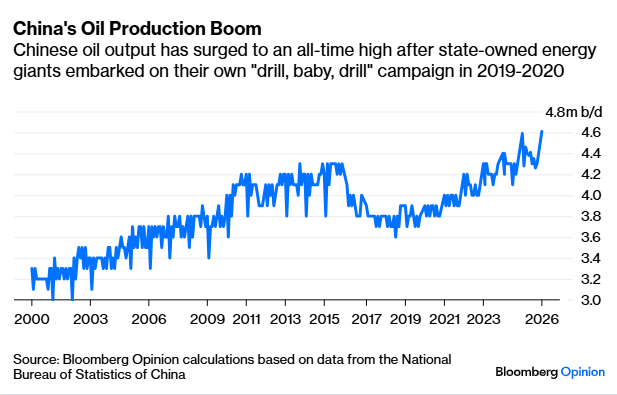
CHART OF THE DAY: Perfect timing! Chinese oil production hit a record high last month >4.6 m b/d. For sure, just a fraction of what the global oil market has lost from the Persian Gulf, but every droplet helps.
(Note Chinese domestic oil production is highly seasonal, and typically peaks in March/April. In metric tons, China produced 19.07 million tons of crude in Mar 2026 vs 19.03 million in Mar 2025)
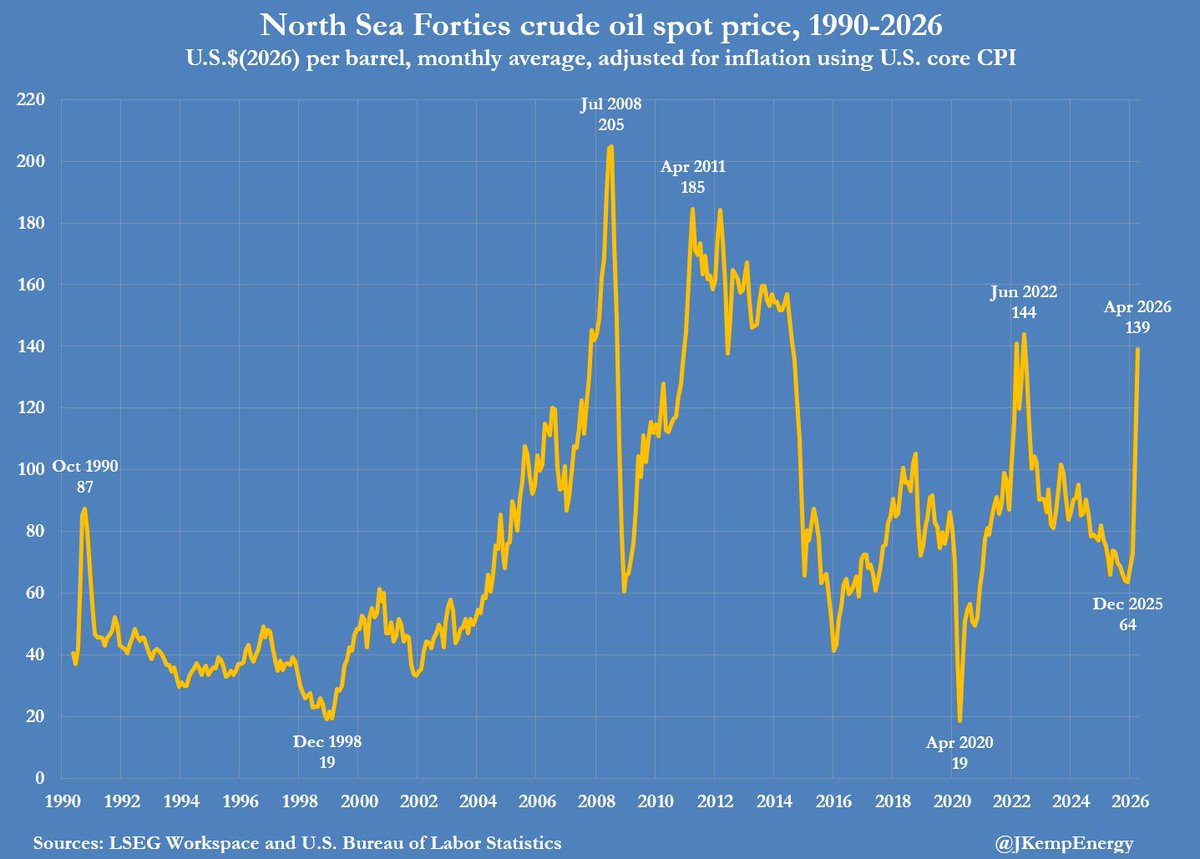
NORTH SEA FORTIES crude prices closed at a record $147 per barrel on April 9. Forties is one of the principal streams in the Brent complex and prices have doubled since before the war between the United States and Iran broke out. Prices have remained high since the ceasefire reflecting the continued scramble for available barrels in the physical market and intense squeeze on North Sea supply. Forties prices have averaged $139 per barrel so far this month but remain slightly below the previous high of $144 in June 2022 (after Russia’s invasion of Ukraine) and well below the record of $205 in June 2008 after adjusting for inflation:
Vertical Aerospace has achieved a historic milestone: piloted thrustborne transition.
An industry first under the oversight of the UK @UK_CAA working closely with @EASA toward certification.
This means our aircraft can now take off vertically and transition seamlessly into efficient wingborne flight - a critical step toward two-way transition.
https://t.co/hHaljfsieP
#ElectricAviation #eVTOL #Aerospace #Innovation
📽️ WHY are diesel prices rising so fast?
Well, partly because this is the worst oil supply shock in modern history.
And partly because of an obscure decision taken by politicians decades ago.
My latest mega primer on the economic consequences of war in the Gulf👇
Demand destruction won’t fix this. The world cannot function with 10–15% less energy.
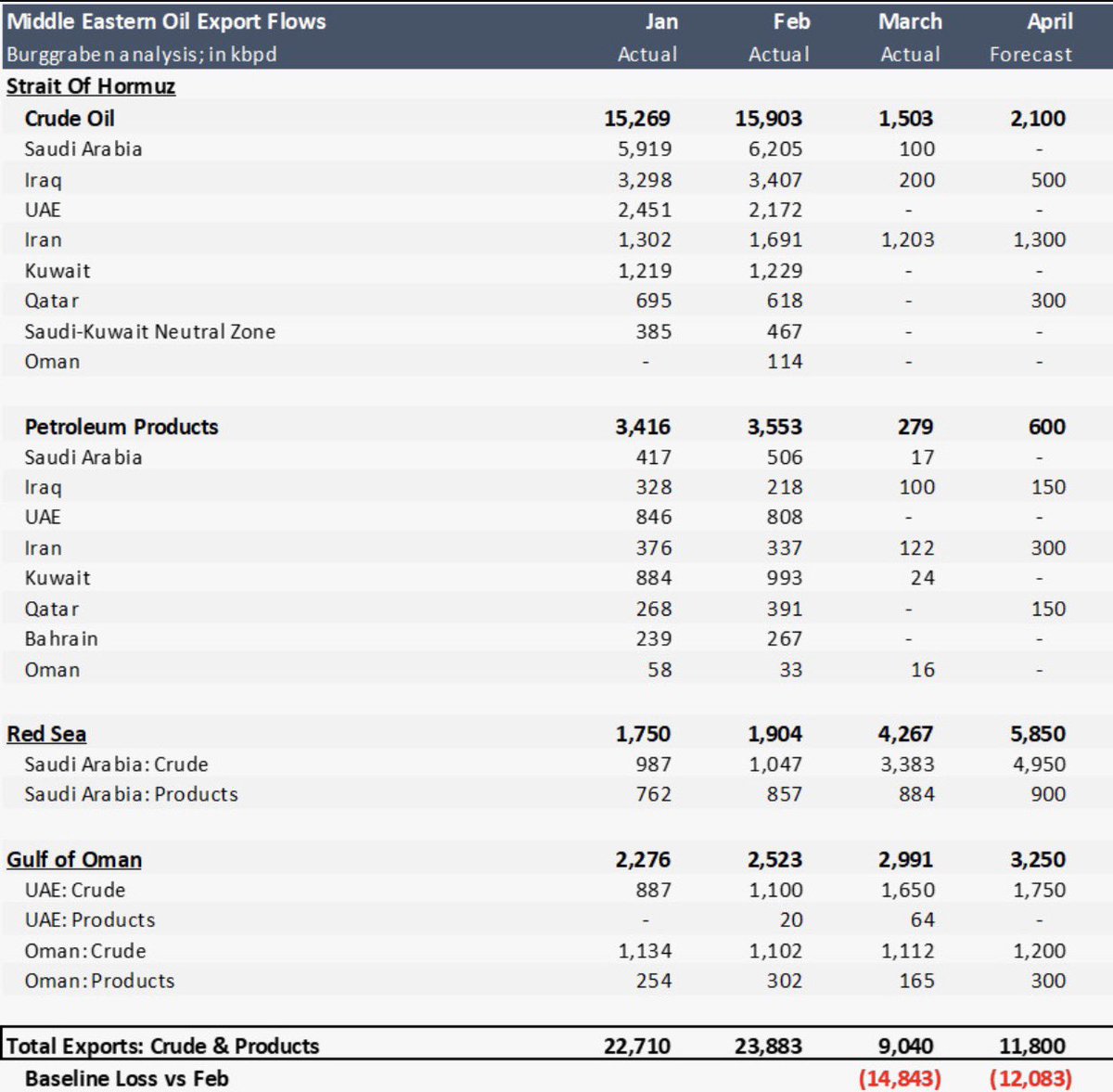
We are 15mbpd short of crude & products versus my Feb baseline. If the Red Sea route remains open to the South (VLCCs) and assuming some VIP toll booths treatment (like 20 « Pakistani » vessels), it reduces to 12mbpd in April.
Some of the gap is compensated with SPR releases, but with highly uneven results due to location & quality issues.
During Covid, when OECD, China, and most major economies briefly shut down (Chinese literally locked people up in their apartments), demand fell by 16.5mbpd at peak, and only for a few weeks. Most demand snapped back within weeks. Demand normalized within months, adjusted for the recession and ex-jet.
Gasoline, diesel, & bunker demand are highly inelastic. People don’t stop driving or shipping because prices rise. Jet and naphtha are more elastic, but cannot fix the lack of crude at the refinery level evenly.
By April, some governments will learn that reopening the Strait is not optional, and that it takes real resources to do so. That’s when panic begins.
This has the potential to become the mother of all crises. Respect it. It’s highly likely to get real awkward. And pay attention to the political blame game that’s already in full swing and isn’t helping.
Eventually this crisis gets fixed and yes, the invisible hand of oil is incredibly powerful. But it won’t return to pre-war barrel counting anytime soon and certainly not with policies like this.
The situation on oil markets is like a car racing towards a wall. The car is not slowing down (at today's prices, there is hardly any demand destruction). Instead, everyone in the car is betting that the wall will disappear before a crash happens.
Good to see our salt story followed up here👇
The slow motion collapse (actually no longer slow motion) of Britain's chemicals industry is a BIG deal.
But NB it's not just salt.
Ammonia, sulphuric acid, ethanol, and a host of other foundational chemicals too. All going or gone
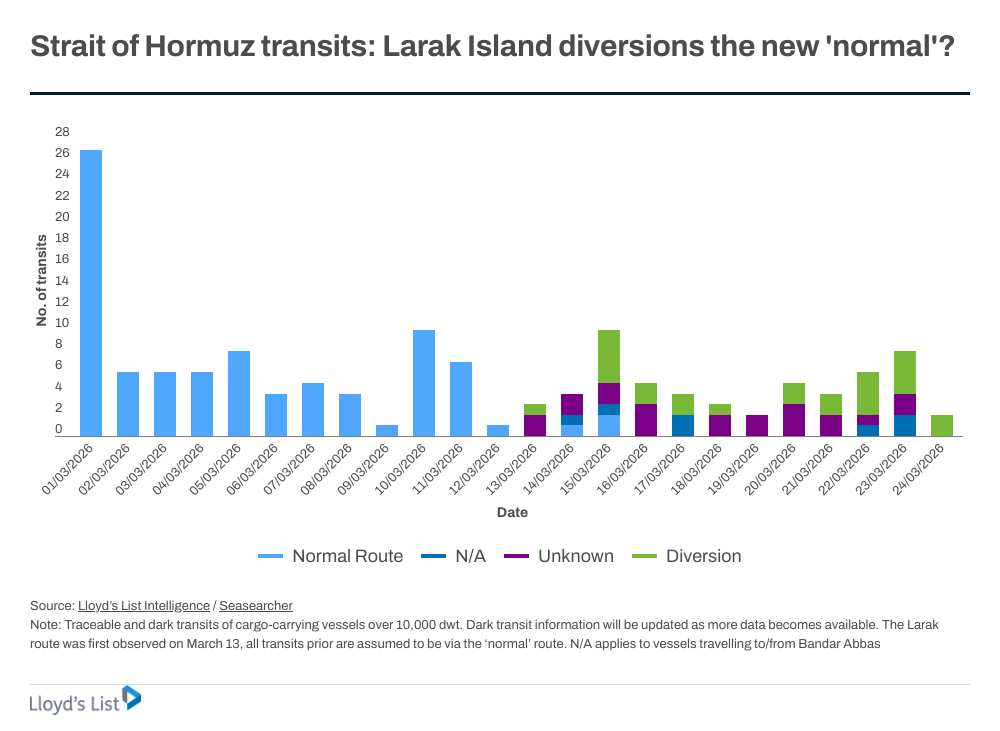
The limited flow of traffic moving through the Strait of Hormuz is now sailing exclusively through an IRGC-controlled corridor requiring specific clearance codes and an Iranian escort service
We’ve been approaching transition from both ends - accelerating from hover, tilting the propellers from 90 to 50 degrees, and decelerating from wingborne flight, tilting the propellers from 0 to 40 degrees, as we incrementally expand the envelope.
Today’s test saw our test pilot Paul Stone accelerate in hover from 0–43 knots, with the front propellers tilting to 50 degrees - huge amount of data captured and another step forward in building real, certifiable performance.
Effective IMMEDIATELY, I have ordered the United States Development Finance Corporation (DFC) to provide, at a very reasonable price, political risk insurance and guarantees for the Financial Security of ALL Maritime Trade, especially Energy, traveling through the Gulf. This will be available to all Shipping Lines. If necessary, the United States Navy will begin escorting tankers through the Strait of Hormuz, as soon as possible. No matter what, the United States will ensure the FREE FLOW of ENERGY to the WORLD. The United States’ ECONOMIC and MILITARY MIGHT is the GREATEST ON EARTH — More actions to come. Thank you for your attention to this matter! President DONALD J. TRUMP
https://t.co/QXScRBubJn
The red arrows are crude oil tankers. You are seeing about 18 million barrels per day of seaborne crude grind to a halt. Data and visualization by @MarineTraffic . Insurers and owners don't want vessels to transit at present. Stakeholders will react accordingly.
Saudi Arabia’s de facto leader Crown Prince Mohammed bin Salman, for the first time, has authorized the Royal Saudi Armed Forces to strike back against Iran if necessary, calling attempted attacks by Iran against the east of the country and Riyadh “cowardly,” and stating that Iran knows that Saudi Airspace was not used for strikes against it by Israel or the United States, according to CNN.
@AlexFinn Surely the heat ejected by the units on top warms the units below... is there thermal throttling on the Mac Studio? Feels like there is a more thermally optimum solution. Must say - love your work and yes.... jealous of your tidy desk and neat set-up. Working on similar here!
⚠️ Reality check re: Commercial Shipping
Regional overview
At this time, there are no confirmed, widespread disruptions to commercial port operations across the Middle East. Ports remain open and operational in most locations, with vessel movements and marine services continuing under local port authority guidance.
Oman
Port operations at Sohar, Muscat, Duqm and Salalah are operating normally.
No operational alerts or restrictions have been issued by local authorities.
ISPS level remains at Level 1.
Air travel remains subject to airline and airspace advisories.
United Arab Emirates
Fujairah and Khor Fakkan ports remain operational, with no navigational warnings issued by local port authorities.
Ruwais Port is operating at ISPS Level 2, while Fujairah and Khor Fakkan remain at Level 1.
Port and marine operations are proceeding as usual.
Some airspace restrictions have been implemented, which may affect flight availability.
Qatar
Port operations continue under local authority guidance.
At Ras Laffan, the port remains open, with reports of GPS signal degradation.
Airspace restrictions are in place and may impact flight movements.
There is no confirmed impact on vessel operations at this time.
Bahrain
Port operations are currently suspended, pending an official circular from the authorities.
Airspace restrictions have been implemented, which may affect travel.
Further updates will be issued once official confirmation is received.
Kuwait
Port operations continue as normal, with no stoppages reported by port authorities.
ISPS level remains at Level 1.
Temporary airspace restrictions may affect flight movements.
Egypt
The Suez Canal and all Egyptian ports are operating normally.
No alerts or operational restrictions have been issued.
ISPS level remains at Level 1.
Pakistan
Port operations are continuing as usual.
No official statements or restrictions have been issued by port authorities at this time.
Jordan
The situation in Jordan remains calm and stable.
Aqaba Port is operating normally, with all terminals and facilities open.
There are no operational restrictions, disruptions, or changes to vessel handling or cargo operations.
Marine services, berthing, stevedoring, and gate movements continue as usual.
ISPS level at Aqaba Port remains at Level 1.
Jordan’s airspace remains open, although a limited number of flights have been temporarily suspended by airlines as a precaution.
Domestic travel within Jordan and access to Aqaba remain unaffected.
Source: Port agents Inchape Shipping (28 Feb 2026)