Warren Buffett turned 96 on August 30.
This year is a little different. After decades of running Berkshire Hathaway, Buffett handed over the CEO role to Greg Abel earlier this year.
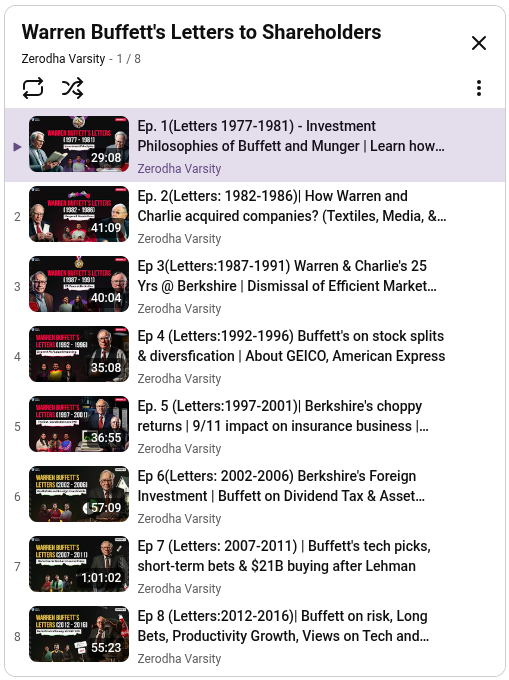
A couple of years ago, we spent nearly 8 months going through 47 of Buffett’s shareholder letters and turned them into a 10-part Varsity series.
The interesting part about these letters isn’t just Buffett’s stock picks. They show how his thinking evolved over the years — on buying businesses, valuing companies, dealing with market crashes, capital allocation, management, mistakes, temperament, and of course, the influence of Charlie Munger.
Now, with Berkshire entering a new era, it felt like a good time to bring this series back.
If you want to understand Buffett beyond the famous quotes, this is a good place to start. Check the link in the comments.
INDIAN EXPRESS DROPS A LAND BOMB ON BJP CM 🔥
After Mohan Yadav became Madhya Pradesh CM, his family and real estate companies reportedly bought at least 137 plots spread over 168 acres in and around Ujjain.
This is the same Ujjain being reshaped for Simhastha 2028 with highways, road widening, townships, riverfront projects, medical city, IT park and new commercial zones.
The most damning part is this: out of the 168 acres bought after he became CM, 111 acres are reportedly located along roads announced by CM Mohan Yadav himself.
His family already had land. But after Dec 2023, the land buying saw a sharp jump, right when Ujjain’s development map started turning into a goldmine.
Indian Express repeatedly asked the CM for answers. He stayed silent.
This is how BJP turns religion into a business model 😡
She destroyed the Indian critics in just 5 minutes with facts and figures. 😊
From Shankar Sharma to all handles here who are cursing LTCG, STT.... She says, u all are dismissive!!
Bravo to that lady!!👍
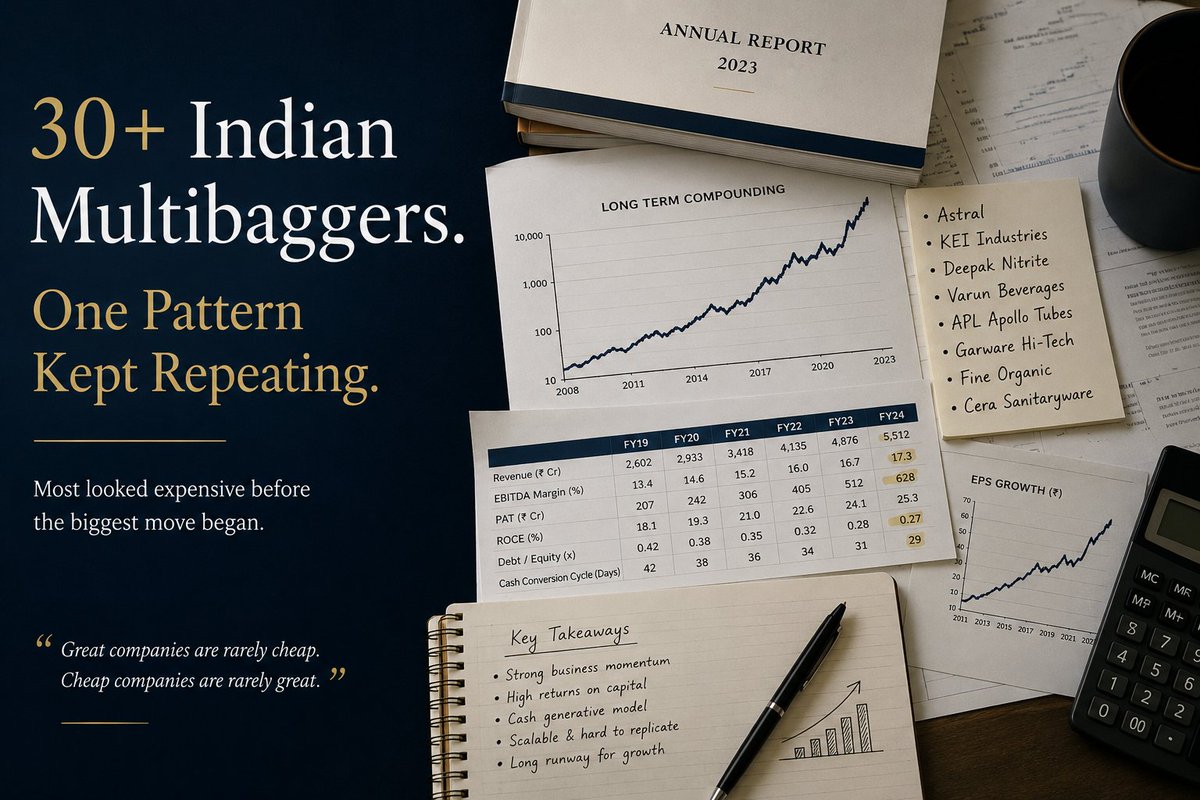
I have tracked 30+ Indian #Multibaggers in the last 15-20 yrs, & there is this 1 very unique pattern that has kept repeating! Always!
Most of these stories looked expensive before their biggest wealth creation phase even started !
✨ Astral traded at premium valuations for years when revenues were still around ₹700–800 Cr levels. Most investors only saw a pipes company trading at 40–50 PE. What the market was actually pricing was distribution strength. Astral kept adding dealers, expanding adhesives through the ResiQuick acquisition & moving deeper into the building materials ecosystem. Revenues today are above ₹5,500 Cr. The stock went from being called “too expensive” at ₹2,000 Cr market cap to crossing ₹40,000 Cr+ later.
✨ KEI Industries is another case I remember very clearly when around 2018–19, many investors refused to buy because the valuation looked stretched for a small cables business firm. But revenues were around ₹3,000-3200 Cr then. Today they are above ₹9,000 Cr. Retail contribution increased sharply, dealer network expanded & operating margins improved despite copper volatility. The market was stopped paying for current yr earnings, it started paying for scale that was still building.
✨ Deepak Nitrite is another such bet that completely changed character during the phenolics expansion. Before that, it was viewed largely as another cyclical chemicals company. Then profits exploded. PAT moved from below ₹200 Cr to above ₹1,000 Cr during the strong cycle. ROCE surged, operating leverage kicked in hard & the stock rerated massively because earnings power itself changed.
✨ Varun Beverages had the “overvalued” bottling company for most. But revenues moved from roughly ₹5,000 Cr levels years ago to above ₹20,000 Cr. Distribution kept expanding across India & overseas territories, volume growth stayed strong & most importantly 'operating leverage' kept surprising analysts. For many quarters people waited for a big correction, but VBL's earnings kept compounding & it delivered massive returns.
✨ APL Apollo Tubes looked expensive compared to traditional steel companies trading at single digit PE multiples, but this was never a traditional steel story. Structural steel tube penetration was rising across India, branded play was strengthening & manufacturing scale became enormous. Revenues crossed ₹20,000 Cr while margins remained structurally superior versus commodity steel players.
✨ Garware Hi Tech Films (I have shared multiple tweets about it) spent years getting ignored because investors mentally placed it in commodity packaging films. Then specialty products started driving the business, products like Sun control films, paint protection films & export focused high margin products improved profitability sharply. Suddenly the market started treating it as a specialty manufacturing company instead of a low-margin commodity player.
✨ Fine Organic is another such NICHE business that kept trading at premium valuations because margins consistently stayed above 20% with very high ROCE. The market understood early that niche food & polymer additives with strong export positioning are very different from cyclical commodity chemical businesses.
✨ Cera Sanitaryware the boring compounder kept growing through dealer expansion, premium bathroom products & improving brand positioning while housing demand & premiumisation trends kept strengthening in India.
Folks, 1 thing I noticed across almost all these companies & it is so easily visible : The market usually rerates businesses long before reported earnings fully reflect the future opportunity. That is why many of the biggest winners never looked statistically cheap during their strongest compounding phase.
This is The GREATEST BOOK Ever Written.
In this book, Billionaire Charlie Munger reveals his top secrets to success.
Here are 21 of the most notable life lessons from the book " The Poor Charlie's Almanack."
1. Money buys freedom; use it wisely.
2. Do the tough tasks first; the rest feels easy.
3. Focus your energy on your top-notch idea. Skip the rest.
4. Only team up with folks you truly look up to.
5. Great ideas are like hidden treasures. When you find one, bet big on it.
6. Stopping a bad habit is simpler than trying to quit one.
7. Identify your core strengths and dedicate yourself indefatigably to them.
8. Only play games where you've got an advantage.
9. Be tough and adaptable—like a superhero's suit.
10. Aim for self-sufficiency; it's a superpower.
11. Sometimes, working backward is the key to solving tricky problems.
12. Avoiding stupid mistakes is more important than being smart.
13. Tough times are a given. When they hit, stand up and keep moving,.
14. Self-pity won't get you anywhere.
15. Brilliant ideas are like rare gems. When you stumble upon one, go all in with your bets.
16. Cultivate the curiosity of a relentless explorer, unwrapping ideas with the zeal of a detective solving a captivating mystery.
17. Self-improvement is a boundless odyssey, an ongoing symphony of attentive evolution.
18. Cultivate Persistence: Approach your goals with the tenacity of a gardener tending to a bonsai tree, nurturing growth with patient persistence.
19. Pinpoint what you rock at, and rock it forever.
20. Focus on your most exceptional idea; avoid spreading yourself too thin.
21. Embrace failure not as defeat, but as an illuminating stepping stone in your journey, illuminating the path ahead.
Software development is undergoing a renaissance in front of our eyes.
If you haven't used the tools recently, you likely are underestimating what you're missing. Since December, there's been a step function improvement in what tools like Codex can do. Some great engineers at OpenAI yesterday told me that their job has fundamentally changed since December. Prior to then, they could use Codex for unit tests; now it writes essentially all the code and does a great deal of their operations and debugging. Not everyone has yet made that leap, but it's usually because of factors besides the capability of the model.
Every company faces the same opportunity now, and navigating it well — just like with cloud computing or the Internet — requires careful thought. This post shares how OpenAI is currently approaching retooling our teams towards agentic software development. We're still learning and iterating, but here's how we're thinking about it right now:
As a first step, by March 31st, we're aiming that:
(1) For any technical task, the tool of first resort for humans is interacting with an agent rather than using an editor or terminal.
(2) The default way humans utilize agents is explicitly evaluated as safe, but also productive enough that most workflows do not need additional permissions.
In order to get there, here's what we recommended to the team a few weeks ago:
1. Take the time to try out the tools. The tools do sell themselves — many people have had amazing experiences with 5.2 in Codex, after having churned from codex web a few months ago. But many people are also so busy they haven't had a chance to try Codex yet or got stuck thinking "is there any way it could do X" rather than just trying.
- Designate an "agents captain" for your team — the primary person responsible for thinking about how agents can be brought into the teams' workflow.
- Share experiences or questions in a few designated internal channels
- Take a day for a company-wide Codex hackathon
2. Create skills and AGENTS[.md].
- Create and maintain an AGENTS[.md] for any project you work on; update the AGENTS[.md] whenever the agent does something wrong or struggles with a task.
- Write skills for anything that you get Codex to do, and commit it to the skills directory in a shared repository
3. Inventory and make accessible any internal tools.
- Maintain a list of tools that your team relies on, and make sure someone takes point on making it agent-accessible (such as via a CLI or MCP server).
4. Structure codebases to be agent-first. With the models changing so fast, this is still somewhat untrodden ground, and will require some exploration.
- Write tests which are quick to run, and create high-quality interfaces between components.
5. Say no to slop. Managing AI generated code at scale is an emerging problem, and will require new processes and conventions to keep code quality high
- Ensure that some human is accountable for any code that gets merged. As a code reviewer, maintain at least the same bar as you would for human-written code, and make sure the author understands what they're submitting.
6. Work on basic infra. There's a lot of room for everyone to build basic infrastructure, which can be guided by internal user feedback. The core tools are getting a lot better and more usable, but there's a lot of infrastructure that currently go around the tools, such as observability, tracking not just the committed code but the agent trajectories that led to them, and central management of the tools that agents are able to use.
Overall, adopting tools like Codex is not just a technical but also a deep cultural change, with a lot of downstream implications to figure out. We encourage every manager to drive this with their team, and to think through other action items — for example, per item 5 above, what else can prevent a lot of "functionally-correct but poorly-maintainable code" from creeping into codebases.
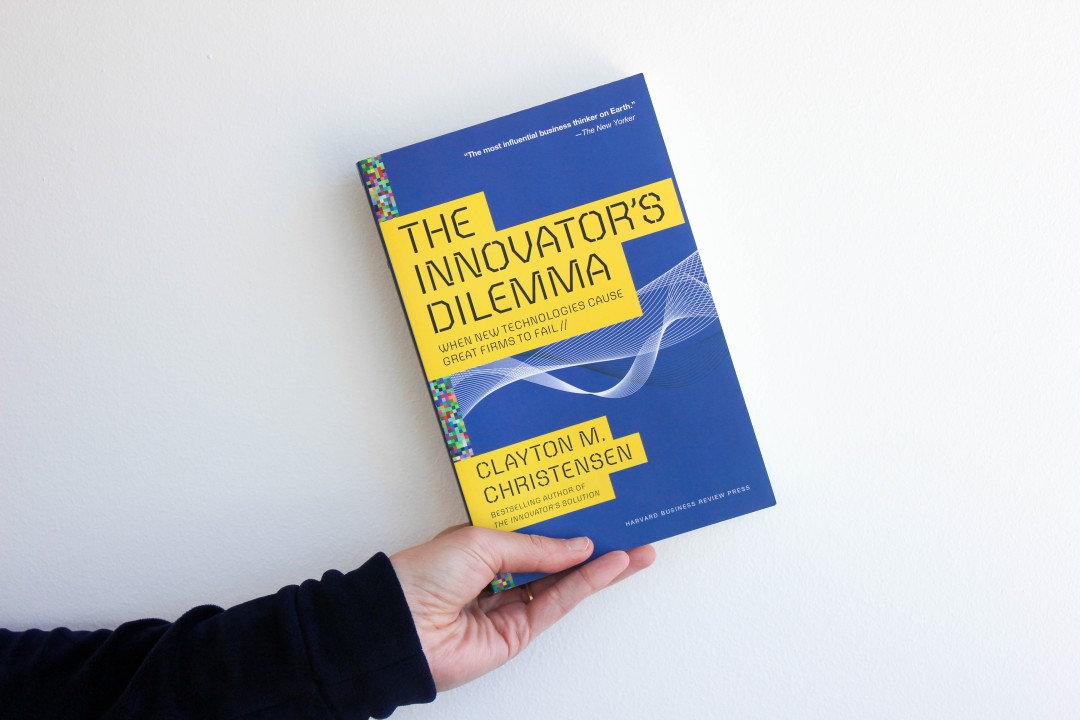
Jeff Bezos called it “the best business book I’ve ever read.”
Clayton Christensen spent 30+ years studying why great companies fail.
Here are 10 lessons from the book that every entrepreneur should know:
Want to make faster, smarter decisions?
Charlie Munger used a system to think better than 99.9% of people alive.
Warren Buffett called him “the best 30-second mind in the world.”
That system? Mental Models.
Here are 21 you can use today:
Custom instructions provide more context about your specific coding preferences and tech stack. Better context = better results from the LLM.
And custom instructions are extra helpful for remote development, where you can provide more info about the type of remote environment you're connected to.