Clever headline by @AnandThaker, "from uncertAInty to certAInty." Even though AI is at the core of every executive conversation, there is a need to take a step back, drop the topic of AI for a hot minute, and recognize the role of leadership in driving business reinvention vs. iteration. AI now and as it evolves, is an enabler. Enabling which outcomes you want to achieve requires leadership and transformation, then AI has purpose, to put AI to work...for people.
https://t.co/0p8yjbLICp
So it seems that @HomeDepot may have been hacked and after several months still unable to repair the damage.
Check your accounts. If you have alternatives, id suggest using them.
~20yr loyal @HomeDepot customer, 6+ months , no resolution.
Lost perks, transaction history and access for services. $30K value gone.
Desk says go online, visa versa. Kind CSRs, poor Tech support.
Interestingly HD online shopping CX times grew 225% while others dropped.
~20yr loyal @HomeDepot customer, 6+ months , no resolution.
Lost perks, transaction history and access for services. $30K value gone.
Desk says go online, visa versa. Kind CSRs, poor Tech support.
Interestingly HD online shopping CX times grew 225% while others dropped.
The more data you put in your presentation, the less likely people are to make a decision.
It’s counterintuitive. Here’s why…
Whenever you’re preparing for an important presentation, you have plenty of data, charts, and statistics you could use.
If you’re like most leaders, you tend to cram all of it into your presentations in an attempt to make the most compelling argument possible.
You think that if they could just see all of these numbers, they’d be convinced.
But here’s the problem…
Humans don’t make decisions based on logic alone.
Yet, we often structure our presentations as if they do because WE understand what all the information means.
The result?
You overwhelm them instead of convincing them.
So, how can you strike the right balance between enough compelling data to convince your audience, but not so much that you overwhelm their decision-making capacity?
The rule of thumb Duarte teaches leaders:
Only include the most critical information that supports your idea.
Display data that creates the biggest contrast between your audience’s present reality and the ideal future they can achieve through your idea/solution.
Don’t “data dump” and think that your audience will be convinced if you keep piling on the stats.
Distill your data into the most compelling story you can possibly tell, and leave out the rest–or, at a minimum, move all your great data into an appendix.
Want other proven data storytelling techniques you can use in your next high-stakes presentation?
Becky Bausman from our team recently did a deep dive on the techniques we’ve seen work wonders over the last few decades to create clear, compelling presentations.
Link to the video: https://t.co/AVbqCMtAZK
Tomorrow: Excited to discuss VC, AI, enterprise startup, & innovation landscape w. host @BrentLeary and fellow investors @sbeechuk of @NorwestVP & @alexbard of @Redpoint both having delivered to our collective, fantastic returns & insights. https://t.co/tju4jbiuHz #VC#AFGM
@andrewchen Found 'How to Win Friends and Influence People' a top marketing book. Use as a start in giving many talks/presos.
Was gifted this 1st 30k print, signed copy by a client (her family collection) after a $90M new LoB outcome from our platform. Sadly a page came out.
My next startup...sort of
Except it's not a startup
Along with a few others, I'm working on building a 6th to 12th grade School of Entrepreneuring.
And so I wanted to share some of my 'wet clay' thoughts on how we're thinking about this as I know there are a lot of smart people here who can sharpen our thinking, advance the mission, etc
In this first note, I wanted to share a loose curriculum outline which is below
If what you see below resonates, pls share/RT this.
OR if you have any ideas, suggestions or helpful resources, pls reach out via a comment or DM.
▶ But first, a bit about the school
* This would be a physical, in-person school. We are evaluating 'campus' options and strategies now.
* It would be 100% scholarship-driven (for at least the first 1000 students). Our primary goal will be to identify and recruit formidable young people to the school irrespective of their ability to pay.
* The school is NOT focused on college prep, i.e., our hope is many students will build businesses and "go pro" in biz out of school. Of course, they can choose to go to college but our focus is not on AP credits, SAT/ACT scores, contrived leadership experiences and community service to pad college applications, etc.
* Experiential- and project-based learning. The best way to learn to swim is to get thrown into the water, i.e. students will build valuable products/services for real customers and generate revenue. We expect many of their ideas, esp initially, won't be great but they will learn a lot by engaging in productive struggle. This is true for many entrepreneurs. If we can work out their bad to ok ideas fast, we can get to the great ideas quicker.
* This will not launch soon. We are talking about a physical school and we are talking about the education of young people. This is not something you can or should launch as an MVP (minimum viable product). It will be done right. And doing it right will take time.
So now, the curriculum.
I'd welcome feedback/ideas here.
As you'll see below, the curriculum is not subject-based the way schools are traditionally set up but instead is skills-based.
This does not mean that English, history, etc will not be taught. As you'll prob be able to see, they will be integrated into the development of these skills thus avoiding the 'cram. exam. erase.' model so prevalent today where students learn for a test and then forget 5 mins after the exam is over.
Note: I'm happy to elaborate via some examples if helpful.
Entrepreneuring School Skills Curriculum
I. Critical Thinking and Decision-Making Skills
◾️Cognitive Agility: Processing new information to adapt perspectives.
◾️Critical Thinking: Evaluating information systematically.
◾️Decision Making: Choosing among alternatives under uncertainty.
◾️Probability & Statistics: Managing and understanding risk & upside.
II. Leadership and Communication
◾️Persuasion: Influencing others effectively.
◾️Spontaneous vs. Public Speaking: Mastering different speaking contexts.
◾️Storytelling and Writing: Engaging and convincing through narrative.
◾️Digital Literacy: Navigating digital tools and platforms effectively.
◾️Leadership: Identifying opportunities and guiding team strategies.
◾️Motivation: Inspiring team commitment and performance.
III. Problem Solving and Innovation
◾️Problem Solving: Developing solutions to complex challenges.
◾️Improvisation & Adaptability: Adapting creatively to on-the-spot scenarios.
◾️Deductive vs. Inductive Thinking: Approaching problems with different reasoning strategies.
◾️Curiosity: Pursuing continual learning and understanding.
IV. Negotiation and Conflict Resolution
◾️Negotiation: Reaching agreements between parties.
◾️Debate: Engaging in structured argumentation to challenge ideas.
V. Personal Development, Resilience and Character
◾️Risk-Taking: Embracing and managing failure and uncertainty.
◾️Resilience: Maintaining effectiveness in the face of discomfort.
◾️Consistency and Dedication: Cultivating habits that lead to success.
◾️Accountability: Showing up and taking responsibility for actions.
◾️Community Improvement: Making decisions that consider impacts on local and broader community.
◾️Physical Toughness: Enhancing personal health and endurance.
Thanks to the many teachers, athletic coaches, parents and entrepreneurs who've provided insights and feedback that has informed the above in addition to a treasure trove of academic research that folks have suggested/shared on how students actually learn best as well as what does not work.
(Note: a lot of what is done in many our schools today is very counter to what actually works)
🏴Some closing thoughts
Ellwood P. Cubberley, the founding dean of Stanford University's School of Education, described the purpose of schools as follows:
“Our schools are, in a sense, factories in which the raw products (children) are to be shaped and fashioned into products to meet the various demands of life”
Schools should NOT exist to train children to be compliant and conforming employees and consumers.
A school should teach students to be explorers, adventurers and leaders.
That is what we're building.
If that interests you, please follow along and spread the word.
A worthwhile read - and beautifully designed - report that should make CEOs re-think everything from:
- Internal Hire vs. Fractional CMO
- 'GTM experts' vs. Direct Team Experiences
- Playing Paced vs. Full Court on Competition
all to be rethought, brought to you by AI.
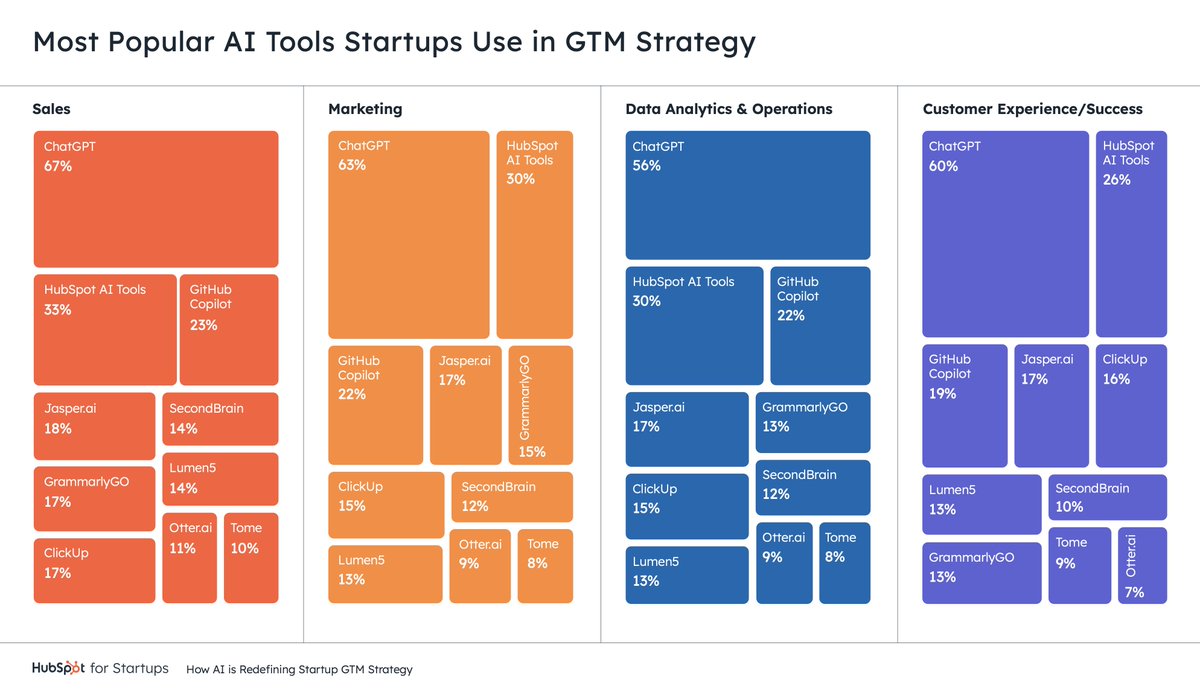
Great new study from @HubSpot@HubSpotStartups on how startup founders (n > 1,000) are adopting AI in their GTM strategy.
Cool graph of the most popular tools they're using for different GTM functions. #martech
https://t.co/rs50NbWqw8
How High-Performing Teams Build Trust https://t.co/0EYxDRV8xS
Survey Said...
1. They don’t leave collaboration to chance.
2. They keep colleagues in the loop.
3. They share credit.
4. They believe disagreements make them better.
4. They proactively address tension.
@daleyervin You might already be on this, but add 'Join or Die' to your viewing queue. Fascinating and insightful for your journey of people remaining connected. Putnam coined 'social capital'. Used some of the research in my early work outcomes w. AI & graphing.