Glad to share our collaborative work @chemengiisc@iiscbangalore on nanoscale mapping of band alignment in 2D MoSe2-WSe2 heterostructures, combining experiment and theory, published in @NanoLetters@ACSPublications:
https://t.co/aZmb7nyjHP
The results reveal fundamental mechanisms of electronic structure modulation at 2D material heterointerfaces and provide a robust platform for tailored band engineering in van der Waals materials.
@Prasana_Sahoo@ManasSharma07
The work has implications for the modeling and simulation of 2D transition-metal dichalcogenides in applications in separations, sensors, and nanofluidic devices.
We thank the @ANRFIndia for funding the work on force-field development and @moesgoi for supporting the work on tailored 2D material membranes for efficient desalination.
Happy to share our latest work, published in @nanoscale_rsc
https://t.co/MX95Gj0foq
We show that 2D MoS2 nanopores are functionalized in water and develop models to describe them. We also uncover how functional groups impact desalination performance.
@chemengiisc@iiscbangalore
Excited to share this work on wafer-scale growth of 2D magnetic CrCl3, now published in Advanced Materials:
🔗 https://t.co/AEf2gsDmA4
I contributed to the theoretical and ML aspects of this study, under the guidance of Prof. @ananthgr, Prof. Sudeep, Prof. @AkshayPhys
The code underlying the unsteady-state kinetic modeling approach is available open-source on GitHub at https://t.co/0gaJPfcbl8.
Further, the research paper can be accessed at: https://t.co/VHWxlzf5E0
The work was led by PhD student @shivam_che and is the result of a fulfilling collaboration with @Shell, involving Dr. Amar Deep Pathak and Dr. Nishant Sinha.
We look forward to the Wiley special collection on "Applications of AI and Computational Methods in Materials and Molecular Design for Decarbonizing the Energy Sector," in which this work will be featured.
We hope that the research community finds this work useful, and we look forward to engaging with the users of the code.
I am happy to share our recent publication in @wileyinresearch's Advanced #Theory and #Simulations, titled "Transient Microkinetic Modeling of Electrochemical Reactions: Capturing Unsteady Dynamics of CO Reduction and Oxygen Evolution."
Electrochemical reactions, such as CO2/CO reduction and oxygen evolution, lie at the heart of sustainable energy conversion technologies, including water electrolyzers and CO2-utilization systems. However, traditional microkinetic models of electrochemical reactors have focused almost exclusively on steady-state behavior, rather than on the transient dynamics observed in experimental measurements.
In this work, we:
🔹 introduce an unsteady-state microkinetic modeling (USS-MKM) framework that captures time-dependent reaction dynamics;
🔹 implement potential sweeping to realistically simulate experimental protocols, such as linear sweep and staircase voltammetry;
🔹 validate the approach against both steady-state modeling and experimental current-potential data; and
🔹 demonstrate automation and scalability, enabling larger electrocatalytic reaction networks to be analyzed and visualized.
🧵 INTRODUCING PyFOCK
I’ve wanted to write my own DFT code ever since I first learned what DFT actually does.
Not use one.
Not wrap one.
Build one.
Today, I’m sharing PyFock ⚛️
https://t.co/vCgoruF5qv
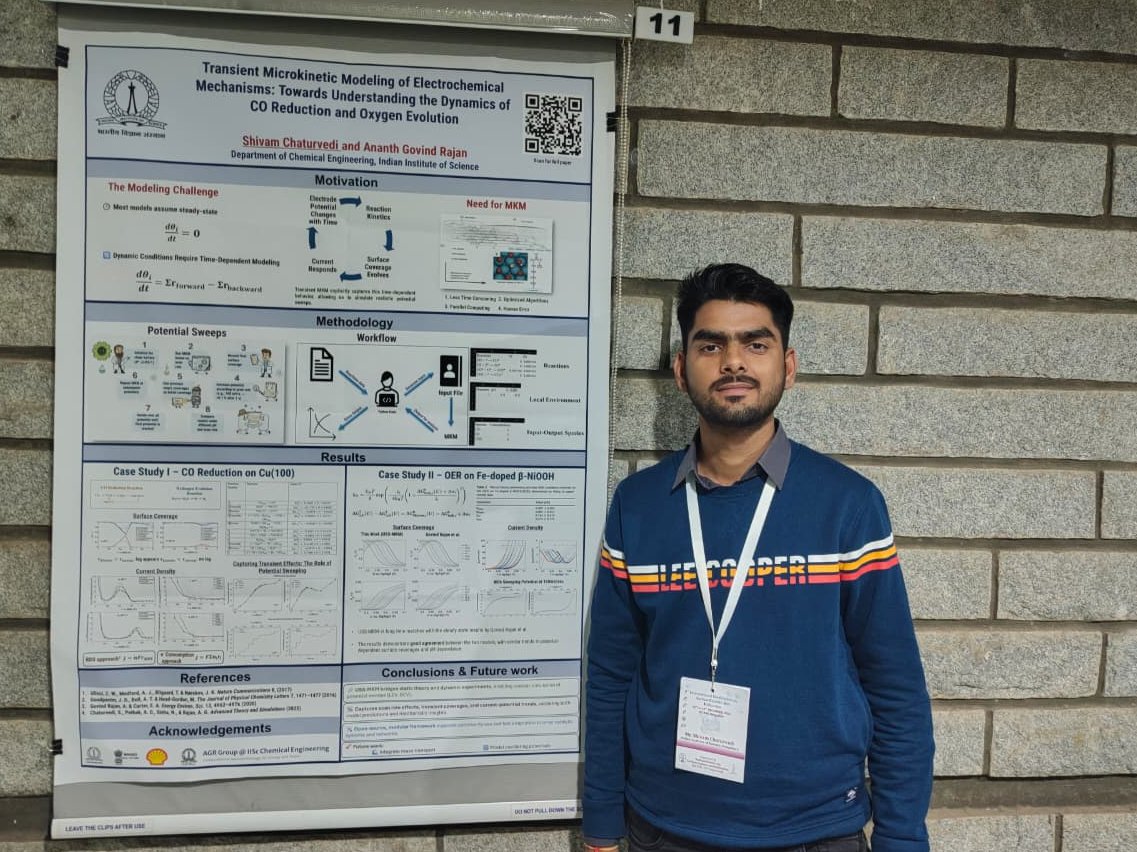
Last week, I had a great experience presenting my poster on our recently published work in ADTS at @ICCCU123775! Lots of engaging discussions and insightful feedback, plus a fun chat with Prof. @maiti_iitb.
#ICCCU25#Catalysis
It also enables predictive EDL modeling and can be integrated into implicit solvation models for quantum calculations.
The work was led by Hari R. Sudhakar (@iitbombay → @MIT), in collaboration with @ankurg90 (@CUBoulder).
Happy to share our latest work from @chemengiisc@iiscbangalore, published in @APSphysics@PhysRevE.
We present a modified, parameter-free theory to predict electrical double-layer (EDL) capacitance:
https://t.co/qjdZgZNg8E
(3/3) Excluded-volume electrostatics matter for EDL structure, but only modestly for capacitance.
Overall, this classical first-principles framework clarifies key electrochemical phenomena.
Looking forward to the Materials Research Society (@Materials_MRS) Fall Meeting in Boston later this week, where I will present our latest research from @chemengiisc@iiscbangalore.
I am honoured to be designated an "MRS Communications Early Career Distinguished Presenter" at the meeting and acknowledge international travel support from @ANRFIndia.
✅ Contributed Talks
• Size and Chemical Environment Control Defect Structure in 2D MoS₂—From Irregular to Triangular Nanopores
Session: NM05.01 | Date: Mon, Dec 1, at 11:30 AM | Venue: Sheraton, Back Bay A
• Machine Learning Accelerates Exploration of Nanoporous 2D Materials for CO₂ Capture and Massive Reaction Networks for Carbon Conversion
Session: MT04.03 | Date: Tue, Dec 2, at 11:15 AM | Venue: Hynes, Room 312
🏅 MRS Communications Early Career Distinguished Presenter Talk
Entropy, Energy, and Temperature in Nanoscale Systems—Impact of a Relative Energy Window in Microcanonical Statistical Mechanics
Session: MT02.04 | Date: Tue, Dec 2, at 2:45 PM | Venue: Hynes, Room 313
🎤 Invited Talk
Designing Functionalized 2D Material Membranes for Seawater Desalination: New Insights from Ab Initio Force Fields
Session: NM03.06 | Date: Wed, Dec 3, at 9:30 AM | Venue: Sheraton, Back Bay C
📌 Session Chair
2D Channels and Membranes II
Session: NM03.08 | Date: Wed, Dec 3, at 3:30 PM | Venue: Sheraton, Back Bay C
Looking forward to engaging with the global materials science community. If you are attending, please feel free to connect!
I’ve lost count of how many times people have asked me for an “easy intro” to TURBOMOLE. So I finally made one 😄
Thrilled to partner with @TurbomoleX for a weekly tutorial series!
Episode 1 is out now 🎥
https://t.co/ubSqvCMtnL
Geom opt + vib freq demonstrated for ibuprofen.
Excited to share our latest collaborative work in @NaturePhotonics: https://t.co/SooVyxrSHA
Prof. Chih-Jen Shih’s team at @ETH_en developed scalable nanoscale OLEDs with 100,000 PPI and 100 nm pixels, well below the diffraction limit!
Our group at @chemengiisc@iiscbangalore conducted molecular simulations to reveal surface-active, oriented emitting molecules, which are key to polarized light emission.
#NaturePhotonics #OLED #Nanotech #IISc #ETHZurich #Photonics #MolecularDynamics