Making the ASCII MMORPG of my dreams!
I realized the water looked artificial without reflections, so I spent few days fixing that. The sky is now faked too, especially the moon
Ansenjeo.
#mmorpg#indiegame#ascii
From the UGC scam to NEET paper leak to the CBSE scandal - all issues were first flagged by the Nationalists (who even coined the epithet cockroach), only to be rebuffed and ridiculed by the govt, that is now scrambling to respond when the Anarchists have jumped in.
My views:
Counter-Strike turns 27 today, and we’re celebrating by watching the best in the world play at the Cathedral of Counter-Strike.
Thank you for playing and thank you for watching. Thank you for your frag movies, nade lineups, silly game modes and videos, jokes, quips, Counter-Strike lore, inside jokes only a CS player would understand, and for your feedback; all of it.
Most importantly, thank you for your passion for the game. It’s all of you who make Counter-Strike your favorite first person shooter’s favorite first person shooter.
Happy birthday, Counter-Strike. 🎉
India is the absolute first to achieve this and every Indian should be extremely proud of how clever this is.
Let me explain what you are even looking at.
That video shows a freight train carrying shipping containers stacked two high, one box on top of another, running under live overhead electric wires.
Sounds simple. But it is not. No other country in the world has pulled this off. India is the only one.
Here is why it is so hard.
When you stack two containers on a wagon, the train becomes very tall. Around 7 metres. Normal electric train wires in India sit much lower, around 5.5 metres. So the two cannot share the same track. The train would smash straight into the wire.
That leaves you with a choice. Go electric and stack only one container. Or stack two containers and pull the train with a diesel engine.
The US, China, Canada and Australia all run double-stack trains. But they mostly do it with diesel, or on routes that were never electrified in the first place. Nobody bothered raising electric wires that high on old tracks.
India did both electric and double-stack together. That is the world first.
The reason India could do this is a decision from the early 2000s.
So, Indian Railways had a basic problem. Goods trains and passenger trains shared the same tracks. Passenger trains always get priority.
So freight trains crawled at 25 to 30 km/h. For a growing economy, moving goods that slowly is a major problem.
So we built separate tracks only for freight. No passenger trains allowed. These are the Dedicated Freight Corridors.
The government approved the project around 2006 and set up a company called DFCCIL to build two corridors.
The Western one runs from near Delhi to the port near Mumbai, around 1,500 km. The Eastern one runs from Punjab down to West Bengal, around 1,875 km.
Because they were building from zero, the engineers were not stuck with old bridges, old tunnels or old wire heights. They could decide the clearances themselves.
So they made a deliberate call to build the whole corridor tall enough for two stacked containers. And electrify it.
Then they had to solve two hard problems.
First, the wire. On a normal Indian line the wire hangs around 5.5 metres. On the freight corridor they raised it to about 7.5 metres. This is called high-rise OHE.
No railway in the world had run a regular freight wire that high before.
Second, the engine. If the wire is way up high, a normal loco cannot reach it. The arm on the roof that touches the wire, called the pantograph, would be too short.
So India needed a new locomotive. A taller reach. And enough power to drag thousands of tonnes.
This is why we built a new loco called the WAG-12.
It is a beast.
12,000 horsepower. Double the power of the old WAG-9 it replaced. It can haul trains over 6,000 tonnes, and up to 15,000 tonnes in some setups, at 100 km/h. That is roughly three times the old freight speed.
The WAG-12 has its own backstory. In November 2015, Indian Railways signed a deal worth about ₹19,604 crore, around 3.4 billion dollars, with the French company Alstom.
They built a new factory in Madhepura, Bihar. Indian Railways holds 26 percent, Alstom holds 74 percent. It was the largest foreign investment ever in Indian Railways.
Over time the factory reached close to 90 percent local manufacturing. So most of each loco is now made in India.
So, the government approved an infrastructure decision in the mid 2000s, then it got built over almost two decades by DFCCIL, Indian Railways and RDSO. The locomotive came through the Alstom joint venture.
The first double-stack train ran under high-rise wires in June 2020, from Palanpur and Botad in Gujarat. The corridor sections were opened in stages after that.
And finally, why only India can do this.
Three things stack up together.
One, broad gauge.
India runs on a wider track than most of the world, 1,676 mm. A wider track gives a bigger loading box. So India can run plain flat wagons with two containers on top. Many countries need special low well-cars to manage height, and those still do not fix the wire problem.
Two, the fresh corridor.
India built new track with no height limits baked in. Old networks in Europe and the US are full of low tunnels and bridges never meant for 7 metre trains. Rebuilding all of that is close to impossible and crazy expensive.
Three, the system.
The tall wire, the high-reach pantograph and the powerful WAG-12 were all designed to work together as one package. You cannot copy just one piece. You need the whole thing.
Put those three together and other railways simply cannot recreate it without rebuilding from scratch.
But the part I keep thinking about is that India approved this in 2006 and ran the first train in 2020.
Fourteen years. :)
Aesthetic morality is the philosophical concept that our judgments of right and wrong are deeply intertwined with our perceptions of looks - beauty and ugliness.
"If you kill a cockroach you are a hero; if you kill a butterfly you are bad. Morality has aesthetic standards"
I.M. Pei, the architect who designed the Louvre's glass pyramid, used to put it this way. In Western buildings, a window is a hole that lets in light and air. In Chinese buildings, a window is a picture frame. And the garden is always painted on the other side.
These are called 漏窗 (lou chuang), or "leaky windows." Wind. Moonlight. Glimpses of the garden, framed by every cutout in the wall. It all leaks through.
A garden designer named Ji Cheng published a whole manual on this in 1635. The Craft of Gardens. The final chapter is titled "Borrowed Scenery." Ji called it the most important part of designing a garden.
He named four kinds of borrowing. Distant: mountains, rivers, far horizons. Adjacent: the neighbor's roof, a wall, a tree next door. Upward: clouds, branches against the sky, even the stars at night. Downward: a pond, the rocks below. Every shape and height in these images is doing one of those four jobs.
In Suzhou, a canal city near Shanghai, the oldest surviving garden was built in the 1040s. It has 108 of these windows along a single corridor. No two are the same. Each frames a different slice of the same pond and the same hills.
By the early 1900s, Suzhou had more than 170 private gardens. Nine of them are now UNESCO World Heritage Sites. Researchers in 2021 photographed almost 3,000 windows across 15 of these gardens, just to train an AI that could tell the patterns apart.
The shapes meant something too. Pine for long life. Plum blossoms for purity. A bat anywhere in the pattern brought good luck to the household. Phoenix for wealth.
There's a pattern called "ice crack." Lines splinter across the wall like cracks on a frozen pond. Scholars adopted it as their own signature. For them, it stood for the moment ice breaks and spring begins, when life starts moving again.
The point of the design was simple. You should never see the whole garden at once. You walk a path, a wall blocks the view, then a window opens it again, framed differently each time. The Chinese proverb for it: "by detours, access to secrets."
A 2024 paper from Xi'an Jiaotong-Liverpool University showed the ice-crack pattern is actually stronger than a regular grid when the weight on top is uneven. Four hundred years later, the math still works.
i’ve been guilty of gatekeeping spots with the fear that more people will destroy the place..but @heyprat & i recently realised that its such a beta move to not share the joy a place can give you
so here's an attempt to share places we love starting with our fav ofc
link below
The heat has been brutal this past week. Temperatures hit 45° in Nagpur, 44° in Ahmedabad, 43° in Prayagraj, 42° in Delhi. Even Bengaluru hit 37°. And we're still in April 😬
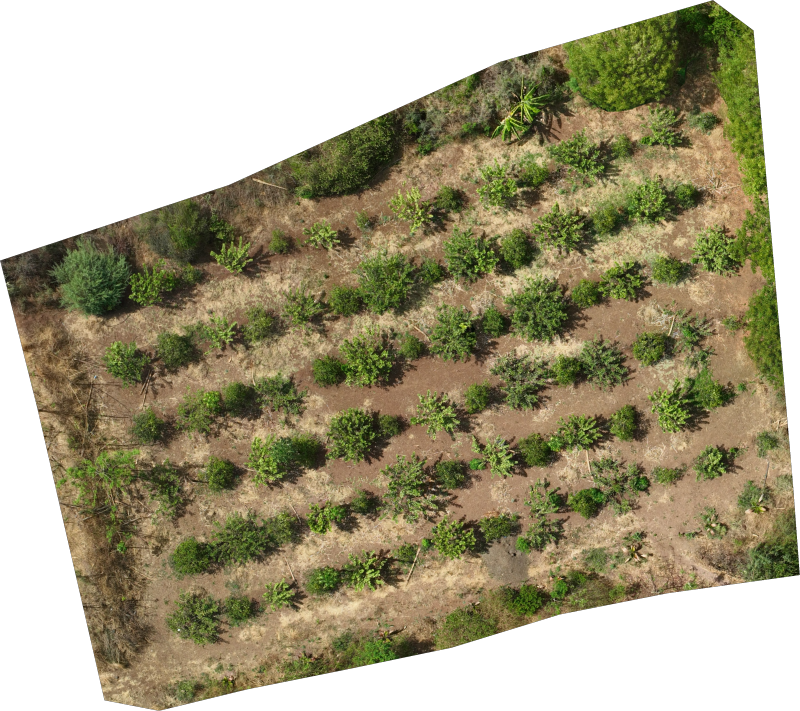
A big contributing factor behind rising temperatures is the loss of forest cover, and India has lost a lot of it. Back in 2020, we met the team behind Farmers for Forests (F4F). Their idea was to do agroforestry at scale. The challenge is that farmers can't afford to wait years for trees to pay off, and most tree-planting projects don't survive the first monsoon. The idea was ambitious, and we at @RainmatterOrg backed them early.
Most tree-planting in India is monoculture, just rows of one species. But a plantation isn't a forest. F4F plants multi-layer agroforests with fruit, timber, shrubs, intercrops, and native species, trying to mimic what an actual forest does.
Six years later, they've gone from 50 acres to 5,000 acres and have just secured funding to reach 40,000 over the next three years. Compared to traditional crop farming, per acre, they're seeing ~4x carbon sequestration, ~3x farmer income, and meaningful improvement in biodiversity and soil health. Still early days, but promising.
Those numbers needed to be verifiable. So F4F built TreeLens, an open-source tree-tracking system that uses drone imagery to measure carbon sequestration, tree height, and biodiversity across thousands of small farms. 15 other organisations now use it.
The hardest problem in agroforestry is time. Fruit trees take 5 to 7 years to pay off, and most small farmers simply can't wait that long. So F4F is now working with the government and the larger ecosystem to design financial instruments like carbon bonds and first-loss guarantees that protect farmers while the trees grow.
Really glad we backed Arti, Aditya, and Krutika early.
If you speak Kannada, Telugu, or Sanskrit, you’ve likely noticed that Hindi sounds "clipped."
Rama becomes Ram. Shiva becomes Shiv.
Even in English, "Chocolate" feels like it’s missing a syllable. Ever wondered why?
I went down this rabbit hole yesterday and was fascinated with what I learnt.
Welcome to the world of 'Schwa Deletion' in linguistics. 🧵👇