"If I'm a developer building an AI-native app, I don't care what hardware you're running it on. I just care that I get the results when I want them, at the quality I'm expecting and at the cost I'm looking for." Our co-founder @nserrino on why picking chips is our job at @gimletlabs 👇
https://t.co/2rB8Yfakrl
Trading Karl the Fog for Sydney Harbour ✈️
I'm heading to #NeurIPS2026, and on Tue Dec 8 @gimletlabs and @nvidia are hosting Weights & Whiskies in Sydney. (There's also BBQ!)
Work on inference, kernels, compilers, or the silicon underneath? Come say hi. Request to join: https://t.co/q6wWjDXRKo
🇦🇺 Heading to NeurIPS in Sydney? Come hang with us 🥃
Single malt and multi-silicon discussions, with BBQ and blues on the side. We’re throwing Weights & Whiskies with @nvidia on Tuesday night (Dec 8).
Link to join is in the post below 👇
If you're heading to @NeurIPSConf Sydney, we invite you to register for our happy hour event.
𝗪𝗲𝗶𝗴𝗵𝘁𝘀 & 𝗪𝗵𝗶𝘀𝗸𝗶𝗲𝘀 𝗶𝘀 𝗮𝗻 𝗲𝘃𝗲𝗻𝗶𝗻𝗴 𝘄𝗶𝘁𝗵 𝗚𝗶𝗺𝗹𝗲𝘁 𝗟𝗮𝗯𝘀 & @nvidia 𝗳𝗼𝗿 𝗽𝗲𝗼𝗽𝗹𝗲 𝗯𝘂𝗶𝗹𝗱𝗶𝗻𝗴 𝗔𝗜 𝗶𝗻𝗳𝗲𝗿𝗲𝗻𝗰𝗲 𝗶𝗻𝗳𝗿𝗮𝘀𝘁𝗿𝘂𝗰𝘁𝘂𝗿𝗲.
Come and re-energize yourself with whiskey, BBQ, and blues after a full day of posters and talks.
Register here: https://t.co/XkQbGheNlC
One of our AI-generated kernels ran 4.6X faster than its baseline but reached just 4% of the hardware’s estimated limit.
How much faster could it go? Does it get the right result at the required precision? Does it stay fast as batch sizes change?
These answers matter to guide agentic kernel generation.
Read Beyond Speedups https://t.co/NhUhFzPusx
And tomorrow: @gimletlabs co-founder & CEO @zainasgar joins a panel on disaggregated infrastructure for agentic AI, moderated by Gimlet’s Tom St. John, with UT Austin, NVIDIA, Argonne and d-Matrix. Thu 1:30pm CST, W185abc 👇
https://t.co/1M7pZS81JE
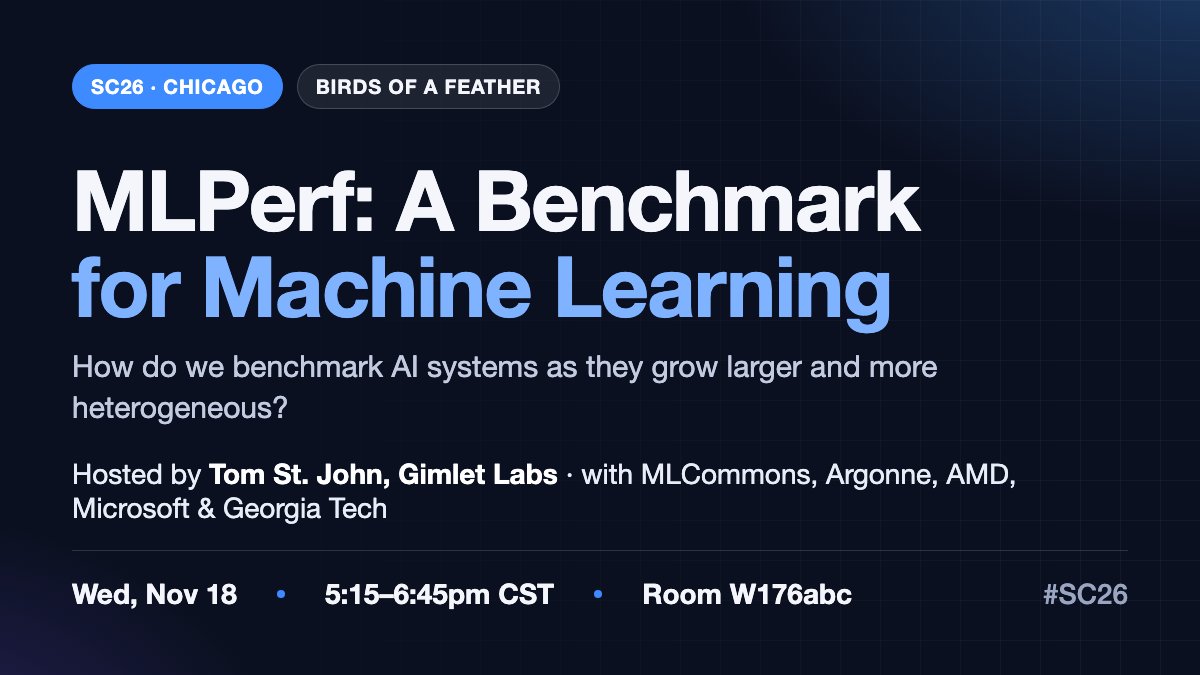
At #SC26 in Chicago? My @gimletlabs colleague Tom St. John is hosting the MLPerf BoF tonight, 5:15pm CST in W176abc, with MLCommons, Argonne, AMD, Microsoft and Georgia Tech. Come help shape the future of AI benchmarking 👇
https://t.co/j3E7ia3kDW
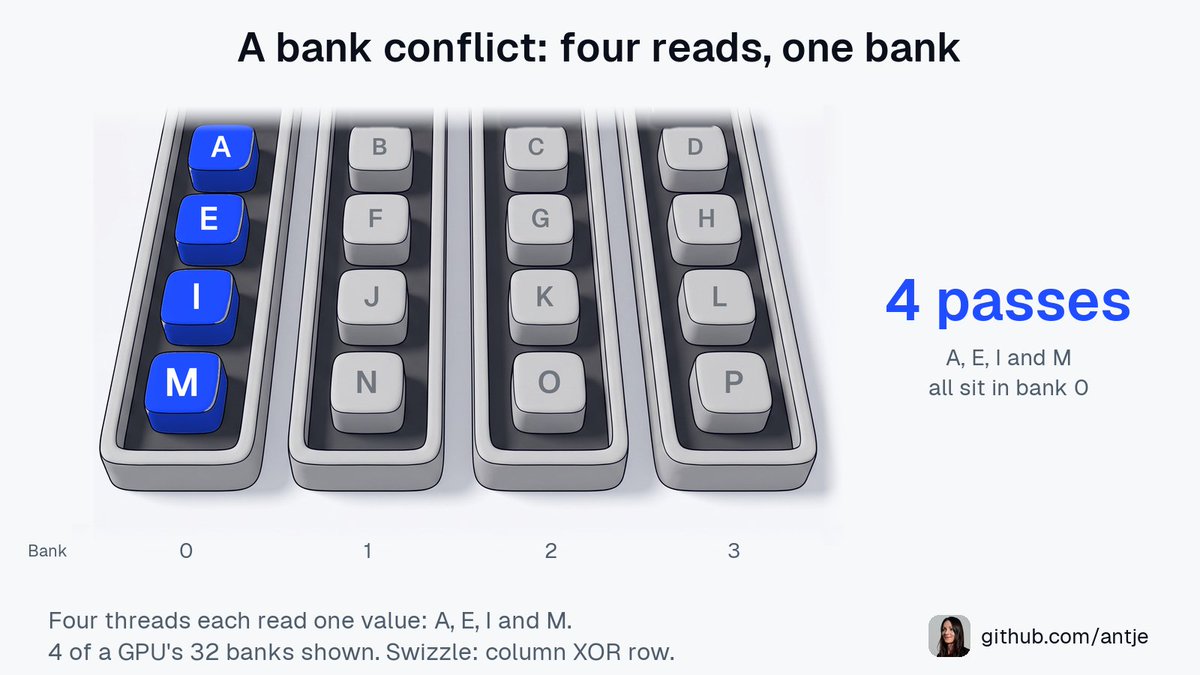
To spot a bank conflict, profile your kernel, or your serving engine, with Nsight Compute, NVIDIA's profiler, with source counters on.
Its Source page shows each instruction's wavefronts (passes), the ideal count and the excess. Any excess on a shared-memory read is a bank conflict.
That's about one read, not tokens per second.
What slowdown did you last hit that passed every test?
👩🏻💻 Follow me (Antje Barth) for hands-on AI inference, from kernels to chip economics
📍 Save + Share
A bank conflict can make a read from a GPU's shared memory take 32 passes where 1 would do. Every answer still comes back right, so a correctness test never catches it.
It's also why a kernel in vLLM stores its data scrambled on purpose. The trick is called swizzling.
vLLM v0.33.0 has an optional kernel for quantized mixture-of-experts layers that does this.
The loads that feed its tensor cores, the GPU's matrix-multiply units, pick up values in 16-byte groups. So it shuffles whole groups. Same idea, sized to how the kernel reads.
The image shows its biggest load: 512 bytes, every bank busy, 4 passes, the fewest a load that size can take.
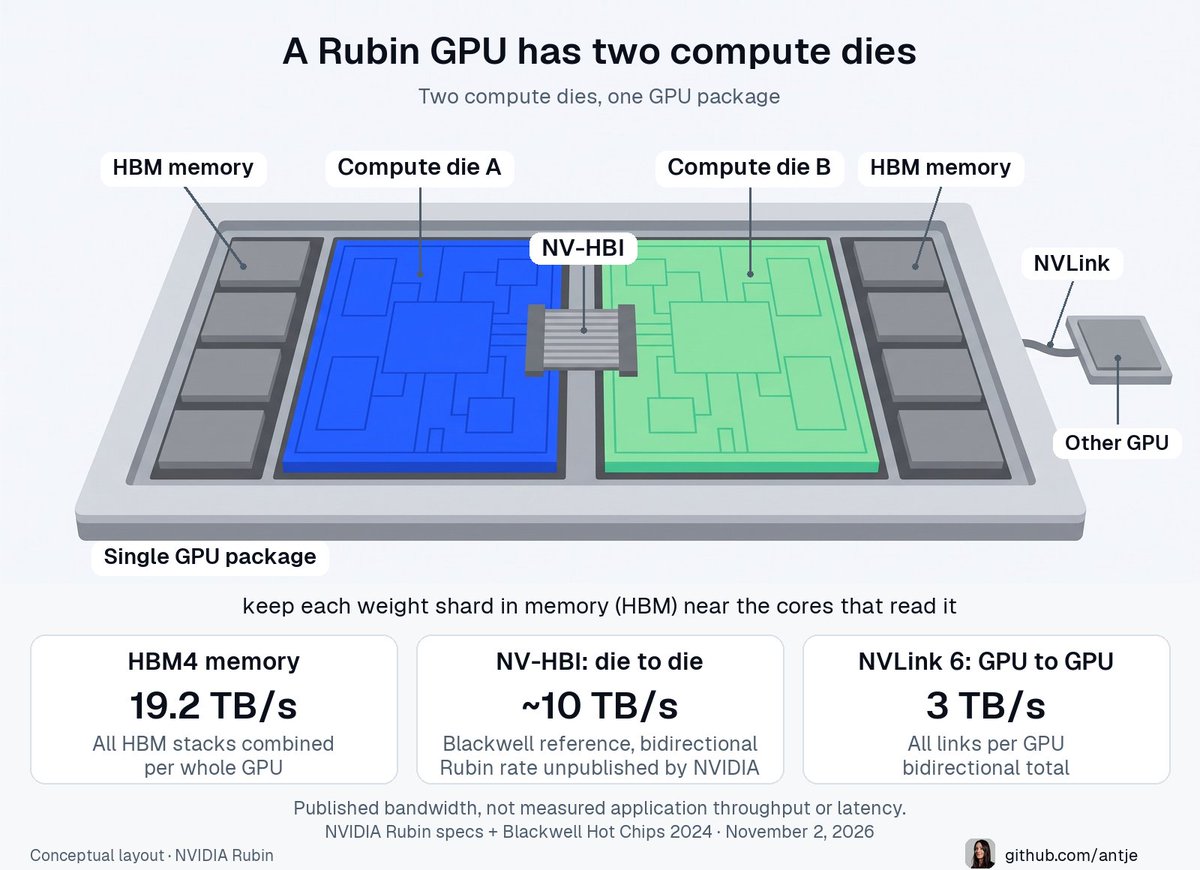
NVIDIA's current specs per Rubin GPU:
HBM4 memory: 19.2 TB/s.
NVLink to other GPUs: 3 TB/s bidirectional.
NV-HBI is the internal die-to-die connection. Neither figure describes that bridge.
https://t.co/l0O02Hca0X
Rubin puts two compute dies inside one GPU. A model can fit and still pay for reads across their bridge.
vLLM's optional MoE path pairs weight shards with local compute on BOTH dies. Using only one leaves cores idle.
Actual vLLM code in the reply.
With CUDA 13.4, vLLM can put the weights and their work together.
GreenContext(sm_partition=partition)
LocalizedAllocator(i, device=idx)
The first controls where the kernels run. The second controls where their memory is allocated.
Full code:
https://t.co/6SCR0TftON
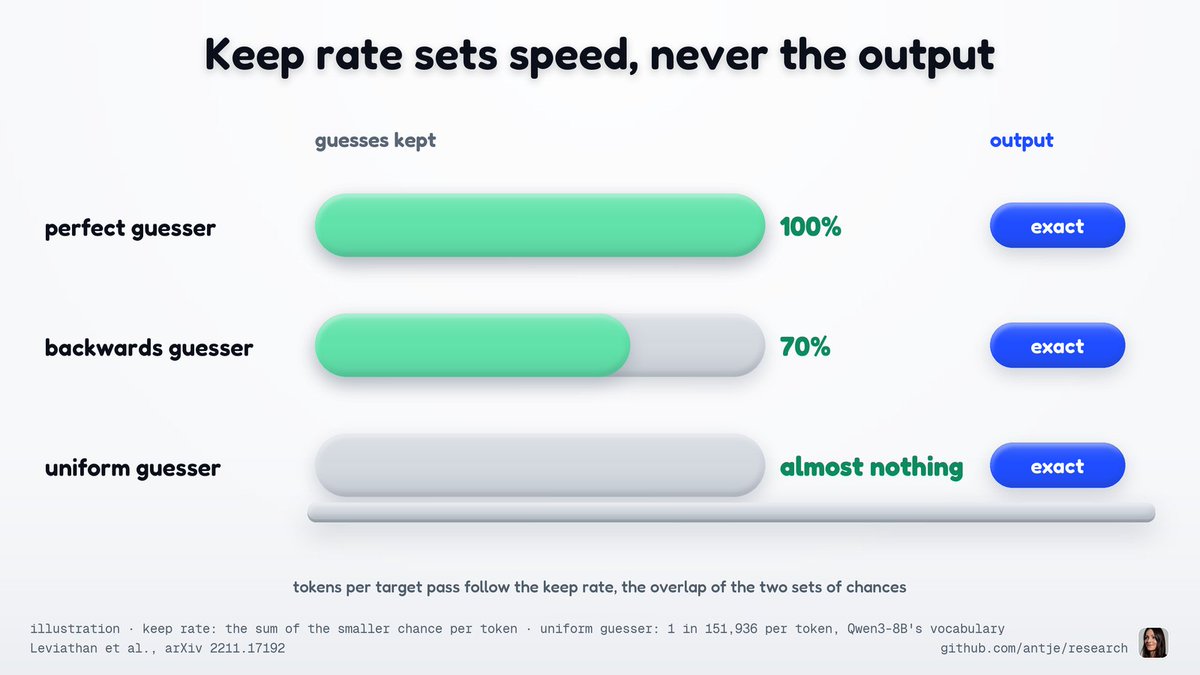
What this means for performance engineers: the share of guesses kept is the overlap of the two sets of chances, and the tokens you get per pass of the big model follow it. A perfect guesser keeps everything, a uniform guess (a 1 in 151,936 chance per token over Qwen3-8B's vocabulary) keeps almost nothing. The output is the same in every row.
How it works: a speculative decoder lets a small model guess tokens and a big one check them. Give it a guesser with every chance backwards: 30% of guesses get thrown out, and the output is exactly the big model's.
One subtraction makes that true:
https://t.co/I97XU4QLFY
The post walks through it, with code.
👩🏻💻 Follow me (Antje Barth) for hands-on AI inference, from kernels to chip economics
📍 Save + Share
🏷️ #HowItWorks #inference #llm #gpu