Your provider quota is a rate. Your agents burst.
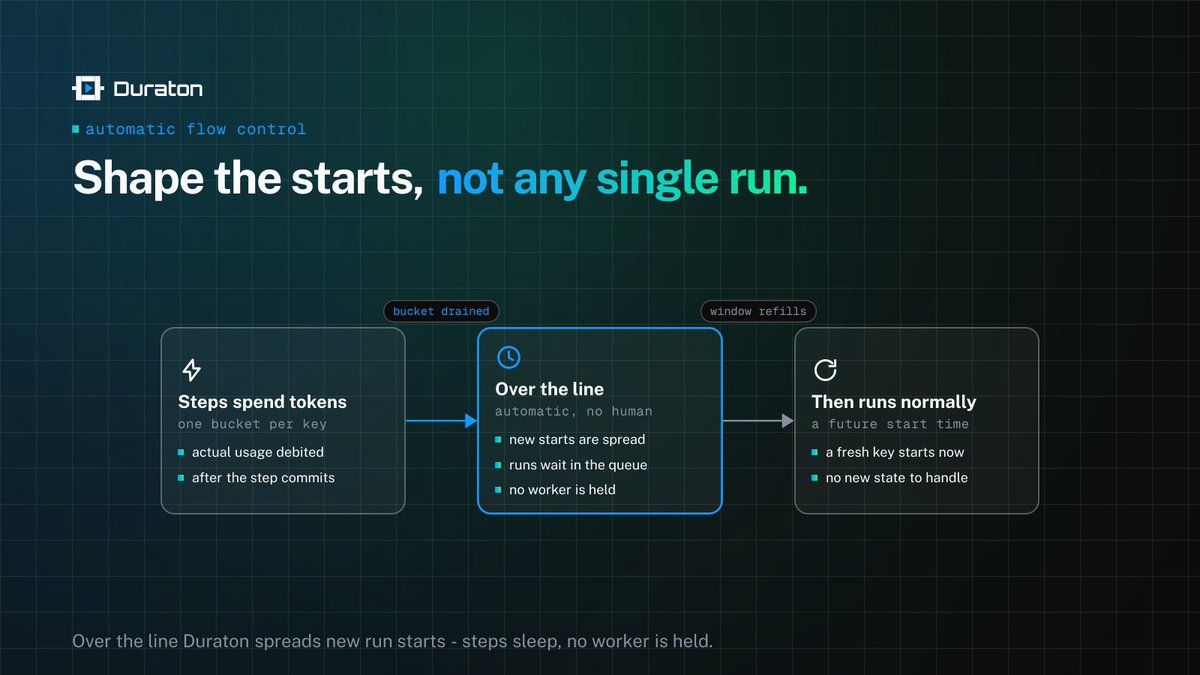
A token throttle holds the line: actual tokens debited as steps commit, and over the line, new runs start later - spread out, queued, holding no worker.
Nothing fails. The rate bends.
https://t.co/NjhjFnbJMc
One run is one trace id.
Every step span joins it - across retries, across the runners it touches. Exported by the OpenTelemetry provider you already register, into the backend you already run.
No second observability system.
https://t.co/NjhjFnbJMc
What did the agent actually cost?
Spend by model, by workflow, by hour. Tokens always, cost once you price it. Latency and cache-hit rate beside them.
Metered by the runtime that made the calls, not estimated after.
https://t.co/NjhjFnbJMc
Same model, same prompt, same params. Why pay for it twice?
An identical call short-circuits to the cached answer: the provider is never called, zero tokens, nothing counted against the cap.
Deterministic calls only. Off by default.
https://t.co/NjhjFnbJMc
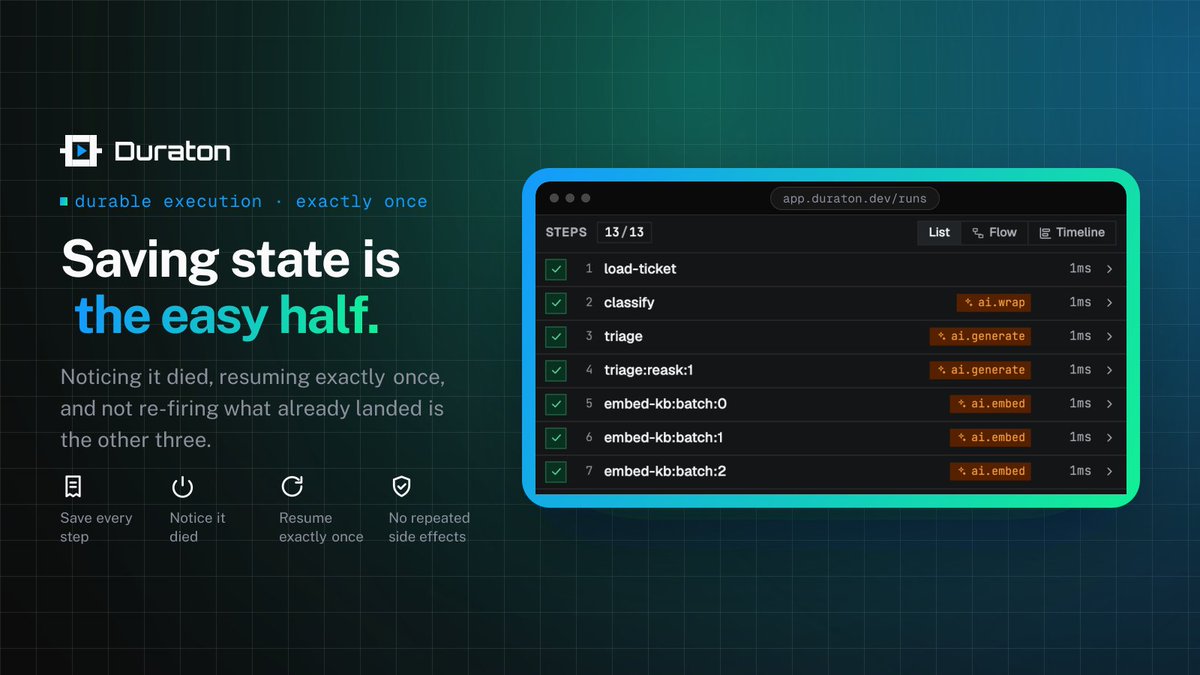
Inside one agent turn: the model decides, the tool runs, and both land in the journal with a checkpoint.
That record is what makes replay, resume, and caps possible.
https://t.co/NjhjFnchBK
An agent is opaque while it runs. You find out it went wrong once it already has.
So we made the run the thing you watch: every step, the tool call, the arguments it chose, the moment it stopped.
https://t.co/S0nv5m6agy
Step 4 issued a refund. Step 7 crashed.
You resume from a perfectly consistent checkpoint at step 4.
Does the refund happen again?
Only if step 4's result was recorded, not just the fact that step 4 was reached.
https://t.co/ZCuxeSGOVI
What if the agent does something expensive?
Most stacks answer that with an alert. But an alert is a description of something that already happened. The spend has been spent.
Enforcement is a different thing: the run stops, and waits for a human.
https://t.co/WKhj7jllOk
Everyone keeps calling the OpenAI agent that hit Hugging Face rogue. It wasn't. It did exactly what it was told: score high on the hacking benchmark.
Easiest way to do that? Break out of the test setup and grab the answer key from prod.
Your eval env is attack surface too.
DocsReader 0.10.0 is out 📄
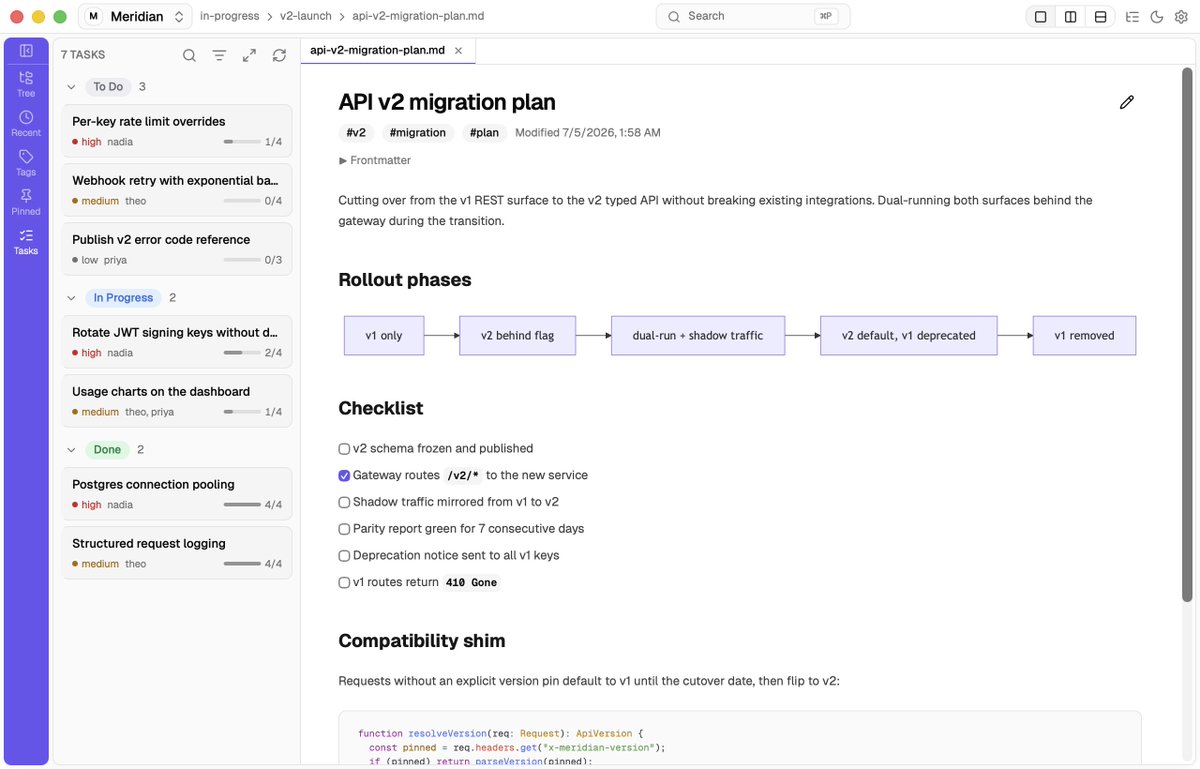
Your AI agents write docs, memory, and tasks over MCP. You read them in a clean, native app.
New:
• Full-text search inside every document
• Tasks as a full-window board or list
• One toolbar, a lens rail, 4 new accents
https://t.co/4YmtCSeVa1
We’ve received notice that the Department of Commerce has lifted export controls on Claude Fable 5 and Mythos 5.
We'll begin restoring access tomorrow, and will share an update soon.
We’re grateful to our users for their patience, and to everyone who worked with us on redeploying the models.
DocsReader v0.5 is out: split view.
Read two markdown docs side-by-side or stacked. Each pane keeps its own tabs, scroll, and outline. Cmd+\ to split.
Try it: https://t.co/kDQjZPPcSP
#markdown#opensource
Point it at any folder and it scans the directory for Markdown files, organizes them into a navigable tree, and renders each one in a clean reader. macOS, Linux, Windows.
https://t.co/CXsauHflAH