Proofs came in for Variant Scholarship. A book about ancient texts in modern contexts. With @mokersel and @JjosseMunch.
More info at https://t.co/Qbex6Oogxo
One thing our research group wants to cultivate is proper attention to provenance and the ethics of manuscript studies. Here is an excellent thread on a recent case.
In case you have any urgent questions about the Tura Papyri or Didymus the Blind or efforts to re-think how we recount the finding and transmission of ancient mss, that Christian Reading book right in the middle from @ucpress might be just the thing.
My co-leader in action! It is astonishing how much theoretical space opens up and how much clarified modelling and methods becomes possible by slowing down and thinking through the actual object and what we call it.
Yesterday we were very happy to welcome @Garrick_V_Allen (University of Glasgow) at our Centre, who was hosting an ERC grant workshop for us and guests!
There are some other stories of museum hauntings, including suspect exculpatory fantasies of unhappy objects in the British Museum, but what about papyrological collections and other institutions where ancient mss are housed? Where can we see the ghost of Shenoute?
A delightful aside in the last meeting of the semester yesterday from Greg Fewster: The @ROMtoronto is haunted by Charles Trick Currelly, its one-time director. Apparently the ghost is typically seen in his jammies, complete with stocking cap. https://t.co/9OsnfrKtc9
Just a gorgeous thread about a hugely significant cultural history. I feel like @BaytAlFann must be the other half of my soul because I wrote extensively about Timbuktu (Timeback) and its manuscripts in my fantasy novel The Blue Eye. How our past informs our present. 💚🧿
Great news for our PhD student @fred259 Fridtjof Leemhuis! He has been awarded an ATTR travel grant to go to Glasgow and research the Tischendorf Collection @UofGlasgowASC.
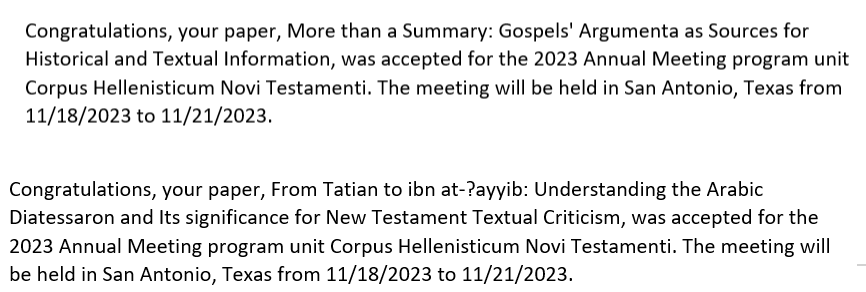
Happy to accept the invitation of the Corpus Hellenisticum Novi Testamenti SBL programme to a panel on the Diatessaron, next year. I haven't yet started my project at the @MFNTEC on the Diatessaron & I already have 2 papers to read. The Diatessaron has become interesting again 😂
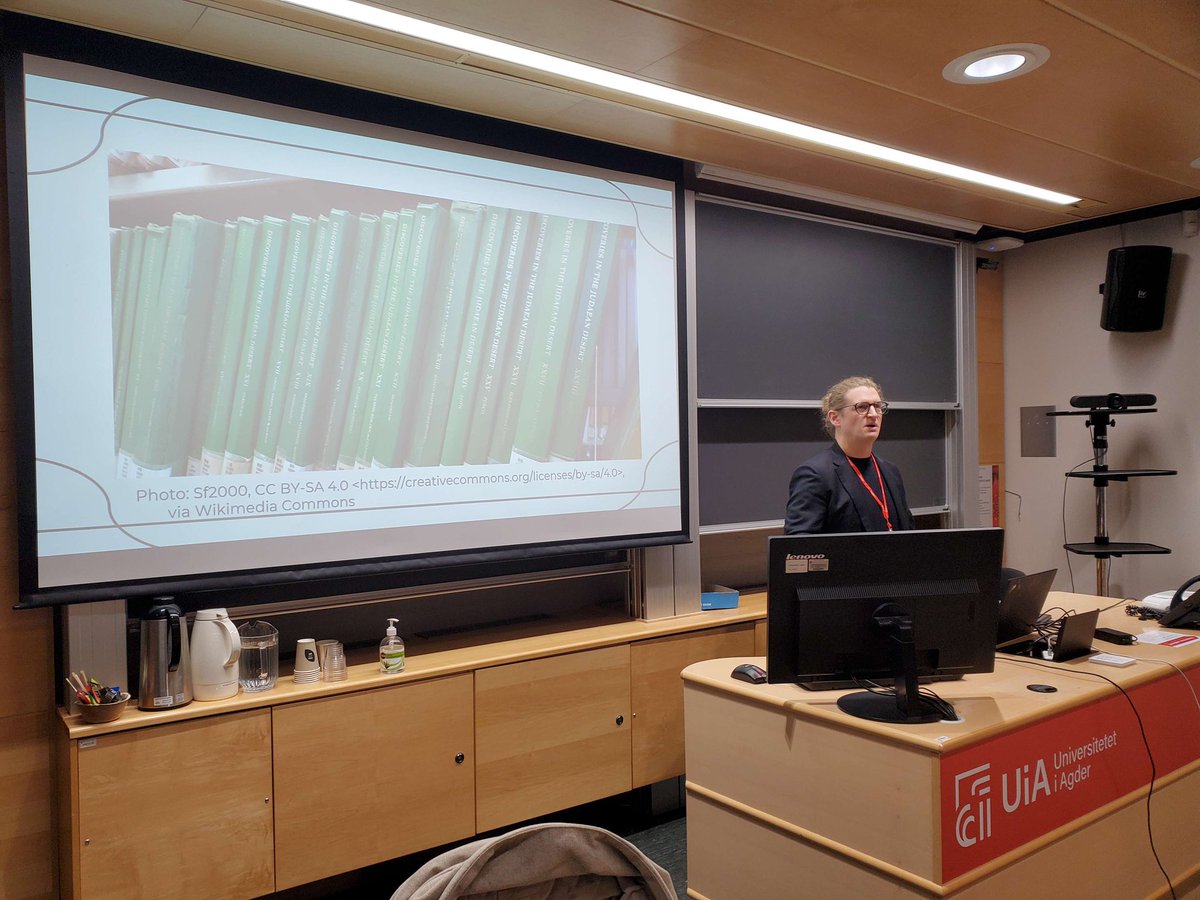
Tomorrow @mifaamii aka Matthew Monger is on double duty at #sblaar2022. Starting at 9 with a paper on Qumran Fragments, Scrolls and Copies, then at 1pm changing to his Syriac Studies hat for a paper on a 9th Century Syriac Companion to the Bible.
Be there, or be fragmentary!
Hi there #sblaar2022! Today 1 p.m. you can see Greg Fewster presenting on resonances between Paul and other figures of the Second Sophistic framed as letter writers, wonderworkers or philosophers in the Historical Paul session AND Brent Nongbri responding.
After lunch you can see Brent Nongbri on the Codex Before Christianity and...
@LivLied once again, this time on Manuscript Finds, Media Engagement and the Tolls of Public Scholarship.
1 p.m. in the Papyrology and Christian Backgrounds section!
See our team in action at #sblaar22 this Saturday!
@LivLied at 9 a.m. on Paratexts, Collection Formation and Syriac Literary Imagination.
Greg Fewster, also at 9 a.m. on Editions as Communication: David Wilkin's 3 Corinthians in the Republic of Letters.
You can read his most recent work on the Jubilees creation account here https://t.co/HtJYcQJUyC in @BrillPublishing Vol. 6 of the Supplements to the Textual History of the Bible Series in a great volume covering a millennium of Hebrew Bible Manuscripts.
Finally introducing Matthew Monger @mifaamii Associate Prof of Near Eastern Languages and Literatures and my co-coordinator. Matthew is also part of the #LyingPen project @uiagder working on scholarly reception of Dead Sea Scroll fragments which you can hear about at #sblaar22 .
Matthew's book project traces naming traditions for the wives of the patriarchs starting from Jubilees and the Syriac Book of the Cave of Treasures, right through late antiquity and the middle ages, using enviable expertise in Hebrew, Syriac, Arabic, Ethiopic and #NewPhilology.