Multiple excitability and transcriptional mechanisms regulate changes in male mating drive over many days. Praneel and Stephen imaged tonic hypothalamic dopamine tone and showed it drops and then recovers over many days after mating, roughly tracking restoration of sperm count.
https://t.co/7CN0VHk4vG
@p_sunkavalli's paper on mating-drive recovery is online! We studied how changes in the activity and neurotransmitter composition of hypothalamic dopamine neurons jointly control a drive state over days.
I'm excited to get to work with this wonderful group of scientists to build community, organize conferences and centralize links to resources in brain body research!
Thrilled to help launch the NIH Blueprint Coordination Center for Interoception Research (BPCCIR) with @KhalsaLab (UCLA), @ruimcosta (Allen Institute), @andermann_mark (Harvard/BIDMC) & @lab_xin
(UCSF), and our broader team. We will build a collaborative community and advance the science of brain–body communication. Appreciate the NIH's vision for interoception science.
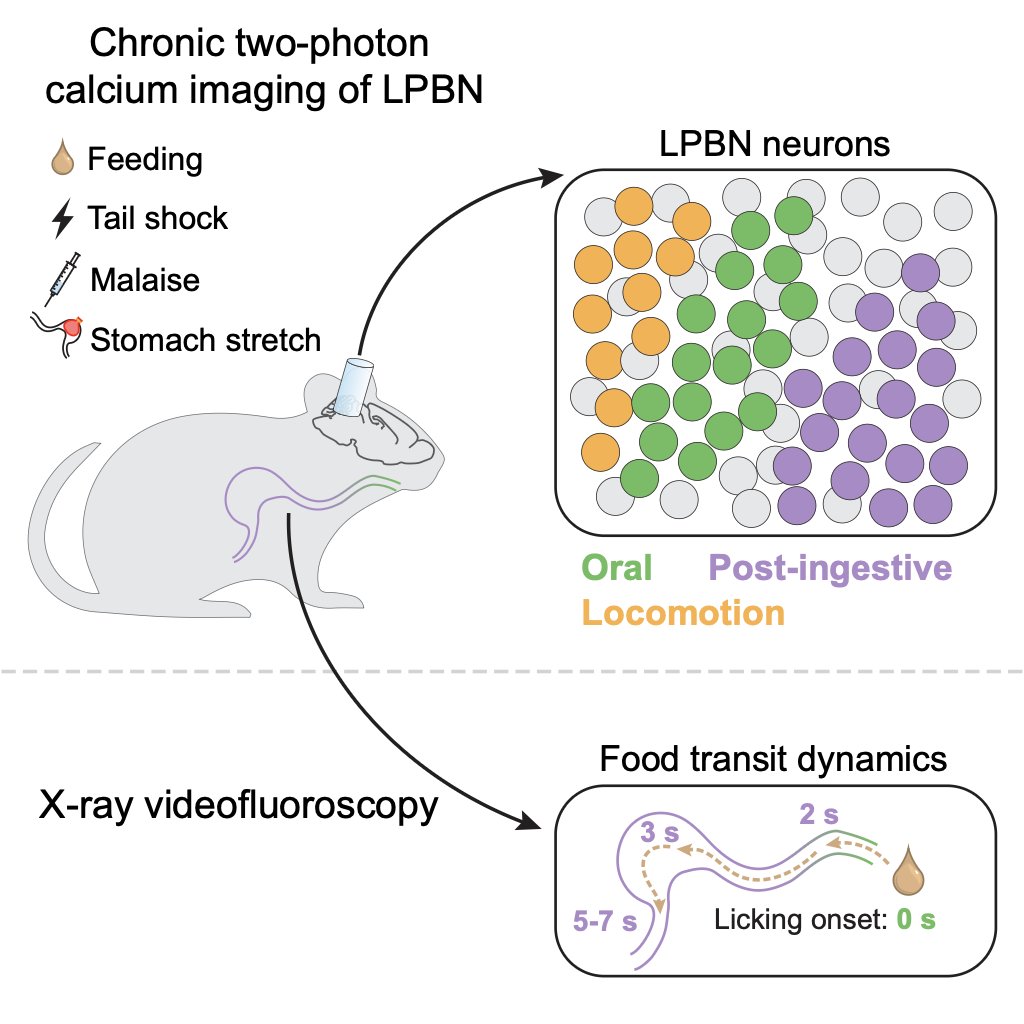
Rachel Essner deserves huge congrats for this opus on integrative brain-to-body signaling in the parabrachial nucelus. Now improved and published! Check it out.
I’m thrilled to share the published version of our paper, now officially out in Neuron! Read it here: https://t.co/zzCBXV7tdl
One updated highlight: with new analyses we now show how functionally-defined groups of neurons putatively overlap with molecular cell types in LPBN
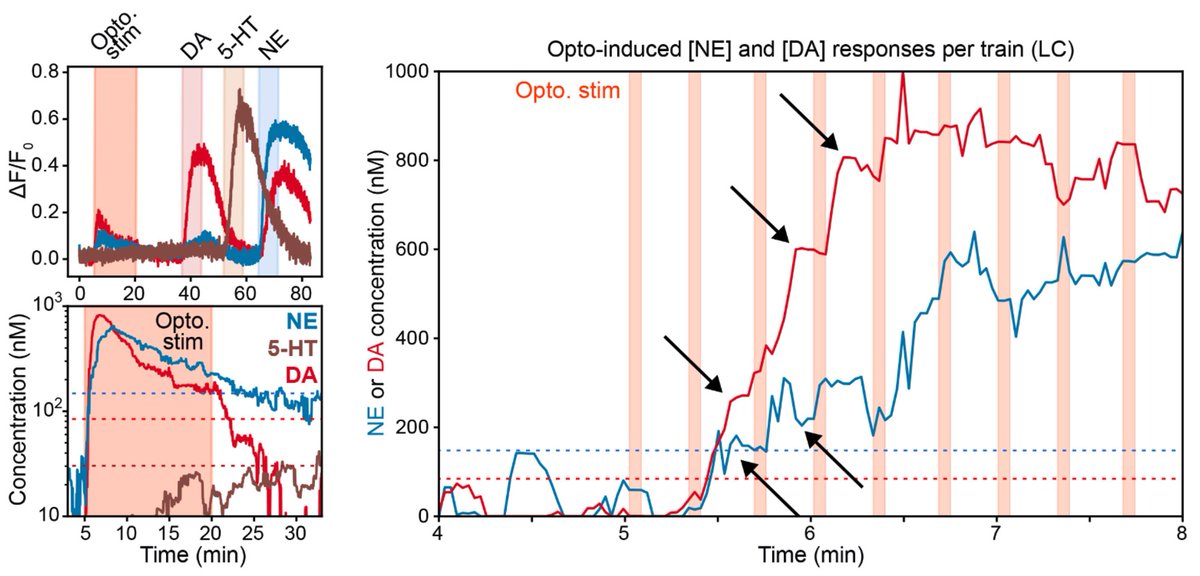
Peter Kalugin's paper on optical tracking of up to ten neuromodulators simultaneously is out in Neuron with some cool new results, including quantitative demixing of norepinephrine and dopamine concentrations. Please check it out and retweet!
MORSE is out now in Neuron, with an expanded dataset: https://t.co/1achdXSZR7
Using crosstalk to our advantage, we demixed norepinephrine & dopamine's binding at each other’s sensors to simultaneously quantify their release from locus coeruleus with resolution in the tens of nM.
Our lab is hoping to hire a long-term lab manager / research associate to help with admin tasks and neuroscience experiments (3-year minimum commitment). Please RT! https://t.co/t3GdEsEX20
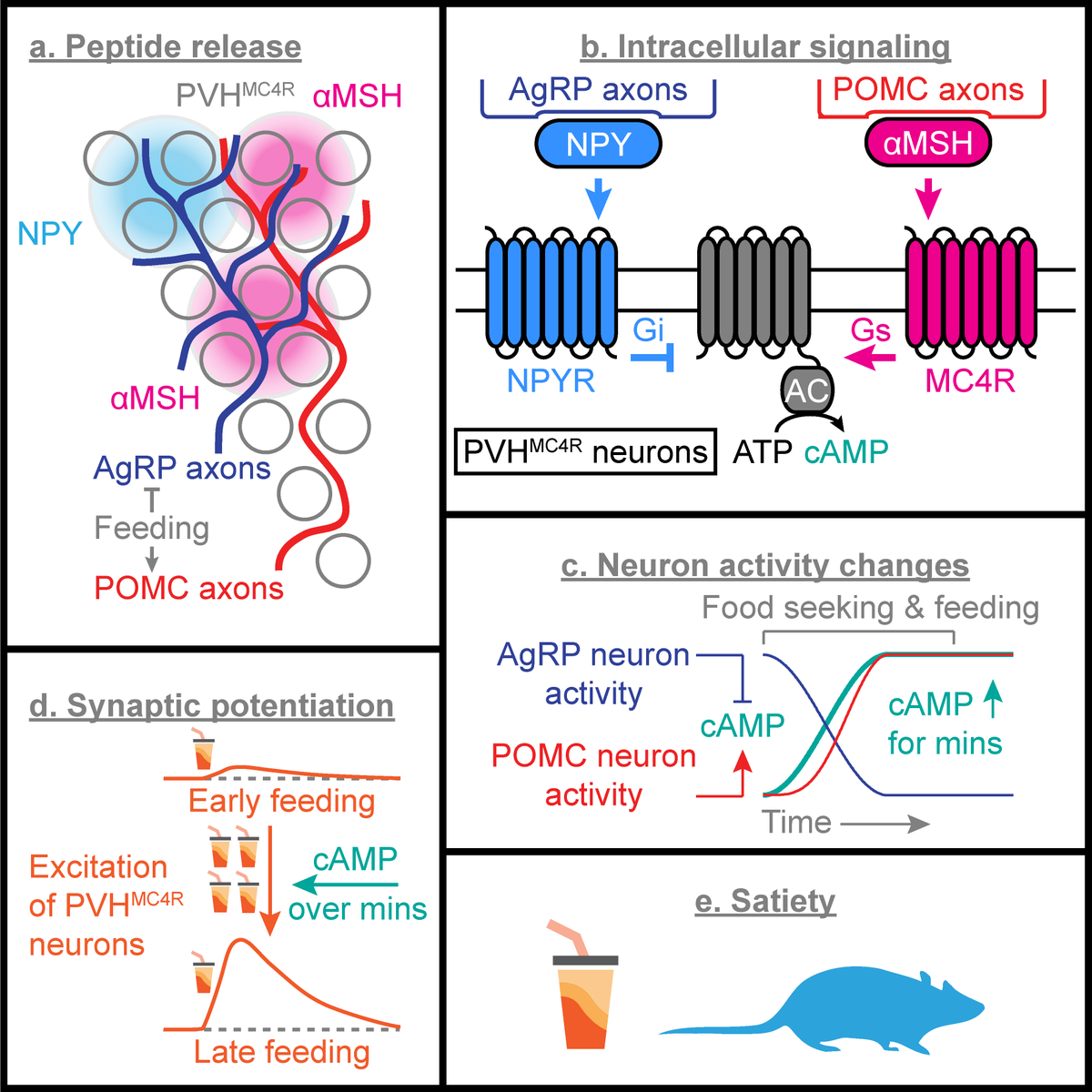
We previously showed that specific hypothalamic neurons get more and more activated by each bite of food until they put a brake on homeostatic feeding. Here, we find that this brake is already on at the start of a meal in obese mice on a high-fat diet.
Nice work, Marta & team!
🚨Paper alert!
📣 We found abnormal feeding-related neural responses in satiety-promoting, MC4R-expressing neurons in the mouse paraventricular hypothalamus (PVHM-C4R) following diet-induced obesity. https://t.co/8pBvZAGcvU #obesity#feedingbehaviour#obesityresearch
A drop of milkshake takes a wild ride after it is swallowed. Rachel and Kiersten came up with cool strategies for visualizing food passing through the mouse GI tract and mapping the activity of the same 100s of brainstem neurons across weeks during feeding and other behaviors.
I’m so excited to share our preprint on how brainstem neurons sense and integrate multiple body signals during food consumption. We imaged 1000s of neurons across the lateral parabrachial nucleus (LPBN) in behaving mice. https://t.co/OB6dozSeMZ
I’m so excited to share our preprint on how brainstem neurons sense and integrate multiple body signals during food consumption. We imaged 1000s of neurons across the lateral parabrachial nucleus (LPBN) in behaving mice. https://t.co/OB6dozSeMZ
[1/4] Registration for our two-day virtual & in-person symposium in June is now open! See below for the full list of cutting-edge experts in #neuroscience and #AI speakers:
We lack tools to track >1-2 changing signals in brain fluids. Peter Kalugin and an amazing team begin to address this challenge with simultaneous, real-time tracking of many (10+) neuromodulatory signals using Multiplexed Optical Recording of Sensors on a micro-Endoscope (MORSE).
I’m thrilled to share our preprint presenting MORSE: a new way to simultaneously and quantitatively track patterns of neuromodulators/neuropeptides in vitro & in vivo using spatially multiplexed 3D imaging of 10+ green optical sensors on a microendoscope.
https://t.co/MpIiMo1MHN
Eight days left to submit your abstract for the 2025 Keystone Symposium on Brain Body Communication at the Allen Institute for Brain Science in Seattle! Join us in exploring the latest in interoception research. Please repost, thanks!
Come explore emerging research in brain-body communication @KeystoneSymp Interoception: Neural Sensing and Control of Organ Function, this April in Seattle! https://t.co/l6KIgl5sSd #KSInteroception25 https://t.co/57McwPKaAL
I am thrilled and grateful to share that I’ll be starting my lab at @ISTAustria in June 2025! We will study how the hypothalamus maintains homeostasis in response to challenges. Check out our website: https://t.co/y7e7atzcTr, and if interested please get in touch!
We found that in vivo peptide release and signaling gradually enhances the response of satiety-promoting hypothalamic neurons to each bite of food during a meal. These consequences of each bite take minutes to manifest, and could help explain why slow eating enhances satiety.
I am thrilled to share the published version of our study on how neuropeptide signals regulate feeding in the hypothalamus! We imaged endogenous peptide signals in subcellular compartments during behavior. Below is an updated summary: https://t.co/ONFDccZXc5