Beautifully written, this guide to distinguishing between truth, misinformation and lies, first published in 1995, remains an essential read for anyone who considers themselves a critical thinker, says Leah Crane https://t.co/WtfsD79af9
My nephew, who is studying in his 2nd year of engineering (CS), called a while back to ask for help with applying for an internship. Along with the rest of the usuals, he asked to learn more about Git. I was a bit surprised - coming into 2nd year, students are still wary of using Git, and it's hurting them in internships and job offers.
I recommended him this beautiful guide from Beej.
https://t.co/Jm1J8sJgKa
And he called today to share his enthusiasm and admiration for it. So here it is again - for all those students and folks getting their hands on Git.
Marie Skłodowska Curie defended her doctoral thesis on radioactive substances at Université de la Sorbonne in Paris on 25 June 1903 and became the first woman in France to receive a doctoral degree.
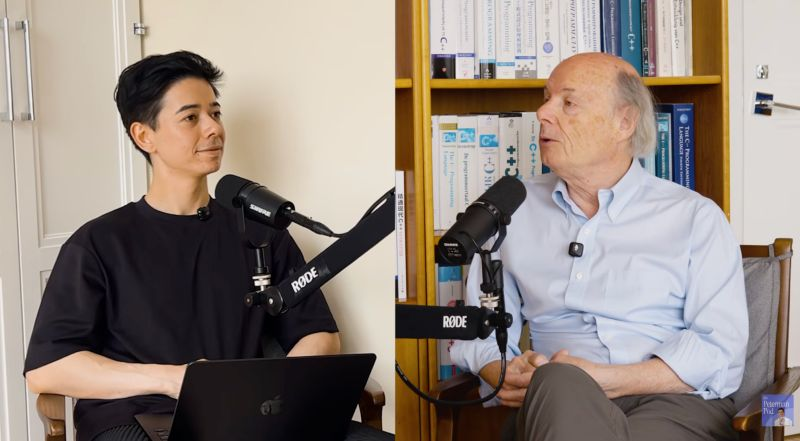
Episode with Bjarne Stroustrup (Creator of C++) dropping Monday morning, excited to share it with you all! Some of the topics we went over:
• What made Bell Labs different
• Programming language design: types, memory safety, bootstrapping
• When abstraction improves performance
• Things he'd change in building C++ knowing what he knows today
He shared a bunch of interesting stories that came from building C++, really enjoyed those and hope you do too
As usual will be available on YouTube/Spotify/Apple Podcasts and I'll post about it here when it drops on Monday
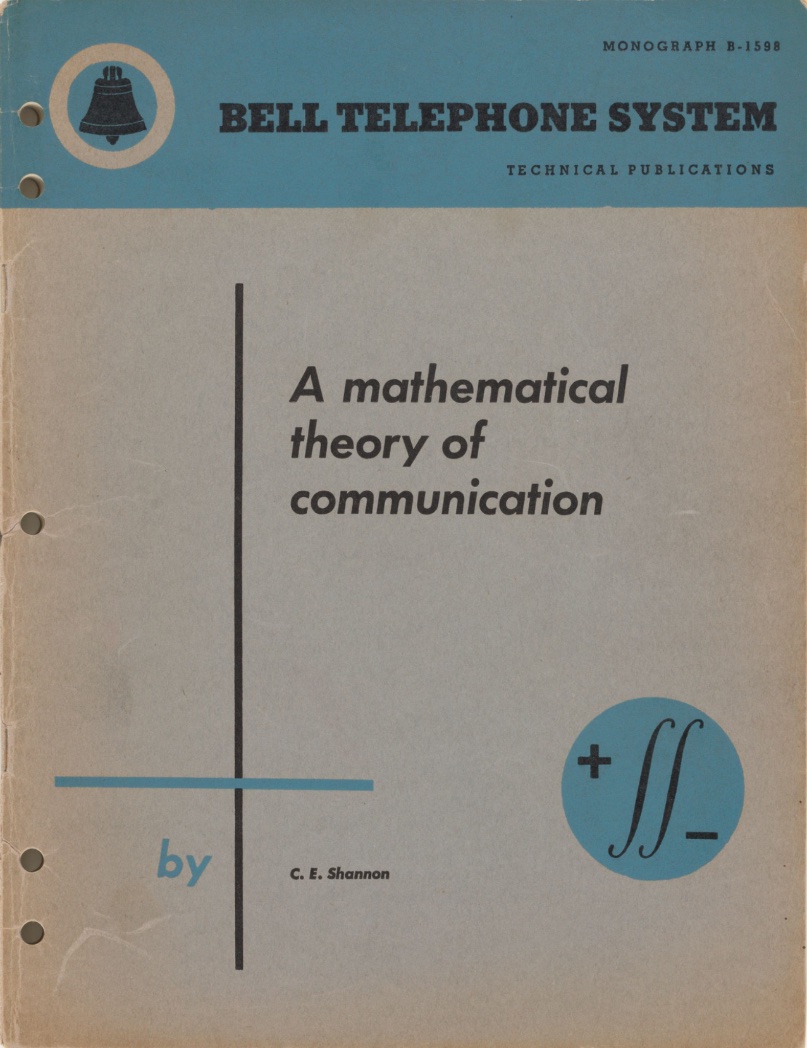
Happy Birthday to Claude Shannon, known by many as the “father of Information Theory.” Shannon was an American mathematician and electrical engineer. In 1948, he published A Mathematical Theory of Communication, which effectively created the field.
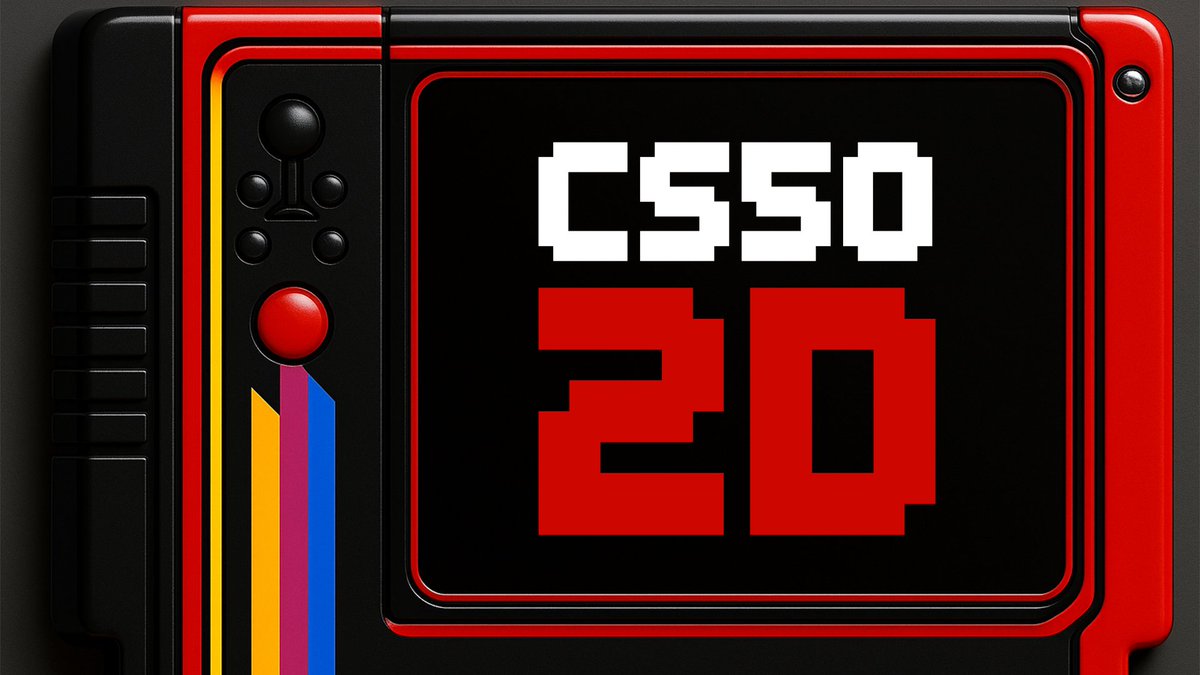
CS50 is launching a new-and-improved course — CS50’s Introduction to 2D Game Development, or simply CS50 2D!
This course, previously known as CS50 Games, picks up where CS50x leaves off and lets you explore the design and mechanics of such childhood games as Pong, Flappy Bird, Breakout, Match 3, Super Mario Bros., Legend of Zelda, Angry Birds, and Pokémon in a quest to understand how video games more broadly are implemented.
The lectures will air on YouTube every day, starting on Tuesday, April 21, at 9am EDT. To take the course for a certificate, register at https://t.co/X2pcQ09dqH. And for now — a word of introduction from Professor @davidjmalan and CS50’s own Colton Ogden!
https://t.co/ehEYnCirgW
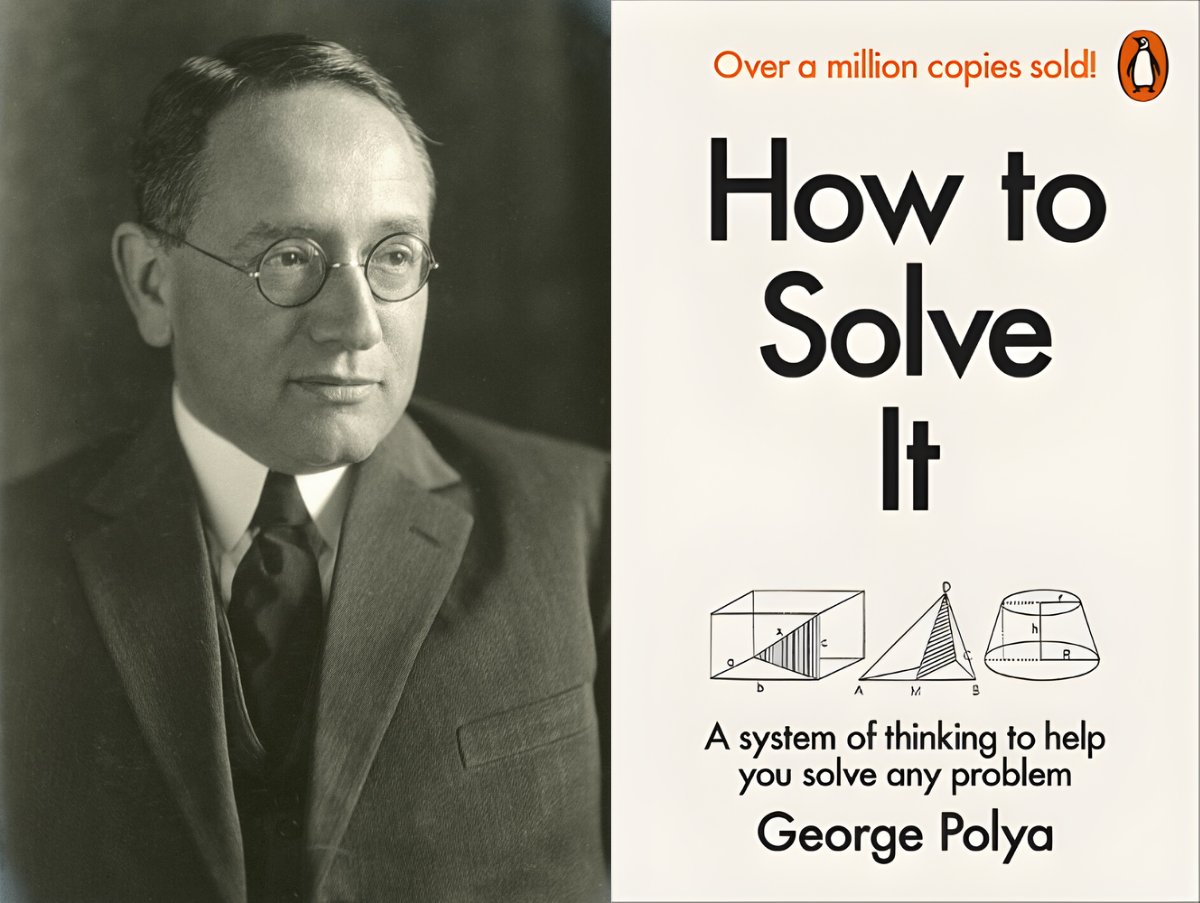
A Stanford mathematician spent 40 years watching brilliant students freeze in front of hard problems.
Not because they lacked intelligence. Because nobody had ever taught them what to do before they started solving.
His name is George Pólya, and the book he wrote in 1945 has never gone out of print. It has sold over a million copies. Marvin Minsky, the man who built the first neural network machine at MIT, said publicly that everyone should know this work. Engineers, mathematicians, and computer scientists treat it as scripture.
Most people have never heard of it.
Here is the framework buried inside it that changed how I think about every hard problem I face.
Pólya watched the same failure repeat itself across decades of students. A problem would be presented. The student would stare at it for a moment, feel the first wave of anxiety, and immediately start calculating. Not because calculating was the right next step. Because calculating felt like doing something, and doing something felt better than sitting with the discomfort of not knowing what to do.
The calculation was almost always wrong. Not because the student lacked the skill to execute it. Because they had not yet understood what they were being asked.
Pólya called this the most neglected step in all of problem solving, and he spent the rest of his career trying to make people take it seriously.
Step one is to understand the problem. Not skim it. Not assume you know what it is asking because you have seen something similar before. Understand it. Completely. He gave students a specific set of questions to force this: What is the unknown? What are the given conditions? Can you draw a figure? Can you restate the problem in your own words without looking at it?
That last one is the filter. If you cannot restate a problem in your own words, you do not understand it. You have only read it.
Most people skip this entirely and wonder why they get stuck.
Step two is to make a plan. Not to execute. To plan. Pólya documented every heuristic he could observe in successful problem solvers, and one pattern appeared more than any other. When a problem feels impossible, find a simpler version of it and solve that first. Not because the simpler version is the goal. Because solving it gives you a foothold, a method, a partial structure you can carry back to the original problem and build from.
He phrased it with precision: if you cannot solve the proposed problem, try first to solve some related problem. Could you imagine a more accessible related problem?
That question alone is worth more than most problem-solving courses.
Step three is to carry out the plan. This is the step everyone thinks is the whole game. It is not. It is the third of four. And Pólya spent the least time on it because it is the most obvious. Once you understand the problem and have a plan, execution is mostly patience.
Step four is the one almost nobody does. Look back. Not to check the arithmetic. To ask a different set of questions entirely. Can you verify the result by a different method? Can you use this result or this method to solve a different problem? What would you do differently next time?
This is where the real learning lives and almost no one goes there.
The look-back step is not about the problem you just solved. It is about building a library of methods that transfers to the next problem, and the one after that. Every expert problem solver Pólya studied had this habit. Every struggling student skipped directly from the answer to the next question on the page, carrying nothing forward, starting from zero every time.
Pólya's deepest insight was not a technique. It was a diagnosis.
The reason most intelligent people feel bad at problem solving is not that they lack the ability to reason. It is that they conflate understanding a problem with having read it. They conflate having a method with starting to work. They conflate getting an answer with having learned anything.
These are not the same things. They never were.
The students who get genuinely good at hard problems are not the ones who practice more. They are the ones who slow down at the beginning and the end, at the two moments every instinct tells them to rush.
The problem is almost always not as hard as it looks at the start.
You just haven't understood it yet.
2004 was a good year, but your Gmail address doesn't need to be stuck in it.
To say goodbye to [email protected] or [email protected] (or whatever you were into at the time), go to your Google Account settings and choose any name available. You'll keep your old username and you can sign in with both.
What can we do to quiet our brains?
Neuroscientists Anne-Laure Le Cunff shares 5 strategies to make reading a restorative antidote to our fragmented attention landscape. @neuranne
Read the full article: https://t.co/AaYOW33qYL
Prof. Donald Knuth opened his new paper with "Shock! Shock!"
Claude Opus 4.6 had just solved an open problem he'd been working on for weeks — a graph decomposition conjecture from The Art of Computer Programming.
He named the paper "Claude's Cycles."
31 explorations. ~1 hour. Knuth read the output, wrote the formal proof, and closed with: "It seems I'll have to revise my opinions about generative AI one of these days."
The man who wrote the bible of computer science just said that. In a paper named after an AI.
Paper: https://t.co/juSOmK9vOt
We rave about giants like Newton, Einstein, Bohr, Tesla, and Edison. But in terms of direct impact on our lives in the information age, nobody comes close to Claude Shannon.
In 1948, he dropped a straight 10/10 paper:
A Mathematical Theory of Communication.
His work has imbued us with the ability to send whispers across continents.
The paper doesn’t just suggest techniques, it draws the boundaries of reality for information... how far compression can go (entropy), the maximum rate a noisy channel can carry reliably (capacity), and why error correction isn’t optional if you want those whispers to arrive intact.
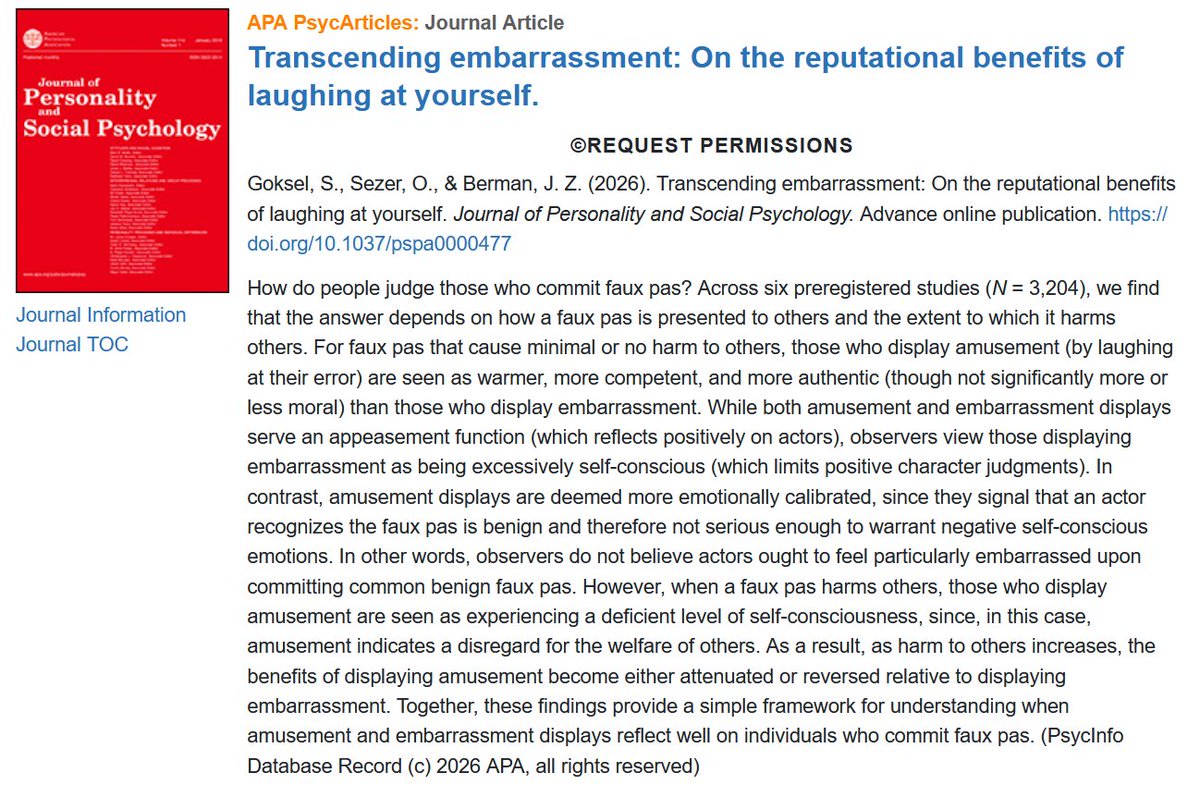
A sign of emotional intelligence is the ability to laugh at yourself.
6 studies: After making small mistakes, people are seen as warmer and more capable if they're amused instead of embarrassed.
Taking your responsibilities seriously but your ego lightly is a core life skill.
Anthropic’s clash with the Pentagon isn't about pacifism versus militarism—it's a fundamental dispute over how to manage the risks of the most transformative technology since the splitting of the atom, @thomaswright08 argues: https://t.co/W3mhSI1yXz
Anthropic CEO Dario Amodei said in an exclusive interview with CBS News' @jolingkent that the AI company sought to draw “red lines” in the government’s use of its technology because “we believe that crossing those lines is contrary to American values, and we wanted to stand up for American values.”
He added: “Disagreeing with the government is the most American thing in the world.”