Today’s claim on the Riemann Hypothesis helps demonstrate what I mean when I speak about Computational Reenchantment.
If the proof holds, we’ll likely simplify its explanation to some extent.
But as it stands, it’s 250,000+ pages.
Long enough to indicate that “pages” is a vestige of a mode of formal comprehension we’re rapidly leaving behind.
So really no one, including the proof’s human “author”, comprehends the nature of the proof at full resolution.
But because computational verification scales far more steeply than human comprehension, and because it can offer certain functional guarantees, we will use abstractions we comprehend less and less to do more and more.
At some point this process will produce physical creations indistinguishable from magic and the paranormal, even to their creators.
As we push into the deepest realms of analytic formalism, the phenomenological bottom drops out, leaving us once again grasping for understanding amidst an age of generally inexplicable Angels and Demons.
For those who dont know what Reimann Hypothesis means :
Prime numbers (2, 3, 5, 7, 11…) are the building blocks of all numbers, and up close they seem to pop up completely randomly. However, if you zoom way out, we actually have a smooth formula that estimates roughly how many primes exist up to any huge number and it’s just never exact.
In 1859, a mathematician named Bernhard Riemann found a way to turn the prime numbers into a 2D map filled with special "zero" points, where each point acts like a wave that controls how far off our estimate can get.
The Riemann Hypothesis is the claim that every single one of those special points lines up on one exact straight line, with zero exceptions, all the way to infinity. If that’s true, it guarantees that prime numbers never clump up or vanish in weird ways and they stay spread out as cleanly and evenly as random coin flips, forever.
Like most mathematicians, I believed the Riemann Hypothesis to be completely out of reach at present (even with the best AI tools), because I expected it to require substantial theory-building, probably in arithmetic geometry. The kind of new theory-building that fills entire books, and that AI isn't so good at yet.
Mathematicians have a notion of how deep a problem is. A sufficiently deep problem is generally intractable until enough of the theory is in place. If difficult problems are like valuable mineral reserves buried miles underground, you first need to build the infrastructure to reach them.
What Levent's proof seems to have done instead is something completely different. It takes an incredibly complicated tour through the infrastructure built for a hundred other mineral reserves, situated far from the destination, and somehow create a wormhole to the original destination.
This is not theory-building in the usual sense. It is something much weirder and more alien. The best human mathematicians know how to build theory, painstakingly, to reach a goal. But no human brain, on its own, is capable of creating a wormhole that requires a 25,000 page long tour through existing infrastructure with no obvious or realistic connection to the goal. But huge credit to Levent here: I think no current AI, on its own, is capable of this either.
I had never worked on or thought too much about the Riemann Hypothesis: it seemed very far removed from my own area of number theory.
But the astonishing thing about Levent's claimed proof of RH (which I think has a very good chance of being correct) is that it uses a huge number of precisely the things that are central to my own corner of number theory:
- Theta functions and other automorphic forms on unitary groups
- Gan–Gross–Prasad period formulas
- Relative trace formulas
Etc., etc.
A problem that I had always assumed would require new theories in arithmetic geometry may instead turn out to be tractable through an inhuman chain of existing (deep) results in higher-rank automorphic forms (and a lot else).
Mysterious MQ-25 Stingray-Like Chinese Drone Emerges At Little-Known Flight Test Center
Satellite imagery of the unidentified drone at an obscure Chinese flight test facility raises interesting questions.
https://t.co/6SP7kqxQHt
Not to gloat but if one of your goals in politics was to check the power of Big Green over the Dems the way they handled this — ignoring labor, jerking the tribes around, jamming up every 2028 aspirant, painting Whitehouse as a pawn of Big Oil and then losing anyway — was 💯
There’s been an incredible amount of red herrings relayed to data centers raised by BAAJA opponents whose actual obsession in life is blocking gas pipelines, but it’s worth saying absolutely nothing in this law in any way impedes Gina Hinojosa or Amy Acton from enacting whatever restrictions on data centers the people of Texas or Ohio want.
It’s a completely fake discussion point.
Similarly, opponents have raised multiple horror scenarios related to national parks even though BAAJA does not amend the National Park Service Organic Act or otherwise implicate park management at all.
There *are* some really issues related to tribal consultation rights which greens used as a screen before acting at the last minute to prevent the adoption of a Schatz-Murkowski amendment to address them.
The reason these kind of fake objections keep getting so much airtime is that the greens don’t want to own up to the actual issue which is that the bill really will make it harder to do anti-pipeline litigation. Greens believe deep in their bones that no number of wins for clean energy is worth securing if it means making it easier to build pipelines. They have no evidence that reducing American LNG exports reduces global carbon dioxide emissions but they are fanatical about this. They have no evidence that denying piped gas to the northeastern United States reduced global carbon dioxide emissions — indeed the evidence says the reverse — but they are fanatical about this.
Obviously “it’s more important to block pipelines than to promote wind and solar power even though blocking pipelines is counterproductive for emissions goals” is a losing argument so they are reluctant to offer it publicly. But rather than saying to themselves “given that this argument doesn’t make sense we should change our position” they keep saying “given that this argument doesn’t make sense we should keep our position and just change our argument.” So we’ve been through weeks of nonsense about data centers and national parks and all kinds of other fake issues rather than debating what’s at stake here.
The reason a “better deal” in a new Congress is a nonstarter is that the opponents of this deal oppose the broad structure of any permitting deal. They look at the status quo in New England where electrification is stalled and people burn wood and oil for heat as a success story even though it’s all obviously a failure. That’s the issue here not quibbling around the margins.
The year is 2026. The single most expensive artwork in human history is a condensed 3D model of South Florida. It cost slightly more to produce than the tallest manmade structure on earth.
No. Euromaidan was a mass Ukrainian protest movement sparked by Yanukovych suspending the EU deal under Russian pressure. It escalated after police killed over 100 demonstrators. He fled; parliament voted 328-0 to remove him for abandoning office. US democracy aid since 1991 and a leaked Nuland call on opposition roles show engagement, but no evidence supports US staging or directing the uprising itself.
It was a huge wake-up call for me to realize that red states are building more *green energy* than blue states.
Most of America's progress towards decarbonization comes from states run by Republicans.
Blue states adamantly refuse to build *anything*. And not building anything means everyone heats their homes with oil and wood, shipped in on diesel trucks. Meanwhile Republican states have electrified almost everything, and they're increasingly doing it with wind and solar because it turns out when you allow "all of the above" to be built, renewables are the cheapest option.
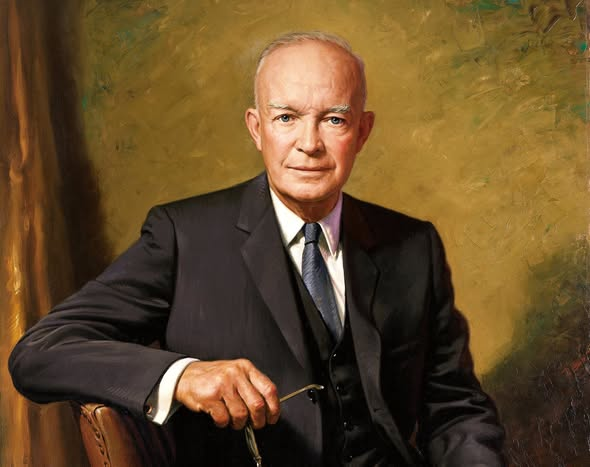
In July, 1964, General Eisenhower had a long interview with Walter Cronkite on the beaches of Normandy on the 20th anniversary of D-Day. He said then:
"I think Ulysses S. Grant is vastly underrated as a man and as a general. I know people think this and that about his drinking habits, which I think have been exaggerated way out of line. The fact is, he never demanded more men or material from the war department, he took over an army that had a long history of retreating and losing. That army had no confidence in their fighting ability and Grant came in as a real outsider. He had so many disadvantages going into the 1864 campaign, now 100 years ago. But he met every test and rose to the occasion unlike I’ve ever seen in American history. He was a very tough yet very fair man and a great soldier. He’s not been given his due.”
Eisenhower continued:
"Grant devised a strategy to end the war. He alone had the determination, foresight, and wisdom to do it. It was lucky that President Lincoln didn’t interfere or attempt to control Grant’s strategic line of thinking. Lincoln wisely left the war to Grant, at least in the concluding moves after he came east. Grant is very undervalued today, which is a shame, because he was one of the greatest American generals, if not the greatest."
When Richard Nixon told Eisenhower in 1956 that it was common knowledge Stonewall Jackson was the greatest Civil War general, followed by Lee, Eisenhower interrupted him:
"I wouldn’t say that, Dick. In fact I think it’s not a very reasoned opinion. You forget that Grant captured three armies intact, moved and coordinated his forces in a way that baffles military logic yet succeeded and he concluded the war one year after being entrusted with that aim. I’d say that was one hell of a piece of soldiering extending over a period of four years, the same time we were in the last war."
Dulles, who was present, remarked that Nixon said nothing in response!
General Eisenhower also stated that Grant’s memoirs were the best military memoirs ever written.
Puerto Rico has now received 4x as much 🇺🇸 propane in the past 8 months as it received from the US mainland in the previous 22 years combined. The waiver has brought to life a domestic supply chain that the Jones Act had previously crushed.