Kenyan Millennial Men Have No Plan B
Kenyan men die young. The average male life expectancy is about 62, and healthy life expectancy, the years you actually live in good health, is closer to 57. So even the so-called average man spends his final years unwell.
Pick a random sample of twenty men in their thirties, and a startling number are already fatherless. Their old men are long dead, or they were never there to begin with: present but deadbeat, or absent and deadbeat, take your pick. Very few men have the privilege of seeing their fathers live into their 80s and 90s.
If I show up in my village right now, the men in their 40s and 50s have already begun to thin out. Between 60 and 75, there are almost none, and the rare one who reaches his mid-70s suddenly has a real shot at 85 and beyond. It is a silent crisis, and you never notice it until you are 40, marrying again, needing uncles to escort you, only to realize there are no uncles left, only cousins.
Our fathers’ generation was wasted by HIV/AIDS and by the economic collapse of the late 1980s and 1990s, a collapse engineered in part by World Bank and IMF prescriptions, the structural adjustment programs, not unlike what is being done to us now. Many in Gen Z may not know this, but there was a time when this country actually made things. The Western Kenya belt ran on sugar: Chemelil, Muhoroni, Nzoia, Mumias, Sony.
Webuye had Pan Paper. There were cotton ginneries and pyrethrum, and coffee farming spread as far as Kisii. Nakuru was busy as hell. So was Kitale, and even small outposts like Kilgoris. Thika was big, big, and industrial. Then, within a decade, the factories went quiet, the parastatals were privatized, and every plant that shut, every institution that was sold off, took real livelihoods and real families down with it.
People retreated to the countryside. I still remember the prettiest girl who transferred to our school. I would vote for Ruto if that is what it takes to find out how her life turned out. She looked like she had lived a cushioned life somewhere, only to land in rural Kisii, in a jigger-infested classroom. Those were the real-time adjustments that millennials rarely talk about. Maybe that is part of why so many of us are quietly traumatized.
As I said, our fathers at least had a Plan B: ancestral land, and our mothers.
As men, we romanticize our independence now, and some treat marriage as a woman’s backup plan, but in the 1980s and 90s, it was often a wife’s ingenuity that kept the whole family alive. And for the many men who died early, leaving behind young, bewildered widows, it was the women who carried the weight of raising everyone, without taking anything away from the men who did their part.
For a while, between roughly 2005 and 2015, I honestly believed millennial men would escape our fathers’ fate. Now I am not so sure. More and more millennial men are walking into something worse than what their fathers faced.
Where the late 1980s and 1990s lost a generation of productive men and women to HIV/AIDS, the late 2010s and 2020s are killing men with something quieter: a broken economy, made worse by terrible political choices, a shaky global situation, and a future nobody can read. As Darius Okolla has argued, millennials are the first generation here to enter adulthood under this much uncertainty.
For our parents, marriage and a home of your own, even a badly built one, were realistic dreams. Plenty of millennials did manage to put up decent houses in the towns ringing Nairobi. But far more never accumulated enough to reach escape velocity from poverty. It is those born in the late 1980s and 1990s who hurt the most: bright enough to get into college and raised to believe that education was the key to everything. What a cruel joke that has turned out to be.
A huge share of graduates since 2014 have never held a properly structured formal job, the kind you keep consistently for five years, long enough to set yourself up for the basics. So instead of marrying, a man in this position ends up with a baby mama, and often cannot even provide for the baby. Just yesterday, I was talking with a younger Gen Z cousin about the recent spike in new HIV infections, and she told me, plainly, that she keeps condoms on her because some of the young men she meets cannot even afford one. That is not a joke, man.
And here is the part that should frighten you: this is the same machine that took our fathers. After years of steady decline, from about 94,000 new HIV infections at the peak down to roughly 16,000 in 2024, new infections jumped again in 2025, past 20,000, the first reversal in years. The cause is almost insultingly familiar. When the United States froze PEPFAR and USAID funding, prevention collapsed almost overnight. Testing fell, PrEP uptake halved, and young people aged 15 to 24 now account for about four in every ten new infections. Donor money built the wall that held the disease back, and the moment it was pulled, the disease started walking back through. History is not repeating. It is rhyming, and it is rhyming in our generation. Worse, our government, like so many across Africa, rarely wants to solve some of these basic problems.
Now that we are in our 40s, economic depression is a silent killer. No amount of motivation, no think piece, no pep talk will bail a man out. At some point, you need the only thing that actually works: money.
Our economy began its slow collapse around 2015. Some of the rot traces back to the 2008-09 global crash; the West never fully recovered, and when America sneezes, the rest of us still catch the cold. But the deeper wounds were self-inflicted. We raised a Eurobond of roughly Sh 200 billion, and to this day the Auditor General cannot fully account for it; by the official reckoning, around a billion dollars has never been traced to any actual project. We built a wildly overpriced SGR. The effects were immediate. As Eurobond repayments and other loans came due, cash drained out of the economy. The banks that used to hawk loans to us before 2015 found a far better customer in the government itself, and what little credit remained for ordinary people dried up.
Before long, counties stopped paying on time. Today, the unpaid bills are staggering: national government pending bills alone have exceeded Sh 500 billion, and the total, including counties, sits north of Sh 690 billion, much of it owed to small suppliers who have since folded. Taxes climbed, inflation climbed, companies issued profit warnings after profit warnings, and many shut, exactly as they did in the 1990s.
The economy kept shrinking, and in the meantime, we handed the keys to a thieving elite, the kind of arrangement where only they get to steal, so the money pools in fewer and fewer hands.
In real life, this is what it looks like: if you run a business, the stock does not move. A friend who sells electronics in Luthuli told me that in his good years, back in the 2010s, he shifted serious volume and was, in real terms, a millionaire. These days, he is lucky to sell one cheap Chinese TV a week. Last I heard, he may close shop.
You can see it in black tax too, which keeps climbing. I told Gordon Opiyo recently that we should be careful about celebrating the rise in diaspora remittances. That money is not flowing home to buy Treasury bonds or build anything; it is flowing home to plug the holes that government irresponsibility keeps tearing open in people’s lives, something both the Central Bank and the Kenyan Demographic Health Survey admit.
Ruto did not kill the Kenyan economy. It was already on life support by the time he inherited it. Whatever little resuscitation he managed, he did for himself and his cronies. Now, standing over a dead economy, all he does is dance and piss on the grave while his bloggers cheer.
None of this is to say women are not suffering. They are, and their story is theirs to tell. But what I am certain of is this: in the coming decade, a lot of men’s deaths will be hastened by the collapsing economy. Whether we lose them to drugs, to suicide, to slow depression, or to plain loss of hope, the direction is grim. If things keep tanking, I would not be shocked to see male life expectancy slide back toward the mid-50s. Broke men cannot afford decent healthcare or good food. And broke men, more than anyone, tend to lose their networks and their relationships, even within their own families. That isolation is its own quiet killer.
So, educated millennials and Gen Z men, hear me clearly.
The point of laying all this out is not to bury you. It is to get you to stop waiting for the economy, or the government, or some motivational speaker, to come and rescue you. They are not coming. The men who make it through the next ten years will be the ones who saw the storm early and built for it: who learned a skill the market actually pays for, who pooled resources with other men instead of competing in misery, who kept their bodies and their minds intact, and who refused to let shame cut them off from the people who love them. Money is the goal, yes, but the things that keep a broke man alive long enough to go and make it are boring and unglamorous: a few real friends, a reason to wake up, and the stubbornness to not check out early.
Our fathers had land and our mothers to fall back on. We were handed no Plan B. We have to become our own. Build it now, while you still can, because the times are bad, and they will get worse before they get better. The men who understand this and move will not merely survive. They will be the ones still standing when the dust settles, and the ones who get to rebuild.
Nothing messes with a man like a bad economy. And this, my friends, is not a wantam or tutam thing. This one outlasts whoever is sitting in State House
"but if we avoid hard things, anything mildly challenging will seem insurmountable. the proof you can do hard things is one of the most powerful gifts you can give yourself."
> Be Jocko Willink
> Wakes up at 4:30 AM every single day
> Posts a picture of his watch to prove it
> Enlists in the Navy straight out of high school
> Spends 20 years in the SEAL Teams
> Becomes Commander of Task Unit Bruiser
> Leads the most highly decorated Special Ops unit of the Iraq War
> Commands legends like Chris Kyle and Jonny Kim
> Retires from the military and doesn't know how to relax
> Starts a leadership consulting firm
> Teaches Fortune 500 CEOs how to run companies like SEAL operations
> Launches a massive podcast completely by accident
> Writes a NYT bestseller called "Extreme Ownership"
> Core philosophy: "Discipline Equals Freedom"
> Writes bestselling children's books to teach kids how to be tough
> Starts a fitness and supplement empire
> Still rolls Jiu-Jitsu with 20-year-olds at 50+ years old
> Views every setback in life with a one-word response: "Good."
And Jocko is still the most disciplined man alive who makes everyone feel lazy.
Jocko is badass.
Uncommon advice: If you don't know what to pursue in life right now. Pursue yourself. Pursue becoming the healthiest, happiest, most healed, most present, most confident version of yourself. Then the right path will reveal itself.
"You need to make yourself a big target for luck, and the way to do that is to be curious. Try lots of things, meet lots of people, read lots of books, ask lots of questions."
— Paul Graham, How to Do Great Work
https://t.co/AyIk5fnKZL
In my address titled "The Political Economy of Obedience," delivered last month at the Josef Korbel School of Global Affairs at the University of Denver, I identified five key mechanisms through which African populations have been trained into political compliance. I am sharing a summary here because they explain precisely what we are watching play out in real time every day on this continent.
The first is colonial education. The curriculum inherited from the French, the Brits or the Portugese administration was not designed to produce critical citizens. It was designed to produce a particular kind of political subject. one who understood authority as something to be respected rather than questioned, and who experienced his own political traditions as a source of shame rather than institutional possibility. As I said in Denver, the most effective political prisons are not made of concrete. They are made of curriculum. The Togolese school I attended taught us the genealogy of French kings with more precision than the history of the governance systems that predated French colonial presence on our territory.
The second is the economy of obedience itself. Authoritarian systems endure not primarily through permanent terror but because they structure the relationship between political compliance and material survival so that obedience becomes, for most people most of the time, the rational choice. Access to employment, scholarships, market licenses, import authorizations, health clinic access: none of it politically neutral, all of it conditioned on loyalty. People in these systems do not collaborate with power because they are morally deficient. They collaborate because the scaffolding of their daily lives has been designed to make non-collaboration economically catastrophic.
The third is the family as a site of control. In conditions of economic precarity, the individual who considers a dissident act must calculate not only her own risk but the risk she imposes on her parents, her siblings, her children, her cousins etc. I have watched people of intelligence and moral clarity retreat from political engagement not because they were afraid for themselves but because they could not justify the devastating exposure their activism would bring to their families. The authoritarian state does not need to threaten everyone. It only needs to ensure that the threat to one is visible and comprehensible to all.
The fourth is religion. In many parts of Africa, religious institutions have been deployed, not by their most honest practitioners but by their most politically convenient ones, to transmit a theology of earthly resignation and otherworldly reward that discourages political engagement. The pastoral instruction to render unto Caesar what is Caesar's sits very comfortably with the interests of Caesars who have no intention of rendering anything to anyone. Liberation theology, which in Latin America produced an extraordinary tradition of religiously grounded political resistance, has had a far more contested reception in much of African Christianity and Islam, partly because of the direct entanglement of many religious institutions with state power, which has made spiritual authority and political compliance structurally allied.
The fifth is media. In authoritarian African contexts, state and privately owned media aligned with power do not typically practice crude propaganda. They practice something more subtle and more durable: the selection of what is visible and what is invisible; the framing of social problems as natural phenomena rather than political choices; and the treatment of opposition voices as marginal or foreign-funded. The film industry participates in this discipline in its own way, through the systematic promotion of narratives that depict poverty and wealth as conditions of fate or personal failure, stories in which the distance between the poor and the rich has everything to do with luck, talent or divine favour and nothing to do with power, policy or the deliberate engineering of inequality.
The cumulative effect, over decades, is a population whose political imagination has been narrowed to the point where alternatives are genuinely difficult to conceive, not because the alternatives do not exist, but because the political ecosystem has ensured they remain invisible.
These are the operating manual of authoritarian systems on this continent. And authoritarianism today is not limited to regimes with a known dictator who has held power for decades. It extends equally to regimes that perform a change of leadership through placebo elections conducted every four to five years, producing a new face every eight to ten years while the same system of impunity, patronage and repression remains structurally intact.
I would argue that these are in fact the more dangerous form of authoritarianism because their citizens are deceived into believing they are living under a democracy when they are in reality governed by plutocrats. The citizen under an obvious dictatorship at least knows what he is fighting. The citizen under a rotating plutocracy has been convinced there is nothing to fight at all. He votes, he watches a new face take the oath, and he mistakes the performance of transition for the substance of change. He ends up with no voice, no justice, no agency, and worse, no drive to fight for his own dignity. For one can only fight for liberation after acknowledging one's condition of oppression.
You dont want a yacht. You dont want a big house. You dont want a super car, a $40,000 watch, or shoes you worry about getting dirty. You want free will.
You want to wake up naturally on a Tuesday and you want to go to bed when you’re done having fun. You want to say yes to everything that excites you without having to request time off. You want to go to the the gym at noon, in absolutely no hurry. You want to spend 18 hours a day doing what you love. You want to be exactly where you desire being, always. You want to spend as much time with the people you care about as possible.
You’re saying you wanna be rich? In what?
Read more, consume less. Your mind is muscle. Train it. Be mentally jacked. Read old books. The classics. The books no else reads. If you read "best sellers", you'll think like everybody else. Read Crime & Punishment. Read Moby Dick. Read 100 years of Solitude. Books that confuse you. Books that change the way you see people, suffering, love, meaning, and life. Books that change the way you perceive reality.
biggest psyop in the world is that you need to work hard
you don't need to work hard at all
in fact, its preferable you be unemployed
why?
because usually best returns come from knowing which table to play at
there's a near infinite number of "games" to play
you can be anything from a welder to a professor to an onlyfans model to AI vibe coder
generally, the best advice is to focus on niches where you have a competitive advantage
in order to find these niches you need to find everything
Mark Zuckerberg (the "Zucc") gave popularity to the phrase "move fast break stuff"
this still not only makes sense but is actually even more true because when he coined that phrase he was referring to the fast information flow due to the internet
now that's exponentially higher due to agentic AI and whatnot
this is also why unemployed but high agency (not a contradiction) people are precisely the best kinds of people to get into certain niches before they become the mainstream meta
because they have their ear to the ground and they don't feel shame in trying, failing, and going back to unemployed
You'll Remain Average Until You Master These 4 Powerful Time Management Rules:
1. The 8-8-8 Rule
- 8 hours for yourself - exercise, hobbies, friends, learning.
- 8 hours of deep, focused work.
- 8 hours of quality sleep to recharge your body and mind.
2. The 1-3-5 Rule
- 1 big goal that pushes you outside your comfort zone.
- 3 important tasks that move you closer to that goal.
- 5 small tasks like emails, errands, or quick chores.
3. The 10-Minute Rule
- Focus intensely on a task for 10 minutes.
- Take a 2-minute break, then repeat.
- This simple cycle helps beat procrastination and build momentum.
4. The 90-90-1 Rule
- Spend 90 minutes every day
- For 90 days straight
- Working on one life-changing goal.
- Consistency at this level creates powerful results.
The person who figures out how to sell identity to people who hate themselves is going to be worth more than every info product guru on earth combined and nobody is framing the opportunity correctly…
Every purchase over $50 is an identity purchase. Nobody buys a $200 skincare routine because they ran the clinical data. They buy it because they want to be the type of person who has a $200 skincare routine. The product is proof of who they're becoming
This applies to everything. A trading course isn't education. It's a costume change. The buyer wakes up Monday morning and they're "a trader" now. A fitness program isn't a workout plan. It's permission to call yourself disciplined. A paid community isn't access to information. It's a membership card to an identity they couldn't get into before
The markets printing the hardest right now all exploit this at the core:
Carnivore diet stuff converts 4-5x higher than generic fitness. Not because the product is better. Because the buyer's identity is welded to the philosophy. Returning the product means abandoning who they decided to be. The psychology won't let them
Looksmaxxing went from incel niche to mainstream in 18 months because it gave young men an identity framework. You're not buying jawline gum. You're buying entry into a transformation arc where you're the protagonist
"Clean living" products aimed at women 35-55 charge 3-5x more than identical products without the belief layer. Because buying "organic" isn't a product decision. It's a statement about what kind of mother you are
The deeper play nobody's running yet: most identity products are selling TO an existing identity. "You're a trader, here's trader stuff." That's level one
Level two is CREATING the identity and then selling everything inside it. You don't sell a course about making money online. You create an archetype, build an entire worldview around it, and then everything from the $47 ebook to the $5,000 mastermind is just gear for playing that character
Every religion understood this. Every luxury brand understands this. Every political movement understands this. The info product industry is still selling features and benefits like it's 2014
the products with the lowest refund rates on earth are the ones where returning the product means killing a version of yourself. build that and you never have to "sell" again
something to think about
Articles from the archieve you won't regret reading
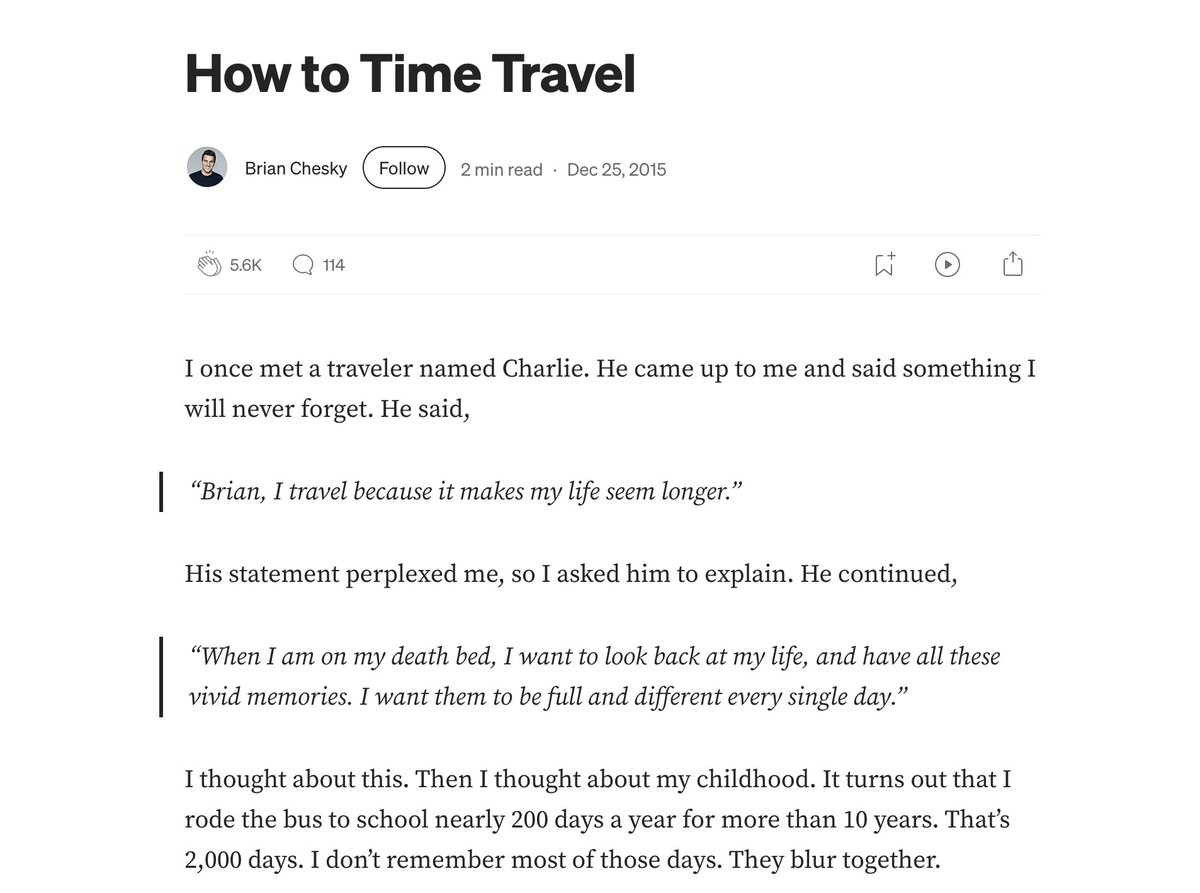
>how to time travel - Brian Chesky
>high agency - George Mack
>how to get lucky - Taylor Pearson
>childhoods of exceptional people - Henrik Karlsson
Seneca has a great quote:
“To be happy,
You must eliminate two things;
The fear of a bad future,
Or the memory of a bad past.”
To accomplish this…
You have to surrender to the present moment;
Accept that this moment is all there ever was, and all there ever will be…
high ROI habits nobody talks about:
→ reading 30 mins a day : compounding knowledge stacks over years.
→ building things consistently : prototypes > ideas.
→ writing daily : clarifies thinking, removes mental clutter.
→ exercising : upgrades energy, focus, and resilience.
→ deep work : 3 hrs of distraction-free focus > 10 hrs of multitasking.
→ asking questions : unlocks shortcuts from people ahead of you.
→ reflection : journaling, prayer, walks… aligning your mind with your path.
→ teaching others : forces mastery, reveals blind spots
these look small today.
they tilt the entire game tomorrow.