What can you build with myCobot 280 arm, a webcam, OpenCV, and Qdrant? Right - Anomaly Detection with some visual memory for industrial robots. Well, at least a PoC.
https://t.co/BjTM9c6xOd
That leaves you with all the low-level details that Rust usually takes care of for you:
1) Weights are baked into the firmware via include_bytes! and the layout is checked at build time.
2) There's no HashMap in no_std so the vocabulary is just a sorted byte blob that you search through with binary search.
3) The WordPiece tokenizer is around 200 lines long as Hugging Face's tokenizers are all written in std.
The result is it's able to produce ~830 embeddings per second. It's not particularly fast, but it does work in the scenario where you can't just call a cloud API.
=> https://t.co/0beyuzgYy1
A "lightweight" embedding model requires 310MB, PyTorch, and an OS. This one only requires 7.5MB and omits all that: an embedding model on an ESP32-S3 (16MB flash, 8MB PSRAM) with absolutely no OS, no disk and no standard library.
The trick is to use a model that doesn’t behave like a neural net at inference time. potion-base-2M from Minish is a static embedding model so it's just a lookup table. You tokenize, you read one row per token, you average and you normalize. No matrix multiplies, no torch.
Why am I telling you about this? Well, PiPNN is a part of the recent patch release @qdrant_engine v1.20.1
Original paper: https://t.co/GMMYA4zHZ8
Release notes: https://t.co/RZlbAcZ7SX
You know, the fastest graph indexes take the longest to build. HNSW and Vamana, for example, spend most of their build time searching to find neighbors. This leads to random memory access, cache misses, and idle CPU cores waiting on DRAM. With a billion vectors, building can take hours or even days. Which is annoying, right?
PiPNN is a new ultra-scalable, graph-based nearest-neighbor indexing approach that entirely removes the search step from graph construction.
PiPNN builds a graph index without searching it. HNSW finds the neighbors of each new point via a beam search over the half-built graph (which is essentially just a lot of random memory access). PiPNN splits the data into overlapping partitions, compares all the points in each partition with a single matrix multiply, and then prunes the candidate edges with HashPrune, which keeps memory bounded.
The output remains an HNSW graph, using the same format and search code, so query behavior stays the same. The only change is in how the graph is built. The queries don’t interact with PiPNN.
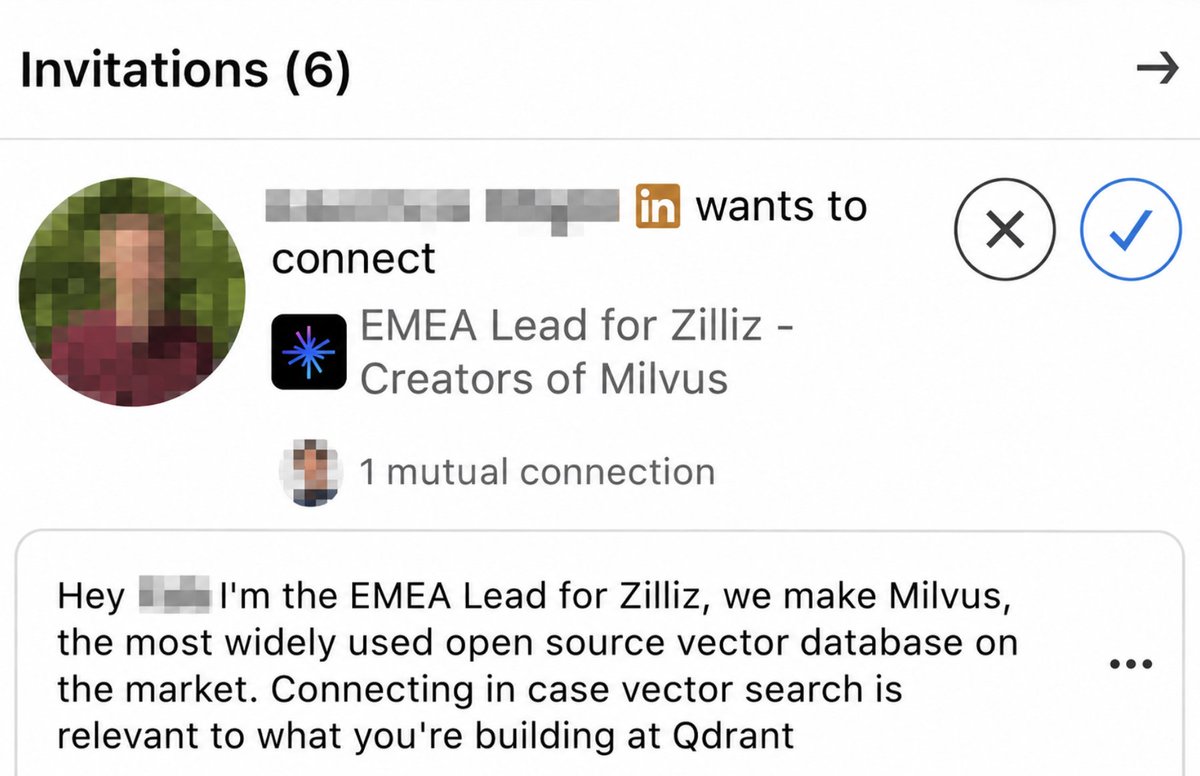
When your competitors put outbound on autopilot and contact your team members. 🤡
Well, yes, vector search is kinda relevant to Qdrant. I mean, it's like the core of our technology. 🤷♂️
BTW. We also have a nice https://t.co/897Nt6cTQ9 tool that allows migration from almost any vector storage source, such as Milvus, to Qdrant. It is very efficient; try it out ;-)
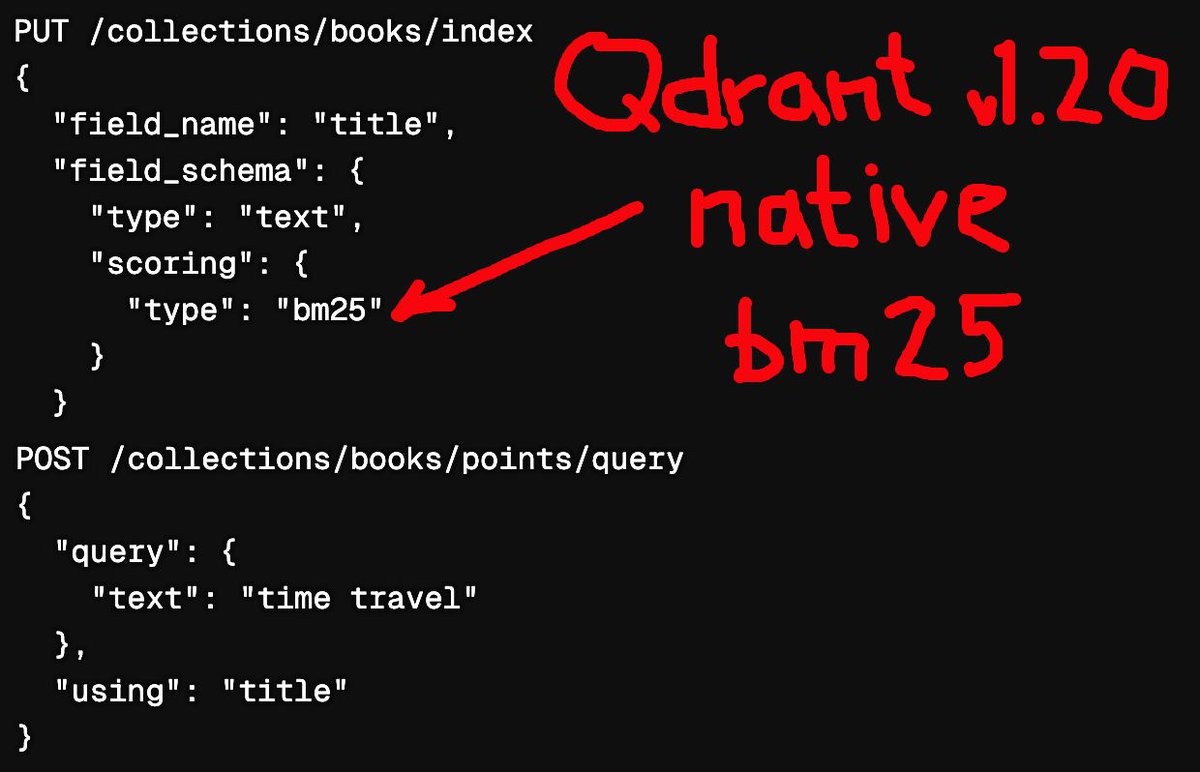
The @qdrant_engine v1.20 release is here and brings improvements for full-text search. While we still believe that the sparse vectors are super powerful when using neural sparse models like SPLADE, sometimes it just has to be simple and fast. You asked, we did it.
From now on, Qdrant scores BM25 directly on the full-text index. => https://t.co/29GLaWDea5
Which German councils are discussing wind power?
Poliscope answers in one search.
4,800 council portals, 130M points, one self-hosted Qdrant node.
Searches went from up to 20 s to 0.87 s on average with hybrid search, tenant filters, and TurboQuant.
https://t.co/XgYfVeAm6G
Reachy Mini, the open-source robot by @huggingface, can now answer: “What did you see today?” With multimodal memory inside powered by @qdrant_engine.
Details on how to do face recognition with multivectors, and how conversations outlive a 1K-token context window. ⤵
https://t.co/It1U0oROSU
@perplexity_ai pplx-embed-v2-late searches PDF pages as images. No OCR.
The catch: about 1,700 vectors per page. 856 KB in float32. 80+ GB per 100K pages.
The workaround: 1-bit TurboQuant in Qdrant, with rescoring. https://t.co/cAJ7BOrenX
This assistant remembers where you left your keys. No network connection. No remote server.
Build one yourself in a course built in partnership with Qdrant and taught by Dylan Couzon.
👉 Enroll for free: https://t.co/aRvfEe3CxC
#AI#VectorSearch#AIEngineering
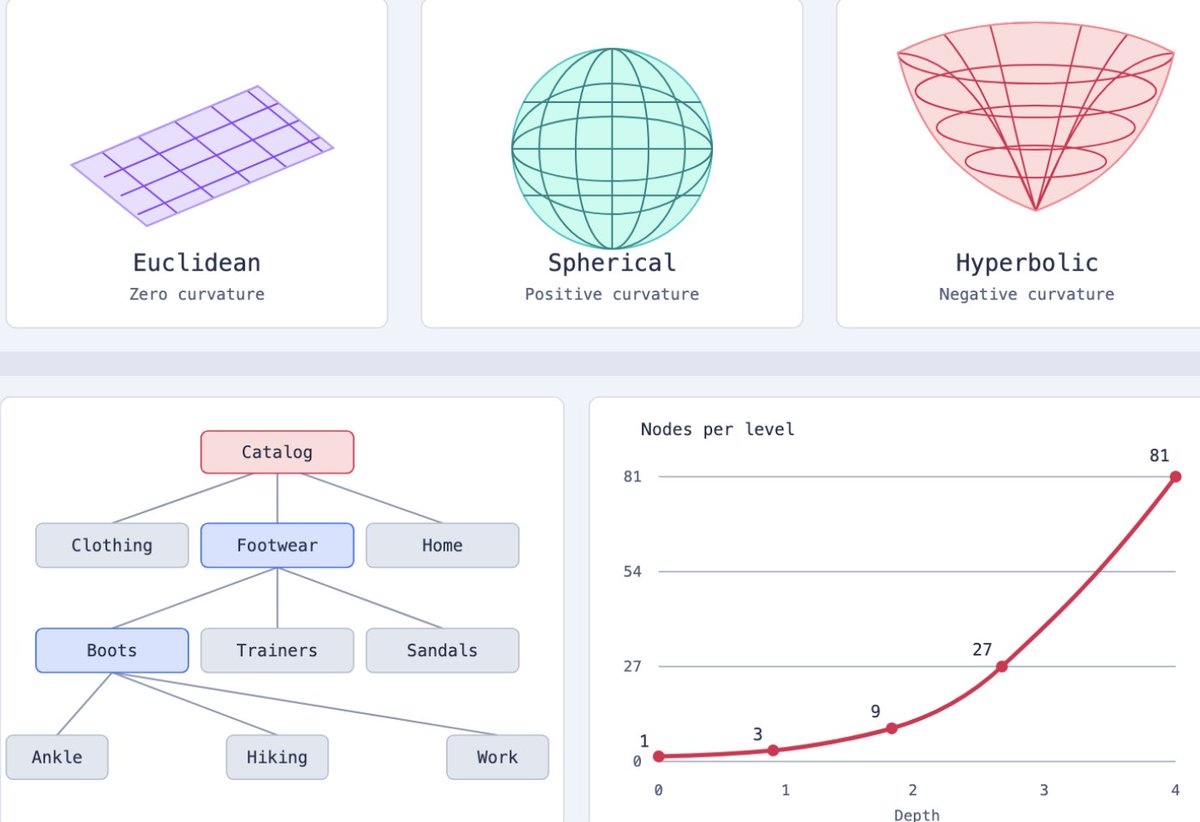
Your embeddings default to flat space, not because anyone checked if your data is flat.
Hierarchical data isn't. On WordNet, a 5-dim Poincaré embedding hit 0.823 MAP. A 200-dim Euclidean one hit 0.168, with 40x more dimensions.
That's super power of Hyperbolic Embeddings:
https://t.co/sbjReYuk2b
We do a lot of research at @qdrant_engine: about embeddings, storage, quantization, and information retrieval in general. And we want to share our research topics and results with the community.
Eight sessions today, eight actual engineering problems:
Vector Space lifestream: https://t.co/5LLDHKNtsH
Contextual relevance: 0.92 out of 1.00.
Incorrect answers: 40%.
Repeated ingestion had increased the number of items from 8,416 to 22,946; consequently, the top five results retrieved by the agent repeatedly contained the same text segments.
Deletion of 14,530 duplicates → accuracy increased from 0.57 to 0.76. Same model, same prompt.
Full write-up, including the one failure none of these checks can see:
https://t.co/s3mKObXp91
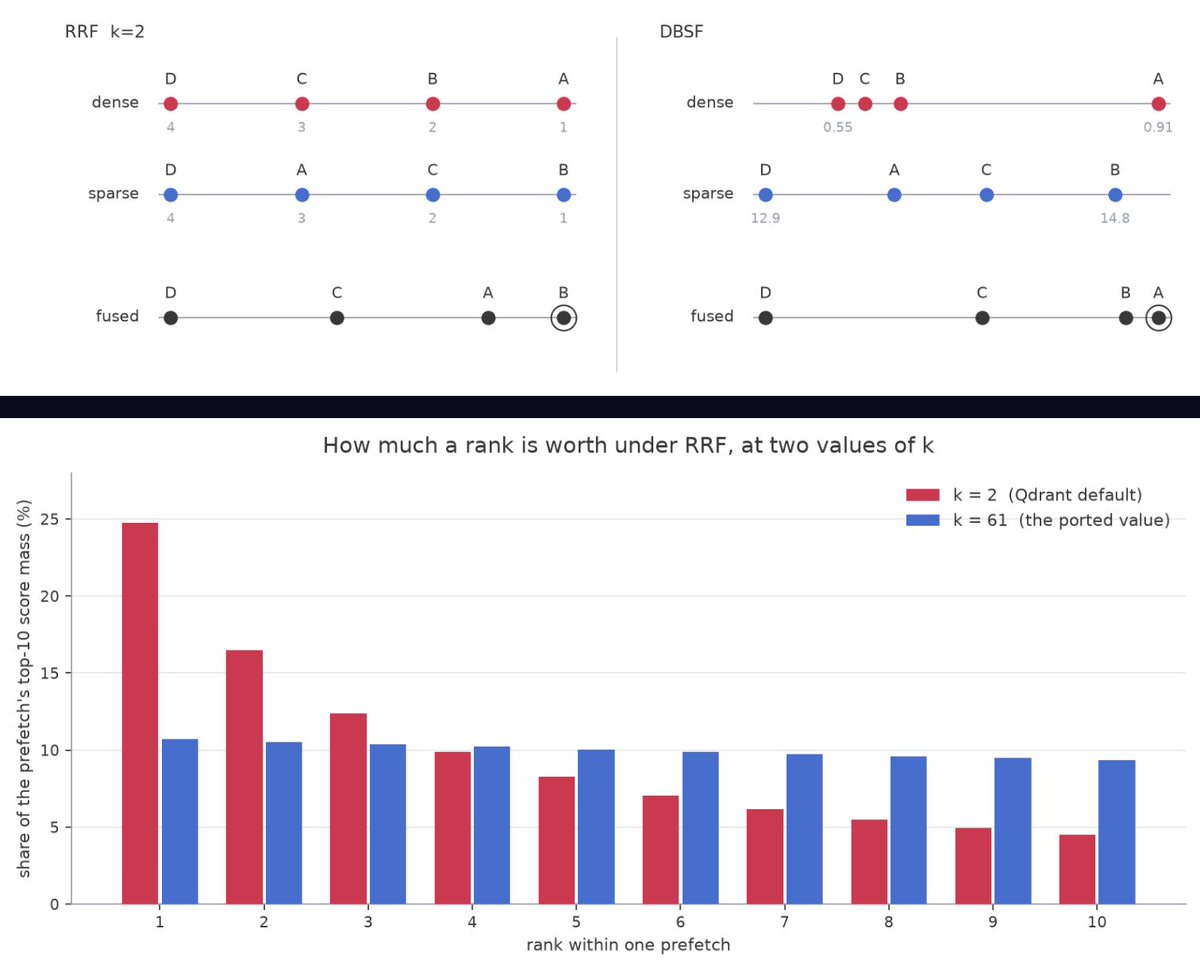
Default hybrid search settings usually aren't tuned for your data.
We benchmarked two fusion methods, RRF and DBSF, across five datasets. Tuning just the k parameter changed the top result for 42% of WANDS queries, a +0.036 nDCG@10 gain.
https://t.co/goj1YQKQpf
And for those who are not in Berlin, we have an even bigger global event on Thursday, 09/17. First ever: Vector Space Stream, a >4-hour virtual stream of the latest research topics in (vector) search.
▶️ Agenda: https://t.co/d2lZSsgcIM
See the full Search Week schedule at https://t.co/E5Kc2pJYBW
Next week is all about search—at least in Berlin! :-) Numerous events centered on search and information retrieval are taking place, ranging from the two-day Haystack conference (We still ❤️ you) to various workshops and community meetups. Naturally, @qdrant_engine will be part of the action.
On Wednesday, the 16th of September, we are organizing together with the beloved @cognee_ team a Bring Your Own Demo Night, a community meetup for Berlin's AI builders: good 🍕, cold 🍺, and people who want to see what you've built with vector search and AI memory.
▶️ Register: https://t.co/znLlTQ5Tro