@lucianocapone Modestamente ritengo che una strategia energetica nazionale non sia argomento per "il popolo" ne sia suscettibile di referndum. E' un argomento di una complessità e di una necessità di visione a lungo termine che è incomprensibile ai più. Io sono pro nuke senza se e senza ma.
@emrato Porsche GT3 RS da concessionario (+o-) 525CV e ha fatto 6:49:328 e puoi farlo per 24 ore. Qunado vedrò una di queste finire una 24H ne riparliamo. PS per me le macchine elettriche hanno molto senso, ma una sportiva è un altra cosa.
@astrosteven_ Io ero rimasto che oltre un tot non aveva senso andare, per i telescopi terrestri, per problemi con la turbolenza dell'atmosfera che degrada le immagini oltre una certa risoluzione. Come è stata risolta la questione?
A 21-year-old MIT student wrote a master's thesis in 1937 that Harvard's most famous professor of cognitive science later called "possibly the most important master's thesis of the century."
I read it at 2am and could not believe one paper had quietly built the entire foundation of every computer that exists today.
His name was Claude Shannon. The thesis is called "A Symbolic Analysis of Relay and Switching Circuits."
Every smartphone in your pocket. Every server farm running ChatGPT. Every chip Nvidia ships. Every line of code an engineer has ever written. All of it traces back to a single insight one graduate student had at 21 years old, working on a side project at MIT.
Here is the story almost nobody tells you.
Claude Shannon was born in 1916 in a small town in Michigan. He grew up tinkering. Built a telegraph between his house and a friend's house using barbed wire from a nearby fence. Repaired radios for the local department store. He studied both mathematics and electrical engineering at the University of Michigan because he could not decide which one he loved more. That refusal to choose is what eventually made him.
When he got to MIT for graduate school in 1936, he was assigned to operate a strange machine called the differential analyzer. It was room-sized. Mechanical. Built by Vannevar Bush. It used a tangle of gears, shafts, and electrical relays to solve calculus problems. Most students just operated it.
Shannon did something else. He stared at the relay circuits inside it. The way they clicked open and closed. The way they routed signals through the machine.
He noticed something nobody had noticed before.
The relays inside the machine had two states. Open or closed. On or off. One or zero. And the way the relays were wired together to make decisions looked exactly like a 90-year-old branch of mathematics that almost everyone had forgotten about. Boolean algebra. Invented by a British mathematician named George Boole in the 1850s. Boole had built a system of logic where statements could be true or false, and you could combine them with operators like AND, OR, and NOT to derive new statements.
For 90 years, Boolean algebra had been a curiosity. A philosophical tool. Nobody saw a practical use for it.
Shannon saw it.
He realized that an electrical circuit was not just an electrical circuit. It was a physical implementation of a logical statement. A switch that closed when both A and B were true was an AND gate. A switch that closed when either A or B was true was an OR gate. The entire branch of pure mathematics that Boole had invented as a thought experiment could be built out of wires and relays. And once you could build logic out of wires, you could build anything that could be expressed in logic out of wires too.
This was the insight that quietly created the modern world.
Before Shannon's thesis, electrical engineers designed circuits the way artisans built watches. By feel. By experience. By trial and error. Every new circuit was a craft project. There was no theory underneath it.
After Shannon's thesis, circuit design became a branch of mathematics. You could specify the logic you wanted on paper, and translate it directly into a wiring diagram. You could prove a circuit was correct before you built it. You could simplify a circuit by simplifying the underlying logical expression.
The MIT historian who reviewed his thesis described the shift in one sentence. It transformed circuit design from an art into a science.
Shannon was 21 years old when he wrote it.
That alone would have earned him a place in every computer science textbook on Earth.
But Shannon was not done. He spent the next 11 years working on a problem nobody had even framed properly. He wanted to know what information actually was. Not what messages were. Not what signals were. What information was. Mathematically. Quantitatively. As a measurable thing.
In 1948, while working at Bell Labs, he published a 79-page paper called "A Mathematical Theory of Communication." The paper invented the entire field of information theory in a single shot.
He proved that all information, regardless of whether it was a voice on a phone, a photograph in a magazine, or a chess move on a board, could be measured in a single unit. He named that unit the bit. Short for binary digit. It was the first time anyone had given information a unit of measurement.
The paper proved something that sounded impossible. He showed that you could send a message reliably through a noisy channel, with arbitrarily low error, as long as you encoded it correctly and stayed below a specific limit he called the channel capacity. Every Wi-Fi connection, every satellite signal, every cell phone call, every fiber optic transmission across the floor of the Pacific Ocean operates inside the mathematical bounds that Shannon proved in this single paper.
He did all of this in his spare time while officially working on cryptography for the war effort.
The strangest part of the man is what he did when he was not inventing the future.
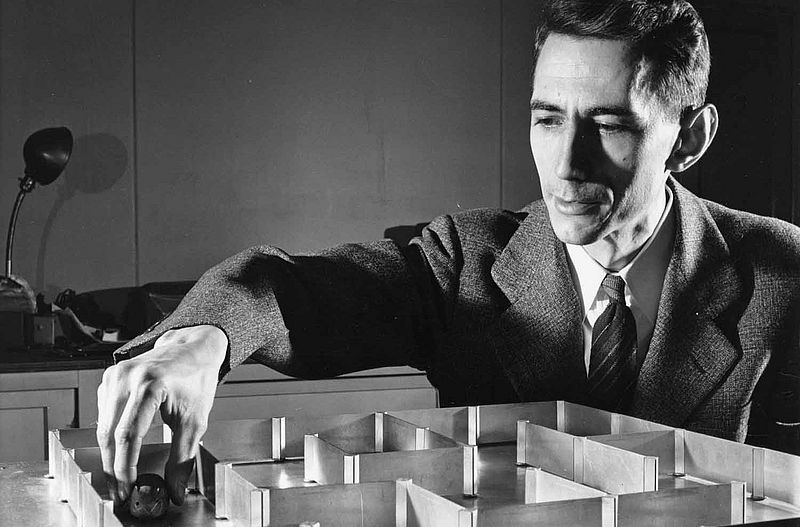
He rode a unicycle through the hallways of Bell Labs at night while juggling. He built a chess-playing machine in 1950 that played a primitive form of chess decades before computers were supposed to be capable of it. He built an electronic mouse named "Theseus" that could solve a maze and remember the solution. It was one of the first machines on Earth that learned. He built a flame-throwing trumpet for fun. He had a closet full of unicycles in different sizes. He installed a chairlift across his backyard so his kids could get to the lake faster.
Marvin Minsky, one of the founders of artificial intelligence, said Shannon was the most genuinely playful great scientist he had ever met. Other people approached research with seriousness. Shannon approached it like a kid who had snuck into the toy store after closing time.
Stevens Institute of Technology called him the least known genius of the 20th century.
That title is exactly correct. Most people have heard of Einstein, Turing, von Neumann. Shannon's name barely registers outside engineering departments. Yet without his master's thesis, there is no digital circuit. Without his 1948 paper, there is no internet. Without his framework, there is no measurement of information at all, which means no compression, no error correction, no cryptography, no machine learning.
He died in 2001 at age 84, after years of Alzheimer's disease that took away his ability to recognize the world he had built. Most newspapers ran a small obituary. The world he had given us did not pause.
His thesis is on the MIT archive. His 1948 paper is on the Bell Labs site. Both are free. Both are short. Both are still readable today by anyone willing to spend an evening with them.
The least known genius of the 20th century is one click away from you.
Most people will never open the file.
[Bastava venderlo per quello che è, che è tanta, tanta roba. Purtroppo quando siedi su una montagna da decine di miliardi di debito, devi inventarti una montagna ancora più alta perchè se ti scappa un investitore finisce come la snow-ball]
Prof @AlfonsoFuggetta: grazie as usual.
@Cr1st14nM3s14n0 A 55 anni ho imparato che l'etica aziendale è per quelli come me che non diventeranno mai ricchi. Chi fa veramente i soldi pensa solo al business e le persone/popolazioni sono solo numeri da rapporto costo/fatturato. Just my 2c.
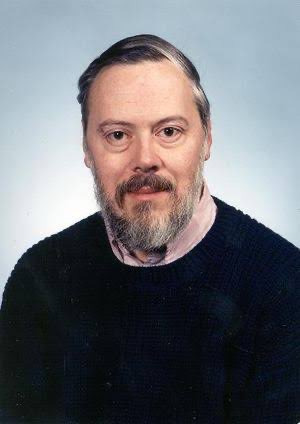
Dennis Ritchie created C in the early 1970s without Google, Stack Overflow, GitHub, or any AI ( Claude, Cursor, Codex) assistant.
- No VC funding.
- No viral launch.
- No TED talk.
- Just two engineers at Bell Labs. A terminal. And a problem to solve.
He built a language that fit in kilobytes.
50 years later, it runs everything.
Linux kernel. Windows. macOS.
Every iPhone. Every Android.
NASA’s deep space probes.
The International Space Station.
> Python borrowed from it.
> Java borrowed from it.
> JavaScript borrowed from it.
If you have ever written a single line of code in any language, you did it in Dennis Ritchie’s shadow.
He died in 2011.
The same week as Steve Jobs.
Jobs got the front pages.
Ritchie got silence.
This Legend deserves to be celebrated.
@GiancarloSpera2@Cr1st14nM3s14n0 Qualche anno fa mi è capitato in mano il filtro gasolio per la mia Seat Leon nella confezione per le officine, sulla scatola c'era l' oem di tutte le case del gruppo VW e ovviamente venduto a prezzo diverso a seconda del marchio.
@Cr1st14nM3s14n0 Modellare un processo è una delle attività più ad alto valore aggiunto, non è per nulla semplice anche se lo sembra. Innovare quel processo poi è un ulteriore step, cercando però di non voler reinventare la ruota come troppo spesso vedo fare.
@kommander61 Concordo con l'abbattere a distanza che conferma abilità di rilevamento a distanza. Usare l'F35 è effettivamente usare una corazzata per abbattere un topolino. Resta comunque vero che i Phalanx avrebbero fatto il loro dovere e prima o poi andranno verificati a saturazione.
@kommander61 Grazie, apprezzo tantissimo i suoi contenuti, giustamente profondi, è un piacere ricavare 5 minuti nella giornata per leggerli. La competenza non si riassume in 5 righe! Buon Anno e speriemo sia foriero di sviluppi positivi.
@emrato Si, ma mi sono anche chiesto se chi c'era prima e non solo il precedente, diciamo dagli anni 80 in poi (che sono quelli che ho visto in vita mia), come avrebbero deciso. Onestamente ritengo che certe decisioni portano alla luce il meglio e il peggio delle persone.
@KersevanRoberto Dal 20% al 30% di import per chiudere il gap con il Load!! Vuole dire essere totalmente dipendenti da altri, non solo geopoliticamente ma nella vita di tutti i giorni. Non che in ITA siamo messi meglio.
@Cinico82306771@bennyherty@ardigiorgio Benissimo allora spiegami perchè tutti questi problemi: chiudiamo ilva, raffineria e porto. Sono meno del 20% quindi assimilabile dal resto del tessuto lavorativo. Dimmi dove sbaglio. Sono serio non è una domanda provocatoria.
@ardigiorgio Indipendentemente da dove era diretta la nave, gli armatori guardano alla sicurezza delle navi e degli equipaggi, se un porto diventa pericoloso lo evitano. Per farli tornare devi abbassare i costi e quindi anche le retribuzioni degli operatori portuali, fantastico!
@Cinico82306771@bennyherty@ardigiorgio Bene e dell'80% quanti lavoravano per quel 20%? Ristorazione, manutenzione, servizi, etc...Se offri servizi li offri a tutta la catena del valore ma se uccidi l'apice tutto crolla.


![Cr1st14nM3s14n0's tweet photo. [Bastava venderlo per quello che è, che è tanta, tanta roba. Purtroppo quando siedi su una montagna da decine di miliardi di debito, devi inventarti una montagna ancora più alta perchè se ti scappa un investitore finisce come la snow-ball]
Prof @AlfonsoFuggetta: grazie as usual. https://t.co/t8tX8tV49O](https://pbs.twimg.com/media/HF-S-3MWYAAPYUj.png)




![Cr1st14nM3s14n0's tweet photo. [Bastava venderlo per quello che è, che è tanta, tanta roba. Purtroppo quando siedi su una montagna da decine di miliardi di debito, devi inventarti una montagna ancora più alta perchè se ti scappa un investitore finisce come la snow-ball]
Prof @AlfonsoFuggetta: grazie as usual. https://t.co/t8tX8tV49O](https://pbs.twimg.com/media/HF-TLvrXAAEmwHj.jpg)