The reason we think dandelions are weeds is because of a 1950s marketing campaign.
Dandelions, native to Europe and Asia, were brought to North America in the 1600s by European colonists who grew them deliberately.
Every part is edible. The leaves are a salad green, the flowers were made into wine, and the roots were roasted as a coffee substitute and used medicinally for liver and kidney conditions for thousands of years. They were a kitchen-garden staple well into the 1800s.
The shift happened after World War II, when 2,4-D (originally developed for chemical warfare research) was approved as a residential herbicide. Companies like Scotts built the modern lawn-care industry around the idea that a perfect green lawn meant zero broadleaf plants.
Dandelions, being bright yellow and resistant to mowing, became a visible enemy, and the campaign worked. By the 1970s, "dandelion-free" was synonymous with "well-kept."
They aren't native, but they aren't doing significant ecological harm either. The herbicides used to kill them, on the other hand, kill bees, contaminate groundwater, and have been linked to non-Hodgkin lymphoma in humans.
If you hate dandelions, it's most likely due to a marketing campaign that ran before you were born.
BREAKING: HOLY SMOKES! Democratic superstar Graham Platner pulls ahead of Republican incumbent Susan Collins by a staggering 9 points!
The people of Maine are fed up with this do-nothing right-winger...
According to independent polling from the University of New Hampshire Survey Center that was conducted from May 21 to 25, Platner is leading Collins 51-42%. 6% are still undecided and 2% prefer "another candidate."
This new lead is even greater than the 7 points recorded by a Pan Atlantic Research poll that was released last week. Momentum is building behind Platner and you can feel it in the onslaught of smears from panicking Republicans and corporate, aggressively pro-Israel "Democrats."
Platner's campaign is built around lifting up the working class, who have been betrayed at every turn by the 5-term Senator Susan Collins. While she likes to present herself as a reasonable moderate, in practice she sides with Trump's fascist agenda every time it really matters.
On top of that, rumors of health problems have begun to plague Collins as time and again she has been spotted visibly shaking in videos. While she claims that the symptom is a result of a "benign tremor," she's a professional liar. You don't survive this long as a Republican politician without developing a profoundly adversarial relationship with the truth.
If Platner wins this race, as it seems increasingly likely that he might, it will prove that brash, unapologetic progressivism is a winning strategy. We don't have to offer voters watered-down centrism. We can offer them a bold vision of the future and deliver lasting, meaningful change.
Please ❤️ and share if you'd vote for Platner for higher office one day!
Campos: While I want to thank CBS news for funding this generous gift towards my education, I want to acknowledge how the recent direction of the outlet stains the legacy of Mike Wallace, the namesake of this scholarship.
If at any time you hesitate to utter the word genocide or remain silent in the face of blatant lies, remember to ask yourself: who is this for?
I’ve been in the Epstein files for months. His network is very much running the country right now.
We are in a battle against technofascists, oligarchs, and extremists who see ordinary people as disposable.
The sooner Americans recognize this and unite, the more suffering we can prevent.
🚨 Every Republican present in the House Appropriations Committee last night voted to make THEMSELVES eligible to collect from Trump's $1.8 billion January 6th slush fund. I am not making this up.
I introduced an amendment to stop Members of Congress, the President, and the Vice President from collecting a single dollar from Trump’s slush fund unless a court actually orders it.
Every single Republican who cast a vote was AGAINST my amendment, making themselves eligible for settlement funds.
Members of Congress, the President, and the Vice President, have no business lining their own pockets by claiming they were victims of government weaponization. Trump set up this fund, now MAGA Republicans in Congress are ensuring they all can collect from it.
That is exactly the kind of self-dealing corruption the American people are sick of.
Mossad booby‑trapped 21,000 communication devices with explosives, sent them to Lebanon through shell companies, and detonated them remotely — killing dozens (including children) and injuring over 3,400.
• The devices exploded in people's hands, on their faces, and in their pockets.
• They did it over two consecutive days.
• On day two, the explosives went off while Lebanese families were at the funerals of those killed the day before.
• The attack inflicted roughly 3,000 injuries in a single hour on the first day alone.
This terrorist attack was the largest simultaneous mass‑detonation in history by the number of individual bombs.
'israelis' joke about it to this day.
If you didn't boycott Apple for the Congo, boycott it now.
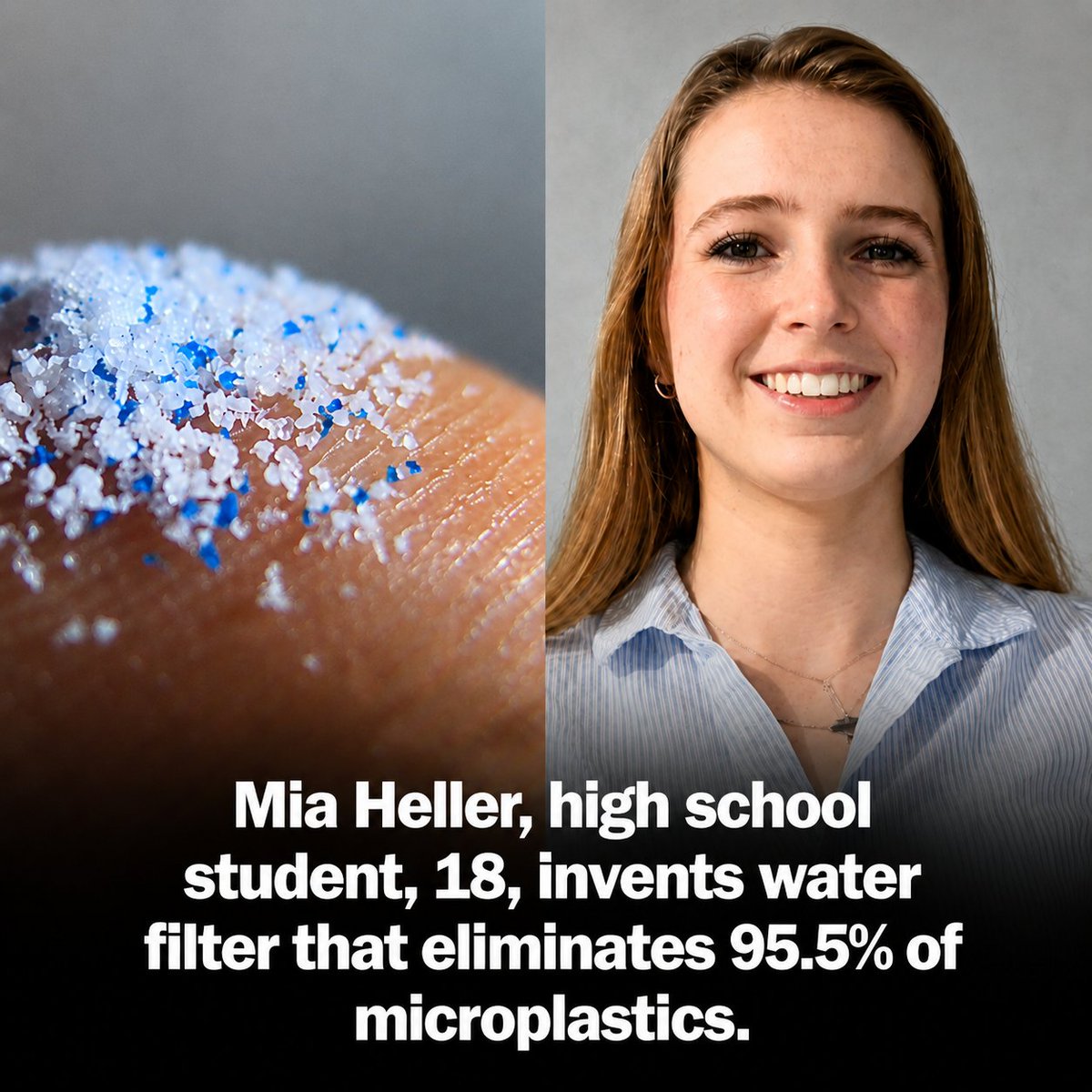
An 18-year-old just did what billion-dollar water companies couldn't.
Meet Mia Heller.
A high school junior from Warrenton, Virginia who built a water filter in her garage that strips out 95.5% of microplastics from drinking water.
That's better than most government treatment plants, which sit somewhere between 70% and 90%.
Her secret weapon? Ferrofluid. A magnetized liquid made of oil and powder that latches onto microplastic particles. Then a magnet yanks them out. No membranes. No constant filter replacements. No endless maintenance bills.
The ferrofluid even gets recycled, around 87% of it, in a closed loop.
The spark for all of this wasn't a classroom project. It was a local newspaper article warning that her town's tap water was loaded with PFAS and microplastics, and that nobody was coming to fix it.
So she watched her mom swap out filter after filter and thought, there has to be a smarter way.
She built the prototype herself. Tested it with a homemade turbidity sensor. Then walked into the Regeneron International Science and Engineering Fair and walked out with a special award from the Patent and Trademark Office Society.
Up against nearly 1,700 students from 62 countries.
She's now eyeing a household version that sits under your kitchen sink.
The future of clean water might not come from a lab in Silicon Valley. It might come from a teenager's garage in Virginia.
Source: Smithsonian Magazine
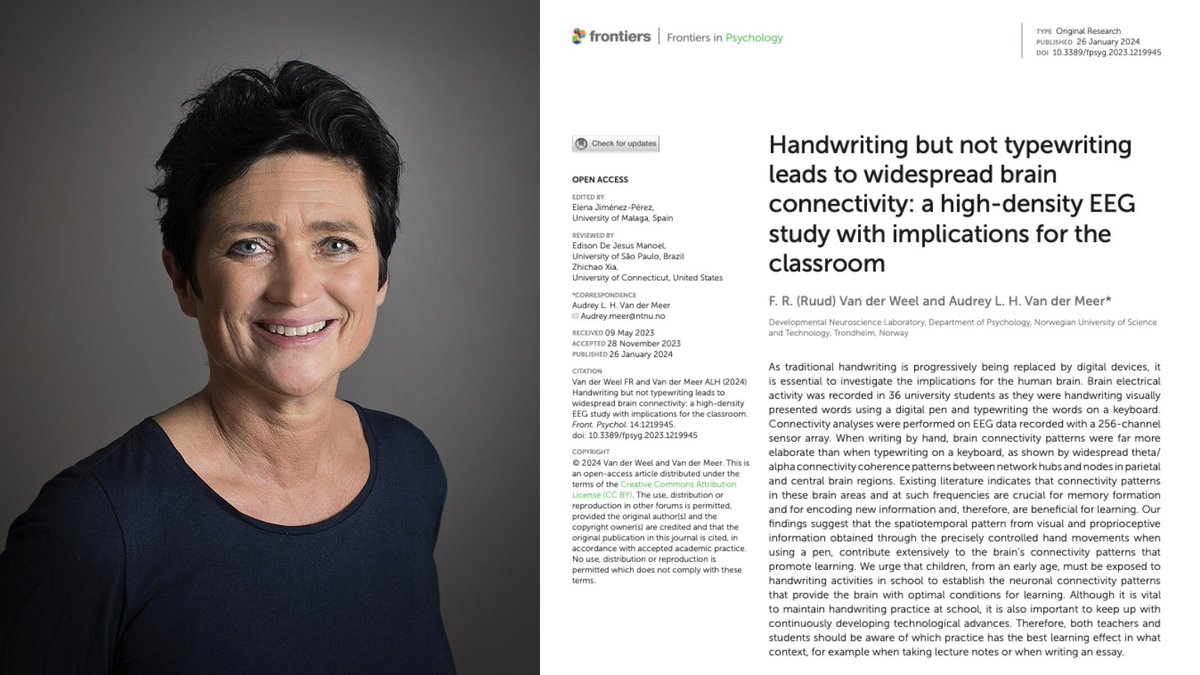
A Norwegian neuroscientist spent 20 years proving that the act of writing by hand changes the human brain in ways typing physically cannot, and almost nobody outside her field has read the paper.
Her name is Audrey van der Meer.
She runs a brain research lab in Trondheim, and the paper that closed the argument was published in 2024 in a journal called Frontiers in Psychology. The finding is brutal enough that it should have changed every classroom on Earth.
The experiment was simple. She recruited 36 university students and put each one in a cap with 256 sensors pressed against their scalp to record brain activity. Words flashed on a screen one at a time.
Sometimes the students wrote the word by hand on a touchscreen using a digital pen, and sometimes they typed the same word on a keyboard. Every neural response was recorded for the full five seconds the word stayed on screen.
Then her team looked at the part of the data most researchers had ignored for years, which is how different parts of the brain were communicating with each other during the task.
When the students wrote by hand, the brain lit up everywhere at once.
The regions responsible for memory, sensory integration, and the encoding of new information were all firing together in a coordinated pattern that spread across the entire cortex. The whole network was awake and connected.
When the same students typed the same word, that pattern collapsed almost completely.
Most of the brain went quiet, and the connections between regions that had been alive seconds earlier were nowhere to be found on the EEG.
Same word, same brain, same person, and two completely different neurological events.
The reason turned out to be something nobody had really paid attention to before her work. Writing by hand is not one motion but a sequence of thousands of tiny micro-movements coordinated with your eyes in real time, where each letter is a different shape that requires the brain to solve a slightly different spatial problem.
Your fingers, wrist, vision, and the parts of your brain that track position in space are all working together to produce one letter, then the next, then the next.
Typing throws all of that away. Every key on a keyboard requires the exact same finger motion regardless of which letter you are pressing, which means the brain has almost nothing to integrate and almost no problem to solve.
Van der Meer said it plainly in her interviews.
Pressing the same key with the same finger over and over does not stimulate the brain in any meaningful way, and she pointed out something that should scare every parent who handed their kid an iPad.
Children who learn to read and write on tablets often cannot tell letters like b and d apart, because they have never physically felt with their bodies what it takes to actually produce those letters on a page.
A decade before her, two researchers at Princeton ran the same fight using a completely different method and ended up at the same answer. Pam Mueller and Daniel Oppenheimer tested 327 students across three experiments, where half took notes on laptops with the internet disabled and half took notes by hand, before testing everyone on what they actually understood from the lectures they had watched.
The handwriting group won by a wide margin on every question that required real understanding rather than surface recall.
The reason was hiding in the transcripts of what the two groups had actually written down.
The laptop students typed almost word for word, capturing more total content but processing almost none of it as they went, while the handwriting students physically could not write fast enough to transcribe a lecture in real time, which forced them to listen carefully, decide what actually mattered, and put it in their own words on the page.
That single act of choosing what to keep was the learning itself, and the keyboard had quietly skipped the choosing and skipped the learning along with it.
Two studies. Two countries. Same answer.
Handwriting makes the brain work. Typing lets it coast.
Every note you have ever typed instead of written went into your brain through a thinner pipe. Every meeting, every book highlight, every idea you captured on your phone instead of on paper was processed at half depth.
You did not forget those things because your memory is bad. You forgot them because typing never woke the part of the brain that would have made them stick.
The fix is the thing your grandmother already knew.
Pick up a pen. Write the thing down. The slower road is the faster one.
@EdKrassen Incredible they all ejected safely! That is one hell of a crash! And yes, it’s real, not AI, this clip was run by BBC, AP, other news outlets
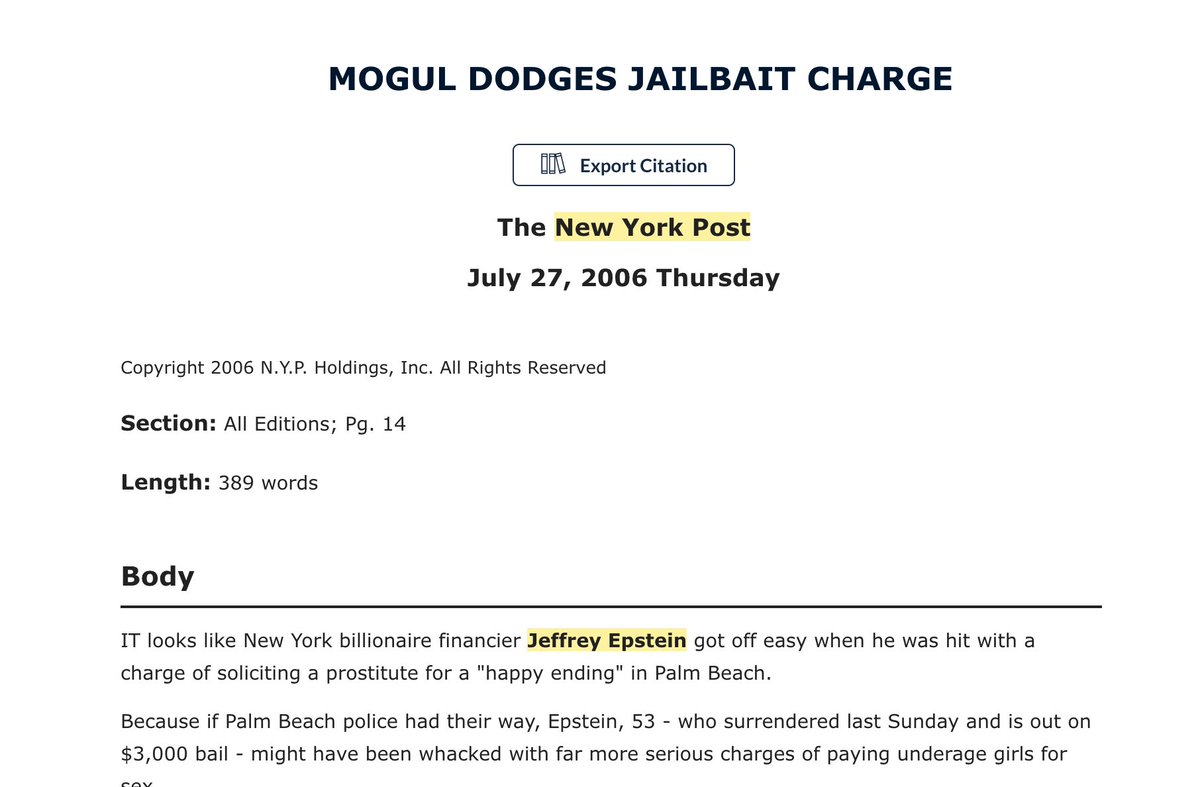
July 27, 2006: "Mogul dodges jailbait charge."
NYP calls 14 and 16 girls "jailbait" who gave Jeffrey Epstein a "happy ending." It's worth looking at how the media covered this story back then to better understand how he was able to away with his crimes.
For 20 years, a $6 knob that takes one hour to 3D print has been grounding Black Hawk helicopters four times a month, and the contractor responsible won't sell us the part or the IP rights to fix it ourselves.
So instead, American taxpayers have been paying $40,000 every single time to replace the entire system, multiplied by four times a month, for two decades.
That is NOT a procurement problem, that is a shakedown, and it is exactly why right to repair has to be in this year's NDAA.