I've been at @MetaMask for over four years now. I've helped ship a lot. but today is the one closest to me.
Finally the 🦊 Agent Wallet is live.
Here's why it matters for years: putting an agent on a self-custody wallet meant choosing between giving it the freedom to actually act or keeping the funds safe. you couldn't have both. most "agent wallets" picked freedom and crossed their fingers.
we killed that trade-off. Agent Wallet is the first self-custodial agent wallet that reaches all of defi
> swaps,
> perps,
> prediction markets
> LP
across every EVM chain and Hyperliquid. and every single transaction runs through mandatory security: simulation, threat scanning, MEV protection. agents can't opt out of it.
Basically, you stay in control. set your limits, and anything outside them needs your sign-off. autonomy and safety stop being a trade-off.
The next wave on-chain won't be humans alone and machines are going to transact, coordinate, and move real capital on these rails. The infra underneath has to be worthy of that. this is us building it.
And now on my way to @ethconf to hear @ethereumJoseph talk!
I got completely owned by the most sophisticated hack I've ever encountered.
I'm a developer. I know what scams look like.
This didn't look like one.
🧵
🚨 I don't think people realize how bad things are at @aave right now.
All core markets are at 100% utilization, that includes $3 bil in USDT and $2 bil in USDC stuck!
That means you CAN'T WITHDRAW your money!
A long post on why and how we ended up here.
When the rsETH exploit happened and AAVE incurred bad debt, whales like Justin Sun, MEXC exchange, and others immediately withdrew billions from AAVE.
This instantly drained all available liquidity in key core markets like ETH, USDT, USDC and so on. Those first to withdraw got out, laggers got trapped.
Initially, the ETH market hit 100% utilization, meaning you could not withdraw your ETH from AAVE.
Worse, this also means the protocol can't process ETH liquidations should ETH price fall/crash. If you can't sell any ETH, you can't liquidate to cover debt obligations.
That means the risk of more bad debt incurred by AAVE is increasing the longer its markets remain stuck.
Nevertheless, users can still sell at a minor loss the aETHwETH tokens on Uniswap or similar aggregators. That exit door is the last one remaining for ETH depositors on AAVE.
The same cannot be said by depositors of USDT and USDC. They are stuck.
That's because AAVE lost over $6 billion in liquidity in the past 24h. As whales took out their money, USDT and USDC also hit 100% utilization.
These markets are now also stuck with money locked. Panic is spreading and desperate times call for desperate measures.
Some users decided to borrow against USDT/USDC and exit via other markets at a 10-25% loss (90-75% LTV). Basically you borrow GHO/DAI/USDe against your locked USDT/C.
But as more liquidity leaves AAVE, more markets get to 100% utilization and get locked/stuck due to low liquidity. This is quickly cascading across all available markets.
Luckily the crypto market was rather flat today so liquidation risks were marginal, but if things change there are billions in stablecoins and other assets locked on AAVE that can't process liquidations = more bad debt for AAVE.
If users or related protocols that are stuck need access to their money to prevent liquidations or other critical function, they have a huge problem on their hands.
Plus, nobody wants to deposit (or provide liquidity) in these markets now since your ETH, BTC, USDC/T could be stuck there for who know how long.
As soon as any available liquidity is made available, it is instantly taken out by bots fighting to get out. As I wrote this I saw 250k in liquidity on USDC vanish in seconds.
Then there is the bad debt question.
There's over $200 mil in bad debt incurred by AAVE via rsETH that's like a hot potato. Nobody knows who will eventually pay this bill.
If you didn't remove your assets from AAVE, you risk receiving at least part of that bill in some form. Not having access to your money is part of that risk too.
Contagion is also extremely high.
Many protocols and apps rely on AAVE for their earn mechanics. These protocols and their users are stuck too and may be forced to incur bad debt with no fault of their own.
October 10th was a CEX driven crash, this is a DeFi risk mitigation failure of epic proportions.
AAVE should have never onboarded rsETH as a collateral asset, at least not to the size of hundreds of millions that allowed the hacker to walk away (i.e. borrow) over $200M in ETH after posting fake collateral.
Rumors on X are saying rsETH was onboarded by AAVE due to a conflict of interest (lobbying) by a given service provider. If true, this is a major failure of its governance structure (nothing new).
The folks at @KelpDAO who manage rsETH also have a tough decision to make on who will actually pay for the $200M exploit. AAVE users? L2 rsETH users? Everyone affected gets a haircut to account for the loss?
The AAVE team and its founder, Stani, have been quiet for over 20h since the exploit after initially announcing the rsETH market freeze.
They have a pretty big problem on their hands since the whole protocol is at risk right now. Trust is already lost as AAVE is bleeding billions in TVL to the level of hitting 100% utilization on all core markets.
Maybe some key actors in the space will step in to provide liquidity to stabilize the markets on AAVE before this gets even worse.
I got lucky to get out of AAVE early when I first saw this. I also removed all assets from DeFi and will not touch any protocol in the next few weeks. Too much risk for a few percentage points in yield.
If you found this informative, like, share, and follow @duonine
This is the most SHAMELESS structural manipulation of a major index I've ever seen.
SpaceX is preparing what could be the largest IPO in history.
Target valuation: $1.75 trillion.
That would make it the sixth-largest company in America on day one.
And Nasdaq wants the listing so badly they're literally CHANGING how the Nasdaq-100 works.
In February, Nasdaq published a "consultation" proposing sweeping changes to how companies enter the index. The timing is pure coincidence, of course.
Just like it's pure coincidence that SpaceX has reportedly made fast index inclusion a CONDITION of listing on Nasdaq.
Here's what they're proposing:
A new "Fast Entry" rule would let any newly listed company whose market cap ranks in the top 40 of current Nasdaq-100 members get added to the index after just 15 trading days.
No seasoning period. No liquidity requirements. Completely exempt from the standards every other company had to meet.
Currently, new public companies typically wait up to a year before they're eligible for major index inclusion.
That waiting period exists for a reason. It lets the market establish real price discovery. It protects passive investors from being forced into untested, illiquid stocks.
And Nasdaq wants to throw all of that out. For ONE listing.
But the Fast Entry rule isn't even the worst part...
The real scandal is the 5x float multiplier.
Right now, the S&P 500 uses a free-float adjusted methodology. If only 5% of a company's shares are available for public trading, the index weights you at 5% of total market cap.
That's common sense. You weight a company based on what investors can actually buy.
Nasdaq's current methodology already uses total market cap rather than free-float for weighting. But for very low-float stocks, they at least had a 10% minimum float threshold.
Under the new proposal, that threshold DISAPPEARS entirely.
Instead, any stock with less than 20% free float gets weighted at FIVE TIMES its actual float percentage, capped at 100%.
Do the math on SpaceX:
If SpaceX IPOs at $1.75 trillion and floats 5% of its shares, there would be roughly $87.5 billion worth of stock available for public trading.
Under Nasdaq's proposed 5x multiplier, the index would weight SpaceX at 25% of its total market cap. That means passive funds would be forced to buy as if SpaceX were a $437.5 billion company.
But only $87.5 billion of stock actually exists in the market.
You are forcing hundreds of billions in passive buying into a $87.5 billion float.
QQQ alone manages nearly $400 billion. The total Nasdaq-100 ecosystem represents over $1.4 trillion in exposure across ETFs, mutual funds, structured notes, and derivatives.
Every single passive vehicle tracking this index would be REQUIRED to buy SpaceX at whatever price the market dictates.
On Day 15.
With zero price discovery. Zero track record as a public company. And a float so thin you could read through it.
So what this actually does is it creates a structural wealth transfer mechanism.
The passive bid from index funds pushes the stock price higher. That higher price benefits exactly one group of people: the insiders and early investors who own the other 95% of the shares.
And when lock-up periods expire 90 to 180 days later? Those insiders sell into the artificially inflated passive bid. Your 401(k) is the exit liquidity.
This is the fundamental corruption of indexing.
Indexing used to be brilliant. Low cost. Efficient. You were free-riding on the price discovery done by active managers. The index reflected the market.
Now the index IS the market. Trillions of dollars flow blindly into whatever the index tells them to buy. And the people who control the index methodology are changing the rules to serve the interests of a single IPO candidate.
The S&P 500 requires companies to have at least 50% of shares available for public trading. It requires 6 to 12 months of seasoning. It uses free-float adjusted weighting so passive investors aren't buying phantom liquidity.
Nasdaq is doing the exact opposite. 15 days. No float requirement. 5x multiplier on insider-held shares.
Every passive investor in QQQ, QQQM, and every fund benchmarked to the Nasdaq-100 should understand what's about to happen:
The rules are being rewritten to benefit IPO issuers and early-stage insiders, and your capital is the tool being USED to enrich them.
45 years in this business and I've watched Wall Street find creative new ways to separate retail investors from their money in every cycle. But usually they at least try to be subtle about it.
This one they put in a PDF and called it a "consultation."
What's your take?
🚨🇪🇺 EU URGES Ukraine to allow access to a pipeline carrying RUSSIAN OIL.
Yes, you read that right. After all the sanctions and speeches, Brussels now wants the taps OPEN.
You cannot make this up 😂
Very interested in what the coming era of highly bespoke software might look like.
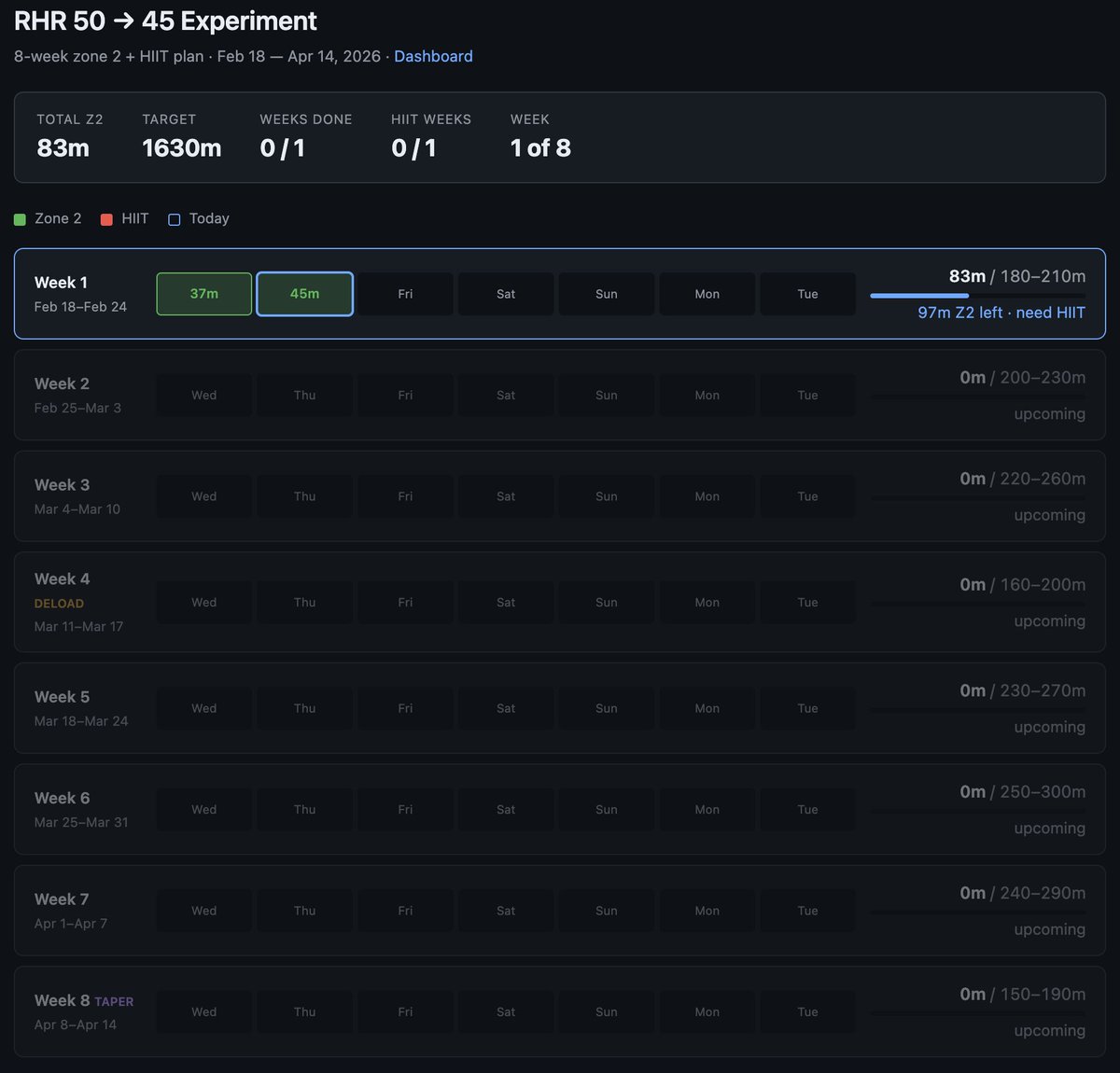
Example from this morning - I've become a bit loosy goosy with my cardio recently so I decided to do a more srs, regimented experiment to try to lower my Resting Heart Rate from 50 -> 45, over experiment duration of 8 weeks. The primary way to do this is to aspire to a certain sum total minute goals in Zone 2 cardio and 1 HIIT/week.
1 hour later I vibe coded this super custom dashboard for this very specific experiment that shows me how I'm tracking. Claude had to reverse engineer the Woodway treadmill cloud API to pull raw data, process, filter, debug it and create a web UI frontend to track the experiment. It wasn't a fully smooth experience and I had to notice and ask to fix bugs e.g. it screwed up metric vs. imperial system units and it screwed up on the calendar matching up days to dates etc.
But I still feel like the overall direction is clear:
1) There will never be (and shouldn't be) a specific app on the app store for this kind of thing. I shouldn't have to look for, download and use some kind of a "Cardio experiment tracker", when this thing is ~300 lines of code that an LLM agent will give you in seconds. The idea of an "app store" of a long tail of discrete set of apps you choose from feels somehow wrong and outdated when LLM agents can improvise the app on the spot and just for you.
2) Second, the industry has to reconfigure into a set of services of sensors and actuators with agent native ergonomics. My Woodway treadmill is a sensor - it turns physical state into digital knowledge. It shouldn't maintain some human-readable frontend and my LLM agent shouldn't have to reverse engineer it, it should be an API/CLI easily usable by my agent. I'm a little bit disappointed (and my timelines are correspondingly slower) with how slowly this progression is happening in the industry overall. 99% of products/services still don't have an AI-native CLI yet. 99% of products/services maintain .html/.css docs like I won't immediately look for how to copy paste the whole thing to my agent to get something done. They give you a list of instructions on a webpage to open this or that url and click here or there to do a thing. In 2026. What am I a computer? You do it. Or have my agent do it.
So anyway today I am impressed that this random thing took 1 hour (it would have been ~10 hours 2 years ago). But what excites me more is thinking through how this really should have been 1 minute tops. What has to be in place so that it would be 1 minute? So that I could simply say "Hi can you help me track my cardio over the next 8 weeks", and after a very brief Q&A the app would be up. The AI would already have a lot personal context, it would gather the extra needed data, it would reference and search related skill libraries, and maintain all my little apps/automations.
TLDR the "app store" of a set of discrete apps that you choose from is an increasingly outdated concept all by itself. The future are services of AI-native sensors & actuators orchestrated via LLM glue into highly custom, ephemeral apps. It's just not here yet.
@GeorgeMerey @TelosDevelopers@HelloTelos Every time telos closes above a certain price the TF are allowed to unlock a large amount of telos.
https://t.co/NDvLFnIv2b