We are opening the call of papers for the 2026 SaM annual conference. This edition will be held in Amsterdam on the 28th-30th May, 2026 and hosted by the Tinbergen Institute, with support of the Dutch Central Bank. The plenary speakers will be Prof. Fabien Postel-Vinay (UCL) and Prof. Belen Jerez (UC3, Madrid).
You can find the call for papers and instructions on how to submit your papers on our new website: https://t.co/RwGFHMQ4ac
The deadline for submissions is 15th February, 2026. Please share this information among your contacts and finishing PhD students.
We hope to see you in Amsterdam.
The SaM Committee
Carlos Carrillo-Tudela (chair, University of Essex), Ana Figueiredo (VU Amsterdam), Manolis Galenianos (Royal Holloway, University of London), Marion Goussé (CREST), Leo Kaas (EUI, Goethe University Frankfurt), Andreas Mueller (University of Zurich), Daphné Skandalis (University of Copenhagen), Antonella Trigari (Bocconi University), and Ludo Visschers (Universidad Carlos III de Madrid)
Sometimes the most revealing thing about an award is not who receives it, but who gives it.
The new FIFA Peace Award is a case in point. When an organization mired in corruption scandals and complicit silence on human rights abuses suddenly crowns itself as a champion of peace, it’s not moral leadership, it’s a showcase of moral ineptitude.
Gianni Infantino’s relentless eagerness to cozy up to the powerful of this world — from autocrats to oil sheikhs — leaves the organization with no credibility to hand out an award for peace.
Sport can be a force for peace and connection. But not when it’s hijacked by those who use it for PR, power, and self-promotion.
— A big fan of football, but not the Infantino-FIFA.
#FIFA #Infantino #Sportswashing #Football #Leadership #Integrity
In 1992 Peter Ratcliffe received this rejection letter from Nature.
His findings were not "a sufficient advance in our understanding".
27 years later he won the Nobel Prize for the same discovery.
Don't lose faith in the things you believe in.
A big leap forward for our department! I am so thankful to Florian Scheuer and everyone else who contributed to making this transformational hire for UZH.
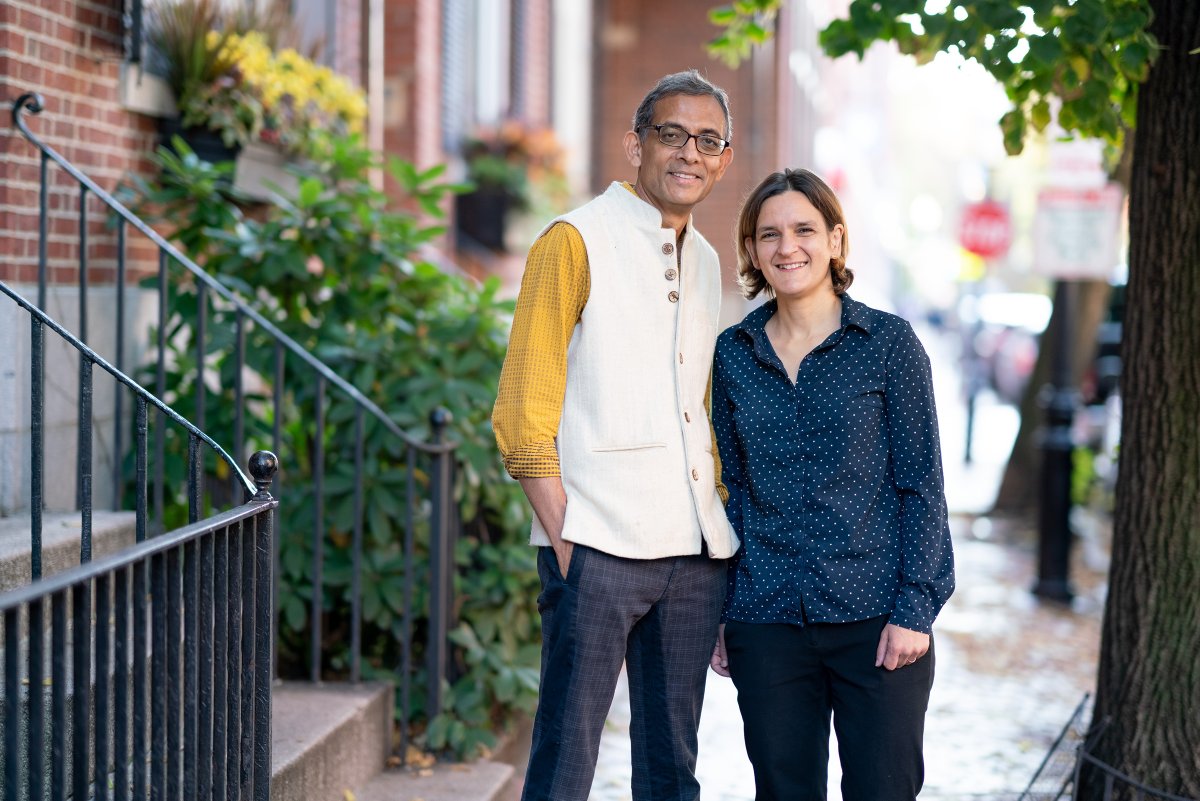
I am delighted to share that Nobel laureates Esther Duflo and Abhijit Banerjee will join our Department of Economics @econ_uzh at the University of Zurich on July 1, 2026, as Lemann Foundation Professors of Economics.
🧵 1/7
I don't understand why some working papers still place tables and figures at the very end. Back in the typewriter era, this made sense. But today, embedding them directly in the text is almost costless, and it makes papers far easier to read, especially on a screen. Instead of flipping back and forth between the main text and the appendix, readers can follow the argument easily alongside the evidence. A small change, but one that makes a big difference for clarity and accessibility, especially for referees and editors.
Here’s a new New York Times story on the rise of long-term unemployment among college graduates. Grateful to have been quoted in the piece!
https://t.co/x7V7pwk78j
#LongTermUnemployment#AI#Restructuring
Reflecting on the close of an inspiring week: I had the pleasure of attending two honorary conferences at Monte Verità in Switzerland and at Stanford University, celebrating the remarkable contributions of my co-authors Josef Zweimüller and Robert E. Hall. Both have shaped economics not only through their research, but also through their life-long and continuing commitment to the economics research community. I am deeply grateful for their mentorship and the example they set.
Across the many heartfelt speeches, including my own, a recurring theme emerged: the importance of friendship in research collaborations. Good relationships with co-authors don’t just make the work better, they make the journey richer and far more enjoyable. Research can often feel solitary, with long hours behind a computer. All the more reason why collaboration and exchange matter so much.
Thrilled to share that my paper “The Nature of Long-Term Unemployment” (with Johannes Spinnewijn) is forthcoming in the Journal of Political Economy.
We challenge the view that long-term unemployment is simply a trap. Instead, we show that the long-term unemployed are distinct individuals with persistently low job-finding rates and a high risk of remaining unemployed.
Using rich administrative data from Sweden, we:
1️⃣ Capture observable heterogeneity with a prediction model.
2️⃣ Capture unobserved heterogeneity through the correlation of multiple unemployment spells for the same person.
These two approaches are highly complementary and most powerful when combined.
https://t.co/jA0Yjcpzls
Trump is silencing the messenger.
The Bureau of Labor Statistics is one of the most respected and reliable statistical agencies in the world. So why remove its chief statistician?
When the data starts to reflect the uncomfortable reality of a cooling labor market—amid tariff hikes and near-daily policy uncertainty—this administration just wants to silence the messenger than face the facts.
https://t.co/wdQGsRG4VW
Firing the head of a key government agency because you don’t like the numbers they report, which come from surveys using long established procedures, is what happens in authoritarian countries not democratic ones. This is surely not the most serious threat to our democracy that @realDonaldTrump poses, but it is the one closest to what we economists do. I don’t see how serious members of the economics profession can stay in his administration.
It was a great pleasure to present our paper “The Ins and Outs of Vacancies” (with Damian Osterwalder and Josef Zweimüller) at the NBER Summer Institute. One of our key findings: replacement vacancies—those posted to refill jobs after workers quit—fluctuate strongly over the business cycle. This has important implications for how we interpret vacancy data and understand labor market dynamics.
Thanks to the organizers and participants for the engaging discussion! As always when you have all the best people in the same room, you get invaluable feedback for your research.
#NBER #JobVacancies #BusinessCycle #LaborMarket #QuitRate
Link to paper: https://t.co/lRmNSyDiho
What drives fluctuations in the job vacancy rate?
It was a real pleasure to present my joint work with Damian Osterwalder and Josef Zweimüller today at Copenhagen Business School. In our paper, “The Ins and Outs of Vacancies”, we use exceptionally detailed vacancy data from Austria to shed light on the dynamics behind changes in the job vacancy rate. We find that vacancy rates decline when both inflows (newly posted vacancies) and outflows (filled positions) fall—roughly in equal measure. A key driver of the declining inflows are replacement vacancies—those posted to backfill positions left by workers who quit to join other firms. When fewer workers quit, fewer replacement vacancies are posted, setting off a domino effect: fewer vacancies today lead to even fewer vacancies tomorrow.
Link to paper: https://t.co/aOFIq1L4fW
Thanks to @dbm27199695 for the invitation to CBS!
Is a retirement age of 65 still sustainable?
Today, the Swiss Council of States (Ständerat) voted to raise taxes while keeping the retirement age fixed at 65 in order to finance the benefit increases approved last year. But this decision risks ignoring long-term demographic realities.
A glance across the border is instructive: while the current retirement age in most OECD countries ranges between 62 and 67, many have already legislated future increases. In Denmark, for instance, someone entering the labor market at age 22 today is projected to retire at 73! While this may seem extreme, it reflects a clear-eyed assessment of rising life expectancy and declining fertility rates.
It is time for Switzerland’s political leadership to take the demographic transition more seriously. Rather than relying solely on tax hikes, parliament and government should begin to gradually raise the retirement age to ensure the long-term sustainability of the pension system.
Harvard University is doing just the right thing. This is extortion. It's a vendetta using all powers of the government because of a political argument with Harvard. It is violating the First Amendment. It is also violating all the laws we have regarding administrative procedures.
I stand with Harvard.
More than Harvard, more than universities, more than science lie in the balance. This is an abuse of power the kind the US so uniquely avoided for so long.
Does UI generosity raise the aggregate unemployment rate? It was a great pleasure to deliver a keynote at this year’s Bristol Macroeconomics Workshop, where I presented joint work with @migacosta, Emi Nakamura, and @JonSteinsson. Our findings show that, in the United States, a 13-week extension of UI benefits does indeed raise the state-level unemployment rate, by about 0.3 percentage points. See here for the full paper: https://t.co/DMP7e32Iaw