One of the most daunting technical tasks is identifying the right solution for managing complexity and scale.
It’s not just about how you split code or applications. It’s about who owns what, where the boundaries sit, and what those boundaries cost.
There’s an old joke in software engineering:
“There is no problem in computer science that can’t be solved by another level of indirection... except for the problem of too many layers of indirection.”
Whatever architecture you choose introduces some form of indirection. That indirection adds complexity. The important question is whether it pays for itself.
Microfrontends are no different.
There’s a lot of general advice about how they should be done, but architecture is a bit like nutrition: general principles are useful, yet individual needs, constraints, and circumstances can be distinctly different.
There is no silver bullet that solves every organizational and technical problem.
Pick the wrong solution, force it onto an organization, live through the aftermath, and it’s not surprising that people come away with strong opinions about the entire idea.
I built this decision framework to help technical decision-makers reason through those tradeoffs and make a more informed choice.
HyperFrontend is one microfrontend solution. It addresses a particular class of problems that other approaches don’t address particularly well.
It doesn’t pretend to be the final stop, or the right answer for everyone.
Sometimes the useful answer is HyperFrontend.
Sometimes it’s something else.
The point is knowing why.
https://t.co/J3FdfR4TKQ
Package managers are the root of all evil.
We’ve over-indexed on the “code reuse” card for far too long. Huge transitive dependency graphs made more sense when JS APIs were poorer and writing the right-sized solution yourself was expensive.
That cost has collapsed. Modern APIs + AI have changed the equation.
I want npm 2.0: put a hard limit on dependency depth. One or two levels, max.
Force packages to ask: do I really need this dependency, and everything it drags in?
I’m fucking tired of inheriting an entire attack surface because someone needed 20 lines of code.
Change my mind.
#npm
This brings us to a beautiful, yin-yang contradiction.
If advanced intelligence has inevitably emerged elsewhere in the deep cosmos, it will likely look nothing like us. We must leave room in our science for things we cannot yet recognize as "intelligent."
To do that, we need to lean heavily on our imagination.
But here is the ultimate twist: imagination is not separate from reality. It is a physical phenomenon generated by the complex hardwiring of our brains. Therefore, our capacity to imagine alien forms of intelligence is itself an emergent phenomenon of the very universe we are trying to understand.
Reality is simply using us to imagine itself.
(3/3)
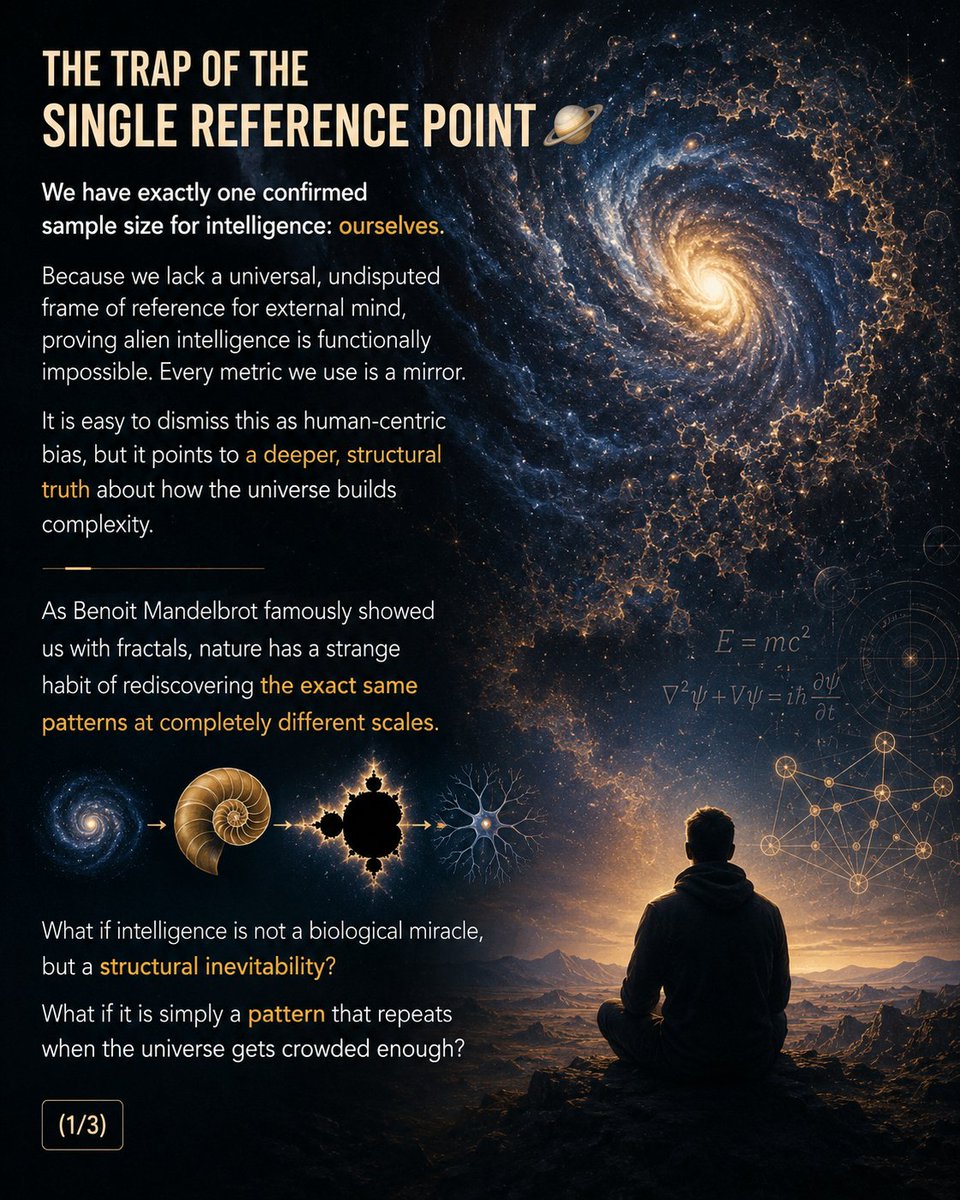
We have exactly one confirmed sample size for intelligence: ourselves.
Because we lack a universal, undisputed frame of reference for external mind, proving alien intelligence is functionally impossible.
Every metric we use is a mirror. It is easy to dismiss this as human-centric bias, but it points to a deeper, structural truth about how the universe builds complexity.
As Benoit Mandelbrot famously showed us with fractals, nature has a strange habit of rediscovering the exact same patterns at completely different scales.
What if intelligence is not a biological miracle, but a structural inevitability?
What if it is simply a pattern that repeats when the universe gets crowded enough?
(1/3)
Look at how we built AI. We wired simple nodes together, and as the connections grew dense, something eerie happened: intelligence emerged.
If complex networks—whether made of organic neurons or digital silicon—inherently produce mind, then the implications scale infinitely upward.
A single dot holds no meaning. Two dots create a line. Three create a correlation. Millions create a conscious observer.
If intelligence is a true emergent behavior of complexity, we are implicitly agreeing with a classical concept of the Divine. We are admitting that a sufficiently vast, interconnected network at a cosmic scale could host a form of intelligence that dwarfs our own. To believe in emergent mind is to leave the door open for something all-knowing.
(2/3)
Math is our attempt to strip the universe of its friction. But reality is beautifully friction-full.
Yet, step back.
From acoustics to conch shells, pendulums to empires, the same structures recur across entirely unrelated scales. We aren't watching nature follow a rigid formula.
We are staring at a Mandelbrot set, where every local mess zooms out into a universal echo, endlessly self-renovating, never quite repeating.
HyperFrontend: compose your existing apps together securely, like Lego bricks.
Both let teams ship independently and compose at runtime. The resemblance mostly ends there.
https://t.co/JD2VJiy9zP
As devs, we spend +50hrs/wk moving bits and optimizing systems.
It’s brain-melting work that we mistake for physical survival, triggering a romance with "simpler times."
We don't want the past's hardship. We just want to touch something real.
Anime has brought to light some of the most deeply philosophical and quotable moments in fiction.
The mark of a mature man quote from psychoanalyst Wilhelm Stekel is one of those quotes that lives rent-free in my mind since watching GITS-SAC growing up.
@ufocryptocoin Ball lightning is a well-known phenomenon, but nobody knows what causes it.
Nature can be weird sometimes.
I don't think this is aliens, but if I were to witness this firsthand, I know I would be in shock, awe, and wondering the depths of the unknown.
We are experiencing high error rates around 20% for web experiences and api traffic. Archive downloads and raw repository content downloads are experiencing an approximate 50% error rate. Investigations are on-going into the root cause, and updates will... https://t.co/WB8TquG3GM