It’s a day of reflection and excitement at @Lucid_Bots as we announce the closing of our Series A round of funding. This capital will allow us to elevate our technology to new heights, better support our customers, and hire the next series of game-changers to join our team.
Congrats to the team @Lucid_Bots on the $9.1M Series A!
Lucid Bots (YC S19) builds intelligent robots purpose-made for dull, dirty, and dangerous jobs— starting with the cleaning industry.
https://t.co/Tbjz93aGbX
A stranger described my company's product to me, and he had no idea I was in the room.
I've gone to the same small barbershop in Huntersville, NC for years. The guy next to me started going on about a drone he saw cleaning a building in Charlotte, how fast it was and how much better it looked.
My barber and I played dumb. We both knew a lot more about cleaning drones than we let on.
Years ago, when we started @Lucid_Bots, most people thought the idea was crazy. Now someone at my local barbershop is raving about it to the guy who helped build it.
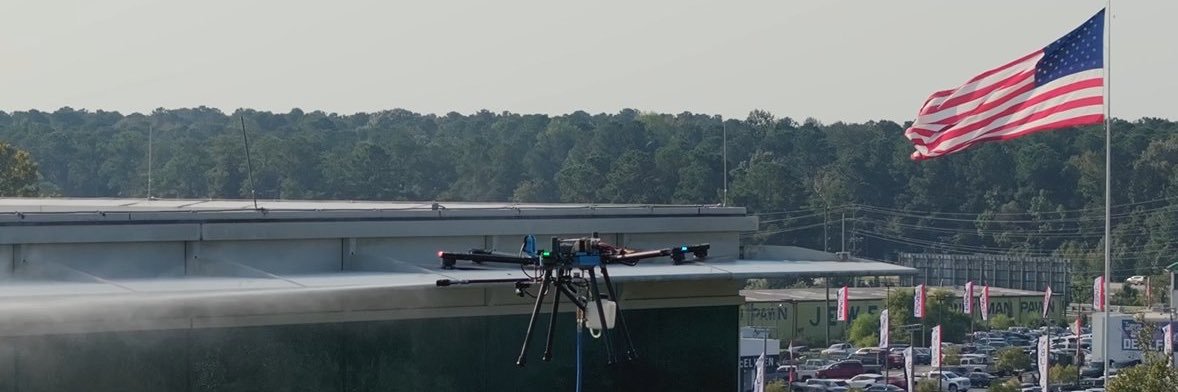
The drone in this video is the @Lucid_Bots Sherpa, which cleans and paints tall buildings and structures up to 8x faster than traditional methods.
The job was done by our customer, Aeroshine. https://t.co/ERfofYLy6n
Everyone's scared robots are coming for their jobs.
Meanwhile a guy bought a cleaning drone as a side hustle and made $38k in less than a week.
The robot didn't take his job. It became his business.
We intentionally went to a first facility where we expanded laterally to neighboring suites within an easy to modify contract. That one building lasted us for 8 years before we completely outgrew it.
That’s pretty good when you consider we’ve grown revenue by over 400x in that timeframe.
If you want to know whether manufacturing is coming back, look at how fast American manufacturing companies are outgrowing their buildings.
Just over 3 years ago, we were in 6k sqft. Then we upgraded to 16k, then outgrew that in 18 months and took back our original space to get to 22k sqft.
Now we've outgrown that too, and we're moving into 45,000 sqft. I wonder how long until it starts to feel cramped.
@NexusBattery@VisforVeteran Exactly, this is great advice. We really lucked out with our first facility because we got to stay in the same building and just keep expanding to neighboring suites.
@VisforVeteran It's definitely important to be mindful when negotiating lease contracts. You want to make sure you have good flexibility and exit options if you can get a new tenant in.
@VisforVeteran Unfortunately, they've all been pretty long leases.
Fortunately, we've always focused on facilities that we thought would be easy for a new tenant to take over if/when we outgrew the facility.
Ie, we can have a fairly clean exit by getting a new tenant in.
When we went from 6k to 16k sqft, we moved our facility overnight in less than 13 hours with no outside help.
We started at 5 pm, and by 6 am the tooling was set up so our manufacturing team didn't miss a minute of work.
I laugh a little watching this now. It felt like we had so much space, and we were also so far from optimized with our layout vs. what we have today.
@leo_rsousa_ Iterating on hardware design and compressing that timeline, yes.
Compressing actual revisions for real world products takes coordination of a lot more things than just the design, though.
Anyone who has built something physical reads "hardware is software in disguise" and laughs a bit.
While part of this statement is true, you can't push an update to a part that's already bolted onto a deployed unit. You order the new part, wait on it, test it on the floor, then get it to every customer using that unit.
Starting and growing a business is hard. I used to think it’ll get easier when:
- I go full time
- we build our first prototype
- we land our first customer
- we hire our first employee
- we make our first million
- we move to a larger facility
- we make $10M
- and so on…
The challenges never went away, they just changed size and shape.
Part of being an entrepreneur is about learning to fall in love with solving problems, which can be especially difficult when people doubt your business early on.
I remember when people told me cleaning and painting with a drone was crazy. And now it feels obvious.
Lock yourself in a room, until you win.
Two years ago people told me our startup BizScout would "never work."
Today:
- 183,000+ users
- 70,000 buyer & seller connections
- 1.5M listing views
- A $5M seed round from Valor, Balaji Srinivasan, Sean Rad & Bill Perkins
- Lots of mad industry incumbents
This year we:
- Partnered with Transworld, the world's largest business brokerage. Every active listing of theirs is now on BizScout.
- Built BizScout Score, which grades every listing 0-100 against similar deals. It's now the #1 way buyers sort.
- Launched Private Client, white-glove help for serious buyers (source 1,000s of off market deals a month).
- Turned on off-market deal alerts, with AI agents hunting your deal box 24/7.
(PS. If you own a business and you're quietly thinking about selling, DM me. Our buyers are real and verified.)
THE HARD PART: We were also buying businesses during it. We had fraud we found in a business that killed a deal. We ALMOST bought 2 businesses. We had one of the sellers pull out at the last minute.
That's buying or building a business. Slow, messy, and full of people who'll waste your time.
Which is exactly why we built it this way.
Score told us more than half of the car washes listed can't pay back an SBA loan at their asking price. Better to find that out in 10 seconds than 10 weeks.
And it's why Contrarian Academy exists. 203+ of our members this year have now closed on a business. 47% still had a day job when they did it.
One of them, Erin, beat cancer, quit her job and joined. A year later she bought a 20-year-old family laundromat for $65K. She followed up with the owner for over a year before he'd sell. Then she found an employee skimming cash. Real revenue was $250K, not $220K.
We saved Tim from a $1.4M nightmare acquisition he would have likely failed at.
Members have closed anywhere from 5 weeks to 18 months after their LOI. One went from joining to owning six territories in 30 weeks.
If you want to own something and you're tired of doing it alone, maybe we're your people. We share real deals, ugly numbers and creative structures here, plus the people who actually closed.
Don't start. Buy.
Just part of our team... steady hustling.
I've been building drones and robots since 2017, so I've watched AI hit software engineering first and now electrical and mechanical.
In 2023, a lot of senior software engineers laughed at AI code and said it would never be as good as theirs. In 2026, it is.
Electrical and mechanical design feels like 2023 right now. The AI outputs aren't great yet, but they're getting better.
I don't think it'll move as fast, though. Software had decades of open-source code to learn from. Hardware knowledge lives in part numbers, revision history and tooling limits, and most of that never got posted online.
There's also more friction to validating mechanical and electrical designs because you have to order parts, understand supply chain, have the right tooling, QA/QC each build and so much more than just hitting buttons on a laptop.
We'll get there with AI in physical engineering. I just expect it to take longer than it did for software.
While people dream about humanoids, everyday entrepreneurs are doing almost $200k in sales in a week with cleaning drones.
The robots that pay are already here.
The real advantage of manufacturing in America is measured in feet, not miles.
Our team designs, builds, tests, and supports all of our products under one roof.
A component will eventually fail in the field. When it does, what matters is how fast we can explain it and fix it.
We don't open a ticket that crosses an ocean and wait on a reply written at 2 am. We walk across the floor to the person who tested that exact board, then to the engineer who designed it, and we have a real answer that afternoon.
If you build things here, you know exactly what I mean.