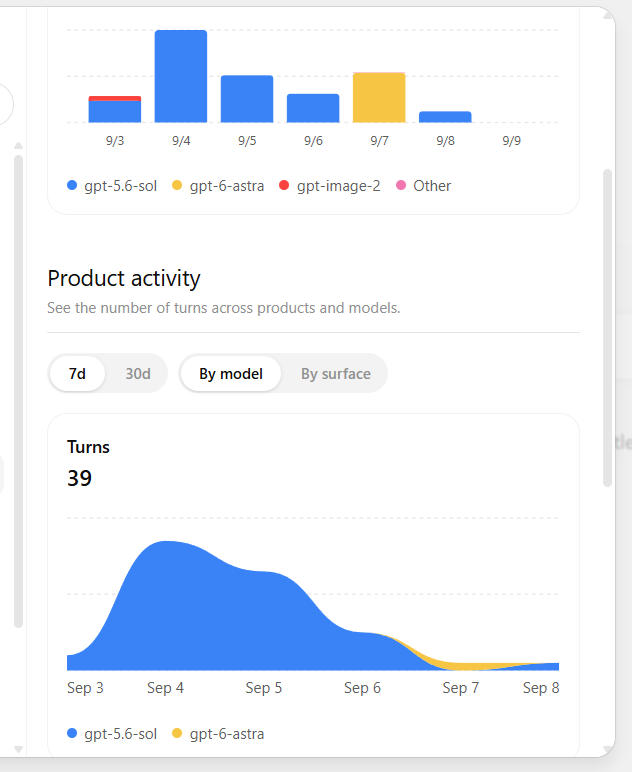
@SemiAnalysis_ Super useful discovery! I am on the 5x plan and did not see any impact.
The 5x plan gives me about a 50x return against the API cost (5b+ weekly token usage).
@CampbellKaleb23 Not having this issue. At 73% of weekly usage with one day left until reset. $100 sub.
5.1b (4.9b cache read) tokens used over last 7 days.
X-High Opus 5.5.
Saturate the Experience Outcome metrics, then watch for regressions.
One of the risks of technological innovation is that we become so focused on what new technology makes possible that we forget what people were already able to accomplish and how well they could accomplish it.
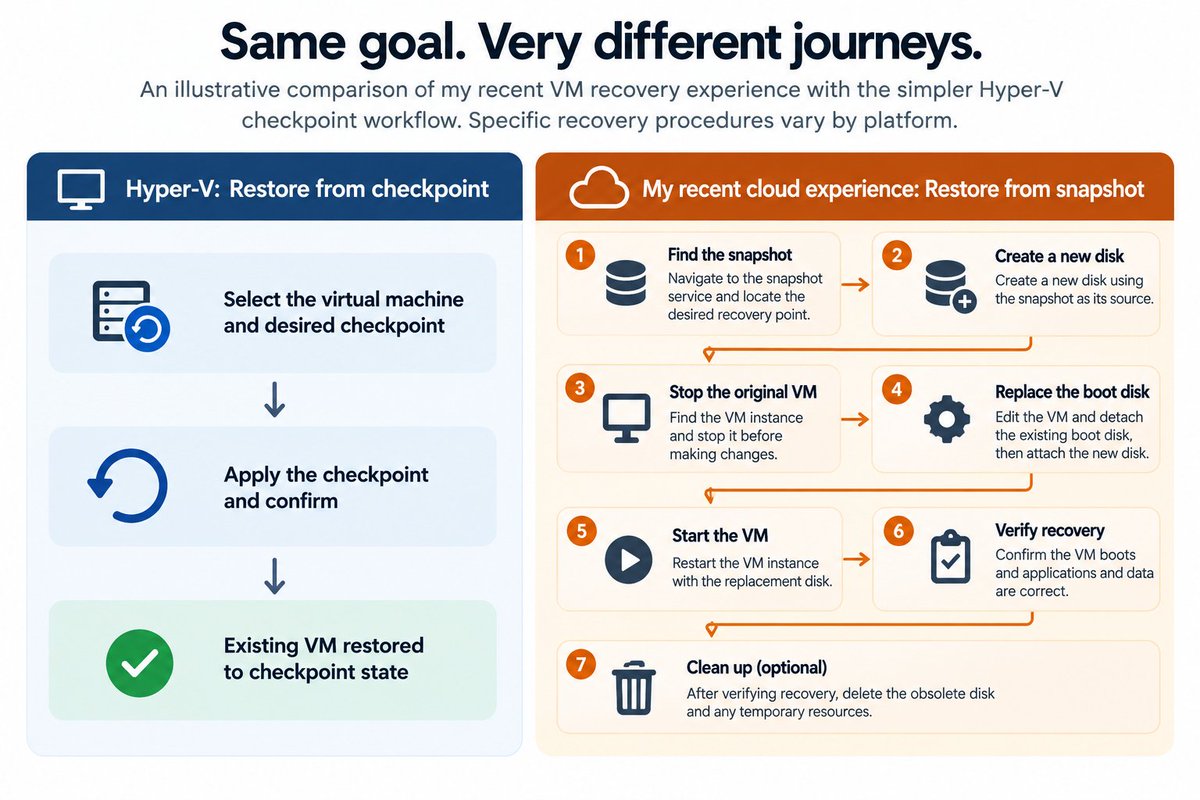
Recently I restored a cloud-hosted virtual machine from a snapshot after allowing my AI agent to change its config to a point it could neither go forward nor backward. No problem, I thought – restoring a VM is easy (I knew I had backups configured). I would argue that 18 years ago the user experience for restoring a VM was fully optimized – it couldn’t have been easier. Restoring a VM in the cloud taught me that the user experience has regressed painfully.
Hyper-V in Windows Server 2008 made it simple to restore to a previous good state: right-click, apply, confirm, done. And it wasn’t just fast. A standard checkpoint could restore the existing machine’s disks, configuration, and even its running memory state. The experience matched exactly what I wanted: put my machine back the way it was.
Today, common snapshot recovery across cloud platforms can mean creating replacement disks, swapping volumes, and navigating multiple infrastructure operations across services. I don’t need to restore disks very often, so this whole rigamarole was a change to my whole mental model (based on 18-year-old tech that I still run), adding even more time as I thought to myself, “It can’t be this convoluted – there is no way I would need to read docs to figure this out today.” It took 20+ minutes to do a job that took less than a minute 18 years ago.
There are probably good technical reasons for those differences, but the experience still feels like a significant step backward, especially when something’s gone wrong and you just need to get back to a working system.
In terms of saturating the experience outcome, we can measure whether people are achieving an outcome, how efficiently, how confidently, and we can improve that until it consistently hits the target. But saturation isn’t a reason to stop measuring; it’s the point where you have something valuable to protect. Without that continuity, it’s easy to lose sight of what mattered to users in the first place.
The technology continues to advance enormously, but did the experience of getting the job done advance with it?
The big technology shift we have seen with AI runs the risk of making us so focused on what the technology can do that we lose sight of what people actually need to accomplish.
Adding AI to a product doesn’t necessarily improve the experience any more than adding Wi-Fi to a toaster makes better toast.
I am a very heavy AI user and believer, but only where it improves outcomes.
The measure of progress isn’t what the technology can do. It’s what people can achieve with it, and whether that experience is genuinely better.
Claude absolutely is AGI - anything that can figure out how to share a SharePoint site with an external email address has solved a problem that has dogged humankind ever since SharePoint came into existance.
(granted, it took two attempts)
I am a Brit living in (near) Seattle. Proud father and husband. Currently focused on utilizing calibrated LLM evaluators to grade the user experience of agentic, conventional, and hybrid app experiences in test and production: Continuous UX Evals.
I started https://t.co/cedljejMaC to address major issues with user/customer experience data capture: it struggles to keep up with the pace of product development, it is asynchronous, and its impact on the business can only be guessed. OARUX uses research-grounded customer experience data to evaluate app experience in test and production to measure improvement or regression on what matters to customers/users and present that data side by side with metrics the business cares about (acquisition, conversion, growth, retention, churn, etc.)
Co-founder and managing partner of a large UX specialist research consultancy in Redmond, WA, that I grew to over 100 employees, serving 7 of the world's 10 largest tech companies. I exited in connection with its acquisition and my drive to focus on innovation in the AI era. I work with AI every day to build apps, systems, and solutions that address hard user experience problems and help make technology work for everyone.
@businessbarista Exited the business I co-founded 19 months ago (over 17 years it became a large and profitable endeavor).
At first, I wanted to avoid the stress of founding something again, but in the end, its really the only thing my brain knows how to do well!
@milesdeutscher Managed to squeeze 10.2b tokens out of my Claude 5x sub last month. 97% cache reads - about $7,300 API value:
Cache read 9.9B ~97.2%
Cache write 247.6M ~2.4%
Output 30.6M ~0.3%
Input 2.1M ~0.02%
@Codeminer__xd@tbkbossswaglord@DavidOndrej1 Its not in chat mode. Its in Work mode and available through Codex on the Plus plan, although I thought I initially found it in chat mode a couple of days back (first discovered on the 7th)...