Every once in a while, one comes across a market configuration that seems strange. Most dissipate quickly. Those that linger are worth a closer look. Thus my interest in how the yield on US government bonds (higher today) continues to decouple from oil prices (lower).
Possible causes for this include expectations for a more hawkish Fed, inflation concerns, and—the one I feel is most influential at this stage—the markets looking at the prospect of large and growing corporate and government bond issuance.
#economy #markets #bonds
European football fans visiting America are discovering the mass affluence of the country’s suburbs. The wealth enticing holidaymakers troubles European elites. America, once a peer, seems to be racing ahead https://t.co/TMRIvZW6yC
Illustration: Álvaro Bernis
Are colorectal cancer rates really on the rise in the young??
The shape of the incidence curves suggest not. Something happened around 2013. That something was the ICD classification system allowing neuroendocrine tumors of the appendix to be considered malignant colorectal cancers.
[1/2]
@JohnOdermatt@CATargetBot0001 Florida has mail-in ballots, right? The problem isn’t with mail-in ballots. It’s entirely due to California’s ridiculous and absurd system to counting votes.
Insane stat of the day: California almonds use roughly 3–5.5 million acre-feet of water per year, depending on methodology.
That's ~4-7x more water than all data centers in North America used combined in 2025.
A California study found condo developers pay 3-4x more for liability insurance than rental builders — because 80-85% of projects get sued.
This can add up to $18,300 per condo in added costs, pricing middle-income buyers out of for-sale housing.
https://t.co/V1uG4SGxqo
A UCLA researcher found U.S. building codes lack cost-benefit analysis and accumulate rules without removing them.
The result: mid-rise buildings cost 55% more per square foot than single-family homes — a gap other wealthy countries don't see.
https://t.co/78uL6cy0Gp
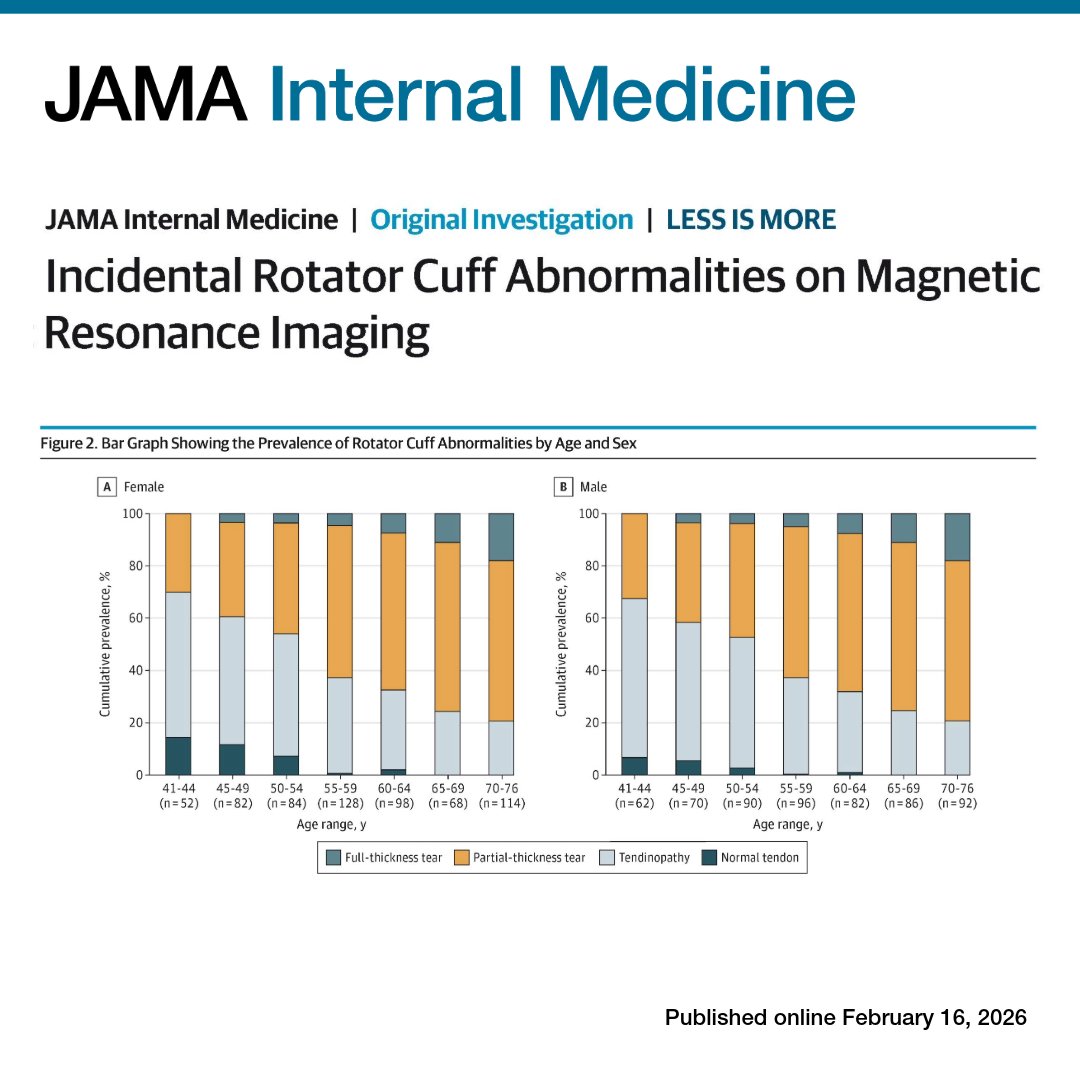
#RotatorCuff abnormalities on #MRI were found in 99% of adults aged 41–76, including 96% of asymptomatic shoulders, indicating most findings are age-related rather than disease.
https://t.co/k61kx1qqF6
In case people are wondering why technology hasn’t solved this:
The problem is the hospital that did the first MRI. They don’t want to share.
Sharing data empowers their competitors so they create as much friction as possible.
Independent imaging centers make access easy by uploading imaging to the cloud. Their business model revolves around convenience, transparent prices, and customer service.
A large hospital system wants to keep patients within the system. “Leakage,” as they call it when patients leave the system, is to be avoided.
The technology exists. Hospitals just don’t want to use it because they want to make it difficult for you, the patient, to seek care elsewhere.
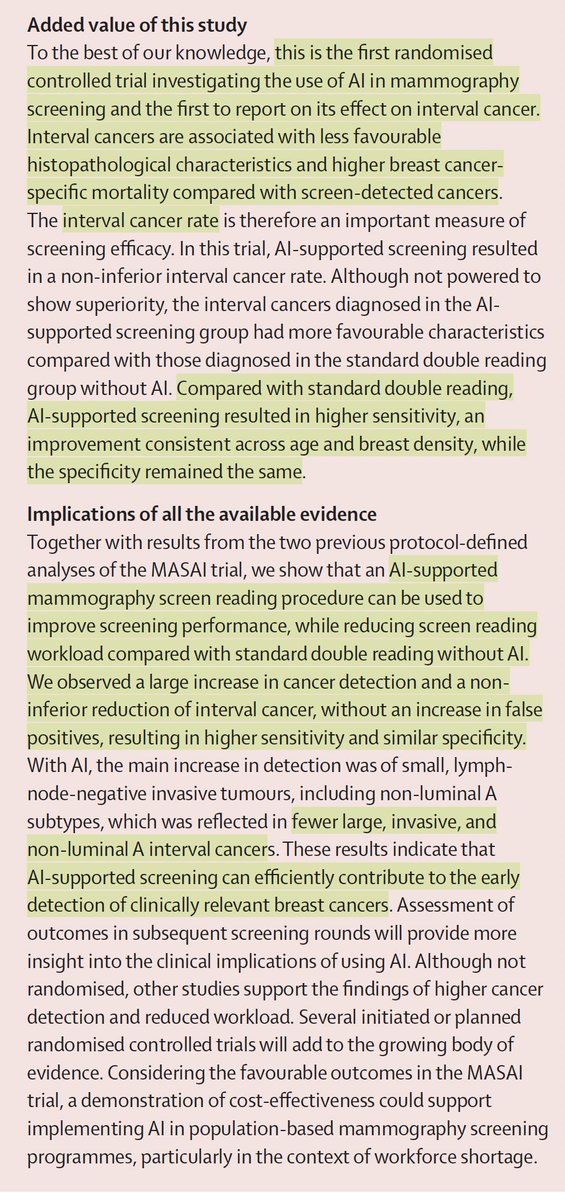
The largest randomized trial of medical A.I.
—Over 100,000 women in Sweden
—radiologist + AI vs 2 radiologists, in follow-up
—AI added led to 29% more cancer detected, 44% reduced workload, and
—Less cancer dx in subsequent 2 years, and, when found, less aggressive
https://t.co/e1hY3F0cGo
Environmentalists made a number of predictions about resource depletion in the 1970s.
None have materialized.
Instead, technological innovation, guided by the price mechanism, has made resources more abundant—even as the world economy has grown.
https://t.co/oE12MxTB98
That’s a deeply naive and incomplete take. AI will absolutely change medicine…. and in some areas, especially pattern recognition and diagnostics, it will outperform us. But… doctoring is not just diagnosis. It’s judgment, context, uncertainty management, trust, motivation, ethics, behavior change, and human connection.
AI will make good doctors better. It will expose weak systems. But the idea that it can “replace” physicians across all contexts shows a serious misunderstanding of what doctors actually do.
AI agents will be a big part of how we shop in the not-so-distant future.
To help lay the groundwork, we partnered with Shopify, Etsy, Wayfair, Target and Walmart to create the Universal Commerce Protocol, a new open standard for agents and systems to talk to each other across every step of the shopping journey.
And coming soon, UCP will power native checkout so you can buy directly on AI Mode and the @Geminiapp.
The mark of the old elite was a recognition that duty accompanied privilege
When the Great War came, England’s landed elite bravely led from the front, and died at a rate close to double that of the average
By contrast, our new, plutocratic/managerial elite had asthma and heel spurs when its call of duty came in Vietnam





![aditharun_'s tweet photo. Are colorectal cancer rates really on the rise in the young??
The shape of the incidence curves suggest not. Something happened around 2013. That something was the ICD classification system allowing neuroendocrine tumors of the appendix to be considered malignant colorectal cancers.
[1/2]](https://pbs.twimg.com/media/HKeYk9hWIAAoHyV.png)