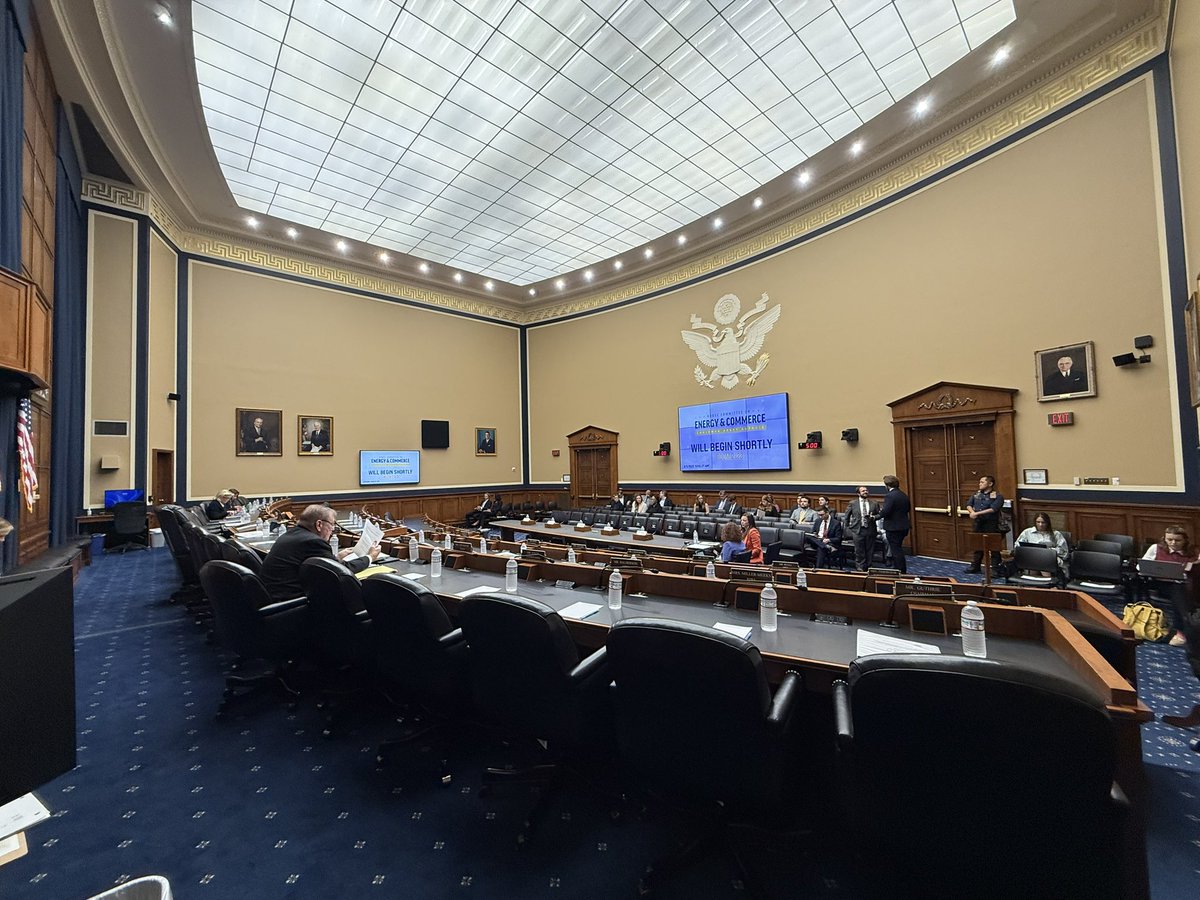
Grateful for the opportunity to testify today at @congressdotgov on a path forward for safe adoption of AI in healthcare.
The potential upside is enormous, but we need the right safeguards and processes to capture the upside efficiently without unforced errors.
An interesting question - in the context of liability - is why these seem to be getting more popular?
There is something about the real-time, on-demand service that will be attractive to a patient. In a hypothetical - would you rather get an AI tool that is maybe right less often (we don’t know yet), but available now? Or a doctor who may be more accurate, but you have to wait months? I think there is some tipping point there to be determined.
Has anyone studied this patient preference angle of this?
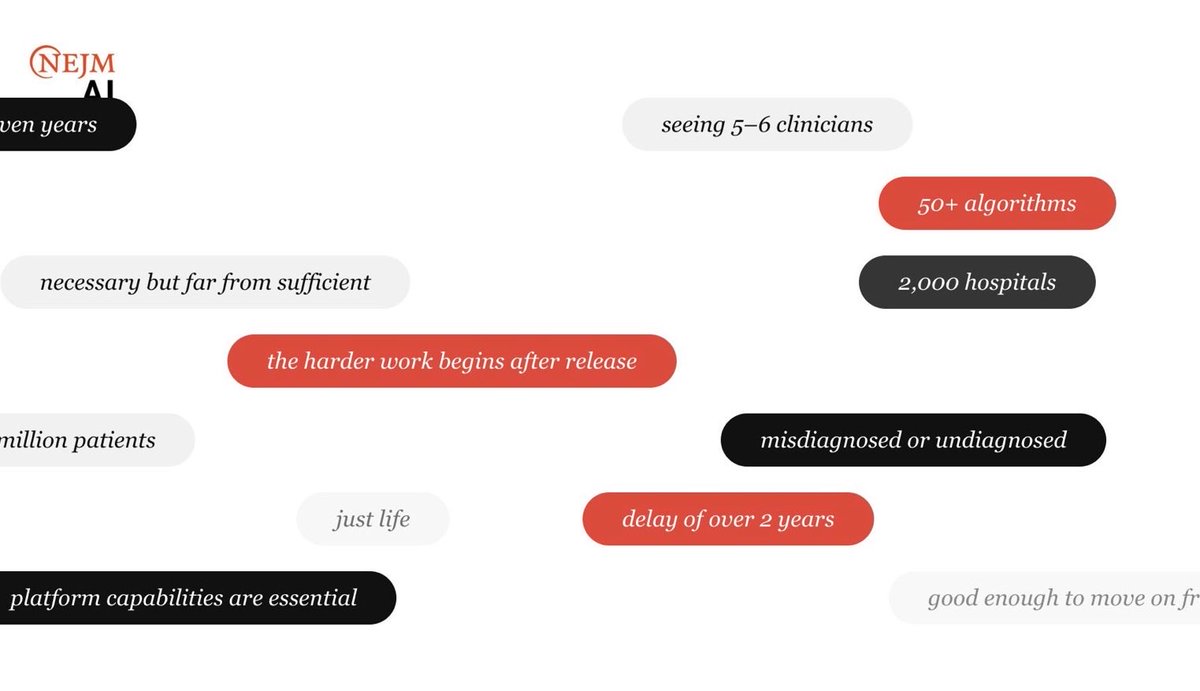
“Unfortunately, this story is not unique to sub-types of heart failure, or even cardiology more broadly. You can find it in every corner of the health care system: a condition presents with symptoms easily mistaken for something far more common, the clinician reasonably treats what it looks like, the patient does not quite get better, and the search quietly stops at a diagnosis that was good enough to move on from. Every clinician — the pulmonologist, the neurologist, the generalist — face their own version of the same challenge. It reflects the modern state of medicine — we have far more diagnoses to choose from, and more inputs to integrate to choose the right one. And it is precisely where AI tools can deliver. But getting them adopted goes far beyond a successful algorithm.”
- @NEJM_AI
https://t.co/9BIVagsvsg
"Hospitals cost $1 to $2 million per bed to build. A single hospital can routinely exceed $1-2 billion. Their floor plans are rigid, fixed for decades. AI is about to make those floor plans obsolete."
Having now been on the front line of clinical care delivery, designing hospitals and building agentic AI infrastructure -- the collision is hard to ignore. We're spending $70B a year on hospitals with designs that may be obsolete before construction is done.
https://t.co/67i7YAspvP
Thread /
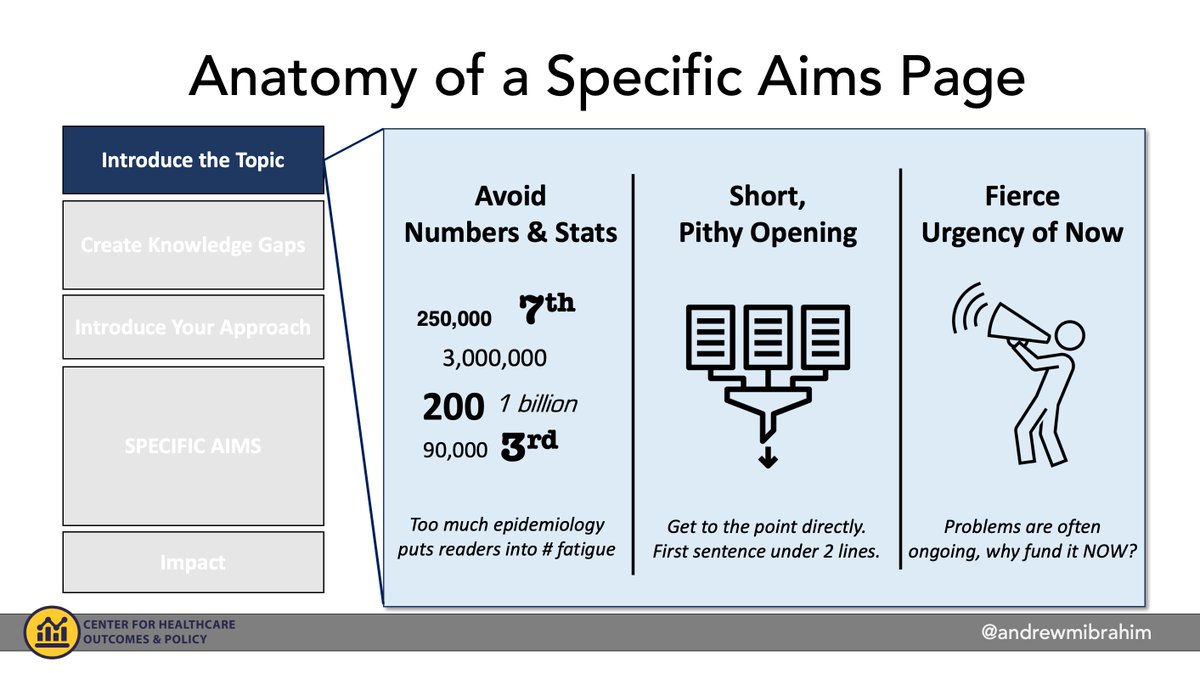
The 5 sections of an effective Specific Aims Page when writing a R01. #ASC2023#FOAmed
1/ Introduce the topic.
Less numbers (everyone has stats), keep it short and pithy. Communicate the fierce urgency of NOW.
The @WSJ articles covers much of it - but in short, the next wave of AI isn’t simple summarizations or tacking on codes. It’s a robust clinical pathway leveraging multi-modal AI that has a meaningful difference in patient outcomes and the ability of the health system to execute consistently at a high level.
https://t.co/TiCMMfFeeK
Full article here:
We are excited to welcome Michael J. Englesbe, MD, as chair of the Department of Surgery (@CUDeptSurg) at the CU Anschutz School of Medicine, effective Nov. 1. Read the full announcement: https://t.co/nn6vIFuqJS
@AnilMakam I thought we abandoned those for laparotomy years ago?! I had one EC fistula and never used it since. And many papers veered away from it except for a sub-set of indications (eg. Delayed closure progressing slowly)
I’m actually surprised the wound vac outcomes weren’t worse. 👀
👀
Arms length guess extrapolating from my general surgery view… how’s the uro-onc job market on the other side? I think geographic optionality is moving up the priority list for many… so if only a handful of jobs each year, resident may not want to be pigeon holed? That at least reflects some of the convos I’ve had with residents about fellowship options (and planning for life after)
Very important study that should energize clinicians and clinical leadership to ask what we want from AI decision-support. What are we maximizing (e.g. accuracy, reproducibility. chain-of-evidence, contextual-specificity etc)? HT @arjunmanrai
For medical information, general AI frontier models (Google, OpenAI, Anthropic) outperformed specialized @openevidence and @UpToDate as assessed by 12 US clinicians, randomized and blinded to which model and extensive testing/benchmarks. This was not anticipated. @NatureMedicine
https://t.co/KCH1ADfQWz
Another successful Moses Gunn Research Conference is in the books!
On Friday, faculty, residents, medical students and others came together to celebrate the incredible breadth of research happening in the department.
Highlights from the day: https://t.co/tFVtix2eHF
Thrilled to welcome Gerard M. Doherty, MD, to give the 95th William J. Mayo Lecture in Surgery at Grand Rounds this Thursday!
Dr. Doherty's talk: Surgery and Change.
Location: Ford Auditorium at 7 AM.
It's official: The 2026 Moses Gunn Research Conference is two weeks away.
Register to attend and enjoy a day showcasing all the great research coming out of the Department of Surgery: https://t.co/qZOLC2dpDl
Please congratulate Pasithorn Amy Suwanabol, MD, MS, who will be the new Division Chief at the Veteran's Administration!
Dr. Suwanabol is an accomplished surgeon-scientist who is passionate about caring for our veterans -- the division is in great hands with her.
To put this together with your other favorite topic - the ridiculous inefficiency in healthcare - the problem is painful. May take 8-12 months to get approvals from all the newly forming AI governance committees of a health system, then another 6+ months of IT integration work. So even if there is proven AI solution that a doctor wants in their practice, it will likely take their hospital 6-18 months to implement. We need better integration (tech), better cooperation (the models, the EHRs playing ball - some better than others), but also far more efficient health system governance and decision making. @mcuban