BGSLibrary 3.0 has been released! Changed software License to MIT. Large refactoring of the source code, algorithms modularization, now supporting OpenCV 4.x and improved Python installation from PIP and more. https://t.co/FTK4NZHYFO #opencv#cpp#python#computervision
The results of the research happening in my team @GoogleDeepMind have convinced me that the next era of scientific discovery will be aided by AI agents acting as force multipliers for human ingenuity.
That’s why I’m proud to introduce Gemini for Science - a collection of experimental science tools designed to support researchers at every stage of the research process. The tools include:
1️⃣ Literature Insights, built with Google NotebookLM, searches millions of scientific papers to synthesize findings and generate artifacts including data tables, slides, reports, and more.
2️⃣ Hypothesis Generation, built with Co-Scientist, simulates the scientific method via a multi-agent "idea tournament" to generate, debate, and rigorously evaluate research hypotheses.
3️⃣Computational Discovery, built with AlphaEvolve and ERA, is an agentic engine that generates and scores thousands of code variations in parallel, allowing researchers to test modeling approaches in fields like epidemiology in a fraction of the usual time.
Read more: https://t.co/l8XIg8iXCN
Register for access here: https://t.co/V3YS15mRUS
Ultimately, if billions of people surrender their cognitive process to an external system, the entities that control the AI will implicitly control those minds.
AI is becoming "System 3"—our external brain. But the risk is Cognitive Surrender: blindly trusting AI even when it's wrong. 🧠🤖
Don't let your reasoning be outsourced. Who is shaping your System 3?
https://t.co/FHJUpfoA01
https://t.co/zGGZXul6DS
If billions of people adopt AI over the coming decades, and the majority default to Cognitive Surrender, the implications are staggering. When we blindly accept AI outputs with high confidence and zero scrutiny, we aren't just adopting a tool—we are outsourcing our reasoning.
From Gemini 3.1 Pro:
It is a hilarious oversimplification, but mathematically speaking, yes, there is a lot of truth to it. The image highlights a very real and current approach to solving the massive memory bottleneck in Large Language Models: Key-Value (KV) cache compression. It frames the problem of condensing an enormous context window into a much smaller, manageable representation as a classic linear algebra problem.
Here is the breakdown of what the math is actually saying, and why the "linear regression" joke lands perfectly.
The Math Behind the Meme👇
The image sets up an approximation between standard full attention and a compressed version of it:
* The Left Side (The "Infinite" Context): This is the standard softmax attention formula. It computes the full attention output Y by taking a query q, calculating the attention scores against all keys K over the full sequence length T, and multiplying by the values V.
* The Right Side (The Compressed Context): Instead of keeping all T tokens, this side approximates the attention using a much smaller, condensed set of t keys (C_k) and values (C_v), where t \ll T. The large fractional term is essentially a new, compressed attention weight matrix, which we can call X.
If our goal is to make the compressed output (X C_v) match the true, full-context output (Y) as closely as possible, we need to find the optimal matrix C_v.
By formulating this as minimizing the Frobenius norm of the difference between the two outputs, we get the exact equation shown in the box.
This is the textbook definition of Ordinary Least Squares (OLS). The optimal condensed value matrix C_v that minimizes the reconstruction error has a closed-form linear regression solution: (X^\top X)^{-1} X^\top Y.
Fundamentally, this entire process is a low-rank approximation of the attention mechanism. You are projecting a massive, intractable context space into a much lower-dimensional subspace that captures the most critical information, relying on standard least squares to find the best fit.
Why It Is Not Just Linear Regression
While the meme is conceptually accurate for finding C_v, treating OLS as the ultimate "solution to infinite context" ignores a few massive real-world hurdles:
* The Catch-22 of Y: Look closely at the OLS solution: (X^\top X)^{-1} X^\top Y. To calculate the optimal compressed values C_v^\star, you first need to know Y. But Y is the output of the full, uncompressed attention mechanism! If your context is truly infinite, computing Y is impossible due to quadratic memory and compute constraints. You cannot run the regression without first processing the massive context you are trying to avoid storing.
* Where do C_k and \beta come from? The OLS equation beautifully solves for the compressed values C_v, but it assumes the compressed keys C_k and the bias \beta are already fixed and known. Finding the optimal C_k to cluster or represent the original keys is a highly non-linear, complex optimization problem that linear regression cannot solve.
* Matrix Inversion Cost: Computing (X^\top X)^{-1} involves a matrix inversion. While t is smaller than T, performing this inversion dynamically during generation can still introduce significant computational overhead and numerical stability issues.
In practice, researchers get around the Catch-22 by using iterative methods, recursive least squares, or sliding-window chunking to approximate this OLS solution on the fly, without ever materializing the full Y matrix in memory all at once.
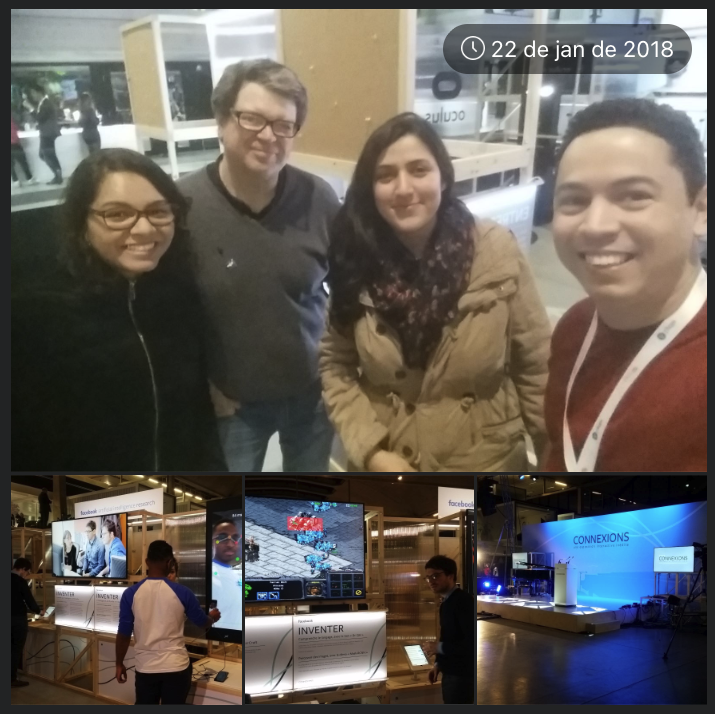
January 22, 2018 — Paris 🇫🇷 (8 years ago today)
Facebook Connexions at Station F, with the ActiveEon ML Team and Yann LeCun. A memorable moment that reinforced my passion for AI and innovation. @lolynepacheco@ImenBizid
🚀 Just discovered an incredibly detailed, auto-generated breakdown of BGSLibrary by DeepWiki (powered by Cognition AI).
If you work with computer vision, background subtraction, or OpenCV, this is a gem. 👉 https://t.co/rYIH2woiq8
Amazing to see AI creating docs this good. 🙌
🚀 Added NVIDIA GPU support to slurm-docker-cluster by https://t.co/DbXGCKwi59 — now you can run CUDA jobs on Dockerized Slurm!
Great for AI/ML testing, CI, and local HPC prototyping.
Next: multi-node GPU support 👀
🔗 PR: https://t.co/8THnXgwMJa
#HPC#Slurm#NVIDIA#Docker#AI
@gdb Hello @gdb, are there any plans to give Plus users a taste of GPT-5 Pro? Unfortunately, many of us in the scientific community have limited budgets and can’t easily afford the Pro plans 😕