@DiamantakiMaria & @NassiPapoutsi explore the
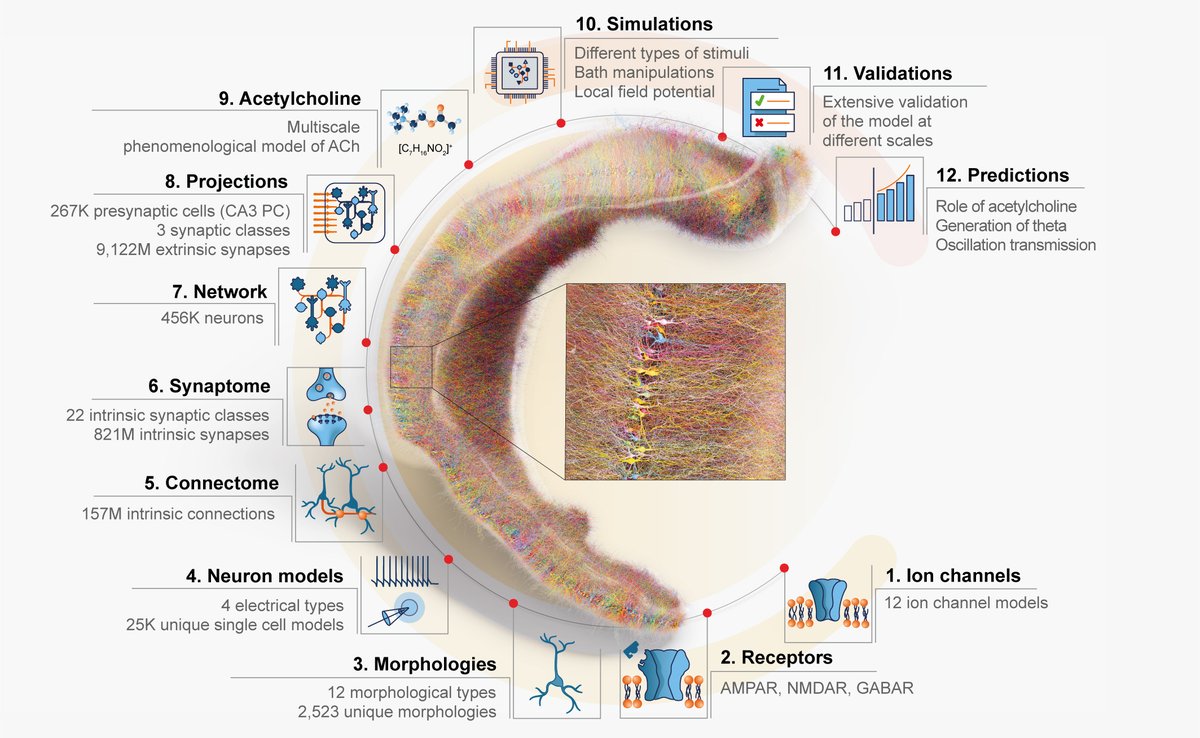
@BlueBrainPjt study in #PLOSBiology that describes a biological model of the rodent CA1 region, building an accessible tool for the whole #hippocampus community. Primer: https://t.co/XE06quusVS Paper: https://t.co/wcFjjaSxW8
Please make some noise to the cool high-order structure - function work of my (mostly) twitterles colleagues. I think it's super relevant to modelers using simplified (even distance dependent) connectomes as it shows what one looses with such an approach.
📢Preprint alert! Our latest manuscript, "Efficiency and reliability in biological neural network architectures" was just shared on BiorXiv, go check it out!
https://t.co/RXMsx0f4U0
Happy to see this out! Shout-out to reviewers, you've actually made this paper better!
Three more publications are coming using similar methods delving into the link between high-order cortical structure and function.
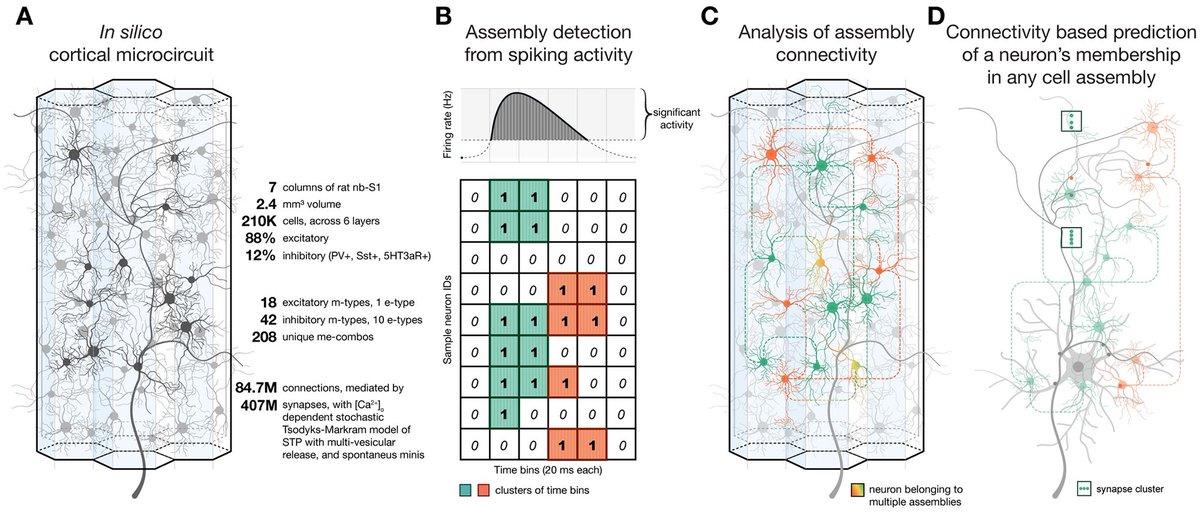
📢New Publication Alert! Our paper "Cortical cell assemblies and their underlying connectivity: An in silico study" is out in @PLOSCompBiol.
We plunge into the world of cortical connectivity to understand the formation of functional cell assemblies.
👉https://t.co/rL6dKamQi5
Flying to @CosyneMeeting, my favorite #CompNeuro conf! Come to poster 1-126 the 29th. Big thanks to #Cosyne2024 reviewers for helping improve the study. We test new spike sorters, new datasets, use neurogeometry to measure sorting-induced loss in stimulus discrimination capacity.
Congratulations to Blue Brain's Dr. @andris_ecker!
András successfully defended his thesis Principles of Network Plasticity in Neocortical Microcircuits 🍾
Amazing job!
#Neuroscience#SimulationNeuroscience
And there I am, getting excited about the plasticity of cross-assembly synapses (i.e., strengthening of the phase sequence) in my "just a model"...
https://t.co/rQYyFK1i4F
🚨New paper from the lab!🚨
Since Hebb, we know that precise sequences of neuronal firing must be the backbone of computation in the brain. For long, we’ve believed it must be related to connectivity, right? And what if it was not (entirely)?
Preprint👇
https://t.co/fTRXrbhxUq
Thanks to @james_isbister, @NeuralEnsemble, @kmaccio and a bunch of twitterless co-authors!
If you don't have time to read, come to my poster at the #BernsteinConference.
The plastic circuit, like all recent models of the @BlueBrainPjt, is open source: https://t.co/zrPaUtsWcC
We modeled 312M plastic synapses and observed only 5% of them changing in 10 minutes of biological time. The network remained stable w/o any homeostatic terms. Synapses that changed were likely to be between cell assemblies and in spatial clusters on postsynaptic dendrites.
Doing a PhD is not hard, neither is writing a thesis! What's hard is organizing a committee, finding a time slot for the defense and getting everyone's signature during the summer...
@cian_neuro@ldallap1@jorgefmejias@Timothy0Leary I think one possible way of doing it is to look for emergent features that you didn't put in in the first place. But I'm 100% with you, one can never be sure...
@cian_neuro@ldallap1@jorgefmejias@Timothy0Leary Both (top-down and bottom-up) approaches are valid (and used in other fields of science) and hopefully they'll converge at some point.
Also: we finally cleaned up our whole infrastructure and open sourced the model so people can judge it themselves after trying it out.
@cian_neuro@ldallap1@jorgefmejias@Timothy0Leary "Physics has done fine without modelling everything in the entire universe" Sure and we're not using the Schrödinger equation to build skyscrapers because there are more abstract models that work for that...
@kendmil@Timothy0Leary E.g here I used the model to study the connectivity of cell assemblies: https://t.co/c7iyGYCiLO which (among many other things) one cannot do experimentally.
@kendmil@Timothy0Leary "But in neuroscience, where there are a zillion unknown uncontrolled parameters, ... ?"
That's the good thing about the in silico nature of the study: part of those zillion parameters that we actually modeled are fully observable and controllable
After 8 and 9 years of building these models the preprints came out on the same day. They're also the first ones from the Blue Brain that you can run yourself (with a big enough computer)!
📢#PreprintAlert Our state-of-the-art models of rat somatosensory cortex https://t.co/NldqwHwIiS and hippocampus CA1 https://t.co/WHoGd2df3x are out! These atlas-based, biophysically detailed models exhibit in vitro and in vivo-like activity and replicate laboratory experiments.